Silence they say is golden, more so in the case of the media in countries like China. Case in point, on Wednesday when US President Donald Trump arrived in Beijing, netizens noticed something unusual: a striking silence across major state media platforms.
For hours, official outlets including Xinhua, CCTV, People’s Daily, and CGTN carried no immediate coverage, images, or updates of the visit, even as speculation and social media chatter built momentum online. It was only later, with the release of the first official photograph of Xi Jinping and Trump together, that China’s tightly controlled media narrative around the high-profile meeting began to emerge.
Coverage was carefully curated with Xinhua News Agency omitting any mention of the visiting leader from its main headlines initially. Beijing’s diplomatic red lines were drawn: China would “never make the slightest compromise on issues involving national sovereignty, security, and development interests.”
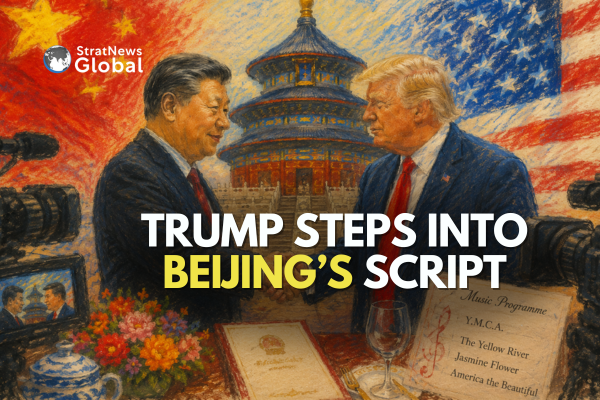
At a photo event outside the Temple of Heaven, local media mentioned the visit of the late US secretary of state Henry Kissinger, seen as the architect of the US opening to China in 1971. Media reports noted that Kissinger had been taken to the same monument then, framing the Trump visit within the historical arc of U.S.–China engagement, suggesting continuity from then to now and therefore the need to stabilise ties.
Cosmic order, political authority: the messaging in temple setting for Trump’s China visit
Global Times played the Trump visit differently, underscoring the president’s praise of Xi Jinping as a “great leader”, that by coming to Beijing, Trump had given China a diplomatic win. Repeated ad nauseam, the target was clearly some online discussion platforms that questioned Xi’s leadership.
Global Times was joined by other state-linked outlets that framed the talks as “historic,” stressing the weight of the world’s two largest economies and arguing that stable China–U.S. relations are essential not just bilaterally, but globally influencing trade, supply chains, and international governance. The future of China-US relations is bright: Global Times editorial
CGTN repeated the same message for international audiences, promoting the idea of a “constructive China–U.S. relationship of strategic stability” as the direction for the future. While competition is a given, China wants the relationship to remain stable, predictable, and free from major conflict or sudden escalation. https://news.cgtn.com/news/2026-05-14/Xi-Jinping-holds-talks-with-Donald-Trump-in-Beijing-1N8fkzawpFK/p.html
Some of the online commentary noted that the song “YMCA”, a MAGA favourite often played and sung at Trump’s rallies, was included at events in the evening alongside traditional Chinese and American compositions. It was seen as a gesture by Beijing aimed at creating a more personal and relaxed atmosphere around the high-profile summit.
On Weibo, even previously critical comments aimed at the US shifted tone, with users posting unusually uniform messages of “warm welcome.” Meanwhile, state television programming choices also drew attention, with CCTV airing A Grandson from America, a film some users interpreted as unintentionally mirroring the optics of U.S.–China cultural contact.
Chinese social media saw a temporary cooling in nationalist commentary, with fewer overtly anti-U.S. posts compared to typical high-profile diplomatic moments. Some nationalist ‘Little Pink’ accounts appeared unusually quiet, or with toned-down commentary than usual. Overall, the conversation online seemed more controlled, with official media setting the tone and relatively little overt nationalist or anti-U.S. reaction circulating.