There is something almost deceptive about the Global Terrorism Index 2026 from the Institute for Economics & Peace.
On the surface, it reads like good news.
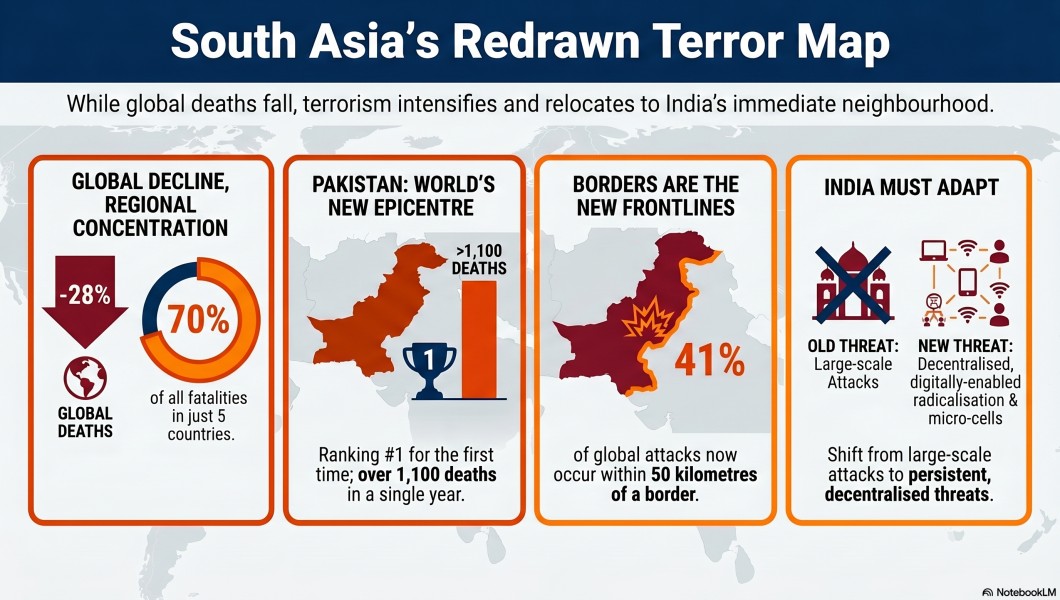
Terrorism deaths are down 28 per cent. Attacks have fallen by nearly a quarter. Eighty-one countries have improved. It is, statistically speaking, one of the most encouraging years in recent memory.
And yet for South Asia—particularly the Af-Pak belt and its uneasy periphery in India, this is less a story of decline and more a story of concentration, mutation, and drift. Terrorism has not receded; it has relocated, reorganised, and in some cases, quietly metastasised.
The numbers tell part of that story. In 2025, 5,582 people were killed across 2,944 terrorist incidents globally, a significant drop from the previous year. But nearly 70 per cent of those deaths were concentrated in just five countries, with Pakistan now ranked as the most terrorism-affected country in the world for the first time in the Index’s history.
That single data point should set off alarms across New Delhi.
Because what the Index captures with clinical precision is a structural shift: terrorism is no longer diffused chaos. It is geographically concentrated, politically entangled, and increasingly embedded in fragile borderlands. And nowhere is this more evident than along the Afghanistan–Pakistan frontier.
The Af-Pak Vortex Returns
For years, the global counter-terrorism narrative suggested that the worst was over in South Asia. Afghanistan had seen a 95 per cent decline in terrorism deaths since its peak. Pakistan had clawed its way back from the abyss of the mid-2010s. India, while not untouched, had managed to contain large-scale attacks.
That optimism now looks premature.
The GTI 2026 identifies Pakistan as the epicentre of a renewed surge, recording 1,139 terrorism deaths and over a thousand incidents in a single year—its worst levels since 2013.
The driver is not mysterious. It is the aftershock of the Taliban’s return to power in Afghanistan in 2021, which has reconfigured militant ecosystems across the region. Groups like Tehrik-e-Taliban Pakistan (TTP) have not only resurged but adapted, leveraging cross-border sanctuaries, ideological alignment, and a permissive security environment. Among the world’s four deadliest terrorist organisations in 2025, TTP is the only one to have increased its lethality.
This is not just Pakistan’s problem. It is India’s problem: strategically, geographically, and inevitably.
Because the Af-Pak borderlands are no longer just a line on a map; they are, as the report underscores, “authority gaps”, or zones where state control is weakest and non-state actors thrive. Over 41 per cent of global terrorist attacks now occur within 50 kilometres of a border. And instability on one side of that border rarely stays contained.
The GTI’s most underappreciated insight is its focus on borderlands. Terrorism today is less about cities and more about seams: those frayed edges where sovereignty thins out.
The Afghanistan–Pakistan frontier exemplifies this perfectly. Porous, mountainous, politically contested, and socially interconnected, it allows militant groups to move, regroup, and strike with relative impunity. The report goes further, noting that cross-border militant activity was a primary driver behind the escalation to open conflict between Pakistan and Afghanistan in early 2026.
For India, watching from the eastern edge of this arc, the implications are stark.
First, instability in Pakistan increases the likelihood of spillover, whether through proxy groups, ideological networks, or displaced militants seeking new theatres. Second, the weakening of Pakistani state control in peripheral regions creates precisely the kind of grey zones that have historically incubated anti-India terror groups.
India’s relative ranking, 13th on the Index, might suggest a manageable threat environment. But that would be a dangerously complacent reading. The Index also shows that terrorism in South Asia remains part of a broader conflict ecosystem. Only one per cent of global terrorism deaths occur outside conflict-affected countries.
In other words, where conflict persists, terrorism follows. And South Asia remains, by any measure, a conflict-rich region.
The Illusion Of Decline
Globally, the decline in terrorism deaths is real. But it is also misleading.
The absence of large-scale, headline-grabbing attacks (no mass casualty events on the scale of previous years) has created a perception of reduced threat. The deadliest attack in 2025 killed 120 people, compared to over a thousand in 2023.
But beneath that decline lies a shift towards fewer, more targeted, and often more strategic attacks. Lethality per incident remains high in key regions. And critically, terrorist groups are adapting their tactics, not disappearing.
Islamic State, for instance, remains the world’s deadliest terrorist organisation, responsible for nearly one in six attacks globally. While its footprint has shrunk geographically, its networked structure allows it to persist across regions, including South Asia through its Khorasan affiliate.
This matters for India because the nature of the threat is evolving. It is less about spectacular attacks and more about persistent, low-intensity destabilisation—something far harder to detect, deter, and decisively defeat.
Another quiet but significant shift flagged by the Index is the acceleration of radicalisation, particularly among youth.
While the data is drawn largely from Western contexts, the underlying mechanisms—online propaganda, algorithmic amplification, and compressed radicalisation timelines—are universal. Radicalisation that once took months or years can now occur in weeks.
For South Asia, with its massive youth population and uneven digital literacy, this is a looming vulnerability. The traditional model of hierarchical terrorist organisations is giving way to decentralised, digitally enabled networks. Lone actors, micro-cells, and self-radicalised individuals are becoming more prominent.
India’s internal security apparatus, long orientated towards organised groups, will have to adapt to this more diffuse threat landscape.
A Region On Edge
Perhaps the most worrying takeaway from the GTI 2026 is not what has happened, but what may come next.
The report is explicit: the geopolitical environment has deteriorated sharply, and the outlook for terrorism in 2026 is “concerning”. The escalation between Pakistan and Afghanistan, ongoing conflicts in West Asia, and the broader fragmentation of global politics all point towards conditions that historically fuel terrorism.
In South Asia, this convergence is particularly volatile.
An unstable Afghanistan, a resurgent militant ecosystem in Pakistan, and enduring India-Pakistan tensions create a triad of risk that is both interconnected and mutually reinforcing. Add to this the role of non-state actors, proxy networks, and external influences, and the region begins to resemble less a set of discrete conflicts and more a single, fluid security theatre.
India’s Narrow Window
For India, the lesson from the Global Terrorism Index 2026 is not one of reassurance but of urgency.
The country has, for now, avoided the worst of the recent surge. Terrorism deaths have declined, and large-scale attacks remain rare. But this relative stability exists within an increasingly unstable neighbourhood. And in South Asia, neighbourhoods have a way of catching up.
The strategic challenge for India is twofold. First, to insulate itself from the turbulence of the Af-Pak region through intelligence, border management, and diplomatic pressure. Second, to anticipate the next phase of terrorism, which is likely to be less visible, more decentralised, and more technologically mediated.
Because if the GTI 2026 tells us anything, it is this: terrorism does not disappear.
It adapts. And right now, it is adapting uncomfortably close to home.