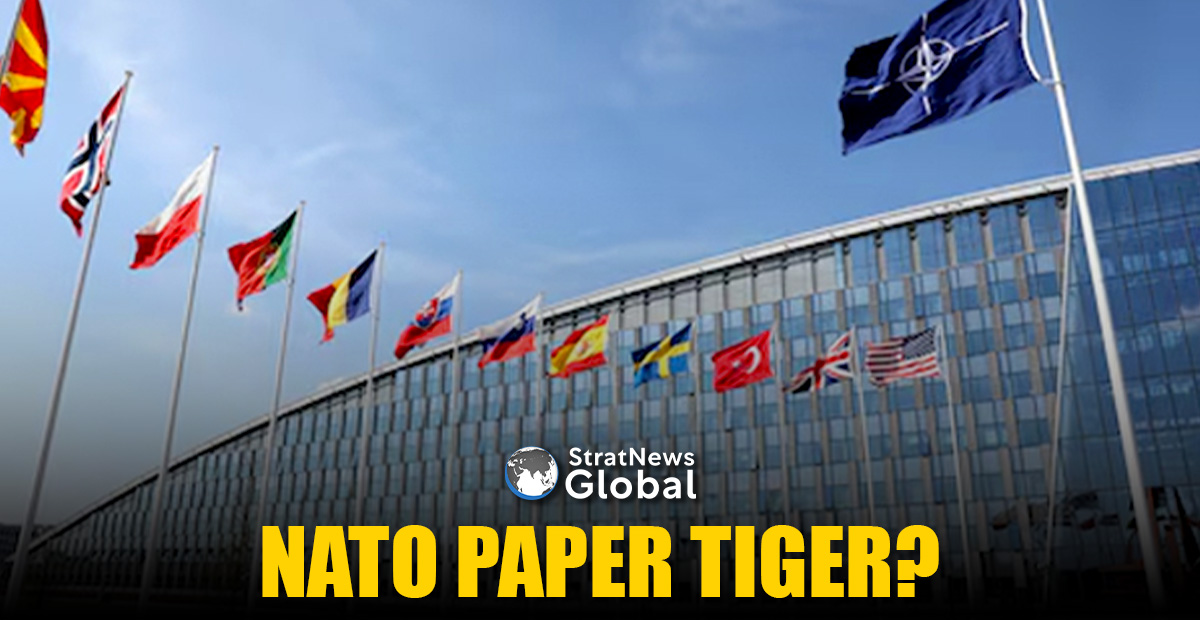
U.S. President Donald Trump said he was strongly considering pulling the United States out of NATO after allies failed to back U.S. military action against Iran, according to an interview with Britain’s Daily Telegraph.
Trump described the alliance as a “paper tiger” and said removing the United States from the defence pact was now “beyond reconsideration,” the newspaper reported. He said he had long held doubts about NATO’s credibility.
“Oh yes, I would say [it’s] beyond reconsideration,” Trump told the newspaper when asked about whether he would reconsider U.S. membership of the alliance after the conflict.
“I was never swayed by NATO. I always knew they were a paper tiger, and Putin knows that too, by the way.”
Meanwhile, Bahrain has circulated a revised U.N. Security Council draft resolution on protecting commercial shipping in and around the Strait of Hormuz, retaining language authorising “all necessary means” but dropping an explicit reference to binding enforcement.
Shipping through the waterway, through which roughly a fifth of global oil supplies pass and which underpins Gulf economies, has already slowed to a near-halt after Iran struck vessels amid its conflict with the United States and Israel.
Bahrain’s initial draft, seen by Reuters and backed by other Gulf Arab states and Washington, explicitly invoked Chapter VII of the U.N. Charter, which allows the Security Council to authorise measures ranging from sanctions to military force.
Diplomats said adoption of such a resolution would have been unlikely, as Iran’s partners Russia and China were expected to veto it if necessary. A Security Council resolution requires at least nine votes in favour and no vetoes from its five permanent members: the
United States, Russia, China, Britain and France.
The revised text seen by Reuters, which diplomats said is still under negotiation, removes the reference to Chapter VII, but retains language associated with it.
It would authorise states, acting alone or through voluntary multinational naval coalitions, to use “all necessary means commensurate with the circumstances” in the Strait of Hormuz, the Gulf and the Gulf of Oman to ensure passage and prevent
interference with international navigation, including within or near territorial waters.