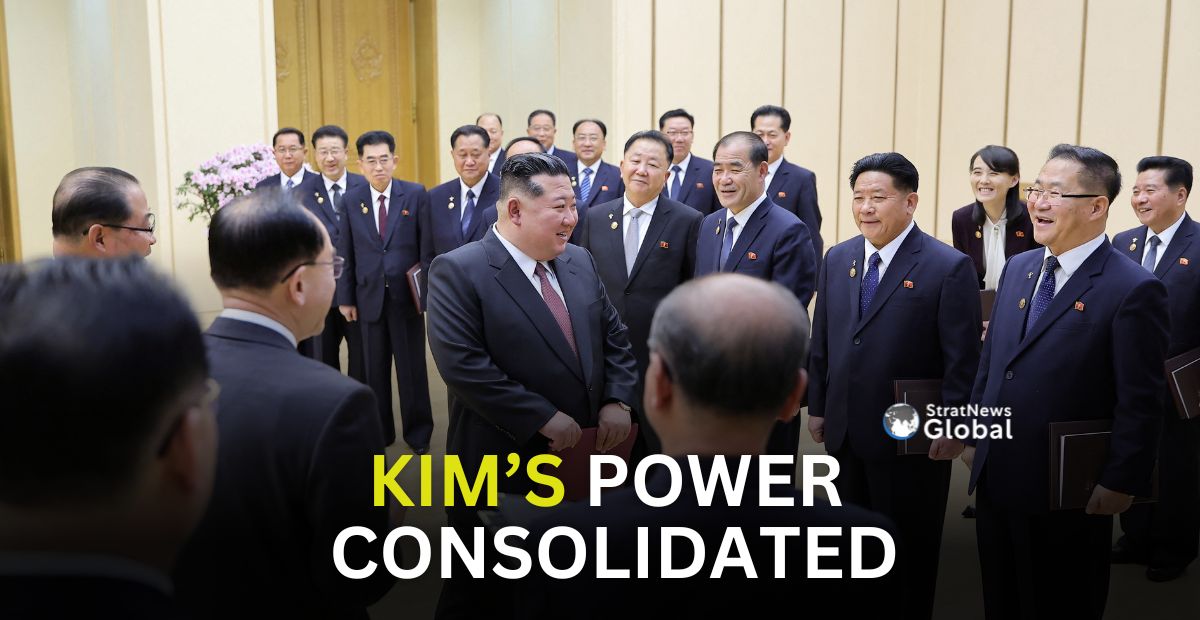
North Korean leader Kim Jong Un has been reappointed as president of state affairs, state media KCNA reported on Monday, following the first session of the country’s Supreme People’s Assembly a day earlier.
The meeting in Pyongyang will discuss amendments and supplements to the socialist constitution, as well as the election of the chairman of the State Affairs Commission and other state leadership bodies.
Policy Agenda and Constitutional Changes
The assembly, North Korea’s rubber-stamp legislature that formally approves state policy, typically meets following a ruling Workers’ Party Congress to turn party decisions into law.
The meeting will also review the country’s economic five-year plan announced at the ninth party congress held in February, KCNA said.
Attention has been focused on whether Pyongyang will revise its constitution to formalise leader Kim Jong Un’s “two hostile states” policy toward South Korea.
In recent years, Kim has abandoned Pyongyang’s long-standing goal of peaceful reunification and redefined the South as a hostile state.
Power Dynamics
Kim’s powerful sister, Kim Yo Jong, was notably absent from KCNA’s list of members of the State Affairs Commission, the country’s highest leadership body, on which she had served since 2021.
South Korea’s Unification Ministry said it was looking into why she was no longer listed, but analysts said the move did not necessarily signal a loss of influence.
“Her absence suggests not a decline in status but a strategic division of roles,” said Lim Eul-chul, a professor at Kyungnam University, adding that the younger Kim continues to wield real power as a department director in the ruling Workers’ Party, where she may play a higher-level, party-centred role coordinating policy.
(With inputs from Reuters)