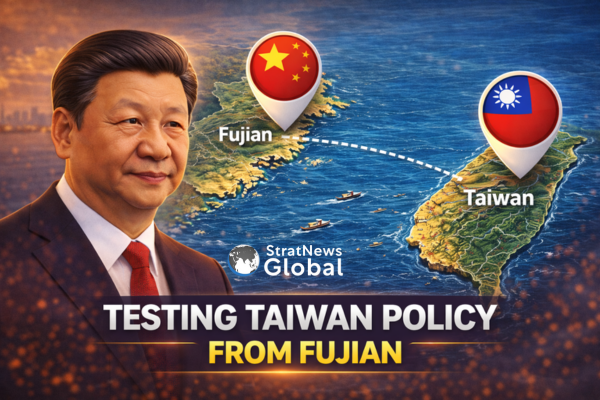
It may not be well known that China’s provinces bordering other countries have a role to play in proposing ideas that strengthen bilateral economic cooperation and people-to-people contact. Fujian, the province facing Taiwan across 100-km of the water, has emerged as a frontline laboratory for Beijing’s cross-strait strategy. It is in fact a testing ground for Taiwan policy.
A Provincial Role in China’s Taiwan Policy
Two years back, Beijing designated Fujian as a Cross-Strait Integration and Development Demonstration Zone and laid down 21 measures aimed at deepening economic, social and cultural ties with Taiwan. Then this year, the province established Taiwan affairs offices in every county and district.
Swayamsiddha Samal, PhD Scholar at the Centre for East Asian Studies, Jawaharlal Nehru University, who is researching Fujian’s role in China’s Taiwan policy, argues that the province is neither a passive executor nor an independent policy-maker. Beijing sets the strategic direction, she told StratNewsGlobal, while provinces like Fujian are expected to design locally tailored policies that operationalise these directives.
At the same time, Beijing sharply curbs Fujian’s autonomy in three key ways. No matter how innovative a local initiative may be, it cannot become policy without central approval. Provinces can propose ideas, but the centre ultimately decides which ones matter. As a result, Fujian’s role remains experimental, with its strategic boundaries firmly defined from the top.
Swayamsiddha further told StratNews Global that Xi Jinping has personally urged Fujian to explore new paths for integrated development and improve Taiwanese livelihoods through economic incentives, but only within politically defined limits. Innovation is encouraged, but deviation is not.
From Provincial Experiments to National Policy
Nevertheless, some proposals originating in Fujian have been implemented at the national level. One key example is the Western Taiwan Straits Economic Zone, first proposed by Fujian in 2004 and approved in 2009. Over time, it evolved into a free trade zone linking Fujian more closely with Taiwan, aimed at attracting Taiwanese businesses, professionals and young entrepreneurs.
According to a forthcoming research paper by Swayamsiddha Samal, expected to be published in the coming months, these Fujian-tested initiatives later informed broader national policies.
Samal told StratNewsGlobal that measures such as the recognition of professional qualifications for Taiwanese citizens, equal treatment for Taiwanese enterprises in financing and government procurement, expanded employment and education benefits, and start-up incentives for Taiwanese youth all originated from this provincial experimentation.
Samal observes that in 2001, during Xi Jinping’s tenure as governor of Fujian, direct postal, commercial, and transportation connections were inaugurated with Taiwan’s Kinmen and Matsu islands under what was known as the “Three Mini Links” initiative.
“Taken together, these cases show that Fujian does more than simply implement directives from Beijing,” Samal said. “The province innovates, tests feasibility and demonstrates results, which are then scaled up nationally under central supervision.”
Symbolism and Strategic Constraints
From Beijing’s point of view, it’s also important that there be progress towards “reunification”. This progress is assessed not only through economic performance and integration metrics, but also by closely watching developments in Taiwan’s domestic politics, including which political parties gain ground and what those outcomes suggest about public attitudes towards China.
But the way the Chinese system works is the focus on what Swayamsiddha Samal describes as largely process-oriented metrics. Success is measured by policies issued, events organised and funds spent, not so much by whether attitudes are really changing in Taiwan.
So we have the situation where Taiwanese identity has continued to strengthen, support for reunification has declined, and Taiwanese investment in Fujian reportedly fell by around 80 per cent year on year in 2023. At the same time, Beijing’s military buildup opposite Taiwan has undermined its stated “hearts and minds” strategy, often reinforcing scepticism rather than goodwill within Taiwanese society.
But the Chinese system continues to roll, with activity, discipline and visible effort prioritised over whether policies actually shift public opinion in Taiwan or advance reunification in any meaningful way.