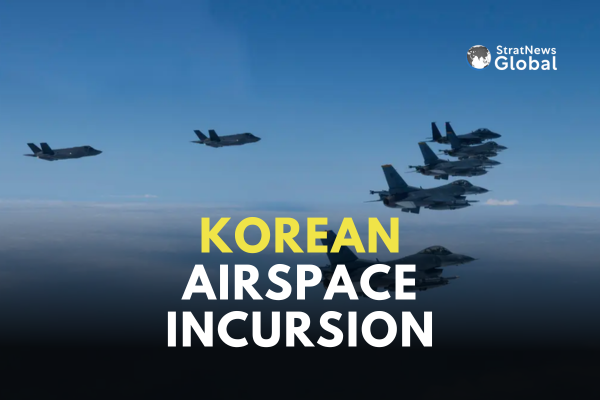
South Korea’s military said it scrambled fighter jets on Tuesday after several Chinese and Russian aircraft entered and later exited its air defence identification zone (KADIZ), an incident that underscored ongoing military coordination between Beijing and Moscow near the Korean Peninsula.
Joint Flights Prompt Rapid Response
According to South Korea’s Joint Chiefs of Staff (JCS), seven Russian planes and two Chinese planes entered the KADIZ at around 10 a.m. (0100 GMT) before leaving roughly an hour later. The aircraft were tracked as they flew off South Korea’s east and south coasts but did not breach the country’s sovereign airspace.
South Korean fighter jets were launched as a precautionary measure to ensure readiness for any potential contingencies, the JCS said in a statement. The military noted that the aircraft had been clearly identified and that the situation remained under control.
An earlier report from the Newsis news agency suggested that as many as 11 planes had entered the air defence zone, though the JCS later confirmed nine in total.
Routine but Sensitive Operations
The Yonhap News Agency quoted military officials as saying the foreign aircraft remained within the KADIZ for about an hour before departing. While such incursions are not uncommon, they are closely monitored due to the security sensitivities of the region, where multiple air defence zones overlap including those claimed by China and Japan.
Chinese and Russian military aircraft have carried out joint flights around the Korean Peninsula roughly once or twice a year in recent years, typically as part of broader strategic coordination exercises. These flights are often interpreted by Seoul and its allies as demonstrations of deepening military ties between Beijing and Moscow.
Regional Tensions Remain High
The latest incursion follows a pattern of increased air activity in Northeast Asia amid heightened tensions over North Korea’s weapons programmes and U.S.-led military drills in the region. South Korea routinely scrambles fighter jets to respond to unidentified or foreign aircraft entering the KADIZ without prior notification.
While the air defence identification zone is not part of South Korea’s territorial airspace, it serves as an early-warning boundary where foreign aircraft are expected to report flight plans for identification.
No hostile actions were reported during Tuesday’s incident, and the JCS said South Korea’s military “maintained full operational readiness” throughout.
(with inputs from Reuters)