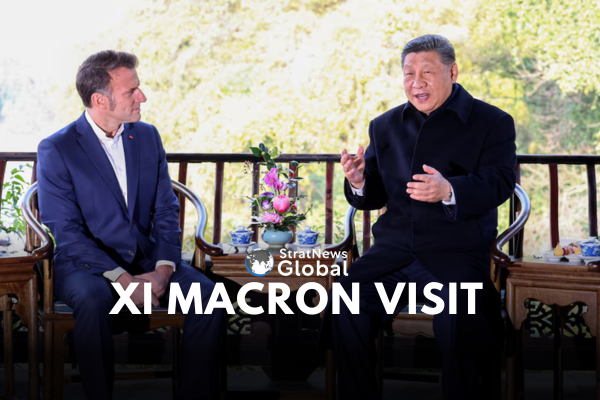
Chinese leader Xi Jinping accompanied French President Emmanuel Macron to Chengdu on Friday, in a rare show of personal diplomacy that underscores Beijing’s focus on Paris within its broader ties to the European Union. The gesture one not extended even to former US President Donald Trump during his 2017 state visit highlights China’s effort to strengthen relations with France amid growing global trade frictions.
Symbolic Diplomacy, Limited Results
Despite the warm optics of Xi and Macron’s meetings, analysts say the French leader’s fourth state visit to China has produced few concrete results. Macron’s trip, seen as a bid to reinforce his global profile after a difficult summer at home, has so far yielded modest cooperation agreements and no major economic breakthroughs.
Talks in Beijing on Thursday concluded with 12 agreements in areas such as ageing populations, nuclear energy and panda conservation, but without any disclosed financial commitments. “They thought Xi would be in a position to offer a lot because Europe is really preparing this economic security doctrine,” said Alicia Garcia-Herrero, senior fellow at the Bruegel think tank. “But nope.”
Macron began his day jogging at Chengdu’s Jincheng Lake Park before joining Xi at a historic dam site. Investors had been watching closely to see whether the visit would lead to new trade deals or progress on EU-China economic tensions, but those hopes appeared slim.
Xi Avoids Major Trade Concessions
Beijing’s ability to offer Paris major incentives remains limited. Xi is unlikely to approve a long-anticipated 500-jet Airbus deal, as it could reduce China’s leverage in ongoing trade talks with Washington. Nor is he expected to ease restrictions on French cognac or pork exports, since that would weaken China’s hand in negotiations with Brussels over tariffs on Chinese-made electric vehicles (EVs).
China’s stance on the war in Ukraine has also curbed the potential for diplomatic progress. Analysts say Beijing’s continued support for Russia prevents Macron from securing any breakthroughs that he could take back to Europe.
Recent visits by Spain’s King Felipe VI and German Finance Minister Lars Klingbeil also ended with limited outcomes, reflecting China’s cautious approach as it seeks to preserve negotiating power amid trade disputes.
Macron’s Message to China and Europe
At Sichuan University, Macron received an enthusiastic welcome from students before urging China to reflect on its global responsibilities. “We are at a moment of unprecedented rupture,” he said, warning that the world order built after World War II was fracturing. He also dismissed Beijing’s claims that Western influence is fading, saying narratives about Europe’s decline were “fabrications.”
Beijing’s Divide-and-Conquer Strategy
While Beijing sees closer ties with France as a way to expand influence within the EU, it remains unwilling to pursue a broad trade deal. Talks over the EU-China investment pact have been frozen since 2021. Although Chinese officials have floated the idea of reviving discussions with individual member states, the European Commission has firmly ruled out any such agreement.
Divisions within the EU further complicate the picture. France supported Brussels’ tariffs on Chinese EVs, while Germany which relies heavily on exports to China opposed them. Chinese policymakers may see an opportunity to exploit such differences, with one Beijing adviser saying the EU “should reflect on its China policy and not tie it too closely to Russia and Ukraine.”
For now, Macron’s visit has delivered symbolism rather than substance a reminder that while Beijing welcomes engagement, it remains in no hurry to offer concessions.
(with inputs from Reuters)