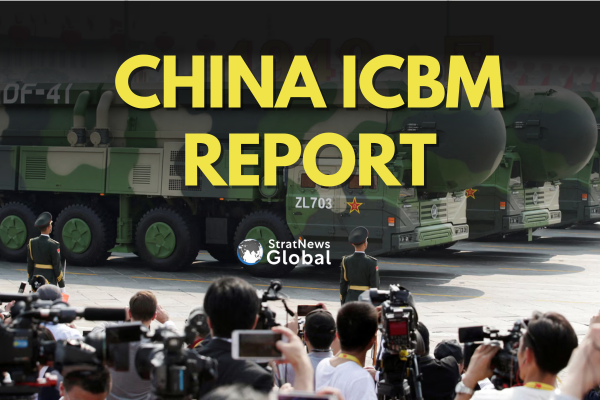
China has likely deployed more than 100 intercontinental ballistic missiles (ICBMs) across three new silo fields and shows no interest in joining nuclear arms control talks, according to a draft Pentagon report seen by Reuters. The assessment highlights Beijing’s rapid nuclear modernisation and growing military assertiveness amid escalating global security tensions.
The report said China’s weapons expansion is advancing faster than that of any other nuclear-armed nation, citing findings by the Bulletin of the Atomic Scientists. Beijing, however, dismissed such reports as attempts to “smear and defame” its image internationally.
Last month, U.S. President Donald Trump suggested he was developing a potential trilateral denuclearisation plan involving China and Russia. Yet, the Pentagon’s analysis suggests that Beijing remains unwilling to engage. “We continue to see no appetite from Beijing for pursuing such measures or more comprehensive arms control discussions,” the draft stated.
Expanding Arsenal and Strategic Reach
According to the report, China has likely placed more than 100 solid-fuelled DF-31 ICBMs in silo fields near the Mongolian border. While the Pentagon had previously acknowledged the existence of these facilities, this is the first time a report has suggested the scale of deployment.
China’s nuclear warhead stockpile stood at just over 600 in 2024 — a slower rate of growth compared to earlier years but the Pentagon predicts that Beijing will possess more than 1,000 warheads by 2030.
The report did not specify any intended targets for the newly deployed missiles. Chinese officials reiterated that the country maintains a “defensive nuclear strategy” and adheres to a “no-first-use” policy. China’s embassy in Washington said its nuclear posture remains limited to the “minimum level required for national security.”
Tensions Over Taiwan and Military Modernisation
The Pentagon report also warns that China expects to be capable of “fighting and winning a war on Taiwan by the end of 2027.” It describes Beijing’s military planning as focused on taking the island “by brute force,” including long-range strike options extending up to 2,000 nautical miles.
Such capabilities, it noted, could “seriously challenge and disrupt U.S. presence” in the wider Asia-Pacific during a conflict.
China regards democratically governed Taiwan as part of its territory and has not ruled out using force to achieve unification. The United States maintains a policy of strategic ambiguity but continues to supply Taiwan with defensive weaponry.
Arms Race Concerns as Nuclear Treaties Expire
The report’s release comes just weeks before the scheduled expiration of the 2010 New START treaty — the last remaining nuclear arms control accord between the U.S. and Russia, which caps strategic warheads at 1,550 per side. The agreement, extended once in 2021, cannot be formally renewed.
Analysts fear its lapse could ignite a new three-way nuclear arms race among the U.S., Russia and China. “More nuclear weapons and an absence of diplomacy will not make anyone safer,” warned Daryl Kimball, executive director of the Arms Control Association.
Trump has previously said he wants the U.S. to resume nuclear weapons testing, though his administration has yet to outline specific plans.
Corruption Purges and Industrial Impact
Beyond nuclear expansion, the Pentagon report details President Xi Jinping’s sweeping anti-corruption campaign within the People’s Liberation Army (PLA) and China’s defence industry. The crackdown, it said, has disrupted procurement and slowed weapons production but could yield “long-term improvements” in military efficiency.
Revenues at state-owned defence firms fell last year despite three decades of steady budget increases, reflecting the purge’s short-term impact. At least 26 senior executives from major arms manufacturers have been investigated or dismissed in the past 18 months.
The probe, initially centred on rocket and missile procurement, has since widened to include China’s nuclear and shipbuilding industries.
As Beijing continues its drive to expand and modernise its military power, U.S. officials warn that the combination of nuclear growth, regional assertiveness and internal restructuring underscores China’s emergence as a strategic rival unlike any other.
(with inputs from Reuters)