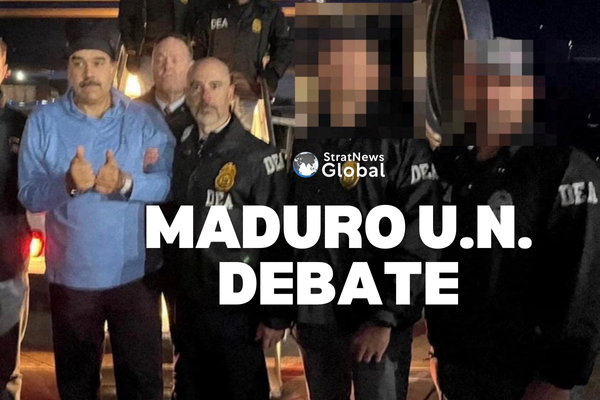
The legality of the United States’ capture of Venezuelan President Nicolas Maduro will come under international scrutiny when the United Nations Security Council convenes on Monday. Despite growing criticism from some countries, Washington is expected to avoid strong condemnation from its key allies over the weekend military operation in Venezuela.
U.N. Security Council to Debate Legality
U.S. Special Forces seized Maduro on Saturday during a raid that reportedly caused power outages in parts of Caracas and struck military facilities. Venezuelan officials said the operation resulted in several deaths. Maduro is now being held in New York, awaiting a court hearing on drug trafficking charges.
Russia, China and other allies of Venezuela have accused Washington of breaching international law. However, Western nations that previously opposed Maduro have been more restrained, avoiding direct criticism of the U.S.
“Judging by the reactions from European leaders so far, I suspect that U.S. allies will equivocate exquisitely in the Security Council,” said Richard Gowan, director of global issues and institutions at the International Crisis Group.
U.N. Secretary-General Antonio Guterres considers the U.S. raid to set “a dangerous precedent,” his spokesperson said on Saturday. Many legal experts share that view, arguing that Washington violated international law. Still, any attempt to censure the U.S. at the U.N. will likely fail, as it can veto resolutions against itself.
Washington Cites Self-Defence
European governments have generally called for adherence to international law without directly criticising the U.S. French Foreign Minister Jean-Noel Barrot, however, stated that Washington breached “the principle of not resorting to force that underpins international law.”
The U.N. Charter obliges member states to avoid using force against the territorial integrity or political independence of any nation. Yet, U.S. Ambassador to the U.N. Mike Waltz defended the operation, invoking Article 51 of the Charter, which allows self-defence in response to an armed attack.
“In this case, you have a drug kingpin, an illegitimate leader indicted in the United States, coordinating with China, Russia, Iran, and terrorist groups like Hezbollah, pumping drugs, thugs, and weapons into our country,” Waltz told Fox News.
Legal scholars reject that justification. They argue the action lacked Security Council authorisation, Venezuelan consent, and the conditions for self-defence.
“The operation violated international law,” said Tom Dannenbaum, a professor at Stanford Law School. “Even if Maduro’s regime is illegitimate, that does not eliminate the need for a legal basis to use military force.”
U.S. Veto Prevents Accountability
Although the U.N. Security Council is responsible for maintaining global peace and security, the U.S. holds a permanent seat with veto power, allowing it to block any motion against itself.
Maduro was indicted in 2020 on charges including narco-terrorism conspiracy, which he has consistently denied.
“Even if Maduro were involved in drug smuggling, that would not constitute an armed attack permitting self-defence,” said Milena Sterio, professor at Cleveland State University College of Law. She added that Washington “cannot exercise extra-territorial jurisdiction to arrest individuals anywhere it pleases.”
Adil Haque, a professor at Rutgers Law School, also described the capture as “an illegal infringement of the inviolability and immunity of a sitting Head of State, who may lack democratic legitimacy but was clearly performing his official duties.”
with inputs from Reuters