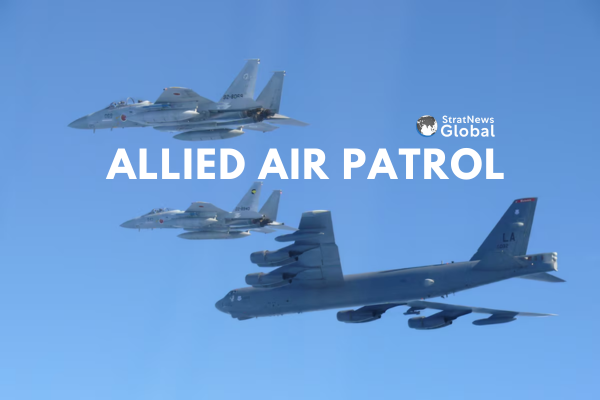
U.S. nuclear-capable B-52 bombers flew over the Sea of Japan on Wednesday, escorted by Japanese fighter jets, in a powerful demonstration of allied strength following recent Chinese and Russian military activities around Japan and South Korea. Tokyo confirmed the mission on Thursday, describing it as a reaffirmation of the allies’ commitment to regional stability and deterrence.
Reinforcing Allied Resolve
Japan’s defence ministry said the joint operation with the United States aimed to “reaffirm their strong resolve to prevent any unilateral attempt to change the status quo by force.” The exercise involved two U.S. B-52 bombers flying alongside three Japanese F-35 stealth fighters and three F-15 air-superiority jets. It marked the first visible U.S. military show of presence since China began large-scale drills in the region the previous week.
The manoeuvre came a day after Chinese and Russian strategic bombers conducted a joint flight over the East China Sea and western Pacific. Around the same time, China’s aircraft carrier group held exercises that prompted Japan to scramble fighter jets, which Tokyo said were targeted by radar beams — a move that drew a sharp rebuke from both Tokyo and Washington.
A U.S. official said the radar incident was “not conducive to regional peace and stability,” stressing that America’s alliance with Japan remained “unwavering.”
Heightened Regional Tensions
Japan and South Korea both host significant U.S. military forces, with Japan home to the largest concentration of American troops overseas, including an aircraft carrier strike group and a Marine expeditionary force. These assets play a central role in maintaining balance amid growing tensions in East Asia.
China denied Japan’s accusation regarding the radar targeting, claiming that Japanese jets had flown dangerously close to its carrier operating south of Japan. Meanwhile, South Korea reported scrambling its own fighter jets when Chinese and Russian aircraft entered its air defence identification zone on Tuesday, an area used for early warning but extending beyond national airspace.
Taiwan and Wider Regional Friction
China continues to intensify military pressure on Taiwan, with daily flights and naval operations around the island. Taiwan’s defence ministry reported on Wednesday that Chinese J-16 fighters and H-6 bombers carried out long-range drills in the western Pacific after passing south of the island.
Tensions have been further inflamed by comments from Japanese Prime Minister Sanae Takaichi, who recently suggested Tokyo would consider its response options in the event of a Chinese attack on Taiwan. Beijing strongly condemned the remarks, reiterating its claim over the self-governed island, which lies just over 100 kilometres from Japan’s southern islands and along vital sea routes crucial to Tokyo’s economy.
(with inputs from Reuters)