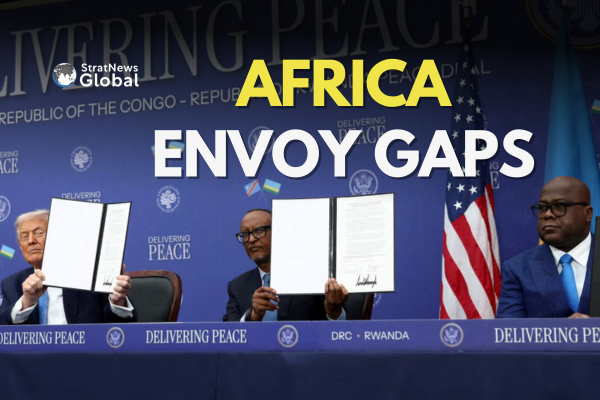
U.S. President Donald Trump’s mass recall of ambassadors has left Washington without senior diplomatic representation in more than half of sub-Saharan Africa, raising concerns about the country’s ability to advance its policies across a region troubled by coups and conflict.
Since taking office, Trump has pursued a business-oriented diplomacy in Africa, shifting the U.S. focus from aid to trade. His administration has promoted bilateral agreements and rare-earth mineral deals while seeking to broker peace accords in volatile areas. Trump has often contrasted this approach with China’s, claiming that Washington offers African nations a more reliable partnership.
Diplomatic Vacancies and Unclear Plans
According to reports from the Associated Press, the recall of 13 chiefs of mission will bring the total number of ambassadorial vacancies in Africa to about 30. Former diplomats said such a high figure would inevitably weaken America’s diplomatic presence. The State Department has not confirmed when, or if, replacements will be appointed.
Cameron Hudson, a former U.S. official with experience in African affairs, described the move as characteristic of Trump’s “personal style.” He noted that Trump prefers to handle key relationships himself rather than relying on ambassadors. “If he’s not personally engaged, that country doesn’t merit his attention. If he is engaged, then he doesn’t see the need for an ambassador,” Hudson said.
Trump’s personal envoy, Massad Boulos father-in-law of Trump’s daughter Tiffany has reportedly played a central role in negotiations involving the Democratic Republic of Congo, Rwanda and Sudan.
Policy Shifts and Political Friction
Trump’s tenure has been marked by efforts to mediate the long-running conflict in eastern Congo. However, renewed advances by M23 rebels, backed by Rwanda, have cast doubt on the sustainability of recent peace efforts. The president has also clashed with South Africa and placed Nigeria on a watch list over the killing of Christians, even hinting at possible military action.
Among the ambassadors recalled were those serving in Rwanda, Nigeria and Niger, where a U.S. missionary pilot was kidnapped earlier this year.
Despite criticism, State Department spokesperson Tommy Pigott said the administration’s policies had delivered “unprecedented success” in advancing U.S. interests, citing new trade and peace agreements as evidence of effective leadership.
Leadership Changes and Ongoing Challenges
The reshuffle extends beyond overseas embassies. Jonathan Pratt, Senior Bureau Official for African Affairs, announced his retirement after serving through the end of the year. Deputy Assistant Secretary Nick Checker will take his place, becoming the third person to hold the position during Trump’s second term.
Former Assistant Secretary Tibor Nagy, who served during Trump’s first administration, said the number of vacancies was “extremely high” and warned that the absence of a Senate-confirmed Assistant Secretary for African Affairs could harm the bureau’s effectiveness.
Nagy noted that while Checker is experienced and capable, “at some point you really do need a Senate-confirmed assistant secretary” to lead diplomacy at the highest level.
with inputs from Reuters