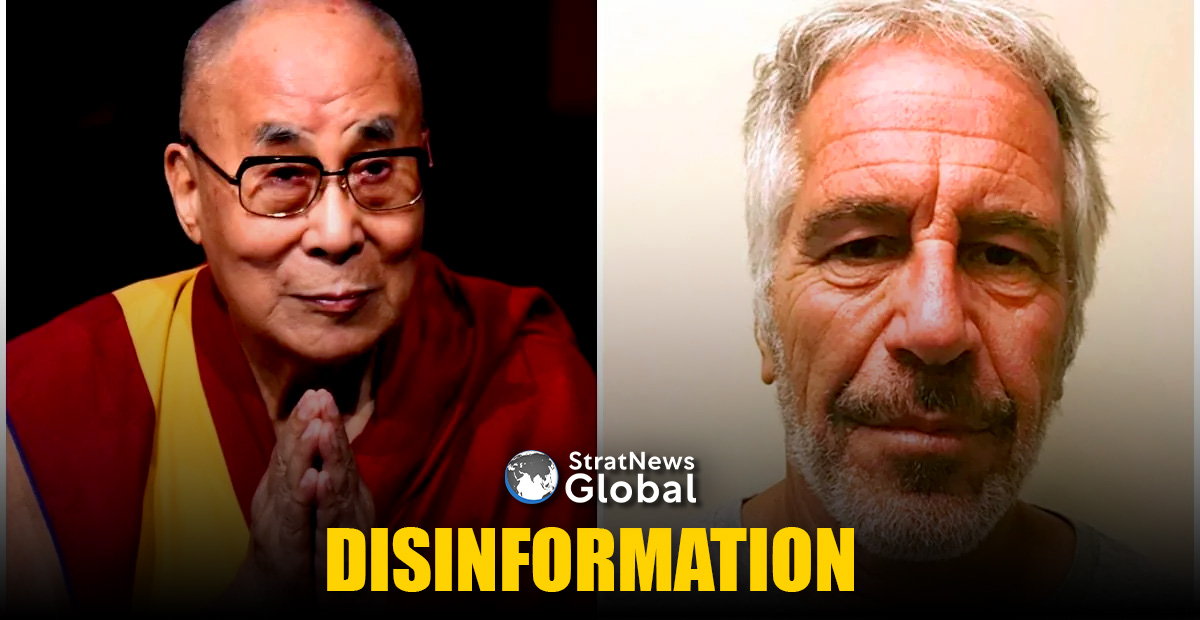
Months after the U.S. Congress passed the “Epstein Files Transparency Act” in November 2025, the Department of Justice (DoJ) released over three million pages of documents, including 2,000 videos and 180,000 images. While these records have exposed the genuine, chilling proximity of Jeffrey Epstein to global elites, in some instances, they have also become a breeding ground for disinformation.
The Dalai Lama’s name appears in these files over a hundred times. However, the context reveals a story of Epstein’s unrequited pursuits, not the Dalai Lama’s complicity. Yet, perhaps not surprisingly, this has not stopped the Chinese state media from weaponising the news item.
A Manufactured Scandal
Within days of the release, outlets such as CGTN and China Radio International flooded social media with headlines framing references to the Dalai Lama as “proof” of repeated meetings. This state-led campaign found a disturbingly uncritical audience; even some Indian media outlets ran the headline: “Dalai Lama met Jeffrey Epstein in 2012,” notably omitting the nature of those mentions. Many of these posts share a format and pattern that strongly suggest they are part of a concerted disinformation campaign. Past analyses of similar disinformation campaigns have shown links to Beijing.
When the media prioritises clickbait over nuance, the burden of proof shifts, forcing the Tibetan community to defend itself against a manufactured scandal. In response, our collective of Tibetan scholars audited all 168 entries for “Dalai” in the Epstein files. We identified two entries as technical/clerical errors; our investigation of the remaining records yielded these key findings.
The Dalai Lama Was On Aspirational “Target Lists”
Between May and July 2015, Jeffrey Epstein sought a meeting with the Dalai Lama. He attempted to leverage Joi Ito (MIT Media Lab) and Tenzin Priyadarshi (MIT Ethics Initiative) to broker an introduction. Epstein’s interest was part of a broader pattern of “collecting” Nobel laureates and scientists to bolster his social credibility and intellectual standing.
No Contact Or Meetings Took Place
Despite Epstein’s efforts, the records show no direct contact or meetings occurred between him and the Dalai Lama or his office. The widely disseminated disinformation regarding a meeting on October 21, 2012, stems from an exchange with an unidentified female associate. When Epstein asked to meet her, she declined, writing: “About the event I told u almost a month ago on the island that dalai lama is coming and I want to go there to see him. But I can skip this event if u need my help today.” Epstein replied, “I did call, … go to event, This is bullshit.” The Dalai Lama was a topic of conversation; the “event” in question was actually a public teaching at Lincoln Center in New York, as publicly documented.
While Michael Wolff—frequently criticised by peers for lacking journalistic integrity and for inventing facts—claimed to have seen the Dalai Lama at Epstein’s Manhattan apartment for a social gathering, contemporaneous email records refute this claim. As late as March 2016, Ito’s email to Epstein referred to a potential meeting with the Dalai Lama as a “next stop,” confirming that such an encounter had not yet occurred. These records indicate that Epstein was still unsuccessfully “working on” an introduction years after Wolff’s alleged sighting. We requested clarification regarding the timing of the alleged meeting from Wolff—via his Substack and X—as well as from The Daily Beast, but we have not received a response. The Dalai Lama’s office has confirmed there were no meetings or authorised dealings with Epstein.
Nature Of Document References
All mentions of the Dalai Lama within the data set are third-party, speculative, or aspirational. Of the 166 mentions, approximately 70% are duplicate or redundant system files (see table below).
| Category | Content Description | Mentions |
| Aspirational Meetings | Emails expressing a desire to meet or plan dinners. | 29 |
| Intermediaries (MIT/Tenzin) | Conversations involving MIT acting as a potential “bridge.” | 24 |
| Automated Newsletters/News Article/Dossier | Mass-produced newsletters or “e-blasts” containing quotes. | 33 |
| Media / Spam / Lists/Name Drop | News clips, junk mail, and name-dropping in unrelated threads | 80 |
| TOTAL | 166 |
Conclusion
The Epstein Files have provided a necessary, if harrowing, accounting of how power protects its own. However, when these records are stripped of context and weaponised by state actors, uncritically amplified by influencers and online activists, they serve a different kind of corruption: manufacturing scandal. Our exhaustive review confirms that the Dalai Lama was never a member of Epstein’s circle; he was a target for “collection” by a man obsessed with proximity to moral authority. Epstein sought the Dalai Lama’s prestige to mask his own depravity, but records show he never reached his goal.
For the Tibetan community, this is more than misrepresentation; it is a coordinated attack on a movement’s moral heart. If legacy media outlets continue to prioritise clickbait over the nuance of these files, they do not just fail their readers—they become silent partners in state-sponsored disinformation. When such disinformation targets an already marginalized community, we must demand greater care and a far more critical eye from those with a platform.
(This article has been authored by a group of Tibetan researchers— Dr Ugyan Choedup, Dr Chime Youdon, Dr Tashi Yangzom, Dr Apa Lhamo and Palden Sonam. Views expressed here are personal.)