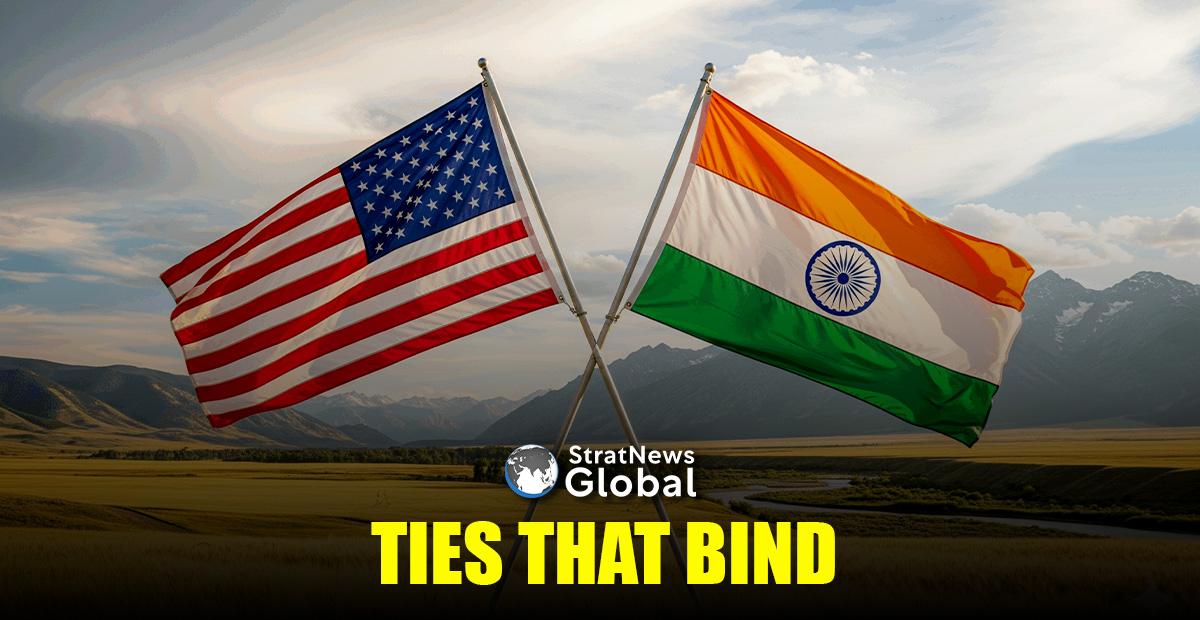
Even as U.S. President Donald Trump’s tariff measures sharpen trade frictions with New Delhi, India and the United States pressed ahead with their strategic agenda, holding the virtual U.S.-India 2+2 Intersessional Dialogue on August 25.
The dialogue was co-chaired by U.S. Senior Bureau Official for South and Central Asian Affairs Bethany P. Morrison and Acting Assistant Secretary of Defence for Indo-Pacific Security Affairs Jedidiah P. Royal, alongside India’s Additional Secretary (Americas) in the Ministry of External Affairs Nagaraj Naidu Kakanur and Ministry of Defence Joint Secretary (International Cooperation) Vishwesh Negi.
Both governments said the talks advanced bilateral initiatives, reviewed regional security developments, and exchanged views on shared strategic priorities. These ranged from trade and investment to energy security, including civil-nuclear cooperation, as well as critical minerals exploration, counternarcotics, and counterterrorism cooperation.
Despite the shadow of tariffs, defence cooperation emerged as the centrepiece of the dialogue. Officials reaffirmed plans to sign a new ten-year Framework for the Major Defence Partnership, aimed at strengthening collaboration in defence industrial production, science and technology, operational coordination, regional security, and information-sharing.
The meeting also emphasised the importance of the U.S.-India COMPACT (Catalysing Opportunities for Military Partnership, Accelerated Commerce & Technology), a framework designed to accelerate cooperation across defence and commerce.
With an eye on regional geopolitics, both sides reiterated their shared commitment to advancing a “safer, stronger, and more prosperous” Indo-Pacific through the Quad grouping of India, the U.S., Japan, and Australia.
The talks concluded with the chairs describing the meeting as “productive” and stressing their determination to expand the breadth and depth of bilateral ties in ways that directly benefit citizens in both countries.
While trade tensions continue to test the relationship, the outcome of the 2+2 Intersessional Dialogue suggests that the strategic partnership remains on a steady track, with New Delhi and Washington choosing to firewall defence and security cooperation from tariff disputes.