Russian satellites carried out dozens of detailed imagery surveys of military facilities and critical sites across the Middle East to support Iranian strikes on U.S. forces and other targets, according to a Ukrainian intelligence assessment reviewed by Reuters.
The assessment also found that Russian and Iranian hackers were collaborating in the cyber domain, offering one of the most detailed accounts to date of alleged Russian support to Iran since Israel and the United States launched their assault on February 28.
Russian satellites conducted at least 24 surveys across 11 Middle Eastern countries between March 21 and 31, covering 46 locations, including U.S. and other military bases, airports and oil fields.
Within days of being surveyed, several military bases and headquarters were targeted by Iranian ballistic missiles and drones, the assessment said, describing a clear pattern.
A Western military source and a regional security source said their intelligence also pointed to heightened Russian satellite activity in the region and indicated that imagery had been shared with Iran.
Regional Surveillance
Nine surveys focused on parts of Saudi Arabia, including five over the King Khalid Military City near Hafar Al-Batin, in what appeared to be an effort to locate elements of the U.S.-made THAAD air defence system, the assessment said.
Areas in Turkey, Jordan, Kuwait and the United Arab Emirates were surveyed twice, while sites in Israel, Qatar, Iraq, Bahrain and the Naval Support Facility Diego Garcia were surveyed once.
The assessment also highlighted increased monitoring of the Strait of Hormuz, a critical waterway for global oil and LNG flows, where Iran has imposed a de facto blockade on all but “non-hostile vessels”.
Satellite Data and Responses
U.S. space-tracking firm Kayhan Space said its orbital analysis showed Russian satellites repeatedly passing over parts of the Gulf region during the same period, including those capable of Earth observation and surveillance.
The company added that activity may have been more extensive than outlined in the Ukrainian assessment, though satellite passes do not confirm imagery collection.
White House spokeswoman Olivia Wales said no external support for Iran was affecting U.S. operational success. Iran’s foreign ministry did not comment, and Russia’s defence ministry did not respond to requests.
At a G7 meeting last month, European leaders raised the issue with U.S. Secretary of State Marco Rubio, though diplomats said he did not respond directly to the allegations and has publicly dismissed Russian aid to Iran as insignificant.
Co-ordination and Strikes
The assessment said satellite imagery exchanges were organised through a permanent communications channel between Russia and Iran, potentially supported by Russian military intelligence personnel in Tehran.
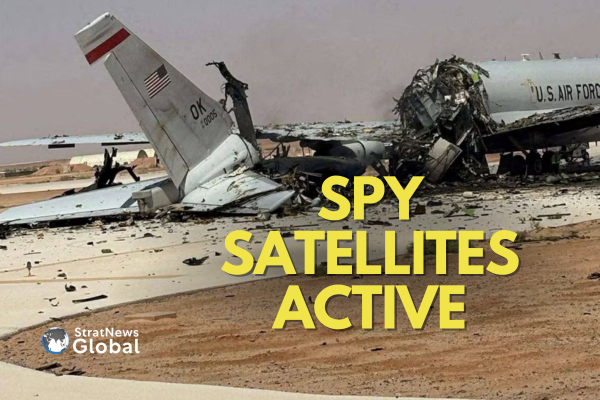
It cited an incident in which a Russian satellite captured imagery of Prince Sultan Air Base in Saudi Arabia days before Iran struck the facility on March 27, hitting a U.S. E-3 Sentry AWACS aircraft.
A satellite passed over the same site the following day to assess the damage, the assessment said.
Deepening Military Ties
Russia and Iran have strengthened military ties since Vladimir Putin ordered the full-scale invasion of Ukraine in February 2022.
Ukraine and Western countries say Iran supplied long-range Shahed drones to Russia, which were used in attacks on Ukraine, while also helping develop more advanced variants. Iran denies supplying such weapons.
Putin and Iranian President Masoud Pezeshkian signed a Treaty on Comprehensive Strategic Partnership in January last year, which includes provisions for intelligence and security co-operation.
Cyber Operations
The assessment and regional sources said Russia was also assisting Iran in cyber operations.
Iranian-linked hacking groups have intensified activity since late February, targeting critical infrastructure and telecommunications companies in the Gulf.
The report cited collaboration between Russian groups “Z-Pentest Alliance”, “NoName057(16)” and “DDoSia Project” and Iran’s “Handala Hack”, including co-ordinated messaging and cyber operations via Telegram.
It added that Iranian hacker groups have used techniques associated with Russian military intelligence and relied on infrastructure such as Russian VPS provider ProfitServer to conduct operations.
(with inputs from Reuters)