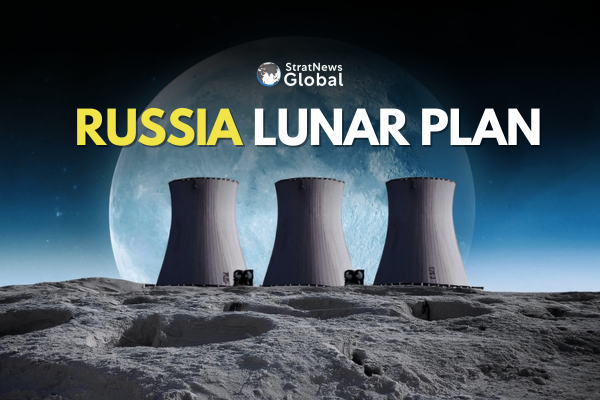
Russia intends to construct a nuclear power plant on the moon within the next decade to support its expanding lunar exploration programme and a joint research base with China. The project marks Moscow’s most ambitious step yet in reviving its space credentials as major powers accelerate efforts to establish a permanent presence on the earth’s only natural satellite.
Roscosmos, Russia’s state space agency, announced that it had signed a contract with aerospace firm Lavochkin Association to build the plant, which it aims to complete by 2036. The facility will provide energy for lunar rovers, observatories and infrastructure forming part of the planned Russian-Chinese International Lunar Research Station.
From Setbacks to Renewed Ambition
Russia’s lunar ambitions have faced severe setbacks in recent years. The 2023 Luna-25 probe crashed into the moon’s surface during a landing attempt, dealing a blow to Moscow’s return to deep-space exploration. Once a pioneer in spaceflight, Russia has since struggled to match the United States and China, both of which have advanced their lunar and planetary programmes significantly.
Despite the failure, Roscosmos insists the latest project will mark a turning point. “This initiative is an important step toward the creation of a permanently functioning scientific lunar station and the transition from single missions to long-term lunar exploration,” the agency said in a statement.
Nuclear Collaboration and Technological Edge
Although Roscosmos stopped short of explicitly confirming the plant’s nuclear nature, the project involves Rosatom, Russia’s state nuclear corporation, and the Kurchatov Institute, the country’s top nuclear research body. Their participation strongly indicates that the facility will rely on nuclear technology to ensure a stable and long-lasting energy supply in the moon’s harsh environment.
Roscosmos head Dmitry Bakanov has previously outlined the goal of deploying a nuclear power source on the moon as part of broader plans that also include renewed exploration of Venus, often described as the earth’s “sister planet.”
Renewed Space Competition
The announcement highlights a growing global competition to secure technological and scientific leadership in lunar exploration. While the United States is preparing for future Artemis missions and China has advanced its Chang’e lunar programme, Russia’s collaboration with Beijing underscores a strategic partnership designed to maintain influence in space research.
The moon, located roughly 384,400 kilometres from earth, plays a crucial role in stabilising the planet’s rotation and influencing tides. For Russia, establishing a permanent scientific base there is as much a symbol of prestige as it is a step toward reasserting its position among the world’s space powers.
with inputs from Reuters