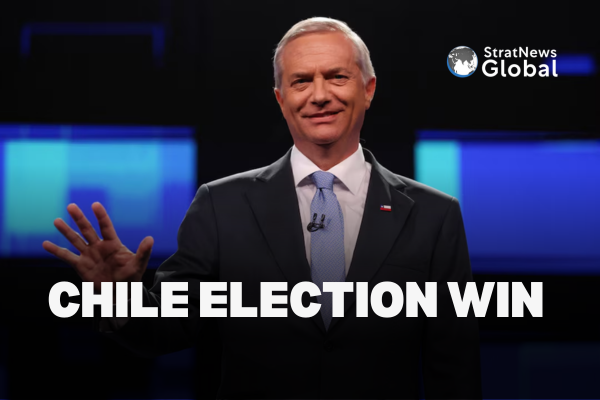
Jose Antonio Kast has won Chile’s presidential election, securing 58% of the vote and leading the country into its most significant rightward shift since the end of Augusto Pinochet’s military rule in 1990. The far-right candidate defeated government-backed leftist Jeannette Jara, who conceded after receiving 42% in Sunday’s runoff.
Security and Migration at the Core of Kast’s Victory
Kast’s campaign centred on public frustration over rising crime and migration, themes that resonated strongly with voters. Throughout his political career, the veteran conservative has maintained hardline positions, advocating for border walls, deploying the military to high-crime zones, and deporting migrants living in Chile illegally.
Addressing cheering supporters at his Republican Party headquarters in Santiago’s affluent Las Condes district, Kast promised to restore security and order. “Without security, there is no peace. Without peace, there is no democracy, and without democracy, there is no freedom,” he said, pledging to make Chile “free of crime, anxiety and fear.”
He also tempered expectations, warning that there would be “no magical solutions” and that change would take time and persistence.
Chile Joins Latin America’s Rightward Drift
Kast’s win adds to a growing list of right-leaning victories across Latin America, including those of Ecuador’s Daniel Noboa, El Salvador’s Nayib Bukele, and Argentina’s Javier Milei. In Bolivia, the October election of centrist Rodrigo Paz ended nearly 20 years of socialist dominance.
For Kast, this marks his third presidential campaign and second runoff. Once dismissed as too extreme, he has now capitalised on growing public unease over crime and migration. His ability to win even in traditionally leftist regions reflects both shifting voter sentiment and disillusionment with Jara, whose Communist Party affiliation alienated moderates, said Claudia Heiss, a political scientist at the University of Chile.
At his victory rally, 23-year-old engineering student Ignacio Segovia summed up the mood of many Kast supporters: “I grew up in a peaceful Chile. Now you can’t go out peacefully we want that Chile back.”
Governing Challenges Ahead
Despite his decisive win, Kast faces a divided Congress that may complicate his legislative agenda. The Senate remains evenly split between left and right parties, while the lower house’s balance of power lies with the populist People’s Party.
Kast has proposed creating a new immigration enforcement force modelled on U.S. Immigration and Customs Enforcement to detain and deport illegal migrants swiftly. He also plans to cut public spending sharply and roll back regulations to attract investment in Chile’s key copper and lithium sectors.
Markets have already reacted positively, with the peso and stock index strengthening on expectations of more business-friendly policies. However, Kast will have to balance investor optimism with social realities and manage a coalition of voters whose support may not align on every issue.
“He must govern for a diverse electorate,” said Guillermo Holzmann, a political analyst at the University of Valparaíso. “Much of his vote is borrowed not everyone who voted for him shares his ideology.”
On socially conservative issues such as abortion, Kast is expected to tread carefully. Although he is a devout Catholic and father of nine who opposes abortion, polls suggest a majority of Chileans support current reproductive rights, making any rollback politically risky.
Kast’s victory marks a decisive moment for Chile, ushering in a government promising order and stability but facing the challenge of delivering both in a politically divided nation.
(with inputs from Reuters)