India on Tuesday formally set the tone for its BRICS presidency by unveiling the official logo and website for BRICS 2026, with External Affairs Minister S. Jaishankar making a strong case for reshaping global governance to reflect today’s political and economic realities.
Speaking at the launch event in New Delhi, Jaishankar said “At a time when the world is navigating multiple and interlinked challenges, the demand for a reinvigorated, inclusive and effective multilateral system has never been greater,” the minister said.
He stressed that bodies such as the United Nations, World Trade Organization, International Monetary Fund and World Bank must become more representative and responsive to contemporary realities.
BRICS 2026 Logo
The BRICS 2026 logo draws heavily from Indian cultural symbolism. The logo is inspired by the national flower the lotus. The design represents resilience and growth amid adversity.
The petals at the centre of the emblem form the Namaste gesture. This symbolises cooperation, dialogue, and mutual respect. The petals surrounding the emblem feature colours associated with BRICS nations, underlining unity among diverse political systems and cultures.
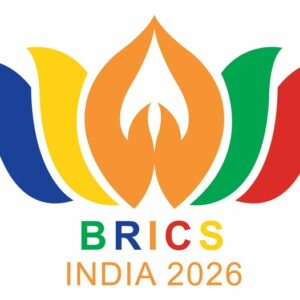
The minister described the design as reflecting a people-first approach that aligns with India’s vision for its chairship.
The theme is “Building for Resilience, Innovation, Cooperation and Sustainability,” which captures India’s belief that collective action among emerging economies can offer practical solutions to shared global challenges.
BRICS Website
Alongside the logo, Jaishankar also launched the official BRICS 2026 website, which will function as a central digital platform throughout India’s presidency. The site will host information on meetings, initiatives, outcomes, official documents and events, aimed at improving coordination, transparency and public engagement.
Officials said the platform reflects India’s push for greater outreach and streamlined communication among member states and partner countries.
Highlighting BRICS’ economic role, the minister pointed to the New Development Bank (NDB) as a key achievement of the grouping. He said the bank has emerged as a significant vehicle for infrastructure financing and sustainable development, particularly for emerging economies.
India, he added, remains committed to strengthening the NDB as a credible, responsible and financially sustainable institution.
People-Centric Focus
He underlined that people-to-people engagement will remain central to India’s BRICS agenda. Youth exchanges, cultural cooperation, education, tourism, sports and academic collaboration will receive special attention during the chairship.
He said India views BRICS as a constructive and consensus-driven platform, guided by principles of sovereign equality and mutual respect, and one that complements, rather than replaces, the broader multilateral system.
Describing India’s leadership approach, Jaishankar said the chairship would be guided by a “humanity-first” philosophy inspired by Prime Minister Narendra Modi.
“India approaches its chairship with a humanity-first and people-centric approach,” he said, adding that cooperation within BRICS can help countries address development gaps, climate risks, economic uncertainty and technological disruption in a balanced manner.
As BRICS prepares to mark 20 years in 2026, its global footprint has expanded significantly. The grouping now includes 11 full members, representing nearly half of the world’s population, close to 40 per cent of global GDP, and over a quarter of global trade.