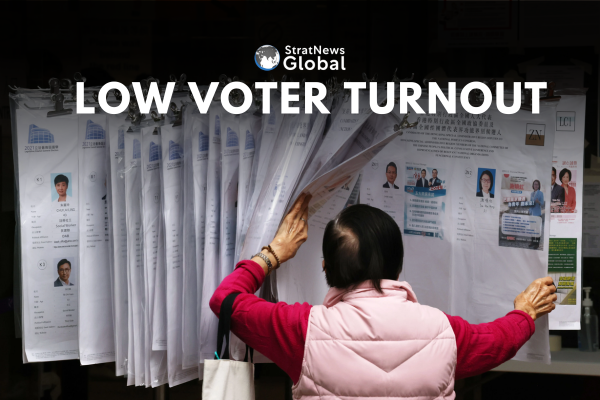
Hong Kong’s legislative election on Sunday drew one of the lowest turnouts in the city’s history, despite a marginal increase from the previous poll, as public anger simmered over the city’s deadliest fire in nearly eight decades.
Voter Turnout Edges Up but Remains Near Historic Low
According to the government, voter turnout reached 31.9%, compared with 30.2% in 2021 the lowest level since Hong Kong’s return to Chinese sovereignty in 1997. While the proportion of voters rose slightly, the total number of ballots cast fell short of that seen four years ago.
All candidates were required to be vetted as “patriots” under new electoral rules introduced after Beijing’s sweeping overhaul of the city’s political system. Of the legislature’s 90 seats, only 20 were directly elected, with the remainder filled by Beijing-aligned election committees and professional groups.
To boost participation, polling hours were extended and new stations opened. However, the city’s sombre mood following the November 26 fire in Tai Po overshadowed the campaign.
“The social atmosphere made this a very difficult election to organise,” said David Lok, chairman of the Election Commission, during a press briefing early Monday.
Deadly Fire Fuels Public Discontent
The blaze, which engulfed seven residential towers in the Wang Fuk Court complex near the mainland border, claimed at least 159 lives and took almost two days to extinguish. Authorities blamed substandard building materials for accelerating the fire’s spread.
Security was tightened in Tai Po, with heavy police patrols around the affected area. Anger among residents has been mounting, with calls for government accountability and stronger oversight of construction standards.
Chief Executive John Lee pledged to work with the new legislature to “drive institutional reform” in response to the tragedy. Authorities have since launched criminal and corruption investigations linked to the incident in an effort to ease public frustration.
Arrests Over Election Boycott Calls
Hong Kong’s anti-corruption agency announced on Sunday that four men were arrested for allegedly using social media to encourage people not to vote or to cast invalid ballots. A fifth man is being sought in connection with similar online activity.
Publicly urging a boycott has been a criminal offence since electoral reforms that curtailed the influence of pro-democracy figures, many of whom have either fled the city or remain in custody. Historically, pro-democracy supporters made up about 60% of the electorate.
Authorities began clearing tributes left at a memorial near the burned-out towers late Sunday, a move widely seen as an attempt to prevent gatherings that might reignite public anger.
Meanwhile, China’s national security office in Hong Kong warned against “anti-China” protests or attempts to “disrupt Hong Kong” using the fire as a pretext. It also cautioned foreign media outlets against spreading “false information” about the government’s response to the disaster.
Waning Public Engagement
The number of registered voters has continued to decline, dropping to 4.13 million from a 2021 peak of 4.47 million. For many, the combination of political restrictions and the recent tragedy has deepened public disillusionment.
A 77-year-old resident, Cheng, who lives near the site of the fire, said he abstained from voting. “I’m very upset by the great fire,” he said. “I won’t vote to support those pro-establishment politicians who failed us.”
(with inputs from Reuters)