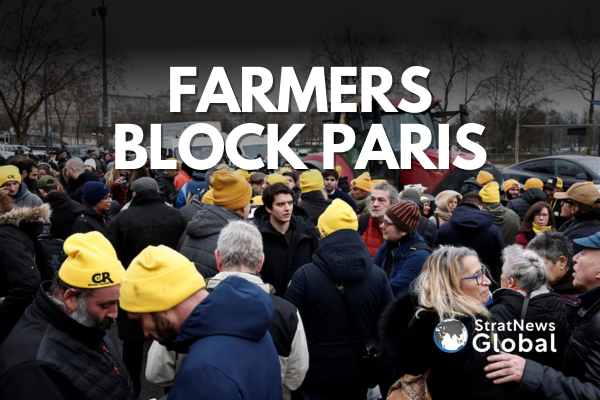
French farmers launched a pre-dawn blockade of roads leading into Paris on Thursday, disrupting traffic around several landmarks in a show of defiance against a proposed European Union trade deal with South American nations. The protests, organised by the Coordination Rurale union, reflect growing anger over agricultural policy, trade liberalisation, and the government’s handling of livestock disease.
Dozens of tractors drove along the Champs Elysees and surrounded the Arc de Triomphe before sunrise, while other convoys blocked major highways leading into the capital, including the A13 from Normandy. The Transport Ministry reported more than 150 kilometres of traffic jams during the morning rush hour as police monitored the situation but avoided confrontation.
“We are between resentment and despair. We have a feeling of abandonment, with Mercosur being an example,” said Stephane Pelletier, a senior member of Coordination Rurale, speaking beneath the Eiffel Tower. Farmers from the FNSEA and Young Farmers unions joined the peaceful demonstration later in the morning.
Mounting Pressure on Macron Ahead of Crucial EU Vote
The protests add to the mounting political pressure on President Emmanuel Macron and his government, coming just one day before EU member states are due to vote on the long-debated trade accord with Mercosur. The proposed deal between the EU and the South American bloc comprising Brazil, Argentina, Uruguay, and Paraguay has faced fierce opposition from French farmers, who fear it will open the European market to cheaper imports produced under lower environmental and animal welfare standards.
Without a parliamentary majority, Macron faces a fragile political environment in which any policy setback could trigger a no-confidence vote. The timing of the protests, combined with rising rural discontent, underscores the government’s political vulnerability ahead of municipal elections in March and the 2027 presidential race, where far-right candidates are polling strongly.
“This treaty is still not acceptable,” government spokesperson Maud Bregeon told France Info radio on Thursday. She declined to say whether Macron would support or oppose the deal, or abstain from the upcoming vote.
France Remains Firmly Opposed to Mercosur Deal
France has long resisted the EU-Mercosur agreement, citing environmental and agricultural concerns. Farm Minister Annie Genevard reaffirmed that even if EU member states back the deal, France would continue to oppose it in the European Parliament, whose approval is required for the accord to take effect.
To ease tensions, the European Commission this week proposed releasing €45 billion in farm support funds earlier than planned under the bloc’s next seven-year budget. It also suggested cutting import duties on certain fertilisers to win over hesitant member states. The deal is supported by Germany and Spain, while Italy’s growing backing could secure the necessary majority for approval, even without France’s support. A vote on the accord is expected on Friday.
Farmers Demand Vaccination Policy and Cost Relief
Beyond trade concerns, farmers are also protesting against what they describe as excessive regulation and spiralling costs. A key demand is the suspension of the government’s culling policy for cattle infected with lumpy skin disease, a highly contagious virus. Farmers are urging authorities to adopt a vaccination strategy instead.
Transport Minister Philippe Tabarot said police were instructed to avoid confrontation. “Farmers are not our enemies,” he told reporters, describing the protests as a legitimate expression of frustration over years of economic and bureaucratic strain.
The blockade marks one of the largest farmer-led demonstrations in France this year, reflecting broader tensions across Europe as agricultural communities push back against trade policies, environmental regulations, and global competition that they say threaten their livelihoods.
with inputs from Reuters