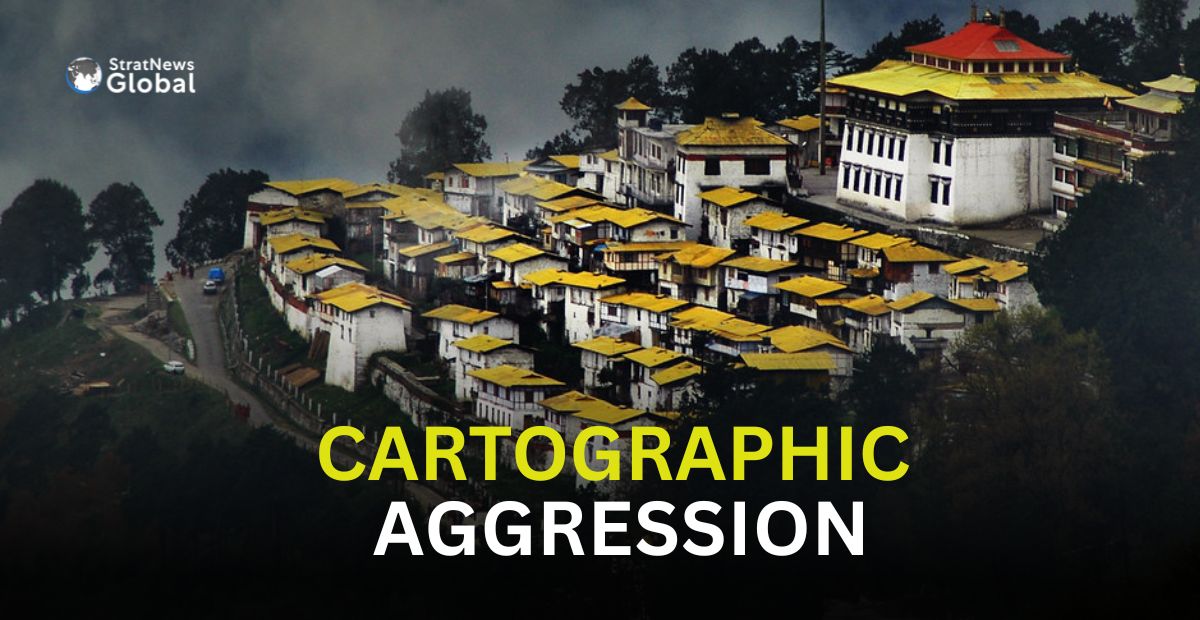
China’s renewed push to ‘standardise’ the names of places across Arunachal Pradesh has raised questions about Beijing’s territorial claims, and the narratives it hopes to cement. China recently released a fifth list this year covering 27 locations, mostly in Arunachal but also, for the first time, in Assam. What do these lists reveal, what does China hope to achieve? SNG’s Anukriti spoke to Tenzin Dhamdul, Senior Researcher at the Foundation For Non-Violent Alternatives who is among the few studying China’s expanding cartographic claims.
Q: What do you think is China’s main strategic objective behind renaming places in Arunachal Pradesh—and now even in Assam?
A: In my opinion what they are trying to do is create a narrative among their people. What is interesting here is like they have been able to cultivate an understanding in their own domestic sphere or domestic bubble. Most Chinese citizens rely on censored domestic platforms like WeChat, Weibo and Douyin, and many do not go out of their way to access outside information. By repeatedly showing these areas as part of ‘South Tibet,’ China builds internal psychological legitimacy.
So, if a future border escalation happens, the average Chinese citizen—who has never seen Arunachal—already believes the area is theirs. It’s narrative-building and psychological conditioning.
Q: Do you notice any pattern in the timing of China’s list releases? Could this be linked to a broader strategic calculation or diversion from domestic issues?
A: That is an interesting question and yes, there is a pattern. China has released five lists so far:
In April 2017, the first list was released by the Ministry of Civil Affairs. It came around the time when the Dalai Lama was travelling to Arunachal/Tawang. The first place on that list was the birthplace of the Sixth Dalai Lama—clearly symbolic.
The second list came out in December 2021, which kind of followed the Doklam and Galwan incidents. The third list came out in April 2023 when India was hosting the G20 presidency. The fourth list came out in April 2024 when India opened Sela Pass in Arunachal Pradesh.
And interestingly enough the fifth list came out in May 2025, when India was facing war with Pakistan, when Operation Sindoor was initiated after the Pahalgam terrorist attack.
So you could see how China is not just randomly coming out with these names but strategically targeting critical geopolitical moments India experiences.
Q: How does this fit into China’s broader pattern of territorial assertion (e.g., South China Sea, Southeast Asia)?
A: In my understanding, it fits perfectly. China expands influence by pushing into others’ sovereign territory and then using it as a negotiation leverage. For example, in the Senkaku/Diaoyu dispute with Japan, China links unrelated negotiations to territorial issues. I think professor Jabin Jacob says China is using ‘lawfare’ tactic, using law to conduct warfare and push their foot forward.
When China comes out with these lists of names, it doesn’t impact us internally. We know that Arunachal Pradesh is an integral part of India’s sovereign territory. But at the end of the day, what they are doing is gradually creating a framework of legitimacy within their own constitution and sphere of influence. Through these actions, they are attempting to claim that territory in a way that appears lawful from their perspective. That is the strategy they are pursuing in many ways.
We drew inspiration from how China has been expanding its influence in the Indian Ocean. American scholars have described this strategy with the term “string of pearls”, me and my colleagues call its parallel in the Himalayas as a “thread of beads.” There is already a popular understanding of Mao’s Five-Finger Theory, which envisions Tibet as the palm and the surrounding regions as its five fingers. Observing these developments, we recognized that something comparable is happening here as well.
Q: What basis or evidence does China present when renaming places?
A: Their lists include names in both Chinese and Tibetan. Beijing claims Arunachal Pradesh as ‘South Tibet.’ Historically, the northern part of present-day Arunachal Pradesh, had regions with strong Tibetan influence. They shared a very interesting relationship. Take the Tawang region, for instance, its monastery used to pay taxes to the then Tibetan government headed by the Dalai Lama. So there is some historical understanding that certain regions were considered part of Tibet at that time. But after the Shimla Convention and subsequent border agreements, these regions became part of India.
Today, the lived reality is clear—people vote, speak Hindi, follow Indian administration.
Q: Can China’s renaming influence international maps or global discourse in the future?
A: In my view, China’s approach to Tibet offers important clues. For instance, Beijing has recently begun referring to Tibet as ‘Xizang’ in English, particularly the so-called Tibet Autonomous Region (TAR)—which represents only half of what Tibetans consider the historical Tibetan region. The TAR itself was created in 1965 as an administrative unit to enable more efficient governance, which is understandable from a state perspective.
But what stands out is how China operates in the international information space. Today’s world is digital, and soon it will be shaped even more by AI. In such an environment, the actor that uploads and circulates the largest volume of data effectively shapes the global narrative. This is already visible: when one searches for Tibet online, the map of the TAR automatically appears. This has been China’s practice since 1965.
It can slowly shift public truth. This is evident in its treatment of Arunachal Pradesh, which it claims as ‘South Tibet,’ or ‘Zangnan.’ Even the name ‘Zangnan’ is linguistically linked to ‘Xizang,’ reinforcing the narrative that the region is an extension of Tibet as defined by Beijing. Over time, such terminology—Zangnan, South Tibet—starts appearing in maps, reports, and online platforms, gradually occupying global information space.
Q: How do Tibetans—inside Tibet and in exile—view this renaming?
A:Tibetans inside Tibet are trying to survive within Chinese governance, so it’s hard to know their views. Exiled Tibetans strongly recognise Arunachal Pradesh, especially Tawang, as part of India in today’s reality. Even His Holiness the Dalai Lama recently acknowledged receiving a delegation from “the Indian border,” reaffirming the region’s Indian identity.
Q: What can be done to counter China’s renaming strategy?
A: Number one, we should let our people know what China is doing. The fact is very clear: every Indian knows Arunachal Pradesh is part of Indian sovereign territory. But we must inform people about China’s actions and the transgressions happening there. The recent case of an Indian passport holder, Pema Thongdok, from Arunachal detained at a Chinese airport, show Beijing’s strategy in action.
We must empower the local people. China is building ‘Xiaokang villages’ and moving people in, but India already has communities living in these border regions—so why not empower them? When the incident of Pema Thongdok from West Kameng happened, the response from local Monpa and other communities was very strong. In Tawang, they even sang the Indian national anthem, and the Chief Minister, Shri Pema Khandu, was present there. So things are happening on the ground.
Another thing is people from North-east India should get more recognition. The situation today is much better than earlier. People are more aware and more accepting. Many individuals from the region are also getting national limelight—whether in government, like Union Minister Kiren Rijiju, or in popular shows like Bigg Boss. These things help show that even if they look different, they are part of India, and most importantly, they see themselves as Indians.
No matter how China tries to intensify its renaming campaign, the real answer lies far from Beijing’s maps—on the ground, with the people who have lived in these border regions for generations. Their identity, resilience and unwavering loyalty to India remain the strongest counter to China’s assertions.