China’s Foreign Minister Wang Yi has accused Japan of “military provocation” and warned that Tokyo’s behaviour is “completely unacceptable” after Japan claimed that Chinese fighter jets had targeted its military aircraft with radar during recent naval drills. The escalating row underscores growing friction between the two neighbours over Taiwan and regional security.
Beijing and Tokyo Trade Accusations
The dispute erupted after Japan denounced what it called a dangerous act by Chinese pilots during carrier-based flight training exercises east of the Miyako Strait over the weekend. According to Japan’s Self-Defense Forces, radar locks from Chinese aircraft on Japanese jets represented a potential threat and forced pilots to take evasive measures.
Beijing rejected the accusation, blaming Japan for repeatedly sending planes to “approach and disrupt” lawful Chinese naval training. The Chinese Defence Ministry insisted that the drills had been publicly announced and accused Tokyo of inflaming tensions.
Relations between the two nations have deteriorated in recent weeks after Japanese Prime Minister Sanae Takaichi said Tokyo could respond to any Chinese military action against Taiwan if it also threatened Japan’s security remarks that provoked a fierce response from Beijing.
Wang Yi Warns Japan Over “Historical Amnesia”
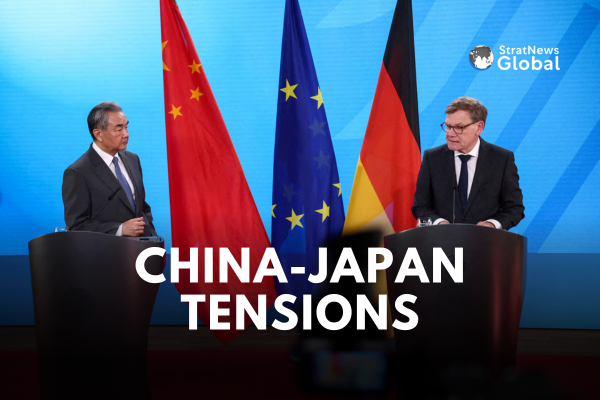
Meeting German Foreign Minister Johann Wadephul in Beijing on Monday, Wang Yi invoked wartime history, reminding Japan that this year marks the 80th anniversary of the end of World War Two. He said Japan, “as a defeated nation,” should act with greater restraint.
“Yet now, its current leader is trying to exploit the Taiwan question the very territory Japan colonised for half a century, committing countless crimes against the Chinese people to provoke trouble and threaten China militarily. This is completely unacceptable,” Wang said, according to China’s state-run Xinhua news agency.
He added that Japan’s leadership had made “reckless remarks” about hypothetical scenarios involving Taiwan, calling them a serious provocation. Wang reiterated China’s stance that Taiwan’s status as part of its territory had been “unequivocally and irreversibly affirmed by ironclad historical and legal facts.”
Competing Historical Claims
Japan ruled Taiwan from 1895 until the end of World War Two, when the island was handed to the Republic of China (ROC) government. The ROC later retreated to Taiwan in 1949 after losing the civil war to Mao Zedong’s Communist forces, who established the People’s Republic of China (PRC) on the mainland.
Taiwan’s government has repeatedly rejected Beijing’s claims, arguing that the PRC has never governed the island. “Only Taiwan’s democratically elected government can represent the 23 million people of Taiwan in the international community,” said Foreign Ministry spokesperson Hsiao Kuang-wei on Tuesday.
Beijing maintains that the PRC succeeded the ROC as the sole legal government of China and therefore “naturally enjoys sovereignty” over Taiwan.
Japan Reiterates Its Position
Asked about the radar incident, Japanese Chief Cabinet Secretary Minoru Kihara dismissed China’s explanation, calling the action “a dangerous act that goes beyond what is safe and necessary.” He declined to confirm reports that Beijing had failed to respond via a bilateral hotline established in 2018 for crisis communication.
Kihara added that Japan would “continue to monitor China’s military movements calmly but firmly,” emphasising that safeguarding regional stability remained Tokyo’s top priority.
The latest diplomatic clash adds to a string of confrontations between the two Asian powers over Taiwan, maritime boundaries and historical grievances, raising fears of further tensions in the East China Sea.
(with inputs from Reuters)