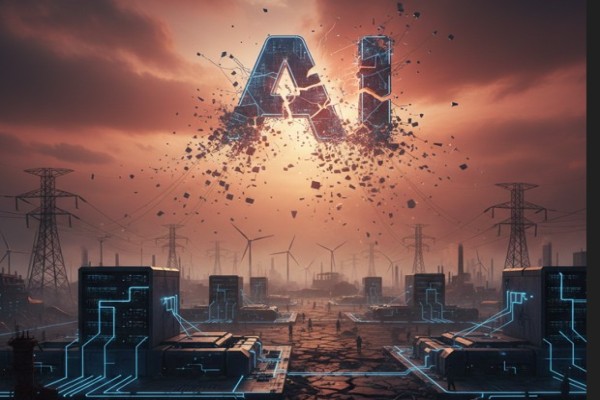
The dizzying rise in AI investment may be laying the groundwork for a severe economic and social reckoning.
That stark warning comes from an article in the December edition of the Bulletin of the Atomic Scientists titled When it all comes crashing down: The aftermath of the AI boom.
The author, New York-based science and tech journalist Jeremy Hsu notes that since the public unveiling of ChatGPT in late 2022, a wave of generative-AI enthusiasm has propelled a massive investment spree — from data centres crammed with chips to vast new infrastructure drawing power as large as whole cities.
Silicon Valley and its backers effectively placed a trillion-dollar bet that current AI can reshape the global economy or eventually yield systems surpassing human capabilities. Yet, the author argues, “marketing hype” has vastly overrated what today’s AI systems can realistically deliver, fuelling what increasingly looks like an AI bubble.
The scale of resources being committed is staggering: annual tech-industry spending on AI chips and data centres has been estimated between US$72 billion and US$125 billion , and private investment continues unabated.
That kind of commitment cannot be sustained infinitely. As the article emphasises, warnings have already begun to surface — from economists pointing out that AI spending has propped up a stock market and buoyed a fragile U.S. economy, to concerns that this surge will be deeply destabilising if and when the bubble bursts.
One major concern is that much of the AI investment is being funnelled into energy-hungry infrastructure that might become “stranded assets”, or facilities built on the promise of rising returns that might never materialise.
Economists quoted in The Bulletin also note that by focusing so heavily on AI, entire swathes of other industries have been starved of investment. As one put it: “We have foregone development in so many industries as we shove food into a mouth that’s already so full.”
Viewed in historical context, this echoes earlier cycles in AI’s troubled past. Previous “AI winters” — periods of disillusionment, defunding and consolidation — emerged when lofty expectations collapsed under the weight of technical and economic reality.
Yet today’s scenario may differ in scale and complexity. The current boom isn’t just about research labs or academic interest—it is now deeply embedded in global finance, energy infrastructure, private credit markets, and major corporate balance sheets.
This raises uncomfortable questions. When valuations collapse, will losses be confined to venture capital firms and tech insiders—or will they ripple out into broader economic disruption, affecting pensions, jobs, and public-facing services? The article implies the latter, suggesting that the societal cost may be wide.
There is also the risk that this frenzy suppresses productive investment in other critical sectors — manufacturing, small business, public infrastructure — locking in a distorted economy overly dependent on speculative tech.
All of this means that the legacy of the AI boom may not be the arrival of super-intelligent machines, but a global dislocation: expensive, underutilised infrastructure, wasted capital, resource-starved industries. With social costs borne by workers, communities and ordinary taxpayers.
That, the author warns, is the real fallout we must begin to prepare for.

In a career spanning three decades and counting, Ramananda (Ram to his friends) has been the foreign editor of The Telegraph, Outlook Magazine and the New Indian Express. He helped set up rediff.com’s editorial operations in San Jose and New York, helmed sify.com, and was the founder editor of India.com.
His work has featured in national and international publications like the Al Jazeera Centre for Studies, Global Times and Ashahi Shimbun. But his one constant over all these years, he says, has been the attempt to understand rising India’s place in the world.
He can rustle up a mean salad, his oil-less pepper chicken is to die for, and all it takes is some beer and rhythm and blues to rock his soul.
Talk to him about foreign and strategic affairs, media, South Asia, China, and of course India.