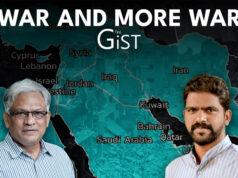
Former Indian Foreign Secretary Vijay Gokhale delivers a stark warning: the global order is no longer fraying—it has collapsed. In a sharply worded assessment of the escalating crisis around Iran, he argues that the rules that once governed international conduct—sovereignty, restraint, negotiation—have effectively been abandoned, leaving a volatile vacuum where power alone dictates outcomes.
According to Gokhale, two pillars once sustained global stability: international law and multilateral institutions. Today, both lie in disrepair. The United Nations is “barely audible,” its Security Council paralysed, while major powers—from the United States to Russia and China—selectively ignore the very rules they helped shape. The result is not a transition, but a breakdown: “There is no such thing as a global order anymore,” he suggests.
The immediate trigger may be tensions involving Iran, but the implications are far wider—and deeply unsettling for India. Gokhale describes a world drifting into prolonged instability, where no power is willing—or able—to enforce order. Washington, he argues, has become the principal disruptor, wielding economic coercion and military force with little regard for predictability. Beijing, meanwhile, is unwilling to shoulder global responsibilities, despite benefiting from the old system.
For India, this presents both danger and opportunity. Gokhale is blunt: New Delhi is not yet a true pole in global power politics. It must recognise its limitations while leveraging its strengths—geography, political stability, and economic potential. Crucially, he warns against over-reliance on the United States, urging a recalibration towards diversified partnerships, including renewed engagement with Russia and a more stable, if cautious, relationship with China.
On the regional front, the fallout from an Iran-centred conflict could be transformative. Gokhale outlines three emerging trends: a dominant yet insecure Israel, a fractured Gulf, and the rise of competing power blocs involving Turkey, Saudi Arabia, Egypt, and Pakistan. For India—with millions of citizens, energy flows, and investments tied to the Gulf—this is not abstract geopolitics but immediate risk.
His conclusion is as sobering as it is urgent: India must prepare for a harsher, less predictable world. That means hard economic reforms, stronger military capability, and above all, diplomatic agility. But it also requires something governments have long avoided—bringing the public into the conversation on difficult trade-offs, especially with China.
In a world without rules, Gokhale’s message is clear: survival will depend not on idealism, but on realism—and the ability to adapt faster than the chaos unfolds.