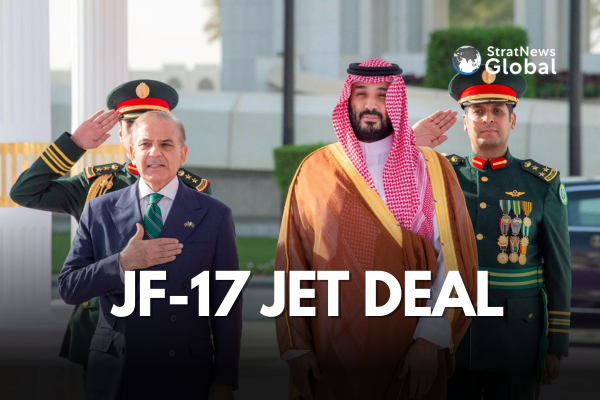
Pakistan and Saudi Arabia are negotiating the conversion of around $2 billion in Saudi loans into a defence deal involving JF-17 fighter jets, two Pakistani sources told Reuters. The discussions mark a significant deepening of military cooperation between the two allies, following the signing of a mutual defence pact last year.
The talks highlight growing strategic alignment between Islamabad and Riyadh at a time when Pakistan faces severe financial challenges and Saudi Arabia is diversifying its defence partnerships amid uncertainty over U.S. commitments in the Middle East. The defence agreement, signed in September after Israeli strikes in Doha heightened regional tensions, commits both nations to mutual defence in the event of aggression against either.
Expanding Defence Ties and Loan Conversion Details
One source said negotiations currently centre on the provision of JF-17 Thunder fighter jets a light combat aircraft co-developed by Pakistan and China and produced domestically. The second source confirmed that the JF-17s are the primary focus among several options being considered.
The first source valued the deal at approximately $4 billion, with an additional $2 billion allocated for equipment beyond the loan conversion. Both sources, with close military ties, requested anonymity because they were not authorised to discuss the matter publicly.
Neither Pakistan’s military nor its finance and defence ministries have commented on the negotiations. Saudi Arabia’s government media office has also not responded.
Pakistan’s Air Chief Zaheer Ahmed Baber Sidhu visited Saudi Arabia this week to discuss “bilateral defence cooperation, regional security, and future collaboration avenues” with his counterpart, Lieutenant General Turki bin Bander bin Abdulaziz, according to a statement from Pakistan’s armed forces.
JF-17’s Growing Market and Combat Record
Retired Air Marshal Aamir Masood said Pakistan is either in discussions with or has finalised agreements with six countries for defence exports, including JF-17 jets and associated systems. Saudi Arabia is among them, though Masood did not confirm the specifics of ongoing talks.
He noted that the JF-17’s appeal has risen because it is combat-tested and cost-effective. “It has been used in actual combat,” he said, referring to its deployment during clashes with India in May last year, which saw the most intense fighting between the neighbours in decades.
Pakistan has long supplied military expertise and personnel to Saudi Arabia, including training and advisory roles. Riyadh, in turn, has provided crucial financial assistance to Islamabad, especially during periods of economic distress.
Long-Standing Financial Partnership
Saudi Arabia’s financial support has been pivotal for Pakistan over the years. In 2018, Riyadh announced a $6 billion package comprising a $3 billion central bank deposit and $3 billion worth of oil supplies on deferred payment. The kingdom has repeatedly rolled over these deposits, including a $1.2 billion extension last year, helping Pakistan maintain foreign reserves amid ongoing balance-of-payments pressures.
Expanding Arms Export Strategy
Pakistan has intensified efforts to expand its defence exports and leverage its domestic arms industry for economic gains. In December, Islamabad signed a weapons deal worth more than $4 billion with Libya’s eastern-based Libyan National Army, one of the country’s largest-ever arms sales, including JF-17 fighter jets and training aircraft.
Pakistan has also held talks with Bangladesh about potential JF-17 purchases, reflecting a broader push to expand arms sales beyond South Asia and the Middle East.
Defence Minister Khawaja Asif recently said the country’s growing weapons industry could reshape its economic prospects. “Our aircraft have been tested, and we are receiving so many orders that Pakistan may not need the International Monetary Fund in six months,” he told broadcaster Geo News on Tuesday.
Pakistan is currently operating under a $7 billion IMF programme its 24th after securing a short-term $3 billion package in 2023 that helped avert default, supported by deposit rollovers from Saudi Arabia and other Gulf allies.
with inputs from Reuters