Operation Sagar Bandhu entered its second week on Monday as India continued providing humanitarian assistance to Sri Lanka following Cyclone Ditwah, one of the most severe natural disasters to strike the island in recent decades.
Launched on 28 November, the mission has made India the first and largest responder, delivering emergency aid by sea and air in coordination with Sri Lankan authorities. The initiative is part of India’s Neighbourhood First policy and Vision MAHASAGAR framework for rapid regional support.
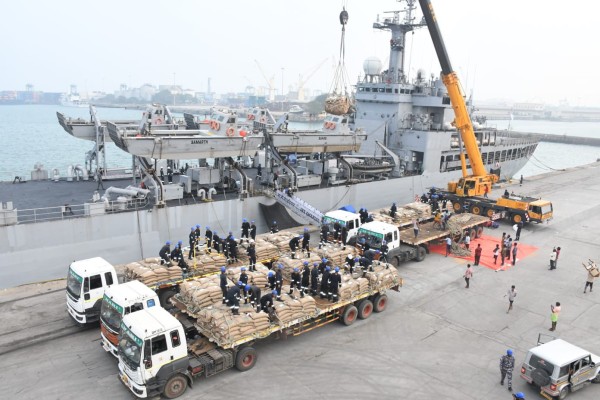
Sri Lankan leaders have publicly acknowledged the response, calling it “swift”, “sustained”, and critical during a period of national emergency. In Trincomalee, where INS Gharial delivered 700 tonnes of food, clothing, and essentials from Tamil Nadu, Sri Lanka’s Deputy Foreign Minister Arun Hemachandra received the supplies and thanked India for its support.
“I express my sincere gratitude to the people and the Government of India, especially under the guidance of Prime Minister Narendra Modi,” Hemachandra said. “Operation Sagar Bandhu is operating at full pace, and we deeply appreciate the technical support, relief supplies, and immediate assistance.”
Sri Lankan officials said the cyclone has resulted in over 627 deaths, affected 2.18 million people, and caused widespread destruction across multiple districts, including Badulla, Puttalam, Colombo and Gampaha, with significant damage to religious sites and cultural infrastructure.
Relief supplies have been continuously delivered since the operation began. Within the first three days, 53 tonnes of relief material reached Sri Lanka. INS Vikrant and INS Udayagiri transported 9.5 tonnes of rations on the first day, while Indian Air Force aircraft including C-130J, IL-76 and C-17 sorties carried tents, medical kits, hygiene supplies and an entire field hospital.
Indian Navy vessels including INS L51, L54, L57, INS Sukanya and INS Gharial have transported close to 1,000 tonnes of dry rations provided by the Tamil Nadu government.
India also deployed rescue teams after the cyclone. Two NDRF Urban Search and Rescue units, including a K9 team, arrived in Colombo within 24 hours and have assisted over 450 people. Helicopters from INS Vikrant and the Indian Air Force have supported evacuations and transported personnel and supplies to isolated communities.
Medical support remains a key part of the operation. The Indian Army Field Hospital in Badulla district has treated 3,388 patients and continues to provide trauma care, surgeries and critical medical assistance. Mobile BHISHM trauma units have also been deployed and training has been provided to Sri Lankan medical teams.
Engineering teams are working to restore damaged transport routes. Four modular Bailey Bridge systems were flown into the country on IAF C-17 aircraft, and work is ongoing to install one of them on the A35 road in Kilinochchi, a crucial supply route.
Both governments have agreed that Indian support will continue as relief and early recovery efforts progress. Officials said engineering, medical and logistics deployments will remain active “as long as Sri Lanka requires them.”