When warships from China, Russia, Iran and South Africa assembled off the South African coast this month for a major naval exercise, one absence stood out. India, a founding member of BRICS and a major Indian Ocean power, chose not to participate, despite being formally invited by the host nation.
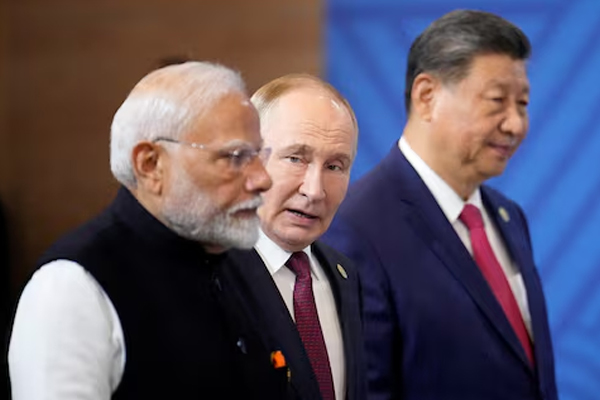
The decision comes in a year when India holds the BRICS chair and is preparing to host the leaders’ summit later in 2026, with Chinese President Xi Jinping and Russian President Vladimir Putin expected to attend. Officials say New Delhi is keen to keep the focus of its presidency on development, reform of global institutions and economic cooperation, rather than military signalling.
According to officials and analysts, New Delhi deliberately stayed away from the exercise, titled “Will for Peace 2026”, to avoid being drawn into a military configuration that increasingly features countries locked in confrontation with the United States and its allies, and, more importantly, to keep defence engagement with China tightly contained.
Brazil, another founding member, also declined to send naval assets, limiting its role to that of an observer. While Brasilia has not publicly detailed its reasoning, diplomats say the choice reflects discomfort with the growing military overtones surrounding an organisation originally conceived as an economic and development-focused grouping.
Inside ‘Will for Peace 2026’
The week-long naval drill, hosted by South Africa and operationally led by China, began near Simon’s Town, a strategically significant port close to the junction of the Indian and Atlantic Oceans.
Participating navies conducted a range of activities including search-and-rescue operations; maritime strike simulations; and communication and interoperability drills.
China deployed a guided missile destroyer and a replenishment vessel. Russia sent a corvette backed by a naval tanker. South Africa contributed a frigate, while the United Arab Emirates quietly dispatched a corvette whose presence was confirmed through independent maritime tracking rather than official imagery.
Initially, Iran sent ships linked to both its regular navy and the Islamic Revolutionary Guard Corps. However, Pretoria requested Iran to scale back its role: to observer status.
South Africa framed the exercise as a response to growing threats to global maritime trade and sea lanes. Defence officials insisted the drill was professional, not political.
Yet the timing placed Pretoria in a delicate position. Relations with the United States have been under pressure due to:
- ongoing trade disputes and tariff threats
- South Africa’s case against Israel at the International Court of Justice
- Washington’s growing suspicion of BRICS as a geopolitical counterweight
Domestically, South Africa’s participation has drawn criticism from within its own governing coalition.
India’s Choice
For India, the calculation was different, and sharper. Despite recent diplomatic engagements with China, including high-level meetings on multilateral sidelines, defence cooperation remains tightly restricted. Military ties have not returned to pre-2020 levels following the Galwan Valley clashes, and New Delhi has consistently signalled that political trust must precede deeper security engagement.
Analysts say participation in a China-led naval drill, alongside Russia and Iran would have sent the wrong signal at a time when India is managing a complex relationship with Washington, facing trade pressure from the US, and expanding maritime cooperation with Western and Gulf partners elsewhere.
“BRICS was never designed as a military platform,” said Harsh Pant of the Observer Research Foundation. “India is cautious about any activity that could blur that distinction or reposition the grouping in a way that affects its strategic autonomy.”
BRICS Unity, With Limits
While the exercise projected coordination among some BRICS and “BRICS Plus” members, the reality remains uneven. Deep political differences persist, not just between India and China, but also among newer members such as Iran, Egypt and the UAE.
The drills underscored a broader truth: BRICS can align on economic reform and development finance far more easily than on hard security issues.
“Will for Peace 2026” was presented as a technical naval exercise. As global rivalries sharpen, the exercise served as a reminder that BRICS may be expanding, but unity within the bloc still has clear boundaries.