

Support us by contributing to StratNewsGlobal on the following UPI ID
ultramodern@hdfcbank

Strategic affairs is our game, South Asia and beyond our playground. Put together by an experienced team led by Nitin A. Gokhale. Our focus is on strategic affairs, foreign policy and international relations, with higher quality reportage, analysis and commentary with new tie-ups across the South Asian region.
You can support our endeavours. Visit us at www.stratnewsglobal.com and follow us on YouTube, Twitter, Facebook and Instagram.
र 500 per month
र 1000 per month
र 5000 per year
र 10000 per year
Donate an amount of your choice
र 500 per month
Donate र 500 per month

र 1000 per month
Donate र 1000 per month
र 5000 per year
Donate र 5,000 per year
र 10000 per year
Donate र 10,000 per year
Donate an amount of your choice
Donate an amount of your choice
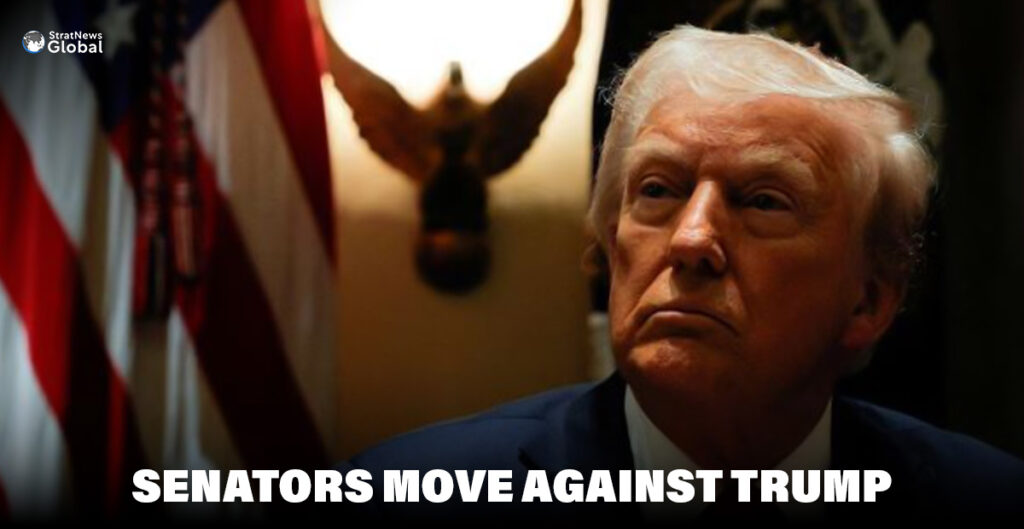




U.S. Senators Move To Prevent Trump From Military Action In Venezuela
Democratic and Republican senators on Friday introduced a resolution to block any U.S. military action against Venezuela without congressional approval, aiming to curb President Donald Trump’s increasing pressure on President Nicolás Maduro’s government.
Senator Tim Kaine of Virginia, who is sponsoring the war powers resolution with fellow Democrat Adam Schiff of California and Republican Senator Rand Paul of Kentucky, said he was responding to the repeated U.S. strikes on boats off Venezuela.
There have been at least five such strikes, which the Trump administration says are part of a campaign against drug traffickers. They have killed at least 27 people.
Kaine noted the U.S. constitutional requirement that only Congress, not the president, authorizes war, except for short-term strikes.
The Trump administration’s campaign in the southern Caribbean has lasted for weeks. Trump has also dangled the possibility of land attacks against Venezuela. And he disclosed on Wednesday that he authorized the Central Intelligence Agency to conduct covert operations in Venezuela.
“It’s clear there’s no congressional authorization for this action,” Kaine told reporters.
The strikes have led some legal experts to question whether the U.S. is violating international law. Colombia, which has condemned the strikes, said one of the vessels was Colombian with Colombian citizens aboard. The Trump administration called that assertion “baseless.”
The surprise announcement on Thursday that the admiral who heads U.S. military forces in Latin America will step down at the end of the year added to questions about the campaign.
Venezuela has asked the United Nations Security Council to determine that the strikes are illegal, according to a letter seen by Reuters on Thursday.
‘Narcoterrorists’
The Trump administration argues it is fighting Venezuelan narcoterrorists, making the strikes legitimate.
Members of the U.S. Congress from both parties have complained they have received scant information, such as who was killed, evidence of trafficking, the buildup’s cost or the administration’s long-term Latin American strategy.
“It’s a complete black hole,” Kaine said.
He also said the administration has not explained why it needed to blow up the vessels, killing everyone on board, rather than intercepting them. Trump on Wednesday said interdicting drug boats was “politically correct” and had not stopped the drug trade.
The Senate blocked a similar resolution last week by a narrow 51-48 vote, mostly along party lines, with two Republicans backing the resolution and one Democrat opposing it. Trump’s fellow Republicans said the president was merely keeping a campaign promise to attack drug cartels.
Kaine said he hoped the new resolution, to bar military action against or within Venezuela without congressional approval, would garner a few more Republican votes.
“The military is not to be used just so we can kill anyone we want anywhere in the world, as long as the president has put them on a secret list,” Kaine said.
“I may be optimistic on this, but I think that there will be a point where more (Republicans) will say, ‘Hold on a second,'” he added.
(With inputs from Reuters)
Japan Protests Russia’s Ban On Foreign Ship Passage
Japan has lodged a strong protest with Russia after Moscow reportedly banned foreign ships from exercising the right of ‘innocent passage’ near disputed islands in the Far East.
The islands, known in Japan as the Northern Territories and in Russia as the Southern Kurils, have remained a constant source of friction between the two nations, standing in the way of a formal peace treaty since the end of World War II.
The dispute dates back to when Soviet forces seized four islands—Etorofu, Kunashiri, Shikotan, and Habomai—that had been administered by Japan. While Moscow maintains the transfer was legitimised under postwar agreements, Tokyo continues to assert that the islands were illegally occupied.
According to Japan’s Sankei Shimbun, Russia’s suspension took effect Monday, barring foreign naval and government vessels ships not registered in Russia from passing through waters surrounding the southern Kuril Islands.
The ban also extends to parts of the sea east of Hokkaido, Japan’s northernmost island.
Tokyo called the measure “unacceptable,” arguing it violates the spirit of international maritime law. The protest was lodged through diplomatic channels, Japan’s Foreign Ministry confirmed.
The ‘innocent passage’ under the United Nations Convention on the Law of the Sea (UNCLOS), which extends up to 13.8 miles (22.3 km) from the coastline, allows all vessels to transit through territorial waters as long as it does not threaten the coastal state’s peace or security.
Russia has cited scheduled firing exercises near Shikotan Island from October 10 to November 1 as justification. The drills coincide with Japan’s own nationwide defence exercises, a move seen by some analysts as a deliberate show of strength amid heightened tensions in the region.
The move also adds strain to a relationship already frozen by the war in Ukraine and Tokyo’s alignment with Western sanctions. Since 2022, Russia has suspended peace treaty talks with Japan.
According to the report, Russia has previously conducted military exercises around the southern Kuril Islands in April, June, July, and August. Japan protested, describing Russia’s latest actions as “incompatible” with its stance on the islands.
As tensions rise, Japan’s challenge will be balancing its U.S.-aligned security posture with the need to prevent the Kuril issue from becoming a flashpoint in an increasingly militarised Pacific.
Portugal: Parliament Passes Bill To Ban Face Veils
Portugal’s parliament on Friday approved a controversial bill, proposed by the far-right Chega party, to ban face veils worn for “gender or religious motives” in most public spaces — a move that effectively targets burqas and niqabs traditionally worn by Muslim women.
Under the bill, proposed fines for wearing face veils in public would range from 200 to 4,000 euros, while anyone found guilty of forcing another person to wear a face veil could face prison sentences of up to three years, according to the draft legislation.
Exemptions In Certain Places
Face veils would still be allowed in aeroplanes, diplomatic premises and places of worship.
If signed into law, the bill would place Portugal alongside several European countries — including France, Austria, Belgium, and the Netherlands — that already enforce full or partial bans on face veils. However, President Marcelo Rebelo de Sousa still has the option to veto the bill or refer it to the Constitutional Court for a constitutional review.
During Friday’s parliamentary session, Chega leader Andre Ventura was confronted by several female lawmakers from left-wing parties who opposed the bill, but it passed with support from the centre-right coalition.
‘Protecting’ Females
“We are today protecting female members of parliament, your daughters, our daughters, from having to use burqas in this country one day,” Ventura said.
Andreia Neto, a lawmaker from the ruling Social Democratic Party, said before the vote: “This is a debate on equality between men and women. No woman should be forced to veil her face.”
Polarising Issue
Only a small minority of Muslim women in Europe cover their faces, and in Portugal such veils are very rare.
But full-face coverings such as niqabs and burqas have become a polarising issue across Europe, with some arguing that they symbolise gender discrimination or can represent a security threat and should be outlawed.
(With inputs from Reuters)
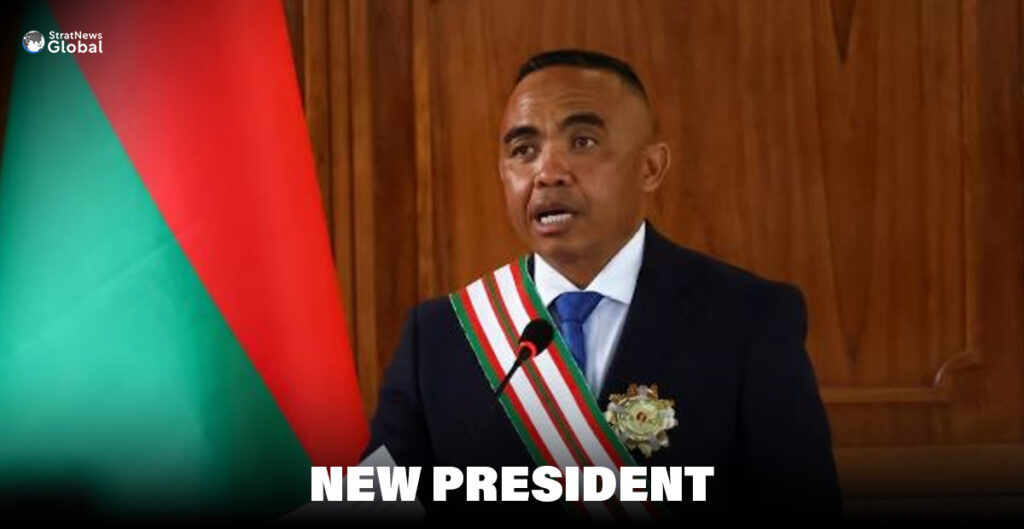
Randrianirina Takes Oath As Madagascar’s New President After Ousting Predecessor
Colonel Michael Randrianirina, who seized power in a coup, was sworn in as Madagascar’s president on Friday amid cheers, trumpet fanfare, and raised swords, days after youth-led protests toppled his predecessor.
Ex-leader Andry Rajoelina, whom lawmakers impeached after he fled abroad at the weekend, has condemned the takeover and refused to step down while in exile, despite widespread defections in the security forces and the High Constitutional Court ratifying the army takeover within hours of it happening.
The African Union and the United Nations Secretary-General Antonio Guterres have condemned the coup, which came after weeks of “Gen Z” protests initially triggered by severe, chronic power and water shortages.
“I will fully, completely, and justly fulfil the high responsibilities of my position as President of the Republic of Madagascar,” Randrianirina said in a ceremony at the High Constitutional Court, a colonial-era red-brick building of French windows, segmental arches and stone balustrades.
“I swear that I will exercise the power entrusted to me and dedicate all my strength to defending and strengthening national unity and human rights,” he added, before military officers raised swords and blew trumpets to mark the handover.
Military Led Committee To Rule
Randrianirina has said that a committee led by the military will rule for up to two years alongside a transitional government before organising new elections, although analysts doubt this can be guaranteed.
“Whether the military returns power depends less on words and more on binding safeguards, incentives and oversight,” Ketakandriana Rafitoson, Malagasy researcher and Vice Chair of Transparency International, said from Washington.
“Commitments such as ‘We will hand over in two years’ are weak if unaccompanied by mechanisms that limit the junta’s capacity to entrench itself”.
While many of the youths cheered the demise of Rajoelina, who came to office in a 2009 coup, some are already expressing misgivings about the swiftness with which the army stepped in.
Even Gen Z protesters who turned up to celebrate the new military leader’s inauguration, some wearing the trademark T-shirt depicting a skull with a straw hat from the Japanese manga series “One Piece”, did not consider their work done.
“Not yet,” 18-year-old student Mioty Andrianambinintsoa said outside the court, as dignitaries draped in the red, green and white of the Malagasy flag walked past her to waiting jeeps. “This is a stage. Our aims haven’t been achieved.”
Asked what those aims were, fellow protester Francko Ramananvarivo, 23, said: “Our objective is to be led by a government that is close to the people. We are not there yet.”
Elite Army Unit
Randrianirina is a commander in the elite CAPSAT army unit that played a role in the 2009 coup that brought Rajoelina to power, although he was not involved in that putsch himself. He broke ranks with the president during the protests, urging soldiers not to fire on protesters and offering to protect them.
Underlying Madagascar’s periodic upheavals is a young population – the average age is under 20 – and some of the world’s worst poverty, which blights the lives of three-quarters of its roughly 30 million people.
Despite exports of prized commodities such as vanilla, nickel, sapphires and the white pigment ilmenite, the Indian Ocean island’s average income is barely $600 a year, while prices of basic goods such as the staple rice have spiralled.
Between its independence in 1960 and 2020, GDP per capita plunged by nearly half, according to the World Bank, making it one of the few nations to have become worse off over that period.
(With inputs from Reuters)
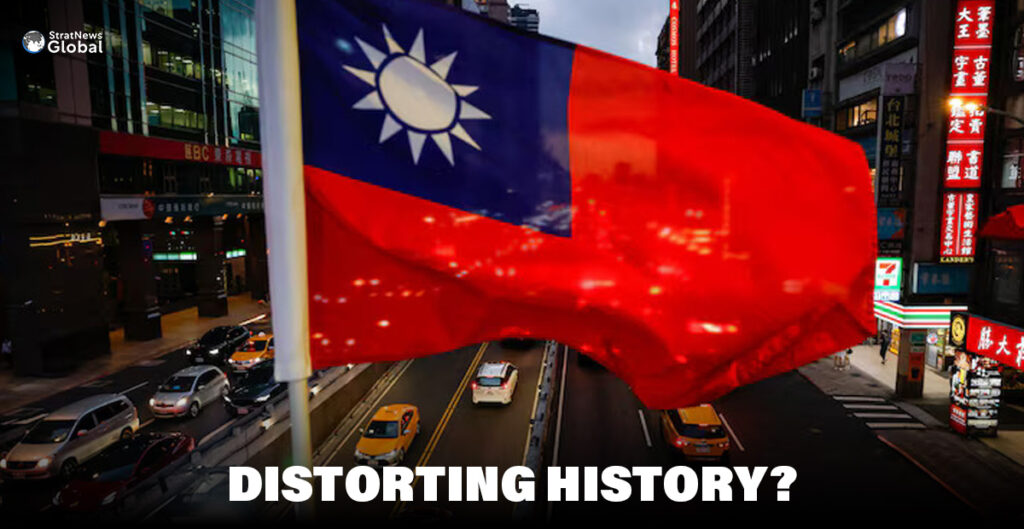
Taiwan Bans Officials From China’s Retrocession Anniversary Events
Taiwan on Friday said its officials have been barred from attending China’s events next week marking 80 years since the island’s “retrocession” to Chinese rule, accusing Beijing of twisting historical facts to serve its political agenda.
Next Saturday marks the anniversary of Japan, which colonised Taiwan in 1895, handing the island to the Republic of China government in 1945. Both Taipei and Beijing refer to the handover as the “retrocession”.
China and democratically-governed Taiwan, which Beijing views as its own territory, have repeatedly clashed this year over their differing interpretations of the 80th anniversary of the end of World War Two.
Different Accounts
Taiwan says it was the Republic of China that fought the war, not the People’s Republic of China, which was founded by Mao Zedong’s communists in 1949 after they won the civil war. The Republic of China government fled to Taipei and the Republic of China remains Taiwan’s formal name.
In a video statement, Chiu Chui-cheng, head of Taiwan’s China-policy making Mainland Affairs Council, said Beijing had repeatedly fabricated “false narratives”.
In events related to the “retrocession”, Beijing has sought to “concoct the claim that Taiwan is part of the People’s Republic of China.
“The ultimate goal is to eliminate the Republic of China and annex Taiwan.”
Putting ‘National Interest First’
The government has banned Taiwanese officials, students and teachers from attending any events China may hold around the anniversary, and calls on all others to “put the national interest first” and also not take part, he said.
China, whose Taiwan Affairs Office did not immediately respond to a request for comment, has not yet announced what it might do on or around the anniversary.
On Wednesday, a spokesperson for the office told reporters in Beijing that the “retrocession” was an important outcome of the end of World War Two and a great triumph for all Chinese people, including those in Taiwan.
China marked last month’s anniversary of the end of World War Two with a massive military parade.
Taipei next Saturday will host East Asia’s largest Pride march, a riotous celebration of LGBTQ+ equality and diversity.
(With inputs from Reuters)
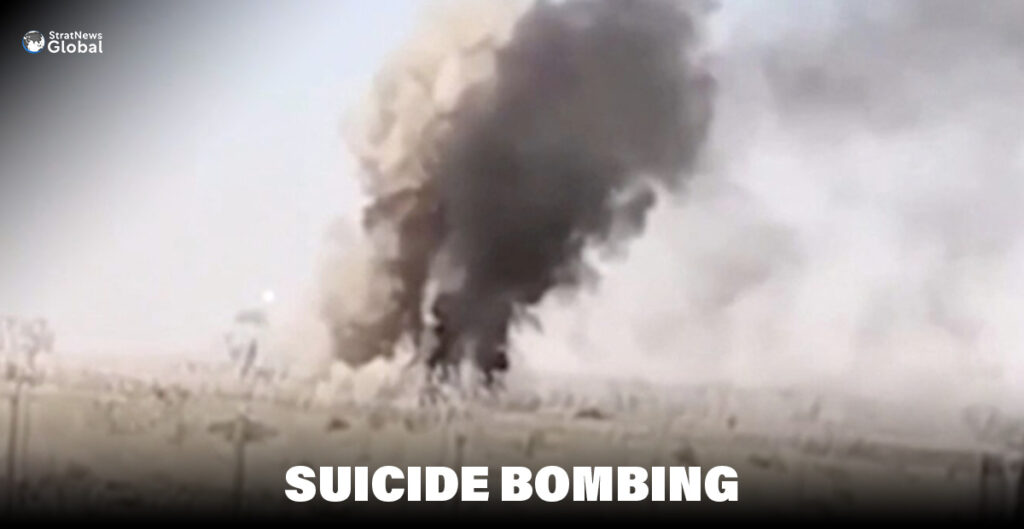
At Least 7 Pakistani Soldiers Killed In Suicide Attack Near Afghan Border
At least seven Pakistani soldiers were killed in a suicide bombing near the Afghan border on Friday, security officials said, as a temporary truce halting days of fierce cross-border clashes expired with no sign of renewal.
The South Asian neighbours engaged in fierce ground fighting, and Pakistan also launched airstrikes across their contested frontier, killing dozens and wounding hundreds, before they reached a 48-hour truce that ended at 1300 GMT on Friday.
The seven soldiers were killed in an attack by militants on a Pakistani military camp in north Waziristan, which also left 13 injured, five security officials said.
While one militant rammed an explosive-laden vehicle into the boundary wall of a fort that served as a military camp, two others tried to get into the facility and were shot dead, they said.
Pakistan Acted After ‘Losing Patience With Kabul’
Six militants were killed in the suicide attack, the office of Pakistani Prime Minister Shehbaz Sharif said in a statement, without providing details on the number of soldiers killed.
Pakistan’s army did not respond to a request for comment.
The identity of the attackers was not known, and no group has claimed responsibility.
Militant violence in Pakistan has been a major irritant in its relationship with the Afghan Taliban, which returned to power in Kabul after the departure of U.S.-led forces in 2021.
The latest conflict between the two countries was triggered after Islamabad demanded that Kabul rein in militants who had stepped up attacks in Pakistan, saying they operated from havens in Afghanistan.
Sharif said on Thursday that Pakistan “retaliated” as it lost patience with Afghanistan following a series of militant attacks, but was ready to hold talks to resolve the conflict.
The Taliban denies the charge and accuses the Pakistani military of spreading misinformation about Afghanistan, provoking border tensions, and sheltering ISIS-linked militants to undermine its stability and sovereignty.
Islamabad denies the accusations.
On Friday, the Pakistan Red Crescent said Afghanistan had handed over to it the bodies of seven Pakistanis – two security personnel and five civilians – who were killed during clashes earlier in the week.
Although the Islamic nations have clashed in the past, the fighting this month is their worst in decades. It has drawn the attention of Saudi Arabia and Qatar, who have mediated and sought to stop the fighting.
U.S. President Donald Trump has said he can help resolve the conflict.
(With inputs from Reuters)
Zelenskyy To Press Trump For Arms In The Shadow Of New Putin Summit
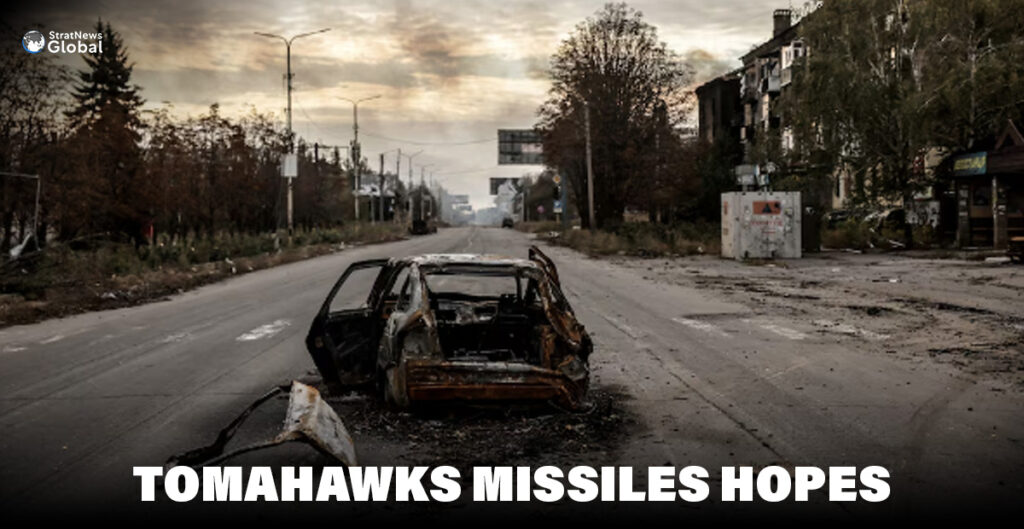
U.S. President Donald Trump is set to discuss the potential supply of long-range Tomahawk missiles to Ukraine with President Volodymyr Zelenskyy on Friday, though the unexpected announcement of a new U.S.-Russia summit has cast doubt on the plan.
Trump said on Thursday he may meet Russian President Vladimir Putin within the next two weeks in Budapest after a more than two-hour phone conversation about Russia’s war in Ukraine that he said was productive.
“My whole life, I’ve made deals,” Trump told reporters at the White House. “I think we’re going to have this one done, hopefully soon.” He said he would brief Zelenskyy on the Russia talks in the Oval Office on Friday.
Trump’s conciliatory tone after the call with Putin raised questions over the near-term likelihood of assistance to Ukraine and reignited European fears of a deal that suits Moscow.
The Kremlin confirmed the summit plan but said much needed to be decided and that it might take place “a little later”.
War Has Intensified
The U.S. president, who has campaigned for the Nobel Peace Prize, is eager to add to the list of conflicts he says he has been instrumental in ending.
More than three and a half years after its full-scale invasion of Ukraine, Russia has ground out some territorial gains this year, but Ukraine’s top military commander, Oleksandr Syrskyi, said on Thursday that the Russian offensive had failed.
Putin earlier this month said his forces had taken almost 5,000 square kilometres (1,930 square miles) of land in Ukraine in 2025 – equivalent to adding 1% of Ukraine’s territory to the nearly 20% already held.
Both sides have also escalated attacks on each other’s energy systems, and Russian drones and jets have strayed into NATO countries.
The White House had seemed in recent days to be increasingly frustrated with Putin and leaning toward granting Zelenskyy fresh support, including the Tomahawk missiles that Ukrainians say would help them inflict more damage to Russia’s war machine.
“We need them, too,” Trump said of the missiles on Thursday in his remarks to reporters after his call with Putin.
Zelenskyy, who has had an up-and-down relationship with Trump, said Putin, who pressed ahead with assaults on Ukraine after meeting with Trump in Alaska in August, was again playing for time.
“We can already see that Moscow is rushing to resume dialogue as soon as it hears about Tomahawks,” he wrote on X.
Ukrainians held out little hope for Zelenskyy’s talks with Trump. “We have already gone through this, and we have not seen any tangible results,” said Olena Puchilo, 54, a social worker from Mykolaiv, adding that there was still room for ‘miracles’.
Analysts See Talks As A Delaying Tactic
Putin’s move was meant to make the U.S. transfer of such weapons less likely, said Max Bergmann, a Russia expert at the Centre for Strategic and International Studies.
“It does seem that Putin’s outreach is perhaps designed to thwart the potential transfer of Tomahawks to Ukraine, so Putin is wanting to put that back in the box,” Bergmann said. “It strikes me as sort of a stalling tactic.”
Mykola Bielieskov, a senior analyst at Come Back Alive, a Ukrainian non-governmental organisation that is a major procurer of military equipment for the Ukrainian armed forces, said Tomahawk missiles would level a playing field that is tipped toward Russia, but that they would not be a silver bullet.
“We don’t expect Russia to crumble after one, two or three successful strikes,” Bielieskov said. “But it’s about pressure, constant pressure. It’s about disrupting the military-industrial complex.”
Since taking office in January, Trump has regularly threatened action against Russia, only to delay those steps after talks with Putin.
“The chances of moving toward a ceasefire by pushing Russia to get serious seem to have diminished,” said Dan Fried, a former State Department official.
During Thursday’s call, Putin told Trump that supplying long-range missiles to Ukraine would harm the peace process and damage U.S.-Russia ties, Kremlin aide Yuri Ushakov told reporters. Trump confirmed Putin had opposed such a transfer.
“What do you think he’s going to say, ‘Please sell Tomahawks?'” Trump joked with reporters. “No, he doesn’t want” Tomahawks given to Ukraine, Trump added, calling them a “vicious weapon”.
(With inputs from Reuters)
From West Of Nepal To East Of Ladakh, We Guard A Large Frontier: Central Army Commander Exclusive
Central Army Commander Exclusive Interview
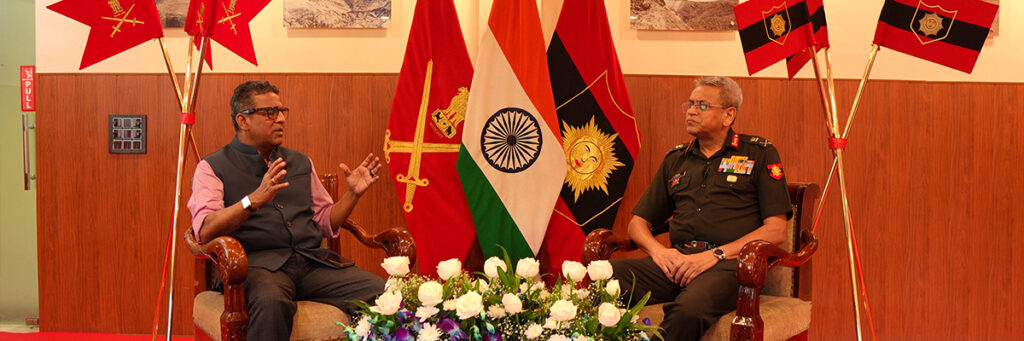
The Indian Army Central Command, also known as Surya Command is headquartered in Lucknow. It guards a less focused but strategically important stretch of the Line of Actual Control (LAC) along China occupied Tibet. It also handles several historical and civilisation pilgrimage centres including the Char dhams (four holy places).
It’s a Himalayan region with as many as 26 high passes. But, this sector is not the centre of attention in border tension between India and China. For those who, perhaps, are unaware, China’s first known transgression across the disputed border happened at Barahoti . located in this sector in the 1950s.
Middle Sector Along LAC
Currently the Indian Army’s deployment is sparse along this stretch (middle sector) of the LAC (when compared to the western and eastern sectors). But, the areas under Central Command have historical trade and civilisational linkages to Tibet.
Before India and China signed the 1954 Panchsheel agreement, trade routes from Lipulekh and Shipki La as well as the route to the Holy Mansarovar and Kailiash Parvat used to happen from this area. Of late, the Indian Army has started concentrating on building adequate infrastructure and military strength in what is known as the middle sector along the LAC. In this candid conversation with Editor-in-Chief Nitin A. Gokhale, Lt Gen Anindya Sengupta, the Central Army Commander, elaborates on the role of the Surya Command. And the progress and development it is involved in currently, in an attempt to make life easier for border residents as well as beefing up India’s defences.
This is the first episode in our series, ‘LAC Logs: Along Himachal’s Himalayan Heights’. The series will have comprehensive coverage in documentaries and conversations from our team of Amitabh P. Revi, Aryaman Singh Negi and Vashisht Mattoo, who filmed extensively along the LAC in Surya Command’s Area of Responsibility (AoR). Deepankar Verma provides the graphics and maps.
Vibrant Villages
While driving home the importance of border areas in this sector, Lt Gen Sengupta points to an advantage India has over China. “We do not have to create new villages to populate this area; we already have a resident population here”. It is extremely important that we help them grow further economically, empower them, he adds. The Army works in close coordination with the civil administration to decipher what the locals want. That is so that development of infrastructure and the local economy are attuned to their needs.
‘Israel Still Waiting on Hamas Promises’
She dismissed allegations that Israeli Prime Minister Benjamin Netanyahu prolonged the war for political survival. “This was not a political maneuver,” she said. “Israel was attacked and had to restore national security on all fronts — in Gaza, Lebanon, Syria, Iraq, and Yemen — amid Iranian-backed aggression.”
On the question of a two-state solution, Slama emphasized that any future political arrangement must begin with internal Palestinian reforms. “The Palestinian Authority is often seen as moderate, but it too supports terrorist activities. Reforms in Gaza and the West Bank are essential before any new framework can emerge,” she said.
Reconstruction of Gaza, she added, will likely involve “the U.S., European countries, and pragmatic Arab and Muslim states such as Saudi Arabia, Qatar, and the Gulf nations.” Slama warned, however, that Hamas remains active and is “trying to regain control by arresting, torturing, and executing opposition elements.”
Despite the challenges, she remains cautiously optimistic. “Hope and faith are vital in Judaism,” Slama said. “If this peace holds, it could pave the way for stability and prosperity across West Asia.”
Yen, Crypto Discussed as BRICS+ Trade Currency Options
Amid growing global debate on de-dollarisation, India has reiterated that the BRICS grouping was not formed to compete with other nations but to cooperate with other economies. This comes even as U.S. President Donald Trump continues to attack BRICS for its alleged push away from the dollar.
The expanded BRICS+ bloc now accounts for over 50% of global economic growth and nearly 40% of the world’s GDP, underscoring its growing influence in shaping a new international order. Yet, debt sustainability remains a key concern amid tariffs, trade barriers, and market volatility.
At an event titled “BRICS+ and the Global South: Shaping a New Architecture of Cooperation” hosted by Chintan Research Foundation, South Africa’s Acting High Commissioner Cedrick Crowley said, “Many African countries have borrowed in U.S. dollars or euros, subjecting them to a significant risk where their own currency fluctuates and depreciates. Hence, we hope to find acceptable mechanisms of financing in local currencies.”
Speaking to StratNewsGlobal, Purushendra Singh, Associate Director of CUTS International, said BRICS+ members were exploring ways to diversify trade settlements using a range of currencies. “To address such issues, BRICS+ countries are looking at diversifying currency exchange in some of the local currencies—namely from China, Russia, India and even Indonesia,” Singh said. However, some other peculiar additions to the list were—Petro yuan, cryptocurrency and even the weakening ‘yen’.
Singh added that while BRICS aims to strengthen South-South and Global South cooperation, “it also wants to focus on North-South and enhance trilateral cooperation. The African continent is a huge part of this, and so the Japan-India-Africa trilateral also has a role to play. The yen has also been used in the UN system for trade, and Japan has provided aid to Africa as well. This makes yen a potential currency for inter-BRICS trade transactions, despite Japan not formally part of BRICS+, but could be in future.”
He said discussions on the inclusion of digital currencies, blockchain technology and cryptocurrencies as possible dollar alternatives are ongoing.
Other initiatives are already in motion. The BRICS Pay system, launched at the 2024 Kazan Summit, provides an alternative mechanism for cross-border transactions in non-dollar currencies.
Looking ahead to India’s BRICS chairship next year, Sudhakar Dalela, Secretary (Economic Relations) at the Ministry of External Affairs, said reforming multilateral development banks and pushing for equitable trade rules will remain key priorities. “India will also focus on mutual investments, resilient and reliable supply chains, urgent resolution of conflicts that are impacting food, fertiliser and energy security, the protection of global commons, and a collaborative leveraging of technology for development,” Dalela said.
He added that the role of the New Development Bank as a source of sustainable finance will be central, alongside India’s continued focus on climate sustainability and strengthened partnerships.
Singh further noted that “joint cooperation on critical and emerging technology, dialogue on regulatory governance issues and joint shipping arrangements in a larger blue economy arrangement will also be in focus.” The blue economy—covering ocean-related commercial activity—contributes around 4% to India’s GDP.
According to Mongabay India, 95% of India’s trade moves by sea, and about 2.8 crore people are employed in fisheries, aquaculture and related sectors. Discussions on maritime trade under BRICS could therefore have significant long-term implications.
“Knowledge economy” and “tech-induced growth” will also be key drivers for the Global South’s strategic autonomy, as per the panel discussion. “A rules-based and inclusive BRICS+ ecosystem can serve as a stabilising force amid growing geopolitical fragmentation,” added former BRICS Sherpa Ambassador Sanjay Bhattacharya.