

Support us by contributing to StratNewsGlobal on the following UPI ID
ultramodern@hdfcbank

Strategic affairs is our game, South Asia and beyond our playground. Put together by an experienced team led by Nitin A. Gokhale. Our focus is on strategic affairs, foreign policy and international relations, with higher quality reportage, analysis and commentary with new tie-ups across the South Asian region.
You can support our endeavours. Visit us at www.stratnewsglobal.com and follow us on YouTube, Twitter, Facebook and Instagram.
र 500 per month
र 1000 per month
र 5000 per year
र 10000 per year
Donate an amount of your choice
र 500 per month
Donate र 500 per month

र 1000 per month
Donate र 1000 per month
र 5000 per year
Donate र 5,000 per year
र 10000 per year
Donate र 10,000 per year
Donate an amount of your choice
Donate an amount of your choice




Trump Reiterates Modi’s Assurance To Halt Russian Oil, Warns Of Tariffs
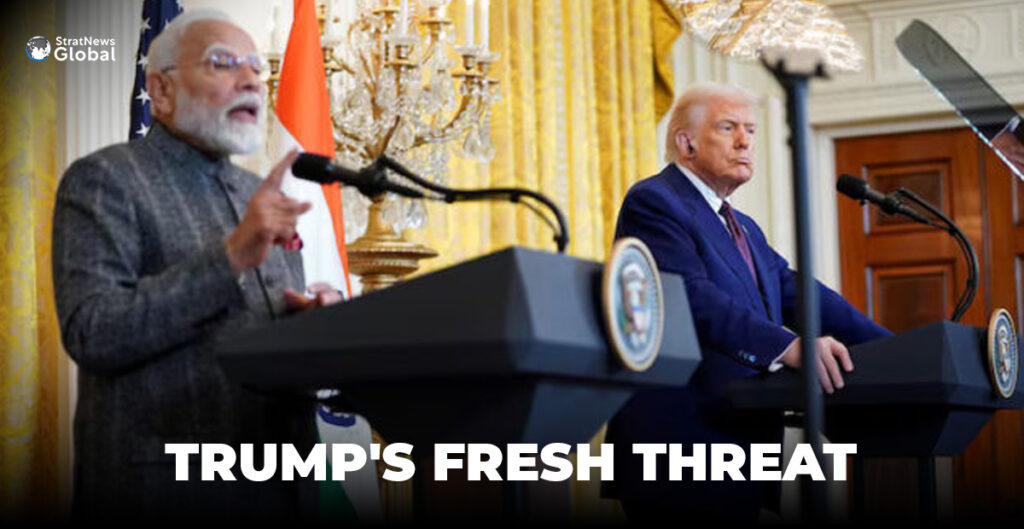
On Sunday, US President Donald Trump once again said that Prime Minister Narendra Modi assured him India would halt buying Russian oil, but warned that New Delhi would face ‘massive’ tariffs if it didn’t.
“I spoke with Prime Minister Modi of India, and he said he’s not going to be doing the Russian oil thing,” Trump told reporters aboard Air Force One.
Asked about India’s assertion that it was not aware of any conversation between Modi and Trump, Trump replied: “But if they want to say that, then they’ll just continue to pay massive tariffs, and they don’t want to do that.”
Russian Oil: A Deciding Factor
Russian oil has been one of the main irritants for Trump in prolonged trade talks with India – half of his 50% tariffs on Indian goods are in retaliation for those purchases. The US government has said petroleum revenue funds Russia’s war in Ukraine.
India has become the biggest buyer of seaborne Russian oil sold at a discount after Western nations shunned purchases and imposed sanctions on Moscow for its 2022 invasion of Ukraine.
Trump on Wednesday said Modi had assured him that day that India would stop its Russian oil purchases. India’s foreign ministry said it was not aware of any telephone conversation between the leaders that day, but said that New Delhi’s main concern was to “safeguard the interests of the Indian consumer”.
Cuts Not Immediate Despite US Claims
A White House official said on Thursday that India has halved its purchases of Russian oil, but Indian sources said no immediate reduction had been seen.
The sources said Indian refiners already placed orders for November loading, including some slated for December arrival, so any cut may start showing up in December or January import numbers.
India’s imports of Russian oil are set to rise about 20% this month to 1.9 million barrels per day, according to estimates from commodities data firm Kpler, as Russia ramps up exports after Ukrainian drones hit its refineries.
(With inputs from Reuters)
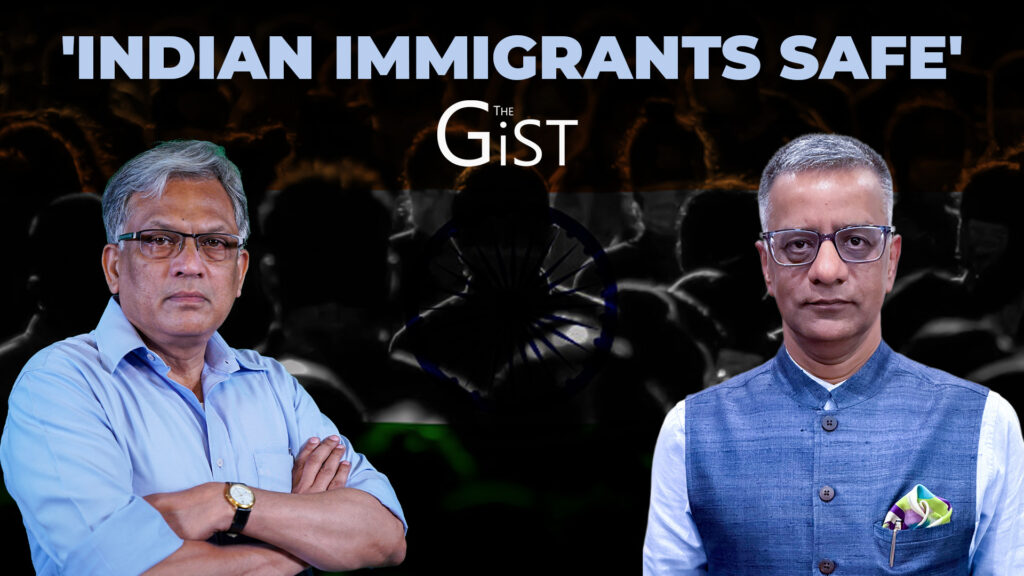
Anti-Immigration Rallies Not Anti-Indian: Gopal Baglay, India’s Envoy To Australia
“The rallies against migration … were not specifically anti any country. They were not specifically anti India,” said Gopal Baglay, India’s high commissioner to Australia during an interview on The Gist.
“A particular political comment linking Indian diaspora to a particular type of political proclivity, that and anti-India overtone to the whole discourse about migration and anti migration … after that, it appeared as if the whole thing is against India.”
He confirmed that across the political spectrum, leaders had denounced the tone and tenor of some of the rallies.
“You would have seen the the statements by the prime minister, by the foreign minister, by the leader of opposition, and they have recently attended community events like the Deepavali organized in Sydney.”
He said the Australian public at large welcomed migrants because “Australia is built like that”, and whatever concerns the Indian diaspora may have, are being shared with the authorities.
On Defence Minister Rajnath Singh’s first visit to Canberra recently, Ambassador Baglay pointed to convergences, “convergence of of a shared values, convergence of a very strategic objectives, the way we look at the world as two diverse democracies which believe in a rule based international order, which believe in free and open Indo-Pacific.”
“There are multiple exercises, bilateral and multilateral. The objective of all this is to, is twofold interoperability and to leverage the synergies, available for us in each other’s capabilities in each of those regions. We had offered, Australia, for example, MRO facilities for their ships, which are deployed into Indian Ocean.”
An MoU was signed on submarine rescue, another on air to air refuelling with both sides stepping up participation in joint exercises, from Talisman Sabre and Pitch Black to drills in India with the aim of building interoperability and enhance trust.
He said there was convergence on the Quad, on the need for both sides to work together to ensure a free and open Indo-Pacific and a rules-based order.
Tune in for more in this conversation with Gopal Baglay,India’s high commissioner to Australia.
Coalition Talks Advance As Takaichi Nears Japan’s Premiership
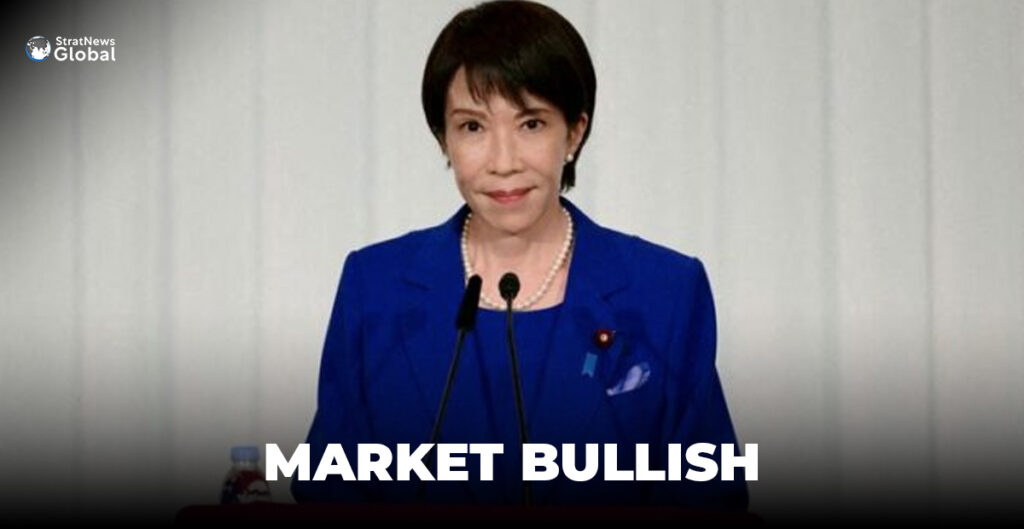
On Monday, hopes rose that hardline conservative Sanae Takaichi could become Japan’s first female prime minister, as support from the right-wing opposition Japan Innovation Party, or Ishin, helped lift Tokyo stocks to a record high.
Ishin lawmakers are set to meet at 2 p.m. (0500 GMT) to discuss forming a coalition with the ruling Liberal Democratic Party (LDP), followed by talks between Takaichi and Ishin leaders Fumitake Fujita and Osaka Governor Hirofumi Yoshimura, where the alliance is expected to be finalised.
Japanese media reported that the parties had agreed to an alliance behind closed doors but an official announcement would follow the meeting.
“The relationship of trust is deepening substantially, and I believe that’s what the other party is thinking,” Fujita said on Sunday after senior party officials met.
Japan’s blue-chip Nikkei share index jumped more than 2% in early trading.
New Partners
A cooperation agreement would deliver a combined 231 seats in parliament’s dominant lower house. It would fall two short of a majority, but ensure Takaichi likely wins a vote in parliament tomorrow to pick Japan’s next prime minister. She will only need a majority of ballots cast rather than of all members in any runoff vote.
To govern, however, she will still need to court the support of other opposition groups, including for an upcoming supplementary budget.
The expected deal with Ishin follows the collapse of the LDP’s 26-year coalition with Komeito, which ended its alliance after the ruling party picked Takaichi as its new leader.
Komeito’s abrupt withdrawal triggered talks among opposition parties, including the second largest Ishin, that could have derailed her premiership ambitions and thrown her party out of power for the first time in more than a decade. Ishin’s decision to side with the LDP ends that possibility.
Fiscal Dove, Security Hawk
Takaichi, a fiscal dove, has called for higher spending and tax cuts to cushion consumers from rising inflation and has criticized the Bank of Japan’s decision to raise interest rates.
“Expectations for Takaichi’s economic policies, which include fiscal expansion and monetary easing, appear to be facilitating rising share prices and a weaker yen,” said Nomura Securities strategist Fumika Shimizu.
Some analysts say Ishin, which advocates for small government and spending cuts, could restrain some of Takaichi’s spending ambitions.
Takaichi wants to revise Japan’s pacifist postwar constitution to recognize the role of its military. A regular visitor to the Yasukuni war shrine in Tokyo, viewed by some Asian neighbours as a symbol of wartime aggression, she wants higher defence spending to deter neighbouring China.
She has also called for stricter immigration rules and opposes social policies, such as allowing women to retain their surnames after marriage, which she says undermine traditional values.
(With inputs from Reuters)
Trump Labels Petro A Drug Leader, Colombia Hits Back
In a sharp escalation on Sunday, US President Donald Trump labelled Colombian President Gustavo Petro an “illegal drug leader” and announced a halt to payments to the country, even as Defence Secretary Pete Hegseth confirmed that American forces had targeted a vessel linked to a Colombian rebel group.
Trump’s comments marked a new low in relations between Bogota and Washington, which have frayed since Trump returned to office in January and since his administration launched a series of strikes on vessels allegedly transporting drugs in the Caribbean.
The US president said on social media that the United States would stop large-scale payments and subsidies to Colombia and Republican Senator Lindsey Graham, a close ally, said Trump will soon announce “major tariffs” on the country.
Colombia currently pays 10% tariffs on most imports to the United States, the baseline level Trump has imposed on many countries.
Hegseth wrote on X that the Pentagon had destroyed a vessel and killed three people on Friday “in the USSOUTHCOM area of responsibility,” which includes the Caribbean.
He said the ship was affiliated with the leftist rebel group National Liberation Army and was involved in illicit narcotics smuggling, without offering evidence to back the claim.
The Pentagon said it had nothing to add beyond Hegseth’s initial post.
Colombia Condemns Trump’s Remarks
“President Gustavo Petro, of Colombia, is an illegal drug leader strongly encouraging the massive production of drugs, in big and small fields, all over Colombia,” Trump wrote on Truth Social.
“The purpose of this drug production is the sale of massive amounts of product into the United States, causing death, destruction, and havoc,” Trump wrote.
Reuters could not immediately establish which payments Trump was referring to. Colombia was once among the largest recipients of US aid in the Western Hemisphere, but the flow of money was suddenly curtailed this year by the shuttering of USAID, the US government’s humanitarian assistance arm.
Colombia’s Foreign Ministry condemned Trump’s remarks as offensive and a direct threat to its sovereignty, and vowed to seek international support in defence of Petro and the country’s autonomy.
“These accusations represent an extremely serious act and undermine the dignity of the president of Colombians,” it said in a statement.
The US State Department referred questions to the White House, which did not immediately respond to a query.
Fraught Relations
Last month the United States revoked Petro’s visa after he joined a pro-Palestinian demonstration in New York and urged US soldiers to disobey Trump’s orders.
The US administration’s deadly strikes on boats in the Caribbean have also outraged Colombians. Many legal experts and human rights activists have condemned the extraordinary series of military actions, with Amnesty International describing it as murder on the high seas.
Earlier this month, Petro said one of the strikes hit a Colombian vessel, an allegation the Trump administration denied.
Petro condemned the most recent bombing, saying the boat belonged to a “humble family”, not the National Liberation Army. He also hit back at Trump’s remarks.
“Mr. Trump, Colombia has never been rude to the United States… but you are rude and ignorant to Colombia,” Petro responded on X. “Since I am not a businessman, I am even less a drug trafficker. There is no greed in my heart.”
Colombia is fighting its own longstanding drug problems. Last year, Petro pledged to tame coca-growing regions in the country with massive social and military intervention, but the strategy has brought little success.
In September, Trump designated countries such as Afghanistan, Bolivia, Burma, Colombia and Venezuela among those the United States believes to have “failed demonstrably” in upholding counternarcotics agreements during the past year.
(With inputs from Reuters)
Xi Jinping Congratulates Taiwan Opposition Head, Calls For Reunification
On Sunday, Chinese President Xi Jinping congratulated the newly elected leader of Taiwan’s main opposition party, urging steps towards “reunification” — a message that came even as Beijing faced allegations of meddling in the election process.
Former lawmaker Cheng Li-wun, who will take over as leader of the Kuomintang (KMT) party on November 1, won Saturday’s election at a time of rising tension with Beijing, which views the democratically governed island as its own territory. Taiwan’s government strongly objects to China’s sovereignty claims.
The KMT traditionally backs close relations with China and is Beijing’s preferred dialogue partner. China refuses to talk to Taiwan President Lai Ching-te and his Democratic Progressive Party (DPP) administration, calling him a “separatist”.
‘Common Political Foundation’
Xi, in a message in his role as head of China’s Communist Party, told Cheng the two parties should strengthen their “common political foundation”, the official Xinhua news agency reported.
Both parties should also “unite the vast majority of people in Taiwan to deepen exchanges and cooperation, boost common development, and advance national reunification,” he added.
Cheng, in her message to Xi, did not make any mention of union with Beijing, but said both sides of the Taiwan Strait were “members of the Chinese nation”, using an expression in Chinese that refers to ethnicity rather than nationality.
“Both parties should, in light of the current situation, strengthen cross-Strait exchanges and cooperation on the existing foundation (and) promote peace and stability across the Taiwan Strait,” Cheng said, according to a party statement.
Accusations Of Chinese Interference
While the KMT lost the presidential election last year, the party and its ally, the small Taiwan People’s Party, together hold the most seats in parliament.
Cheng, 55, opposes Taiwan increasing defence spending, a key policy plank of Lai’s, and won the leadership vote over the KMT establishment candidate, former Taipei mayor Hau Lung-bin.
Accusations of Chinese interference in the election by a key supporter of Hau’s, the KMT’s vice presidential candidate last year, Jaw Shau-kong, overshadowed the campaign. Jaw said social media accounts had spread disinformation about Hau.
China said on Wednesday that the election was a KMT matter, and that online comments did not represent an official stance.
Writing on his Facebook account on Sunday, Jaw said the KMT must reduce pro-China influence and that the majority of Taiwanese desire peaceful relations and dialogue with China.
“The KMT must recognise that elections are held in Taiwan, and voters are in Taiwan, not mainland China,” Jaw added.
Late on Saturday, DPP spokesperson Justin Wu said there were clear signs of Chinese interference in the KMT election.
His comments were dismissed by the KMT, which responded with a statement saying: “Who is this?”
(With inputs from Reuters)
Bolivia’s Centrist Paz Ends Nearly 20 Years Of MAS Rule
On Sunday, centrist Rodrigo Paz won Bolivia’s presidential runoff, beating conservative Jorge “Tuto” Quiroga, as the country’s worst economic crisis in decades ended almost two decades of leftist rule.
Paz, a senator from the Christian Democratic Party, won 54.6% of the vote, ahead of Quiroga’s 45.4%, according to early results from Bolivia’s electoral tribunal. But Paz’s party did not win a majority, forcing him to forge alliances to govern effectively.
The new president takes office on November 8.
The 58-year-old senator’s win marks a historic shift for the South American country, governed almost continuously since 2006 by Bolivia’s Movement to Socialism, or MAS, which once enjoyed overwhelming support from the country’s Indigenous majority.
Paz’s moderate platform — pledging to maintain social programs while promoting private sector-led growth — appeared to resonate with left-leaning voters disillusioned by the ruling MAS, founded by former President Evo Morales, but wary of Quiroga’s proposed austerity measures.
Support for MAS cratered in the August first round amid a deepening economic crisis.
‘Political Turning Point’
“This election marks a political turning point,” said Glaeldys Gonzalez Calanche, analyst for the Southern Andes at International Crisis Group. “Bolivia is heading in a new direction,” she said.
Outside a polling station in La Paz, Lourdes Mendoza said she had grown weary of the MAS era. “My children were born and raised with a single government,” she said, “I hope they can see other possibilities and alternatives.”
Bolivia’s fragile economy dominated the runoff campaign. Once plentiful natural gas exports have plummeted, inflation is at a 40-year high, and fuel is scarce.
Voters Want Economic Change
Both candidates campaigned to roll back elements of the MAS era, state-led model, but differed over how drastically. Paz favored gradual reform, including tax incentives for small businesses and regional fiscal autonomy, while Quiroga proposed sweeping cuts and an IMF bailout.
“We’re going for a new stage of Bolivian democracy in the 21st century,” Paz told Reuters two days before the election at his family’s ranch in the southern gas-producing region of Tarija.
“We’re going to try to build an economy for the people,” he said, one where “the state is no longer going to be the central axis.”
Like his opponent, Paz has pledged to improve diplomatic ties with Western countries, including the United States, after years where Bolivia had aligned itself with Russia and China.
Voters like businesswoman Marcela Martinez, 52, who cast her ballot for Paz on Sunday said she supported his plans to open up the economy to investment. “We’re totally cut off from the outside world, ” said Martinez.
Other voters said they were not convinced that his victory represented a true break from MAS: “I think he’s a puppet of the outgoing government,” said 21-year-old Esther Miranda from La Paz, who works in a nail salon.
“I just hope we get a president who’s more decent, someone who helps people,” Miranda said.
Running Mate’s Populist Appeal Boosts Paz
Paz’s campaign was boosted by his running mate Edman Lara, a former police officer known for viral TikTok videos exposing corruption. Lara’s populist appeal helped Paz connect with younger and working-class voters, analysts said.
Economists warn the incoming administration faces immediate challenges, including securing fuel supplies and building coalitions in a fragmented legislature.
Outgoing hydrocarbons minister Alejandro Gallardo said last week that the state energy company was struggling to obtain foreign currency for fuel imports.
Paz told Reuters he was already addressing the issue through deferred payment agreements with fuel suppliers to ensure diesel and gasoline arrive within days of his inauguration.
Paz said he would also begin phasing out universal fuel subsidies. Targeted support would go to vulnerable groups, while bigger industries such as agribusiness would pay market rates for fuel.
“The market will have to adjust prices, but there are sectors that will have government support until the economy is reactivated,” he said.
Bolivia’s main labor union, the Central Obrera Boliviana (COB), has previously warned it would oppose any threats to the social and economic gains achieved so far, in a sign of the juggling act before Paz’s government to avoid street protests.
Paz’s PDC won 49 of 130 seats in the lower house and 16 of 36 in the Senate, just ahead of Quiroga’s coalition, which secured 43 seats in the lower house and 12 in the Senate.
(With inputs from Reuters)
Ceasefire Resumes After Israeli Soldiers Killed In Gaza Attack
The Israeli army said on Sunday that the ceasefire in Gaza is back in place, after a sudden attack killed two of its soldiers. In response, Israel carried out airstrikes, which Palestinian officials say killed 26 people. This has been the biggest test so far for the US-brokered truce that began earlier this month.
Aid into the enclave was set to resume on Monday following US pressure, an Israeli security source said, shortly after Israel announced a halt in supplies in response to what it said was a “blatant” violation by Hamas of the truce.
The Israeli military said it struck Hamas targets across the enclave, including field commanders, gunmen, a tunnel and weapons depots, after militants launched an anti-tank missile and fired on its troops, killing the soldiers.
The strikes killed at least 26 people, including at least one woman and one child, according to local residents and health authorities. At least one strike hit a former school sheltering displaced people in the area of Nuseirat, residents said.
Violation Of Ceasefire
US President Donald Trump’s envoy Steve Witkoff and son-in-law Jared Kushner were expected to travel to Israel on Monday, an Israeli official and a US official said.
The armed wing of Hamas said it remained committed to the ceasefire agreement, was unaware of clashes in Rafah, and had not been in contact with groups there since March.
US Vice President JD Vance did not mention the Israeli strikes when asked about Gaza by reporters on Sunday evening, but said there were about 40 different cells of Hamas and no security infrastructure yet in place to confirm their disarmament.
“Some of those cells will probably honor the ceasefire. Many of those cells, as we saw some evidence of today, will not,” he said.
“Before we actually can ensure that Hamas is properly disarmed, that’s going to require … some of these Gulf Arab states, to get forces in there, to actually apply some law and order and security keeping on the ground.”
Israeli Prime Minister Benjamin Netanyahu said he had ordered the military to respond forcefully to what he described as Hamas’ violations of the ceasefire.
Path To Peace Is Uncertain
Fearing the truce may collapse, some Palestinians rushed to buy goods from a main market in Nuseirat and families fled their homes in Khan Younis further south, after airstrikes hit nearby.
The strikes were reminiscent of Israel’s response to what it viewed as serious violations of its ceasefire with Hamas’ Lebanese ally Hezbollah in late 2024, less than a week after it came into effect and after days of mutual accusations of truce breaches, though that ceasefire has since largely held.
But formidable obstacles remain in the way of a durable peace in Gaza, where a ceasefire collapsed in March after nearly two months of relative calm when Israel unleashed a barrage of airstrikes.
Dispute Over Bodies Of Deceased Hostages
The new ceasefire took effect on October 10, halting two years of war, but the Israeli government and Hamas have been accusing each other of violations of the ceasefire for days.
Defence Minister Israel Katz said the “yellow line” to where Israeli forces had pulled back under the ceasefire agreement would be physically marked and that any violation of the ceasefire or attempt to cross the line would be met with fire.
Hamas detailed what it said was a series of violations by Israel that it says have left 46 people dead and stopped essential supplies from reaching the enclave.
On Saturday, Israel said the Rafah border crossing between Gaza and Egypt, which had been expected to be reopened this week, would remain closed and that its reopening would depend on Hamas fulfilling its obligations under the ceasefire.
Israel says Hamas is being too slow in handing over bodies of deceased hostages. Hamas last week released all 20 living hostages it had been holding and in the following days has handed over 12 of the 28 deceased captives.
More Aid Is Needed
The group says it has no interest in keeping the bodies of remaining hostages and that special equipment is needed to recover corpses buried under rubble.
The Rafah crossing has largely been shut since May 2024. The ceasefire deal also includes the ramping up of aid to Gaza, where hundreds of thousands of people were determined in August to be affected by famine, according to the IPC global hunger monitor.
The crossing has in previous ceasefires functioned as a key conduit for humanitarian aid to flow into the enclave.
Although the flow of aid through another crossing had, until Sunday’s decision to halt aid, increased significantly since the ceasefire began, the United Nations says far more is needed.
Key questions of Hamas disarming, future governance of Gaza, the make-up of an international “stabilization force”, and moves towards creation of a Palestinian state have yet to be resolved.
(With inputs from Reuters)
India For Credible, Inclusive Polls In Myanmar But The Junta Has Other Plans
The story seemed singularly unremarkable going by the headline: Mizoram: Two arrested, cache of explosives seized at Indo-Myanmar border village.
But there was nothing unremarkable as one read further. It was the seizure by the Assam Rifles two days back, of 5,800 gelignite rods used for blasting, 10,500 metres of cordtex or fuses and 6000 detonators. Adequate it would seem to start a small war.
The seizure was made at Vaphai, a small village in Mizoram near the border with civil war torn Myanmar. Police investigations are on, so at this point it remains unclear what it was intended for and by whom. But it came from Myanmar, that much seems certain.
It’s a pointer to the challenges India faces as the civil war deepens in that country, society fractures and armed groups proliferate. It could get even worse as the military junta plans to hold elections in the areas it controls.
“Post poll India will see a volatile country as resistance will harden against a government that has not changed,” warned scholars and diplomats. “Ethnic organisations have said they will deal with the elections appropriately, meaning they will not be held in areas under their control.”
India has called for “credible and inclusive elections”, although it’s quite clear the elections will be neither credible nor inclusive given the Myanmar army’s record. But Delhi probably hopes the elections may provide some daylight on the way forward.
India is also bracing for what will happen: as infiltration goes up India will need to strengthen border security. India will also need to expand and deepen its humanitarian outreach as the conflict intensifies.
The junta is nowhere close to winning the war, it has lost ground in many parts of the country as ethnic armed organisations press forward and consolidate their hold over territory the army has been driven out from.
Yet despite suffering battlefield reverses and total loss of credibility, the junta hangs on and is able to move forward on elections. It is expected to make full use of the two to three million refugees sheltering in army-controlled areas. Expect them to vote for the army backed candidates, they don’t have any choice.
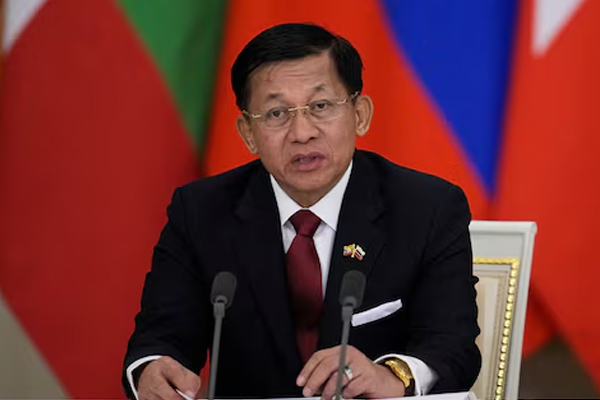
The process has been structured to ensure the army-backed USDP wins and a new leadership steps in, enabling junta chief Gen Min Aung Hlaing to exit after having brought ruin to his country.
The ethnic organisations apart from refusing to take part in the elections or allowing any voting in areas they control, lack unity of purpose. Numbering around 200, they are fragmented.
The NUG or National Unity Government comprising MPs and other elected members who were ousted in the wake of the 2021 military coup, is operating from jungle hideouts in Myanmar. The NUG had a huge advantage in the wake of the coup, given international support, and offices in many influential world capitals
But it has come under increasing criticism for corruption, for being divided internally and faulted for not being able to bring together the ethnic armed groups on a common platform. The Arakan Army, for instance, acknowledged as the most sophisticated and effective in its operations in Rakhine State, has worked largely to its own plan.
There’s also the National League for Democracy (NLD) which was running the country before the military threw them out. It has refused to register for the elections under the new laws laid down by the junta.
Aung San Suu Kyi, who was state councillor and foreign minister before the coup, is a formidable foe for the junta despite age and failing health, which is why she remains in their custody.
The outlook is bleak. The US has shown no interest in countering the junta, leaving the field open for China to exert its influence over ethnic groups like the Kachins and of course the junta. Russia is a major arms supplier to the generals. The elections are unlikely to bring stability and an end to the fighting.
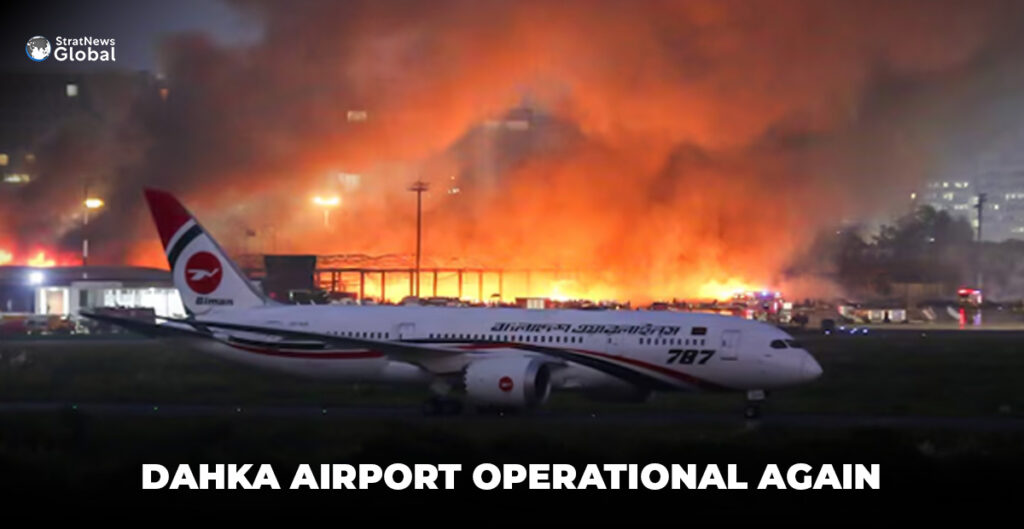
Flights Resume At Dhaka Airport After Fire Halts Operations For Six Hours
Flights resumed at Dhaka airport on Saturday, officials said, after a fire in the cargo section forced Bangladesh’s main international gateway to suspend operations for six hours.
The first flight departed at 9.06 p.m. (1506 GMT), officials told reporters.
The fire has been completely brought under control, the Ministry of Civil Aviation and Tourism said in a statement.
“Steps will be taken to identify the source of the fire and implement measures to prevent such incidents in the future,” the ministry added.
Operations at the Hazrat Shahjalal International Airport were suspended after the fire broke out in the cargo section of the airport, with around 37 firefighting units working to douse the flames.
The army, navy, and air force also joined the fire service in efforts to bring the blaze under control.
Kabir Ahmed, president of the International Air Express Association of Bangladesh, said it was too early to estimate the exact losses but that the overall impact – direct and indirect – on imports and exports could exceed $1 billion.
Both domestic and international flights were affected.
An IndiGo flight from Delhi to Dhaka was diverted to Kolkata, and an Air Arabia flight from Sharjah in the United Arab Emirates was directed to Chittagong, about 250 km (155 miles) southeast of Dhaka.
This is the third major fire reported in Bangladesh this week.
A fire on Tuesday at a garment factory and an adjacent chemical warehouse in Dhaka killed at least 16 people and injured others.
On Thursday, another fire burnt down a seven-storey garment factory building in an export processing zone in Chittagong.
The interim government said all recent fires across the country are under thorough investigation, with security forces working to protect lives and property.
It said any evidence of sabotage or arson would be met with a swift and decisive response and that no criminal act or provocation would be allowed to disrupt public life or the political process.
(With inputs from Reuters)
China Accuses U.S. Of Hacking National Time Centre
China has accused the U.S. of cyber breaches at its National Time Centre, alleging that American hackers stole sensitive data that could have disrupted communication networks, power grids, and financial systems.
The U.S. National Security Agency has been carrying out a cyber attack operation on the National Time Service Center over an extended period of time, China’s State Security Ministry said in a statement on its WeChat account on Sunday.
The ministry said it found evidence tracing stolen data and credentials as far back as 2022, which were used to spy on the staff’s mobile devices and network systems at the centre.
The U.S. intelligence agency had “exploited a vulnerability” in the messaging service of a foreign smartphone brand to access staff members’ devices in 2022, the ministry said, without naming the brand.
The national time centre is a research institute under the Chinese Academy of Sciences that generates, maintains and broadcasts China’s standard time.
The ministry’s investigation also found that the United States launched attacks on the centre’s internal network systems and attempted to attack the high-precision ground-based timing system in 2023 and 2024.
The U.S. embassy did not immediately respond to a request for comment.
China and the U.S. have increasingly traded accusations of cyberattacks in the past few years, each portraying the other as its primary cyber threat.
The latest accusations come amid renewed trade tensions over China’s expanded rare earth export controls and the U.S. threatening to further raise tariffs on Chinese goods.
(With inputs from Reuters)