

Support us by contributing to StratNewsGlobal on the following UPI ID
ultramodern@hdfcbank

Strategic affairs is our game, South Asia and beyond our playground. Put together by an experienced team led by Nitin A. Gokhale. Our focus is on strategic affairs, foreign policy and international relations, with higher quality reportage, analysis and commentary with new tie-ups across the South Asian region.
You can support our endeavours. Visit us at www.stratnewsglobal.com and follow us on YouTube, Twitter, Facebook and Instagram.
र 500 per month
र 1000 per month
र 5000 per year
र 10000 per year
Donate an amount of your choice
र 500 per month
Donate र 500 per month

र 1000 per month
Donate र 1000 per month
र 5000 per year
Donate र 5,000 per year
र 10000 per year
Donate र 10,000 per year
Donate an amount of your choice
Donate an amount of your choice
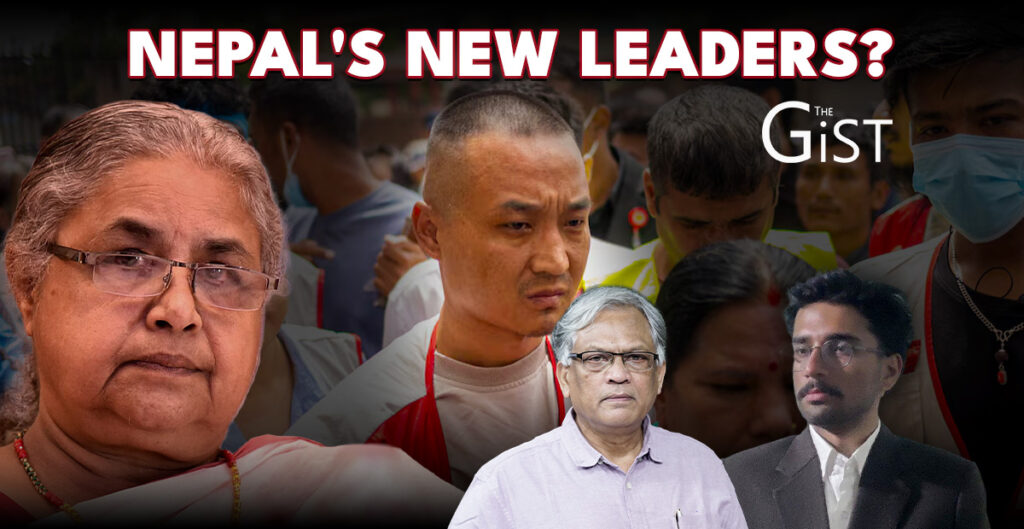

‘Nepal’s GenZ Movement Driven By Anger Over Political Graft, Nothing Anti-India’
Nepal’s GenZ movement last month that threw out the government of prime minister KP Sharma Oli, was driven entirely by issues like corruption or poor governance, unemployment, educational decay and the erosion of public trust in politics.
Speaking to SNG on The Gist, Pradeep Pande, a student activist who was involved in the protests said “The youth, educated, connected and intellectual, are deeply aware the realities of corrupt government. So what began as frustration, transformed into a peaceful civic movement demanding accountability, integrity and transparency.”
It was not funded, inspired from outside, he underscored. It was driven by unemployed and poor Nepalis, driven by frustration over the lack of accountability with which successive governments had functioned.
Pande said the students want to ensure morality and integrity in public life, people should be able to carry out their democratic responsibilities so that good and non corrupt leaders will represent them.
He made it clear that the students did not seek revenge and were not motivated by hatred. If the law and investigations proved that leaders like Oli and Nepali Congress chief Deuba were corrupt and took part in attacks on the student activists, (34 were killed in police firing), then they would be punished according to the law.
“We are getting good response from Nepali Congress. But lately the CPN-UML is not speaking out against their corrupt leaders now. And now we have got from many parties their youth leaders speaking out against their leaders.”
He pointed to corruption in the bureaucracy, noting that if good leaders are identified and selected, they will help cleanse the government system of corruption and graft.
“If the investigations prove their corruption, many others will go on trial,” Pande warned. “We demand the government bring Mr. Oli to trial for the order he gave to shoot our friends during the protest. Okay. That is the only charge against him so far. There are other many corruption cases that he can be charged with.”
Tune in for more in this conversation with Pradeep Pande, a student activist involved in Nepal’s GenZ protests.
Louvre Jewel Heist Suspects Detained Near Paris, Prosecutor Says
Suspects linked to the daring jewellery heist at the Louvre have been arrested, including one who was apprehended while preparing to leave France, the Paris prosecutor said on Sunday.
Two men in their 30s and originally from the capital’s Seine-Saint-Denis suburb – which includes some of the country’s most deprived areas – were detained on Saturday evening, according to Le Parisien newspaper, which first broke the story.
They were known to French police, and one of the suspects was about to fly to Algeria from Charles de Gaulle airport, the newspaper said.
There was no indication on Sunday that any of France’s stolen crown jewels had been recovered.
Prosecutor Angered By Leak
Paris prosecutor Laure Beccuau did not say how many people were arrested or give any more details about them. In a statement, she deplored the fact that information about their arrest was leaked.
“This revelation can only hinder the investigative efforts of the 100 or so mobilised investigators, both in the search for the stolen jewellery and for all the perpetrators. It is too early to provide any specific details,” Beccuau said.
Interior Minister Laurent Nunez, under public pressure to deliver results a week to the day after the robbery, congratulated investigators in a tweet, but gave no more details.
Four hooded thieves made off with eight precious pieces worth an estimated $102 million from the Louvre’s collection on October 19, exposing security lapses at the world’s most-visited museum.
They broke in using a crane to smash an upstairs window during opening hours and escaped on motorbikes.
News of the robbery reverberated around the world, prompting soul-searching in France over what some regarded as a national humiliation.
The stolen treasures included a tiara and an earring from the jewellery of Queen Marie-Amélie and Queen Hortense from the early 19th century.
The crown of Empress Eugenie, the wife of Napoleon III, was found damaged outside the museum. The thieves apparently dropped the piece, made of gold, emeralds and diamonds, as they made their getaway.
Built in the late 12th century, the Louvre Palace used to be the official residence of the kings of France until Louis XIV abandoned it for Versailles. It was turned into a museum for the royal art collection in 1793, four years after the French Revolution.
Its huge collection of masterpieces, including the Mona Lisa and the Venus de Milo statue, brought in 8.7 million visitors last year.
(With inputs from Reuters)
Israel Will Decide Which Foreign Forces Can Join Gaza Ceasefire Mission: Netanyahu
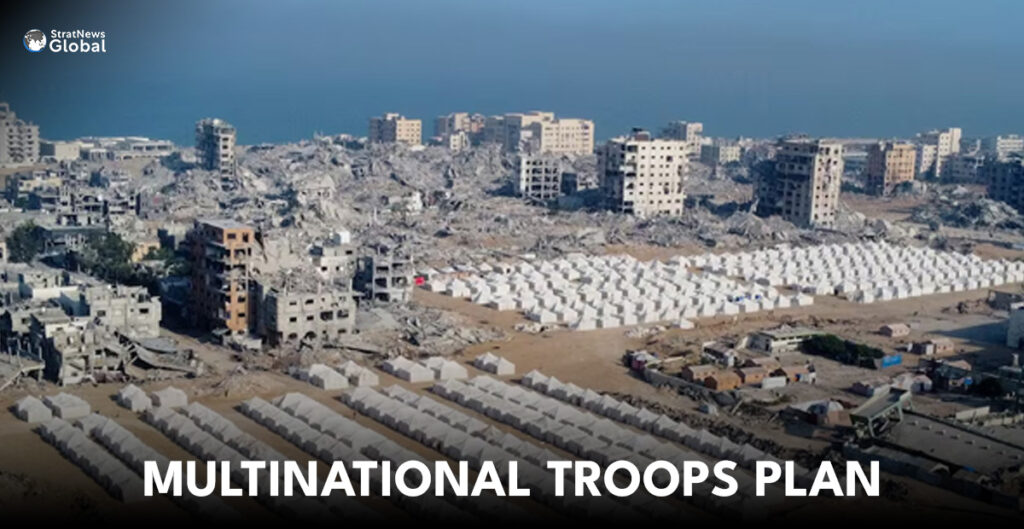
Prime Minister Benjamin Netanyahu said on Sunday that Israel will decide which foreign forces are permitted to participate in a planned international mission in Gaza aimed at securing a fragile ceasefire under U.S. President Donald Trump’s proposal.
It remains unclear whether Arab and other states will be ready to commit troops, in part given the refusal of Palestinian Hamas militants to disarm as called for by the plan, while Israel has voiced concerns about the make-up of the force.
While the Trump administration has ruled out sending U.S. soldiers into the Gaza Strip, it has been speaking to Indonesia, the United Arab Emirates, Egypt, Qatar, Turkiye and Azerbaijan to contribute to the multinational force.
“We are in control of our security, and we have also made it clear regarding international forces that Israel will determine which forces are unacceptable to us, and this is how we operate and will continue to operate,” Netanyahu said.
“This is, of course, acceptable to the United States as well, as its most senior representatives have expressed in recent days,” he told a session of his cabinet.
Israel, which besieged Gaza for two years to back up its air and ground war in the enclave against Hamas after the Palestinian militant group’s cross-border attack on October 7, 2023, continues to control all access to the territory.
Israel Opposed To Turkish Role In Gaza Force
Last week, Netanyahu hinted that he would be opposed to any role for Turkish security forces in Gaza. Once-warm Turkish-Israeli relations soured drastically during the Gaza war, with Turkish President Tayyip Erdogan lambasting Israel’s devastating air and ground campaign in the small Palestinian enclave.
U.S. Secretary of State Marco Rubio, on a visit to Israel aimed at shoring up the truce, said on Friday the international force would have to be made up of “countries that Israel’s comfortable with”. He made no comment on Turkish involvement.
Rubio added that Gaza’s future governance still needed to be worked out among Israel and partner nations, but could not include Hamas.
Rubio later said U.S. officials were receiving input on a possible U.N. resolution or international agreement to authorise the multinational force in Gaza and would discuss the issue in Qatar, a key Gulf mediator on Gaza, on Sunday.
A major challenge to Trump’s plan is that Hamas has baulked at disarming. Since the ceasefire took hold two weeks ago as the first stage of Trump’s 20-point plan, Hamas has waged a violent crackdown on clans that have tested its grip on power.
Israel Says Hamas Knows Where Hostage Remains Are
At the same time, the remains of 13 deceased hostages remain in Gaza, with Hamas citing obstacles to locating them in the pervasive rubble left by the fighting.
An Israeli government spokesperson said on Sunday that Hamas, which released the remaining 20 living hostages it took in its October 2023 assault, knew where the bodies were.
“Israel is aware that Hamas knows where our deceased hostages are, in fact, located. If Hamas made more of an effort, they would be able to retrieve the remains of our hostages,” the spokesperson said.
Israel had, however, allowed the entry of an Egyptian technical team to work with the Red Cross to locate the bodies. She said the team would use excavator machines and trucks for the search beyond the so-called yellow line in Gaza, behind which Israeli troops have initially pulled back under Trump’s plan.
Netanyahu began the cabinet session by stressing Israel was an independent country, rejecting the notion that “the American administration controls me and dictates Israel’s security policy.”
Israel and the U.S., he said, are a “partnership.”
Diplomats and analysts say Trump managed to push Netanyahu, who had long rejected global pressure for a ceasefire in Gaza, to accept his framework for a broader peace deal and also forced Netanyahu to call Qatar’s leader to apologise after a failed bombing raid targeting Hamas negotiators in that country.
Trump also persuaded Arab states to convince Hamas to return all the Israeli hostages, its key leverage in the war.
(With inputs from Reuters)
US Seals Trade, Minerals Pacts With ASEAN Nations
Seeking to strengthen economic ties and reduce dependence on China, the United States on Sunday signed a series of agreements on trade and critical minerals with four ASEAN partners. The move aims to address existing trade imbalances and diversify supply chains, particularly in light of Beijing’s tightening export curbs on rare earth elements.
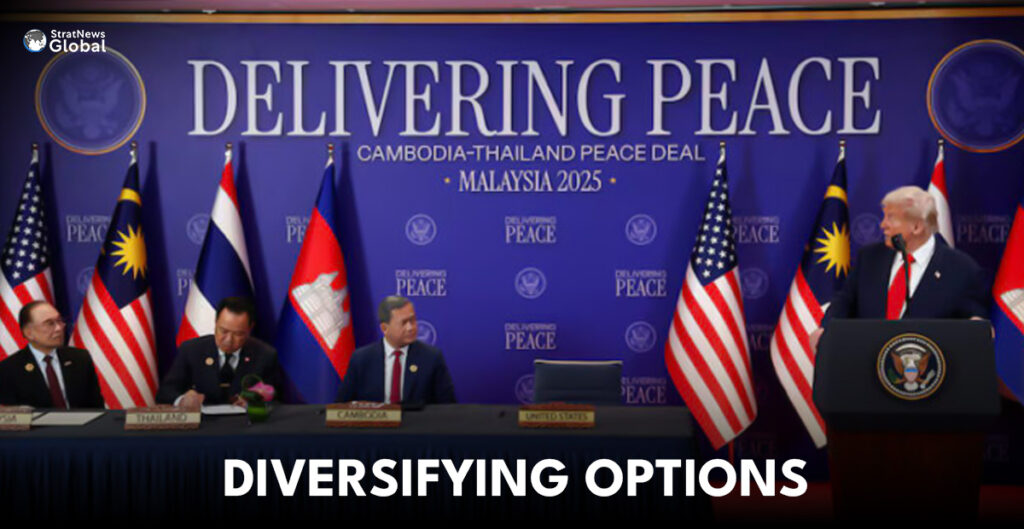
US President Donald Trump, who is in Kuala Lumpur to attend a summit of the Association of Southeast Asian Nations, signed reciprocal trade deals with his Malaysian and Cambodian counterparts, as well as a framework trade pact with Thailand that will see the countries work to address tariff and non-tariff barriers.
The United States would maintain a tariff rate of 19% on exports from all three countries under the deals, with the levy to be reduced to zero for some goods, according to joint statements released by the White House.
Washington also announced a similar framework deal with Vietnam, which has been levied with a tariff rate of 20% on its exports to the United States.
Vietnam, which recorded a trade surplus of $123 billion with the United States last year, has pledged to vastly boost its purchases of US products to reduce the trade gap between the two countries.
Malaysia Not Banning Rare Earths Exports To US
Trump on Sunday inked two separate US deals with Thailand and Malaysia seeking cooperation to diversify critical minerals supply chains, amid competing efforts from Beijing in the rapidly growing sector.
Reuters reported exclusively this month that China was in talks with Kuala Lumpur on rare earths processing, with Malaysian sovereign wealth fund Khazanah Nasional expected to partner with a Chinese firm to build a refinery in Malaysia.
China, the world’s top miner and processor of rare earths, has imposed increasingly stringent export controls on its refining technology, sending global manufacturers scrambling to secure alternative supplies for critical minerals used widely in semiconductor chips, electric vehicles and military equipment.
Malaysia agreed on Sunday to refrain from banning or imposing quotas on exports to the US of critical minerals or rare earth elements, the countries said in a statement.
The statement however did not specify whether Malaysia’s pledge applied to raw or processed rare earths.
Malaysia, which has an estimated 16.1 million tonnes of rare earth deposits, has banned the export of raw rare earths to prevent the loss of resources as it looks to develop its downstream sector.
Eliminating Tariff Barriers
The agreements were inked after Trump oversaw the signing of an enhanced ceasefire agreement between Thailand and Cambodia, following deadly border clashes between the neighbours earlier this year.
Under the deals, the four Southeast Asian countries pledged to remove trade barriers and provide preferential market access to various US goods.
The deals also include commitments in digital trade, services and investments as well as promises by the Southeast Asian countries to protect labour rights and strengthen environmental protections.
Thailand, Malaysia and Vietnam further agreed to accept vehicles built to US motor vehicle safety and emissions standards, according to the statements.
Malaysia, a majority Muslim country recognised as a global leader in halal certification, agreed to streamline requirements for US products such as cosmetics and pharmaceuticals.
Its trade minister Tengku Zafrul Aziz told reporters that Malaysia had also secured tariff exemptions for aerospace equipment and pharmaceutical products as well as commodities such as palm oil, cacao and rubber.
Thailand said it would eliminate tariff barriers on approximately 99% of goods, and relax foreign ownership restrictions for US. investment in its telecommunications sector, both countries said in a statement.
They also took note of several forthcoming commercial deals between Thai and US companies, including the purchases of agriculture products such as feed corn and soybean meal worth an estimated $2.6 billion per year.
Thailand has also committed to purchases of 80 US aircraft totalling $18.8 billion and energy goods including liquefied natural gas and crude oil of around $5.4 billion annually, the statement said.
(With inputs from Reuters)
Singapore Sets Aside More Land For Green Energy Projects And Tech Infrastructure
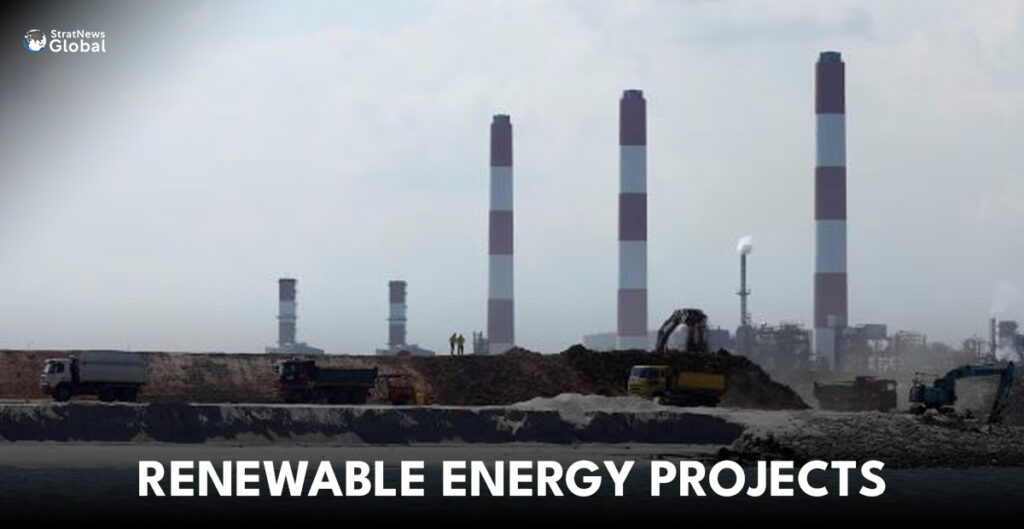
Singapore announced plans on Monday to dedicate additional land on Jurong Island, its key manufacturing hub, for the development of renewable energy projects and a new data centre park, according to a joint statement by the Singapore Economic Development Board and JTC Corporation.
About 300 hectares (741.32 acres) of land on the island’s western side, roughly 10% of Jurong Island’s total area, will be set aside for renewable power projects and low-carbon fuel production, the agencies said.
The 3,000-hectare Jurong Island is the centre of Singapore’s energy and chemicals industry, housing two of the city-state’s three refineries operated by Exxon Mobil, Chevron, and PetroChina.
Jurong Island will be a global test-bed for new energies and low-carbon technologies, said Tan See Leng, Singapore’s minister-in-charge of energy, science and technology, at the Singapore International Energy Week conference on Monday.
Scaling Up Renewable Energy Sources
The development will scale up facilities for renewable energies, including solar sources, sustainable aviation fuel, low-or-zero carbon ammonia solutions for power generation and maritime bunkering, as well as battery storage, according to EDB and JTC.
These include Singapore’s project for low-or-zero carbon ammonia power generation as well as hydrogen-ready power plants.
Separately, another 20 hectares of land will be set aside to develop Singapore’s largest data centre park, designed to support up to 700 megawatts of power capacity.
Operators will be able to tap Jurong Island’s existing ecosystem, including shared energy storage and utility infrastructure, ample power supply, and access to emerging low-carbon energy sources.
At the same time, Jurong Island will continue to diversify and drive growth opportunities in specialty chemicals and sustainable products, while battery storage infrastructure is also expanding on the island.
“There has been increasing interest from specialty chemicals players to grow their presence in Singapore, driven by growth in regional demand for higher-quality products,” Tan said.
Sembcorp Industries said on Monday that it has piloted a battery stacking solution at its existing Jurong Island energy storage system facility.
The vertical expansion increases storage capacity without enlarging the physical footprint, boosting the energy storage system’s capacity from 285 to 326 megawatt-hours.
(With inputs from Reuters)
Trump Begins Asia Trip, Heads To Japan Seeking Trade Deals And Defence Boost
U.S. President Donald Trump left for Tokyo on Monday to begin a round of high-level meetings that include talks with Japan’s emperor and newly elected Prime Minister Sanae Takaichi.
The visit forms part of a broader Asia tour focused on strengthening trade agreements, boosting investment, and encouraging Japan to expand its defence spending.
Trump, on his longest journey abroad since taking office in January, announced a slew of deals with Southeast Asian countries and oversaw the signing of a ceasefire agreement between Thailand and Cambodia during his first stop in Malaysia.
His trip is expected to conclude in a summit with Chinese President Xi Jinping in South Korea on Thursday, where the world’s two largest economies will seek to avert an escalation of their trade war.
While Trump has already landed a $550 billion investment pledge from Japan in exchange for respite on punishing import tariffs, Takaichi is hoping to further impress Trump with promises to purchase U.S. pickup trucks, soybeans, and gas.
Major Deals Signed
“Just leaving Malaysia, a great and very vibrant Country. Signed major Trade and Rare Earth Deals, and yesterday, most importantly, signed the Peace Treaty between Thailand and Cambodia. NO WAR! Millions of lives saved,” Trump said in a post on Truth Social shortly before his departure.
“Such an honor to have gotten this done. Now, off to Japan!!!”
Takaichi, who became Japan’s first female premier last week, told Trump that strengthening their countries’ alliance was her “top priority” in their first phone call on Saturday.
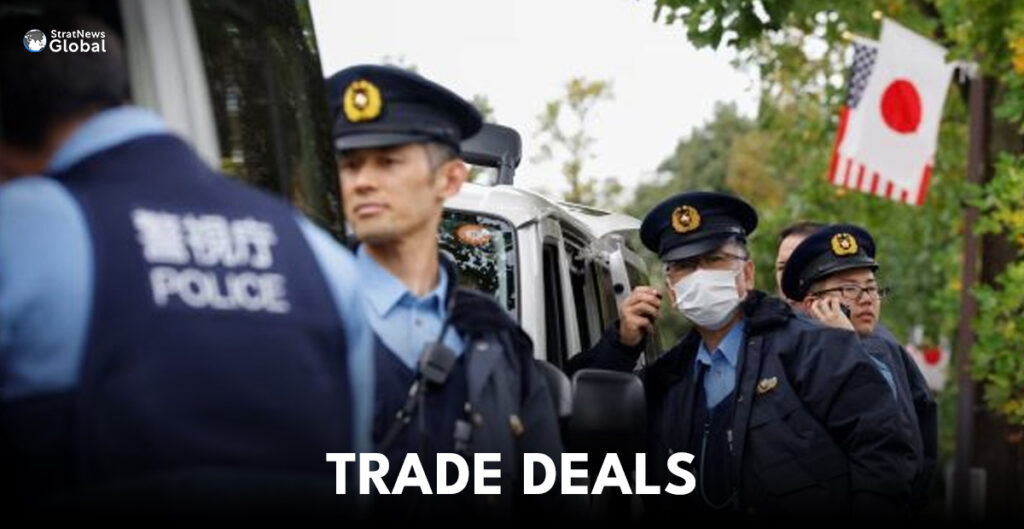
Thousands of police have been deployed across the Japanese capital for Trump’s arrival, with the arrest of a knife-wielding man outside the U.S. embassy on Friday and an anti-Trump protest planned in downtown Shinjuku adding to the tension.
Commerce Secretary Howard Lutnick and his Japanese counterpart Ryosei Akazawa, architects of the tariff deal agreed in July, are set to hold a working lunch on Monday.
Treasury Secretary Scott Bessent, travelling with Trump alongside Secretary of State Marco Rubio, is also expected to meet with his new counterpart Satsuki Katayama for the first time.
Imperial Welcome For Trump
Trump’s first engagement in Japan will be to meet Emperor Naruhito at the Imperial Palace in the heart of Tokyo.
Trump was the first foreign leader to meet Naruhito after he came to the throne in 2019, continuing an imperial line that some claim is the world’s oldest hereditary monarchy. Naruhito’s role, however, is purely symbolic and it will be with Takaichi on Tuesday that the meaty diplomacy will take place.
Takaichi was a close ally of assassinated Japanese premier Shinzo Abe, who formed a bond with Trump over hours spent on the golf course during his first term, and appears to have already impressed the U.S. president.
“She’s great… we’re going to be seeing her very soon. She’s very friendly,” Trump told reporters on Saturday after their call. “She was a very, very close ally and friend of Prime Minister Abe and you know he was one of my favourites.”
The two are due to meet at the nearby Akasaka Palace, the same venue that Trump met Abe six years ago, where Trump will be welcomed by a military honour guard.
As well as investment pledges, Takaichi is expected to reassure Trump that Tokyo is willing to do more on security after telling lawmakers on Friday that she will accelerate Japan’s biggest defence build-up since World War Two.
More Investment In Defence Spending
Japan plays host to the biggest concentration of U.S. forces abroad and Trump has previously complained that Tokyo is not spending enough towards defending its islands from an increasingly assertive China.
“Some kind of statement on standing shoulder-to-shoulder together to deter and respond to attempts to change the status quo in the region by force or coercion would be useful,” said Kevin Maher, a Japan expert at NMV Consulting in Washington and former U.S. diplomat.
While Takaichi has said she will accelerate a plan to increase defence spending to 2% of GDP, she may struggle to commit Japan to any further increases that Trump asks for as her ruling coalition does not have a majority in parliament.
Trump is due to leave for Gyeongju on Wednesday where he will first hold talks with South Korean President Lee Jae Myung. They are unlikely to finalise a long-sought trade deal, however, Lee’s advisor, Oh Hyun-joo, said.
Thursday’s meeting with Xi comes after Washington and Beijing have raised tariffs on each other’s exports and threatened to halt trade involving critical minerals and technologies.
Neither side expects a breakthrough that would restore terms of trade that existed before Trump’s return to power. Talks between the two sides to prepare for the meeting have focused on managing disagreements and modest improvements, before a visit by Trump to China that is expected to happen early next year.
(With inputs from Reuters)
China, Australia Balance Friendship And Friction Amid Tensions In Asia-Pacific
China and Australia on Monday emphasized their intention to maintain stable relations even as disputes over military activity in the South China Sea and strategic competition in the Asia-Pacific continue to test their partnership. Australian Prime Minister Anthony Albanese described the relationship as one of “friends.”
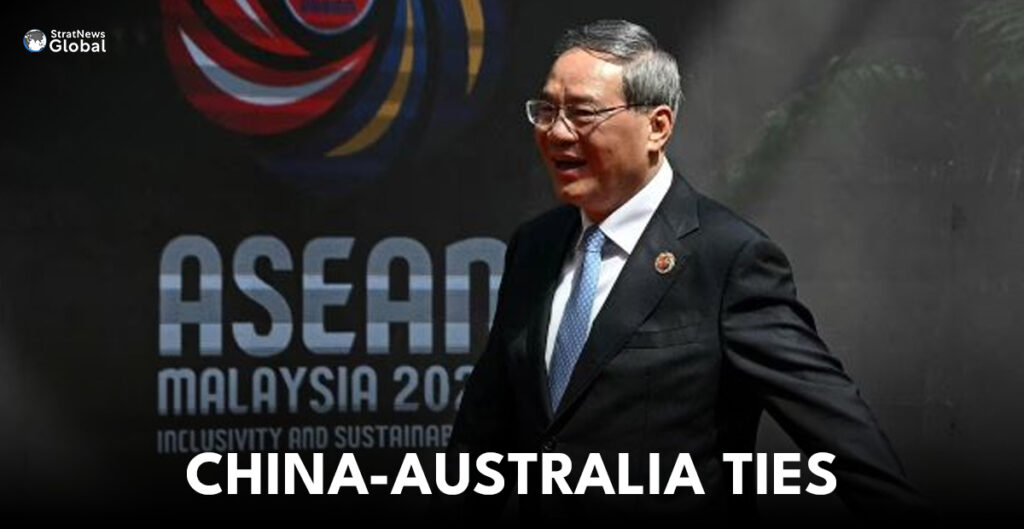
China is ready to build a more stable and strategic partnership with Australia, Premier Li Qiang told Prime Minister Anthony Albanese on the sidelines of a Southeast Asian summit in Malaysia, according to China’s official Xinhua news agency.
Albanese visited China in July to mend ties that had been strained to near breaking point under the previous Australian administration, vowing to keep communication channels open and look for areas of cooperation while guarding against “misunderstanding”.
A Positive Trend
China-Australia relations at present are showing a positive trend, Li told Albanese in their meeting in Kuala Lumpur, Xinhua reported.
Last week, both sides traded barbs over an encounter between their militaries in the South China Sea, most of which is claimed by Beijing as part of its territory.
Australia said a Chinese fighter jet dropped flares near one of its patrol planes, prompting Beijing to complain that Canberra was trying to cover up an “intrusion” into Chinese airspace.
“I made the position directly clear that this was an incident of concern for Australia,” Albanese told reporters after his meeting with Li.
Australia, in February, also criticised the actions of a Chinese fighter jet as “unsafe and unprofessional”, saying it had dropped flares within 30 m (100 ft) of a maritime patrol plane, also in the South China Sea.
In the Asia-Pacific region, China has been deepening its influence over Pacific Island nations through trade and diplomacy.
In 2022, Beijing inked a security deal with the Solomon Islands, and a year later it signed a policing agreement.
This month, Australia signed a defence cooperation deal with Papua New Guinea that observers say is aimed at countering China’s growing security presence in the broader region.
Stable Economic Ties
Despite the rivalry and military incidents, economic ties have remained stable, with both countries repeatedly calling for free trade and further dialogue.
China is willing to work with Australia in the green economy, high-tech industries and the digital sector, Li told Albanese, according to the Xinhua report.
Albanese said his seventh meeting with Li showed Australia and China, its largest trading partner, could manage differences through dialogue.
“We have disagreements and friends are able to discuss issues frankly – I did that,” he said.
(With inputs from Reuters)
Milei’s Party Wins Big In Argentina Midterms
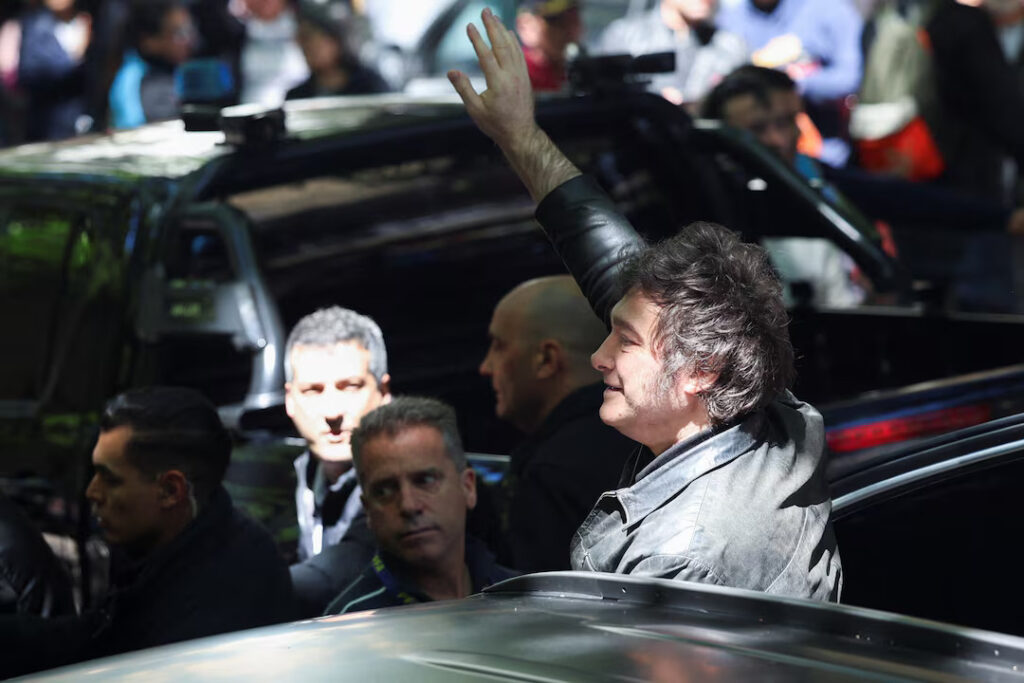
Argentine President Javier Milei’s party scored a decisive win in the midterm elections, as voters endorsed his free-market reforms and tough austerity drive, strengthening his mandate to push ahead with his ambitious economic overhaul.
The results will also likely be welcome news to US President Donald Trump, whose administration recently provided Argentina with a hefty financial bailout but had threatened to pull away if Milei did not do well.
Analysts said the stronger-than-expected showing could reflect fear of renewed economic turmoil if the country abandoned Milei’s policies which, while painful at times, have succeeded in drastically slowing inflation.
Argentine Public Wary Of Past Economic Crises
Gustavo Cordoba, the director of the Argentine Zuban Cordoba polling firm, said he was shocked by the results and thought they reflected public wariness over a possible return to the economic crises of past governments.
“Many people were willing to give the government another chance,” he said. “We’ll see how much time Argentine society gives the Argentine government. But the triumph is unobjectionable, unquestionable.”
Cordoba said Milei’s government appeared to have secured the one-third of seats it needs in the Chamber of Deputies to prevent any future presidential vetoes from being overturned by Congress. Several key Milei vetoes of spending bills were overriden in the months ahead of the midterms.
“The result is better than even the most optimistic Milei supporters were hoping for,” said Marcelo Garcia, Americas director of risk consultancy Horizon Engage.
“With this result, Milei will be able to easily defend his decrees and vetoes in Congress,” Garcia said, adding that allies will have more of an incentive to support a winning president.
The White House and foreign investors have been impressed by the government’s ability to significantly reduce monthly inflation from 12.8% before Milei’s inauguration to 2.1% last month, while achieving a fiscal surplus and enacting sweeping deregulation measures.
To support Milei, the Trump administration offered a bailout potentially worth $40 billion, including a $20 billion currency swap that is already signed and a proposed $20 billion debt investment facility.
The White House did not immediately respond to a request for comment on Sunday’s election result.
Milei Gets Big Wins In Buenos Aires And Nationally
The president’s party, La Libertad Avanza, scored 41.5% of the vote in Buenos Aires province compared with 40.8% for the Peronist coalition, according to official results. The province has long been a political stronghold for the Peronists, marking a dramatic political shift.
Nationwide, La Libertad Avanza got 64 seats in the House of Deputies, up from 37, according to government figures.
Half of Argentina’s lower Chamber of Deputies, or 127 seats, as well as a third of the Senate, or 24 seats, were up for election in the midterm vote. The Peronist opposition movement held the largest minority in both houses, overshadowing Milei’s relatively new party.
Political experts had said that capturing more than 35% of the vote would be a positive outcome for Milei’s government and could allow him, through alliances with other parties, to block opposition lawmakers from overturning his vetoes of laws that he said threaten Argentina’s fiscal balance.
Milei has said he expects a cabinet shake-up after the election that could include members of the centrist PRO party, a frequent ally of the government in Congress led by former President Mauricio Macri.
Bonds and stocks are expected to rally on Monday when markets open, as the result gives Milei the votes and political capital needed to accelerate his reforms.
Many analysts also predict there will be a devaluation of the peso, which they say has been overvalued to contain inflation.
(With inputs from Reuters)
SPD Lawmaker Urges Germany To Rethink China Strategy
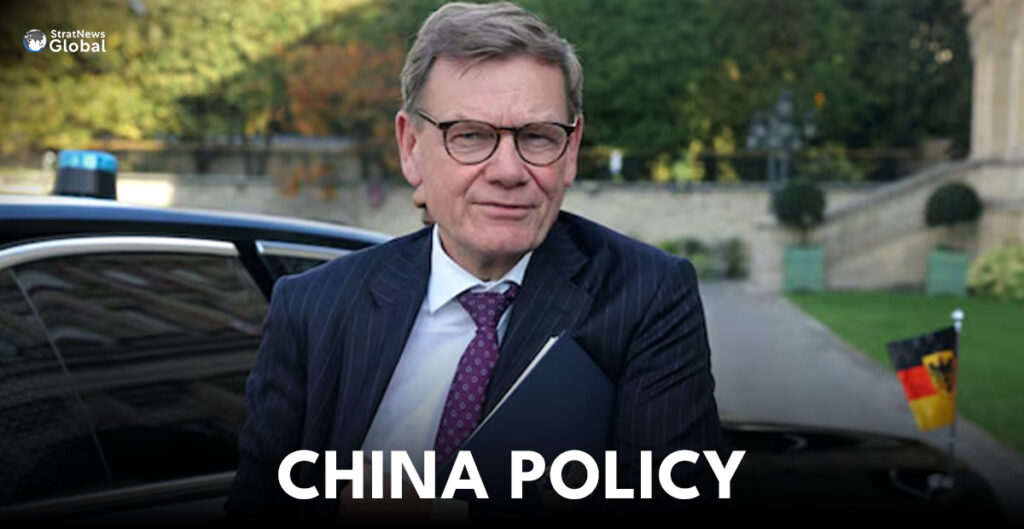
A senior Social Democrat lawmaker, part of Chancellor Friedrich Merz’s coalition, called on Saturday for a shift in Germany’s China policy after Foreign Minister Johann Wadephul postponed a Beijing trip.
Wadephul, a member of Merz’s Christian Democratic Union (CDU), cancelled the trip on Friday after Beijing confirmed only one of his requested meetings, a move that pointed to rising tensions over trade and security matters.
“The short-term cancellation of the trip to China does not bode well for an improvement in tense German-Chinese relations,” said Adis Ahmetovic, foreign policy spokesperson for the Social Democrats (SPD).
“We need to rethink Germany’s China strategy. More than ever, we need an active, strategic foreign policy that focuses on dialogue, clarity and long-term interests,” he said.
Germany is Europe’s biggest economy. China is Germany’s biggest trading partner and the largest economy in Asia.
The only meeting Beijing had confirmed during Wadephul’s planned trip had been with his direct counterpart, Wang Yi. A German foreign ministry spokesperson, commenting on the trip’s postponement on Friday, also said Germany was concerned about constraints placed on rare earth exports.
Wadephul Underlined Importance Of Fair Trade
Wadephul told Reuters this week he planned to urge China to relax export restrictions on rare earths and semiconductors during his trip, which had been due to start on Sunday, and underlined fair trade as a cornerstone of successful relations.
In a strategy on China agreed in 2023, Berlin urged the “de-risking” of the two countries’ economic relationship, calling Beijing a “partner, competitor and systemic rival”.
China provides Germany with critical components such as rare earths and chips, two areas that have been subject to severe bottlenecks as global trade tensions intensify.
“Direct dialogue with China is particularly important in a phase of global tension,” Ahmetovic said.
Talks should be deepened “especially on issues of peace, security, the economy, trade and human rights,” he said.
Juergen Hardt, foreign policy spokesperson for the CDU, said China was trying to use trade policy as a means of exerting pressure and that Wadephul had been right to postpone the trip.
“The German government is not playing along with this game,” he said, adding that Germany continued to value good and fair relations with Beijing.
(With inputs from Reuters)
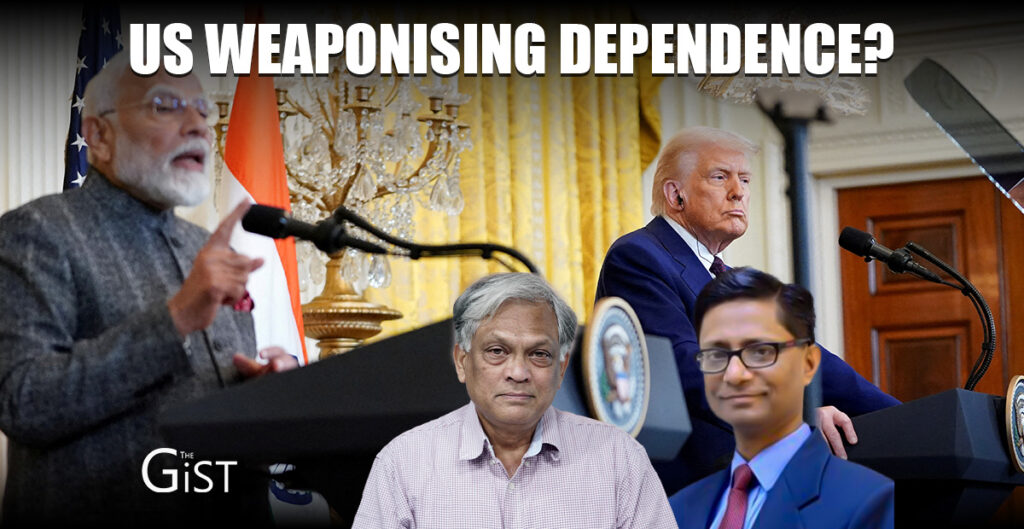
US Is Weaponising India’s Dependence On Its Market: Abhijit Das
Prime Minister Modi’s decision to attend the ASEAN summit in Kuala Lumpur virtually on Sunday, suggests that negotiations with the US on a free trade agreement are still ongoing.
Abhijit Das, former head of the Centre for WTO Studies in Delhi, told StratNews Global on The Gist programme that “It’s an open secret that in agriculture the US interests are centered around soybean, corn, some nuts and vegetables, dairy and poultry. So clearly, the US is negotiating very hard to secure its objective.
“On the other hand, we have the assurance from the Indian prime minister that the interests of farmers, fishermen and the dairy sector would not be compromised, would be protected in the final deal. So clearly, there is lots happening and very difficult to see at this juncture, whether India has given up its red lines or where the common ground is.”
He warned that during such negotiations, it is common for the US to bring in new issues which it then tries to bulldoze through. The strategy is that with a deal so near at hand, it can push the envelope a bit and wring more concessions.
“India being the other party in this case, would be hesitant to let go of the deal and would be also reluctant to have the blame put on its shoulders for collapse of the negotiations,” Das said. There is no harm in the deal taking a longer time. We must not become victims to the US.”
He underscored a major Indian weakness, it’s dependence on the US market with around 18% of its exports going there.
“If our exposure to the US market had been much lower, clearly President Trump would not have had the leverage vis-a-vis India. The US is weaponizing dependence of other countries on its markets through tariffs.”
In his view, the trade deal should not become an instrument whereby India’s reliance or dependence on the US market only grows.
Tune in for more in this conversation with Abhijit Das, former head of the Centre for WTO Studies.