

Support us by contributing to StratNewsGlobal on the following UPI ID
ultramodern@hdfcbank

Strategic affairs is our game, South Asia and beyond our playground. Put together by an experienced team led by Nitin A. Gokhale. Our focus is on strategic affairs, foreign policy and international relations, with higher quality reportage, analysis and commentary with new tie-ups across the South Asian region.
You can support our endeavours. Visit us at www.stratnewsglobal.com and follow us on YouTube, Twitter, Facebook and Instagram.
र 500 per month
र 1000 per month
र 5000 per year
र 10000 per year
Donate an amount of your choice
र 500 per month
Donate र 500 per month

र 1000 per month
Donate र 1000 per month
र 5000 per year
Donate र 5,000 per year
र 10000 per year
Donate र 10,000 per year
Donate an amount of your choice
Donate an amount of your choice



Pacific-India Digital Corridor: The Time Has Come!
Imagine a Pacific-India Digital Corridor linked through shared digital infrastructure. Data connectivity cyber-standards, and digital inclusion could become new pillars of Indo-Pacific cooperation — parallel to maritime security and trade.
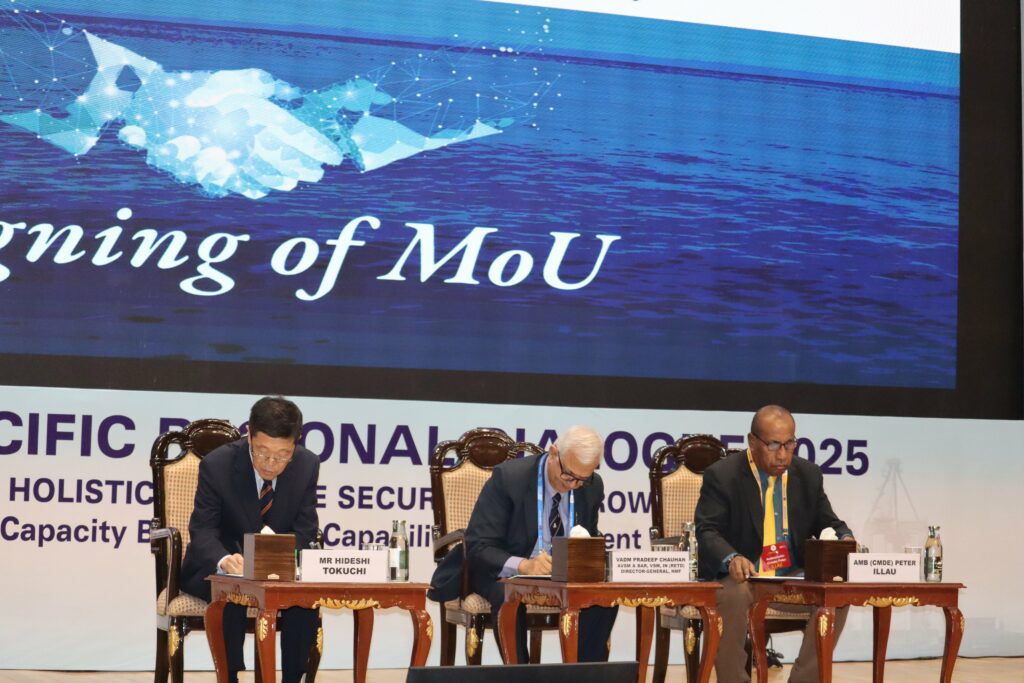
“We envision a Pacific-India Digital Corridor, a strategic pathway that links data, sovereignty and shared prosperity,” said Peter Ilau, former head of the PNG Defence Force, who was addressing the Indo-Pacific Regional Dialogue in Delhi.
“This corridor would not only connect our fibre and subsea assets but also harmonise cybersecurity standards, digital-trade protocols and regional innovation ecosystems.”
Ilau added that the corridor would allow students, entrepreneurs, and institutions across the Indo-Pacific to collaborate safely and securely.
“From mud hut to UPI, India has shown the world that digital transformation can be both sovereign and scalable,” he said. “We seek to learn, adapt and co-create, not replicate.”
Reimagining PNG
For decades, Papua New Guinea has been viewed largely through the lens of mineral and energy resources. Ilau’s remarks signal a re-imagination of the country’s role, from a commodities exporter to a digital pivot in the Pacific.
“Connectivity is sovereignty,” he declared. “The ability to transmit data securely, communicate without constraint and access digital infrastructure is the foundation of national resilience and regional agency.”
That vision aligns with PNG’s recent infrastructure moves. In November 2024, the country joined Google’s Pacific Connect Initiative, participating in the construction of the Bulikula subsea cable branch to Manus Island.
Once operational, the cable will strengthen regional data routes between Guam, Fiji and other Pacific nodes — positioning PNG as a potential data-landing and transit hub.
The digital push also builds on PNG’s MoU with India signed in July 2023 to explore the adoption of India Stack, the suite of open-source digital public goods behind India’s success in digital identity, payments, and e-governance.
Through these steps, Port Moresby is signalling that digital infrastructure is not just an economic tool, it is strategic sovereignty infrastructure, central to both security and development.
Strategic Convergence
For India, the Pacific-India Digital Corridor dovetails neatly with its own strategic priorities. Under the Indo-Pacific Oceans Initiative (IPOI) and Act East Policy, New Delhi has sought to deepen digital and maritime linkages with partners beyond its immediate neighbourhood.
India’s global leadership in digital public infrastructure — from Aadhaar and UPI to DigiLocker and India Stack — gives it unique leverage as a technology partner that offers interoperable, inclusive, and sovereign alternatives to Western or Chinese digital ecosystems.
By aligning with India, PNG and other Pacific states can gain not only connectivity but also a model of digital governance rooted in open standards, consent-based data sharing, and public-private innovation. The arrangement would also strengthen India’s soft-power footprint across the wider Indo-Pacific, allowing it to engage with the Pacific Islands in a development-oriented, non-hegemonic manner.
If realised, the Pacific-India Digital Corridor could yield tangible regional benefits:
High-speed Subsea Connectivity: Linking Pacific cable networks like Bulikula to Indian landing stations would reduce latency and build redundancy across the Indo-Pacific data grid.
Shared Cybersecurity and Data Standards: Harmonising frameworks could enable secure cross-border collaboration in finance, education, research, and e-commerce.
Innovation Partnerships: Joint research hubs and student exchange programmes could tackle regional challenges such as ocean health, climate adaptation, and disaster-management tech.
Inclusive Growth: Improved access to broadband and digital finance could empower island communities, boosting local enterprise and reducing digital inequality.
Such collaboration could also complement India’s broader outreach to the Global South, enhancing its credibility as a partner that exports not just hardware, but institutional know-how and governance models.
Yet, translating this digital corridor from concept to reality will demand sustained political will and investment. Subsea cable projects are capital-intensive, and maintaining them across dispersed island geographies requires long-term partnerships.
Within PNG itself, digital divides remain stark: only 15–20 per cent of the population has consistent internet access. Local last-mile networks, stable power supply, and human-capital development must keep pace if the benefits are to be broadly felt.
Equally, expanding digital infrastructure heightens exposure to cyber-risks and data-sovereignty concerns, issues that require robust governance and coordinated regional frameworks.
Still, for both PNG and India, the political and symbolic value of this proposal is immense. It demonstrates how digital technology, once viewed as an adjunct to development, has become a core axis of strategic autonomy in the Indo-Pacific.
A future Pacific-India Digital Corridor could mirror India’s “Digital Public Goods” diplomacy: interoperable, inclusive, and affordable. If supported by regional stakeholders, such as Fiji, Tonga, and the Solomon Islands, and multilateral partners, it could transform the Pacific’s digital map.
For India, the corridor offers a route to extend its influence beyond the Indian Ocean without stepping into the traditional military competition that defines the US–China rivalry in the Pacific. For Papua New Guinea, it promises to convert its geography into digital geoeconomic leverage.
Hungary: PM Orban Rolls Out Pension Bonus Ahead Of 2026 National Elections
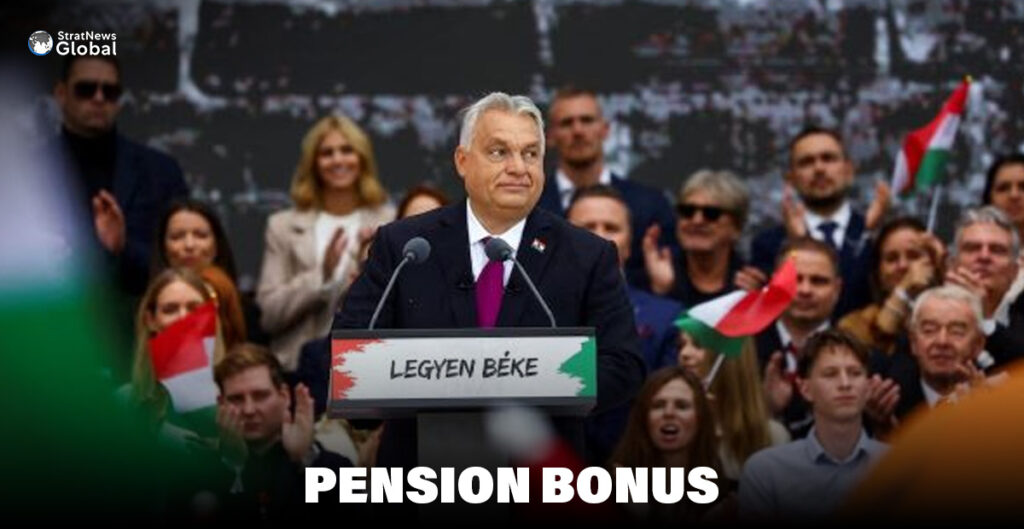
Hungarian Prime Minister Viktor Orban announced on Friday that his administration will introduce an additional pension payment. The move comes as he intensifies his political agenda in the run-up to the country’s 2026 national elections.
Faced with the weakest economic stretch of his 15-year rule, Orban has already announced tax cuts for families, wage hikes and a massive subsidized housing loan programme ahead of the vote, stretching the state budget at a time when the economy is stagnating.
Hungary’s third-quarter GDP data came in flat on Thursday, missing expectations and signalling a stagnating economy.
Orban told state radio on Friday that growth this year could be between 0.6% and 1%. This is way below earlier government projections for 3.4% growth in 2025, which was cut later to 2.5% and then 1%.
He also said the economy cannot be boosted by cutting spending as some economists suggest.
“We should do what is good for people….and not what straightens the numbers. So I believe Hungary’s economy cannot be put on the growth track with saving steps,” Orban said.
14th-Month Pension Plan
He said the only question was in how many steps the so-called “14th-month pension” could be introduced. The top-up would see pensioners who already receive an extra month’s worth of pension per year receive an extra “14th month” payment.
While the economic recovery remains weak, stubborn inflation is preventing interest rate cuts. The central bank’s base rate stands at 6.5%.
Orban also faces strong competition from a new centre-right opposition party which currently leads most polls.
Peter Virovacz, an economist with ING Bank, said introducing the pension top-up would cost an equivalent to 0.6% of Hungary’s GDP.
Hungary’s fiscal consolidation will be slower than expected, Fitch Ratings said earlier this month, adding that recently flagged tax cuts could create additional risk to its deficit and debt projections amid weak growth.
(With inputs from Reuters)
Tanzania Opposition Claims Hundreds Killed In Protests Over Elections
Tanzania’s main opposition party said on Friday that hundreds were killed in nationwide election protests this week, while the government claimed it was restoring order after what it described as “isolated incidents.”
The United Nations said credible reports indicated at least 10 people were killed in protests in three cities, the first public estimate of any fatalities by an international body since Wednesday’s vote.
The government has not released any estimates on casualties or responded to requests for comment. Reuters could not independently verify the figures.
Protesters have taken to the streets since Wednesday, angered by the exclusion of President Samia Suluhu Hassan’s two biggest challengers from the race and what they described as widespread repression.
Witnesses have said police fired tear gas and gunshots to break up some demonstrations.
Police have imposed an overnight curfew in the commercial capital, Dar es Salaam, over the past two nights after government offices and other buildings were set ablaze. Internet access has been disrupted since Wednesday.
Heavy Security Presence
Military and police patrolled the streets of Dar es Salaam on Friday, preventing people from moving around without a valid reason. The government extended a work-from-home order to civil servants.
John Kitoka – a spokesperson for the CHADEMA party, which was barred from the election for refusing to sign a code of conduct and had its leader arrested for treason in April – said the party had documented about 700 deaths since Wednesday based on accounts from health workers.
He said protests continued on Friday in several cities, although they had waned in some due to the heavy security deployment.
“We are calling for the protests to continue until our demands for electoral reforms are made,” he told Reuters.
The unrest presents a test for Hassan, who won praise after taking office in 2021 for easing repression but has more recently faced criticism from opposition parties and activists after a series of arrests and alleged abductions of opponents.
Hassan has denied allegations of widespread rights abuses. She said last year she had ordered an investigation into reports of abductions, but no official findings have been released.
The electoral commission began announcing provisional election results on Thursday, which showed Hassan winning commanding majorities in a number of constituencies.
Government: ‘Normalcy Will Return’
Her government issued its first comments directly addressing the unrest on Friday in a message from the foreign affairs ministry to diplomatic missions broadcast on state television.
The message said that, “owing to isolated incidents of breaching law and order, the Government has heightened security and taken several other precautionary measures.
“The security measures in place are temporary but necessary, and normalcy will return shortly,” it added.
In Geneva, U.N. human rights spokesperson Seif Magango told reporters there were credible reports of at least 10 people killed in Dar es Salaam, Shinyanga and Morogoro.
He called on security forces “to refrain from using unnecessary or disproportionate force,” and urged protesters to be peaceful.
One Dar es Salaam resident, who asked not to be named for safety reasons, told Reuters a family member had been shot dead outside a hospital when he was mistaken for a protester.
A police spokesperson did not respond to requests for comment.
In a statement on Thursday, the chair of the European Parliament’s committee on foreign affairs and two colleagues called the elections a “fraud”, saying they “unfolded in an atmosphere of repression, intimidation, and fear”.
(With inputs from Reuters)
Critics Sound Alarm Over Trump’s Major Nuclear Reactor Plan
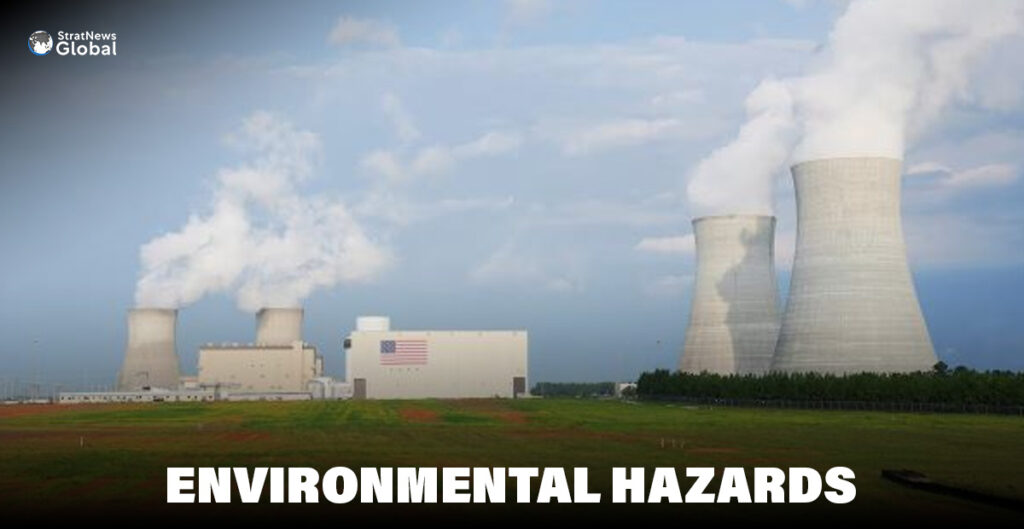
Earlier this week, the Trump administration unveiled a major nuclear initiative that offers billions in incentives tied to government approvals for new Westinghouse reactors. The unusual arrangement has prompted critics to warn that it could endanger the environment and pose threats to safety.
Under the agreement with Westinghouse Electric’s owners, Canada-based Cameco, and Brookfield Asset Management, the U.S. government will arrange financing and help secure permits and approvals for $80 billion worth of Westinghouse reactors.
In return, the plan offers the U.S. government a path to a 20% share of future profits and a potential 20% stake in the company if its value surpasses $30 billion by 2029.
The deal is one of the most ambitious plans in U.S. atomic energy in decades, underscoring President Donald Trump’s agenda to maximize energy output to feed booming demand for artificial intelligence data centers.
But the financial incentives risk clouding regulatory scrutiny aimed at preventing nuclear accidents, according to safety advocates and regulatory experts.
“The things that could go wrong are Three Mile Island, Chernobyl and Fukushima,” said Greg Jaczko, a former chairman of the Nuclear Regulatory Commission, pointing to three of the worst nuclear power accidents on record.
“All have causes tied to insufficient regulatory independence.”
Safety Concerns
The White House said concerns about safety were unfounded.
“The regulatory regime remains the same and is not compromised. There’s nothing in the deal about regulatory changes,” the White House said in an emailed statement.
Westinghouse owner Cameco declined to comment. Brookfield and Westinghouse did not respond to messages requesting comment.
TD Cowen analysts told clients in a research note this week they expect Westinghouse to have 10 new large-scale reactors – enough gigawatts to power several million homes – under construction by 2030 as a result of the deal.
Typically, it takes around a decade for a new nuclear power plant to get built, largely due to the rigorous permitting requirements and enormous costs and complexities associated with construction.
Patrick White, a nuclear regulatory and technology expert at the Clean Air Task Force, said effective regulation did not need to be a slow or extended process and there were benefits to moving more efficiently.
“Ensuring that nuclear regulation is also timely and predictable is in the best interest of both companies and the public,” White said.
Todd Allen, a nuclear expert at the University of Michigan, said the design of Westinghouse reactors is well established, but questioned how fast projects could progress.
“With that aggressive timeline, and demand for the reactors around the world, I wonder if there is a big enough workforce to handle all of these projects,” Allen said.
Delays To Previous U.S. Project
Westinghouse’s last U.S.-based nuclear project, building two nuclear reactors at the Vogtle power plant in Georgia, forced the company into bankruptcy protection in 2017.
The two reactors were about seven years behind schedule and cost about $35 billion, more than double the original estimate of $14 billion.
Patty Durand, director of nonprofit Georgians for Affordable Energy, has spent years analyzing that project and said she fears fast permitting would overlook the risks associated with climate change.
She said severe droughts have forced operators to curtail nuclear power in Europe and the United States to avoid overheating their reactors.
Westinghouse also had a slew of problems related to the modular design of its AP1000 reactors, such as some parts’ dimensions being wrong when they arrived on site. The AP1000 would also be used for the new reactors, built from prefabricated parts and assembled on site.
Edwin Lyman, a physicist at the Union of Concerned Scientists, said he fears the Trump administration will exert too much power over the Nuclear Regulatory Commission to get the new reactors permitted.
“If the White House fully takes over the NRC and it is no longer at all independent, then it could be used just as a tool for sweeping deals for which the White House could accelerate licensing on its preferred projects regardless of their actual safety implications, and that’s a dangerous thing,” Lyman said.
(With inputs from Reuters)
Germany’s Far-Right AFD Party Strengthens U.S. Connections
Germany’s far-right AfD party, which has long been isolated domestically, is increasingly looking to Washington for backing and is strengthening its connections with pro-Trump figures who now occupy prominent roles in the U.S. administration.
The Alternative for Germany (AfD), classified as extremist by Germany’s domestic intelligence service and ostracised by mainstream parties, has held meetings with senior U.S. State Department officials in recent months — a rare move for a far-right opposition party in an allied country, according to a current and a former U.S. official and a German government source.
The outreach reflects a growing alignment between the AfD and parts of Trump’s MAGA (Make America Great Again) movement, which has voiced support for the party’s complaints about political repression at home and its hardline stance on immigration.
At a private reception in Manhattan earlier this month, an opera tenor serenaded AfD lawmakers Jan Wenzel Schmidt and Kay Gottschalk with the taboo first stanza of Germany’s national anthem: “Germany, Germany above all, above all in the world” — lyrics the Nazis used to assert German superiority.
Schmidt, fresh from a meeting with a top U.S. foreign service official, joined in the singing with hand over heart. He later denied any link between the lyrics and the Nazis.
AfD’s Growing Ties In Washington
The private reception in Manhattan, hosted by the New York Young Republican Club, underscores the AfD’s efforts to build international legitimacy and challenge what it calls undemocratic exclusion at home.
“We have no democracy anymore,” Gottschalk told attendees. “You can’t say what you think or what you like.”
The AfD’s growing ties in Washington come as it surges in German opinion polls, threatening Chancellor Friedrich Merz’s conservatives ahead of a series of state elections next year that polls suggest could give the AfD its first state premier.
“It’s a calculated opportunity to … attract attention and achieve a proximity to government power that would be completely unthinkable in the concert of European or other states,” said Oliver Lembcke, political scientist at the University of Bochum, referring to the AfD’s series of meetings in the U.S.
The State Department did not comment but pointed to a photo on X of Darren Beattie, the senior foreign service official, meeting with Wenzel Schmidt and his colleague Markus Frohnmaier.
The State Department official, who requested anonymity because they were not authorised to talk to media, said: “When you have an organisation that’s outside the mainstream, they crave the imprimatur of legitimacy that historically engaging with American diplomats has offered them.”
Parallels With The Nazi Party
Many Germans are alarmed by the AfD, whose rise evokes unsettling parallels with the Nazi Party’s ascent in the 1930s, when authoritarian rule was established through legal means.
Germany’s other parties refuse to work with its lawmakers by giving them influential positions in parliament or forming coalitions.
That pact – known as the firewall – is undemocratic, the AfD argues. AfD politicians say they want to raise awareness about what they view as the worsening state of democracy in Germany, and gain high-profile backing abroad.
So far, they have struggled. The AfD is shunned by many of Europe’s other far-right parties after a series of scandals and inflammatory comments. But, with the return of Trump to the White House, the AfD has found a sympathetic ear.
In February, U.S. Vice President JD Vance shocked European leaders by accusing them of censoring free speech, repressing political rivals and failing to control immigration.
Vance then met with AfD co-leader Alice Weidel in a sign of support shortly before federal German elections, where they came in an unprecedented second place.
German Intelligence Says The AfD Is “Extremist”
In May, Secretary of State Marco Rubio said the party’s classification as extremist was tyranny in disguise.
“The AfD pounces on it whenever these comments come out, and they use it to pressure the government,” the German government official said. “This is a problem because outwardly we want and need good relations with Americans, and this sabotages it.”
The AfD’s grievances include wire-tapping by authorities, moves to bar AfD members from the civil service and undemocratic attempts to exclude them from power, they said.
German intelligence earlier this year found the AfD to be “extremist” in part due to racist and anti-Muslim views. The designation allows the state to recruit informants and intercept communications and allows authorities to bar members deemed disloyal to the constitution from the civil service.
AfD politician Joachim Paul said the State Department had invited him to “explain the situation of the opposition in Germany” after he was barred from running for a mayoral position. German authorities had cited doubts about his loyalty to the country’s constitutional order.
Paul said the U.S. officials he met in Washington were well-informed and told him they would follow his case. However, he added, they stopped short of offering direct assistance.
AfD’s U.S. Contacts Before Trump
The foundation for the AfD’s ties with the U.S. government was laid in the years running up to Trump’s re-election.
The New York Young Republican Club has for years cultivated contacts with far-right European parties.
Some former club members went on to hold senior positions in the Trump administration. Former club president Gavin Wax, who visited the AfD in Berlin in 2023, became chief of staff to the U.S. Undersecretary for Public Diplomacy, who until recently was Beattie. Beattie, now the department’s Senior Bureau Official in Public Diplomacy, is on the club’s advisory board.
Before joining government, Wax met with right-wing Hungarian Prime Minister Viktor Orban at a May gathering of nationalist parties in Budapest also attended by the AfD’s Weidel.
“In previous administrations, whether Democratic or Republican, the State Department didn’t swing too much left or right,” said the former State Department official. “Now that’s changing.”
Frohnmaier, one of the AfD lawmakers photographed meeting Beattie, welcomed the U.S. interest in the party’s challenges.
It is “our duty to raise awareness among democratic partners abroad about these developments, so that the anti-democratic forces in Germany encounter resistance from all sides,” he said.
(With inputs from Reuters)
Israeli Strikes Kill Three In Gaza, Straining Fragile Truce
The Israeli military launched strikes on the Gaza Strip for a fourth consecutive day on Friday, killing three people, according to Palestinian health officials, in a fresh challenge to a fragile ceasefire.
Residents reported Israeli shelling and gunfire in northern Gaza on Friday, as Israel continued to bombard areas of the enclave despite saying that it remains committed to a ceasefire brokered by U.S. President Donald Trump.
The Israeli military did not immediately reply to a Reuters request for comment.
Another Palestinian died of wounds sustained from previous Israeli shelling, the Palestinian WAFA news agency reported.
The U.S.-brokered ceasefire, which left thorny issues like the disarmament of Hamas and a timeline for Israeli withdrawal from the Gaza Strip unresolved, has been tested by periodic outbreaks of violence since it came into place three weeks ago.
Between Tuesday and Wednesday, Israel retaliated for the death of an Israeli soldier with bombardments that Gaza health authorities said killed 104 people.
More Bodies Handed Over
Gaza’s health ministry said the Red Cross had delivered to it 30 bodies of Palestinians killed by Israel during the war, a day after Hamas handed over two bodies of hostages.
Under the ceasefire accord, Hamas released all living hostages held in Gaza in return for nearly 2,000 Palestinian prisoners and wartime detainees, while Israel agreed to pull back its troops, halt its offensive and increase aid.
Hamas also agreed to hand over the remains of all 28 dead hostages in exchange for 360 Palestinian militants killed in the war. After Thursday’s release, it had handed over 17 bodies, while 225 Palestinian bodies have so far been returned to Gaza.
Hamas has said that it will take time to locate and retrieve the bodies of all the remaining hostages. Israel has accused Hamas of violating the truce by stalling in the handover.
Two years of conflict in Gaza have killed over 68,000 Palestinians, according to Gazan health authorities and left the enclave in ruins.
Israel launched the war after Hamas-led fighters attacked southern Israel in October 2023, killing 1,200 people and bringing 251 hostages back to Gaza.
(With inputs from Reuters)
Taiwan’s President Rejects China’s ‘One Country, Two Systems’ Proposal
Taiwan rejects China’s “one country, two systems” framework and will defend its freedom and democracy, President Lai Ching-te said on Friday, dismissing Beijing’s renewed efforts to bring the island under its control.
China said this week it “absolutely will not” rule out using force over Taiwan, striking a much tougher tone than a series of articles in state media that pledged benign rule if the island comes over to Beijing under a system of autonomy it uses for Hong Kong and Macau.
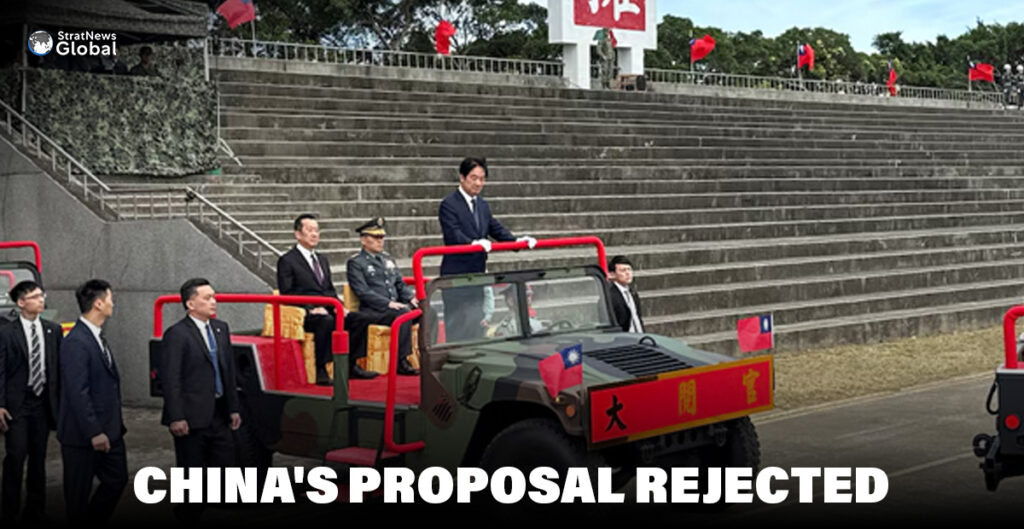
Lai, whom China views as a “separatist”, told soldiers at a military base in northern Taiwan’s Hukou that only strength can bring true peace.
“Accepting the aggressor’s claims and abandoning sovereignty certainly cannot achieve peace. Therefore, we must maintain the status quo with dignity and resolve, firmly opposing annexation, aggression, and the forced advancement of unification,” he said.
“We reject ‘one country, two systems’ because we will forever uphold our free and democratic constitutional system,” Lai added.
China’s Taiwan Affairs Office did not immediately respond to a request for comment.
No Support For China’s Proposal
No major political party in Taiwan supports China’s “one country, two systems” idea.
Lai said that the Republic of China – Taiwan’s formal name – and the People’s Republic of China are “not subordinate” to each other and that “Taiwan’s sovereignty cannot be violated or annexed” and its future can only be decided by its people.
“The Taiwanese people safeguarding their sovereignty and preserving their democratic and free way of life should not be viewed as provocation. Investing in national defence is investing in peace.”
Lai has pledged to increase military spending to 5% of GDP by 2030, strengthening the island’s defences in the face of a rising threat from its giant neighbour China.
Lai was in Hukou for a commissioning ceremony for Taiwan’s first battalion of M1A2T Abrams tanks, made by General Dynamics Land Systems, a unit of U.S. firm General Dynamics.
Taiwan has so far received 80 of the 108 M1A2T tanks it ordered from the United States, the island’s most important international backer and arms supplier, despite the lack of formal diplomatic ties.
The M1A2T tank can fire high-explosive anti-tank warheads and kinetic energy ammunition, such as armour-piercing fin-stabilised discarding sabot.
The U.S. is bound by law to provide Taiwan with the means to defend itself, though President Donald Trump has yet to approve any new arms sales since he took office earlier this year.
U.S. Defence Secretary Pete Hegseth, meeting Chinese Defence Minister Dong Jun in Kuala Lumpur on Friday, said he had emphasised U.S. concerns about China’s activities around Taiwan, as well as in the contested South China Sea.
Dong said China-Taiwan “reunification” was an irreversible historical trend and the U.S. should take a clear stance in opposition to the island’s independence, his ministry said in a statement.
(With inputs from Reuters)
Russia Fires Missile In Ukraine That Prompted Trump To Quit Nuclear Treaty: Kyiv
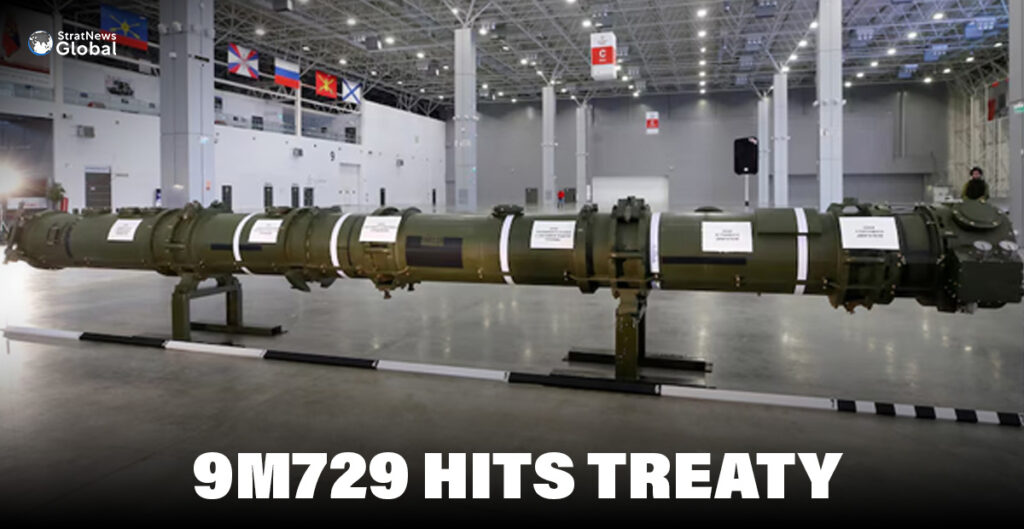
Russia has in recent months struck Ukraine with a cruise missile whose covert development led Donald Trump to withdraw from a nuclear arms control treaty with Moscow during his first presidential term, Ukraine’s foreign minister said.
Andrii Sybiha’s comments are the first confirmation that Russia has used the ground-launched 9M729 missile in combat – in Ukraine or elsewhere.
Russia has fired the missile at Ukraine 23 times since August, a second senior Ukrainian official told Reuters. Ukraine also recorded two launches of the 9M729 by Russia in 2022, the source said.
Russia’s defence ministry did not immediately reply to a written request for comment.
One Missile Flew 1,200 KM
The 9M729 led the United States to quit the Intermediate-Range Nuclear Forces (INF) Treaty in 2019. Washington said the missile was in breach of the treaty and could fly far beyond its limit of 500 km (310 miles), although Russia denied this.
The missile, which can carry a nuclear or conventional warhead, has a range of 2,500 km, according to the Missile Threat website produced at the Centre for Strategic and International Studies in Washington.
A military source said a 9M729 fired by Russia on October 5 flew over 1,200 km to its impact in Ukraine.
“Russia’s use of the INF-banned 9M729 against Ukraine in the past months demonstrates (President Vladimir) Putin’s disrespect to the United States and President Trump’s diplomatic efforts to end Russia’s war against Ukraine,” Sybiha said in written remarks.
He told Reuters that Kyiv supported Trump’s peace proposals and that Russia should face maximum pressure to push it to peace, saying that boosting Ukraine’s long-range firepower would help persuade Moscow to end its war in Ukraine.
Ukraine has urged Washington to provide it with long-range Tomahawk missiles that were not banned under the INF because they were only sea-launched at the time. Russia says this would be a dangerous escalation.
‘An Issue For European Security’
Use of the 9M729 expands Russia’s arsenal of long-range weapons for striking Ukraine and fits a pattern of Moscow sending threatening signals towards Europe as Trump seeks a peace settlement, Western military analysts said.
“I think Putin is trying to ramp up pressure as part of the Ukraine negotiations,” said William Alberque, a senior adjunct fellow at the Pacific Forum think tank, adding that the 9M729 was designed to hit targets in Europe.
Russia tested its nuclear-powered Burevestnik cruise missile last week, and on Wednesday said it had tested a nuclear-powered torpedo named Poseidon.
The White House did not respond to specific questions about Russia’s use of the 9M729. Trump ordered the U.S. military on Thursday to resume testing nuclear weapons, citing “other countries’ testing programs”.
After the U.S. withdrew from the INF treaty, which banned ground-launched missiles with a range of 500-5,500 km, Russia declared a moratorium on deploying intermediate-range missiles. The West said Russia had already deployed some 9M729 missiles.
On August 4, shortly before using the missiles in Ukraine, Russia said it would no longer limit where it deploys INF-range missiles that can carry nuclear warheads.
“If it’s shown that Russia’s using INF-range missiles, which could easily be nuclear, in Ukraine, then that is an issue for European security, not just Ukraine,” said John Foreman, a former British defence attache to Moscow and Kyiv.
Missile Fragments
Ukraine’s foreign ministry did not provide details or dates of the 9M729 strikes.
The senior official said they began on August 21 – less than a week after a Trump-Putin summit in Alaska.
Reuters reviewed images of debris after a Russian attack in which a residential building was hit and four people were killed in the Ukrainian village of Lapaiivka on October 5 – over 600 km from Russian territory.
The images showed that two missile fragments, including a tube containing cabling, were marked 9M729.
Jeffrey Lewis, Distinguished Scholar of Global Security at Middlebury College, reviewed the images with analysts.
He said the tube, engine and engine panelling were consistent with what he expected the 9M729 to look like and that the markings made a match even more likely.
Firing From Further Back
Russia has various missiles that can reach across Ukraine, including the sea-launched Kalibr and air-launched Kh-101, but Lewis said the 9M729 offers something slightly different.
“This gives them slightly different attack axes, which is difficult for air defences, and it increases the pool of missiles that are available to the Russians,” Lewis said.
The INF prohibited ground-launched missiles because the launchers are mobile and relatively easy to conceal.
Douglas Barrie, Senior Fellow for Military Aerospace at the International Institute for Strategic Studies, said Russia could use the 9M729 to conduct ground-launched strikes from safer locations deeper inside Russia.
Russia would also benefit from testing the system in a battlefield environment in Ukraine, though 23 uses would imply a military purpose, said Barrie.
(With inputs from Reuters)
As Trump Skips APEC, Xi Steps In With Pro-Trade Message
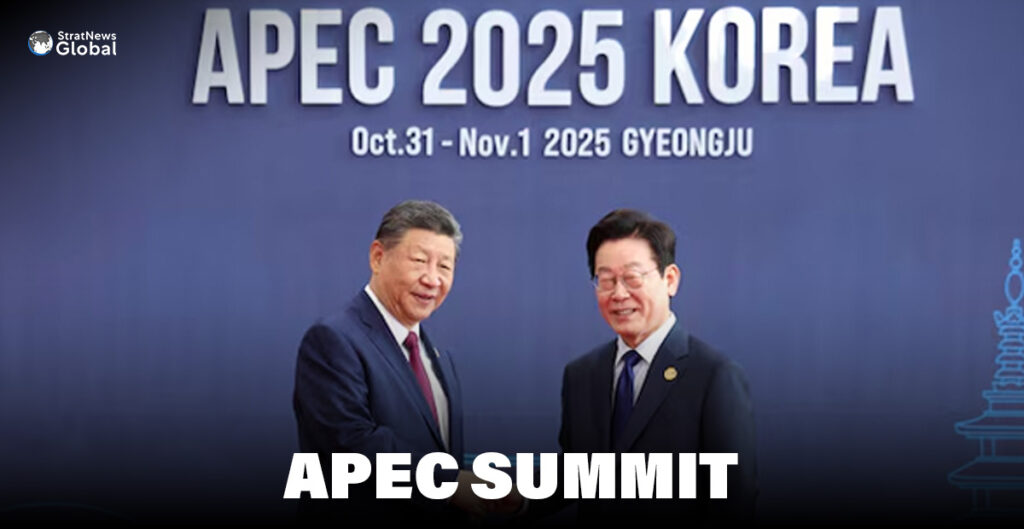
As U.S. President Donald Trump‘s Air Force One departed South Korea’s Busan airport after U.S.-China talks on Thursday, Xi Jinping’s Hongqi N701 limousine sped toward the APEC summit 80 km away.
The split-screen moment captured a shift in global economic leadership: U.S. President Donald Trump heads home after a 24-hour visit, while China’s leader settles in for a festival of multilateral diplomacy that America now sees as an afterthought.
This encapsulates a change in the contest for influence across the Asia-Pacific, home to the world’s fastest-growing economies and critical supply chains rattled by Trump’s tariffs.
Multilateralism, Versus ‘America First’
As Washington embraces barriers and bilateral deal-making, Beijing positions itself as the predictable champion of free and open trade, a role the U.S. has dominated for decades.
“We must practice true multilateralism, and enhance the authority and effectiveness of the multilateral trading system with the WTO at its core,” Xi told the leaders gathered for the opening of APEC, referring to the World Trade Organisation.
Xi called on the gathering of leaders, where U.S. Treasury Secretary Scott Bessent stood in for Trump, to “update international economic and trade rules to reflect the changing times, so as to better protect the legitimate rights and interests of developing countries.”
However, many Asian nations are wary of China’s stated support, given its muscular defence posture in the region, dominance in manufacturing, and its own willingness to use export controls and other tools in trade disputes.
Trump’s decision to skip the APEC summit marks a dramatic reversal in Washington’s engagement with an institution the U.S. helped create with Australia in 1989 as part of America’s post-Cold War vision of binding the region’s economies through trade.
The U.S. leader has stunned global markets with his “Liberation Day” tariffs and has forced most economies into tough bilateral talks, hiking levies on their products and forcing them to commit to hundreds of billions of dollars in investment.
At the forum, U.S. Senior Official to APEC Casey Mace described America’s presence at the event as “very strong and robust,” adding that schedules “didn’t align perfectly to allow for President Trump to stay for all of the events”.
Hours after returning to Washington from his Asia tour, Trump hosted the White House’s annual Halloween party, along with first lady Melania Trump.
China has sought to exploit the uncertainty brought by Trump policies, through diplomacy and by making inroads into markets that are even more crucial for Beijing at a time of sagging growth and Western accusations that it has fuelled global overcapacity through cheap exports.
Far more than a tactical ploy, the rewiring of the trading system is a long-term strategy for China. Its forthcoming five-year economic plan outlines ways to “safeguard the multilateral trading system and promote broader international economic flows.”
Beyond messaging, China has also taken action. During a trip to Malaysia last week, Chinese Premier Li Qiang attended the Association of Southeast Asian Nations summit in Kuala Lumpur and signed an upgraded China-ASEAN free trade deal.
As was the case at APEC, the contrast with the U.S. was palpable. Trump’s six-hour blitz of meetings at the ASEAN forum achieved four trade deals — but none of them reduced U.S. trade barriers, and some included further threats.
They stipulated that if a country deepens relations with another that “jeopardises essential U.S. interests”, it would face more levies, in what experts say is a reference to China.
“The upgraded free trade agreement only reinforces China’s dominant posture in terms of regional economic engagement,” Yun Sun, co-director of the East Asia Program at the Stimson Centre think-tank, said in reference to the China-ASEAN deal.
“In comparison, U.S. bilateral trade deals with individual countries are much more circumstantial and limited in their scope.”
Price Of Free Trade
Although no policy breakthroughs are expected at APEC, Xi’s presence at the summit, along with Li’s at ASEAN, sends a powerful message about China investing in relationship-building with regional countries, say analysts.
Sun said that compared to China’s consistent presence, the U.S. “inevitably appears selective and conditional”.
Xi will hold meetings with Canadian Prime Minister Mark Carney and Japan’s new Prime Minister Sanae Takaichi on Friday, and both meetings are likely to be difficult, given Takaichi’s hardline conservative bent and China’s ongoing trade dispute with Canada.
But countries in the region are also wary of China’s economic dominance, its own willingness to use trade barriers as a weapon, and its export-led model, flooding other countries with cheap goods that creates fears of deindustrialisation.
China this month said it would dramatically ratchet up its restrictions on rare earths exports, including outside of China’s borders, sending shockwaves through already brittle global supply chains.
“China is very powerful, a big country in terms of economy, and they try to make use of these U.S. tariff issues in order to pretend as if they are the guardian or champion of the free trade system,” said Japanese foreign ministry spokesperson Toshihiro Kitamura on the sidelines of the ASEAN meeting.
“But for Japan, it’s not true. As I said, for example, the rare earths issue, they try to utilise their own resources in order to impose their positions on politics to others. So we don’t think that they are champions of the free trade system.”
Eric Olander of the China Global South Project added that China’s strategy was “through expanded trade, infrastructure development, and supply chain logistics to bind this region to the Chinese economy to the point where it eventually becomes totally unfeasible for countries to extricate themselves from their reliance on Chinese economic engagement.”
(With inputs from Reuters)
Hegseth Meets Rajnath Singh In Malaysia, Signs 10-Year Defence Pact
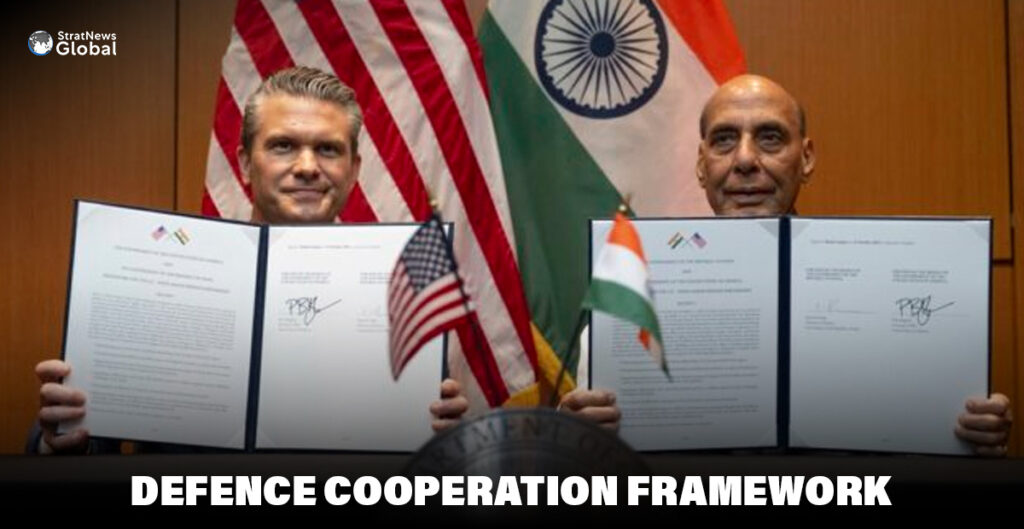
U.S. Defence Secretary Pete Hegseth on Friday met Defence Minister Rajnath Singh and Chinese Defence Minister Dong Jun at an ASEAN defence summit in Malaysia, launching a series of talks aimed at strengthening regional security ties.
Hegseth said on X that he told China’s Dong Jun the United States would “stoutly defend its interests” and maintain the balance of power in the Indo-Pacific, while voicing concern about Chinese activities in the disputed South China Sea and around Taiwan.
He also hailed “a cornerstone for regional stability and deterrence” a new 10-year defence cooperation framework signed with Rajnath Singh.
“It’s a significant step for our two militaries, a roadmap for deeper and even more meaningful collaboration ahead,” Hegseth told reporters after the signing.
Hegseth and Singh were meeting for the first time since the United States imposed tariffs of 50% on Indian goods in August as punishment for New Delhi’s purchases of Russian oil.
The tariffs prompted India to pause purchases of U.S. defence equipment, with the two sides expected to discuss on Friday a review of India’s plans to buy the military hardware.
As Washington looks to tackle China’s growing assertiveness in the region, Hegseth is expected to meet the defence ministers of Indonesia, the Philippines and Thailand, among others, said an official, who spoke on condition of anonymity.
Delegations from Australia, New Zealand, South Korea and Russia are attending the meeting of defence ministers from the Association of Southeast Asian Nations.
Chinese Grey-Zone Tactics
Hegseth met Malaysia’s defence minister on Thursday, and both leaders committed to maritime security in the South China Sea.
The busy waterway is claimed almost entirely by China, although it overlaps the exclusive economic zones of Brunei, Indonesia, Malaysia, the Philippines and Vietnam.
Beijing has deployed a coast guard armada that has clashed repeatedly with Philippine vessels and been accused of disrupting the energy activities of Malaysia and Vietnam.
“Grey-zone tactics, such as hydrographic research conducted under the protection of foreign coast guard vessels, threaten sovereignty and are a clear provocation and threat,” Malaysian minister Mohamed Khaled Nordin said in a joint statement.
Unresolved disputes have festered for years over the sovereignty of islands and features in the South China Sea.
Beijing says its coastguard has operated professionally in defending Chinese territory from incursions.
The United States has sought to shore up its presence in Southeast Asia to counter China’s growing influence.
On Sunday, President Donald Trump told ASEAN leaders the United States was “with you 100% and we intend to be a strong partner for many generations”.
Washington has a defence pact with the Philippines that involves dozens of annual military drills and use of some of its bases, in addition to similar exercises with Thailand and Indonesia and exchanges with Malaysia.
Order To Resume Nuclear Weapons Testing
Shortly before meeting Chinese counterpart Xi Jinping on Thursday, Trump said he had ordered the U.S. military to resume nuclear weapons testing amid a rapid expansion of China’s nuclear stockpile.
ASEAN was consistently opposed to nuclear weapons and was working to get all five nuclear-weapon states to endorse a nuclear-free zone in Southeast Asia, Secretary-General Kao Kim Hourn told reporters on Friday, when asked about the resumption.
The Trump administration’s efforts to persuade its allies to spend more on defence have also caused friction, but Japan’s Prime Minister Sanae Takaichi told the U.S. President this week that she was determined to boost defence capabilities.
On Wednesday, Hegseth urged Japan to hasten plans to boost defence spending to 2% of GDP, saying the alliance between Washington and Tokyo was “critical to deterring Chinese military aggression”.
(With inputs from Reuters)