

Support us by contributing to StratNewsGlobal on the following UPI ID
ultramodern@hdfcbank

Strategic affairs is our game, South Asia and beyond our playground. Put together by an experienced team led by Nitin A. Gokhale. Our focus is on strategic affairs, foreign policy and international relations, with higher quality reportage, analysis and commentary with new tie-ups across the South Asian region.
You can support our endeavours. Visit us at www.stratnewsglobal.com and follow us on YouTube, Twitter, Facebook and Instagram.
र 500 per month
र 1000 per month
र 5000 per year
र 10000 per year
Donate an amount of your choice
र 500 per month
Donate र 500 per month

र 1000 per month
Donate र 1000 per month
र 5000 per year
Donate र 5,000 per year
र 10000 per year
Donate र 10,000 per year
Donate an amount of your choice
Donate an amount of your choice



India’s Race To Unearth Critical Minerals
India’s growing demand for critical minerals is becoming a key factor in its pursuit of 50% decarbonisation by 2030 and its ambition for a Viksit Bharat by 2047. These minerals are essential for expanding clean energy technologies such as solar panels, wind turbines, electric vehicles, and energy storage systems.
A new paper by former Foreign Secretary Ranjan Mathai, titled “India’s Mineral Requirements in a World of Economic and Geopolitical Transition,” and published by the Centre for Social and Economic Progress, underscores the urgency of addressing India’s dependency on mineral imports. According to Mathai, sourcing more minerals domestically could save the country over US$100 billion annually in import costs.
The paper highlights that India’s mining sector remains underdeveloped, with “only 30% of India’s obvious geological potential properly explored.” Currently, mining contributes about 2% to the national Gross Domestic Product (GDP), compared to 7.5–12% in countries like Australia and South Africa, which share similar geological characteristics.
India is also highly dependent on imports for key minerals critical to renewable energy. The country relies on imports for 93–100% of its copper, nickel, lithium, and cobalt needs. A separate paper by the Institute for Energy Economics and Financial Analysis (IEEFA), published in April 2025, noted that India lacks facilities to refine battery-grade cobalt and remains entirely reliant on imports. Similar issues persist for copper and graphite due to smelting limitations and continued reliance on imports.
To bridge these gaps, the government has introduced several policy measures, including amendments to the Mines and Minerals (Development and Regulation) Act to streamline mining approvals and remove customs duties on critical minerals. The Geological Survey of India (GSI) has also been tasked with undertaking 1,200 exploration projects between 2024–25 and 2030–31 under the National Critical Minerals Mission.
India has been a member of the Mineral Security Partnership (MSP) since 2023, working with other governments and industry players to develop diverse and secure mineral supply chains to reduce dependence on China. Bilateral partnerships with other mineral-rich countries would also be useful. However, Mathai stresses the need for a stronger domestic mining industry, and that “more needs to be done in terms of reforms to yield better results.”
Speaking to StratNewsGlobal, Mathai said that one of the first steps toward a stronger domestic ecosystem should be the introduction of an exploration and production license model. “Exploration licenses need to be able to be seamlessly converted to mining licenses, or sold to more well-capitalised entrepreneurs willing to take up development of discovered
resources,” he said. Tax incentives are also necessary to encourage mineral processing industries.
He also emphasised the importance of community support for mining projects. Mineral development must be done with adequate environmental protection and ensure livelihood opportunities for affected communities. Without the support of local communities, projects will continue to face opposition, and “you won’t be able to build mines,” he cautioned.
While acknowledging the challenges ahead, Mathai’s paper concludes that India has a significant opportunity to transform its current vulnerability in critical minerals into a source of economic strength and strategic influence.
Pakistan To Receive First China Built Sub Next Year
Pakistan’s navy chief told Chinese state media that the country’s first Chinese-built submarine is expected to enter service next year.
A deal under which Islamabad will take delivery of eight Hangor-class submarines by 2028 is “progressing smoothly,” Admiral Naveed Ashraf told the Global Times in an interview published on Sunday, adding the submarines would boost Pakistan’s ability to patrol the North Arabian Sea and Indian Ocean.
Five Billion Dollar Deal
Under the $5 billion deal of eight submarines, the first four submarines will be built in China and the rest will be assembled in Pakistan to boost its technical capacity.
Pakistan has already launched three of the submarines into China’s Yangtze River from a shipyard in the central province of Hubei.
“Chinese-origin platforms and equipment have been reliable, technologically advanced and well-suited to Pakistan Navy’s operational requirements,” Ashraf told the tabloid, which is published by the ruling Communist Party’s People’s Daily.
Islamabad has long been Beijing’s top arms customer, and over the 2020-2024 period bought over 60% of China’s weapons exports, data from the Stockholm International Peace Research Institute shows.
Billion-Dollar Build Up
Along with billions in arms sales, Beijing has heavily invested in building out its connections to the Arabian Sea through a 3,000 km (1864.11 miles) economic corridor stretching from China’s Xinjiang to Pakistan’s deep-water port of Gwadar.
The China-Pakistan Economic Corridor, part of Xi Jinping’s Belt and Road initiative, seeks to give China a direct route for Middle Eastern energy imports, bypassing the vulnerable Strait of Malacca.
The initiative also extends China’s sphere of influence toward Afghanistan and Iran and onto Central Asia, and effectively encircles India, given Beijing’s ties to the junta in Myanmar and good relations with Bangladesh.
India currently operates three indigenously developed nuclear-powered submarines, along with three classes of diesel-electric attack submarines acquired or developed over decades with France, Germany, and Russia.
(With inputs from Reuters)
Trump Could Be Lighting A Nuclear Fuse If He Resumes Atomic Tests
The world is yet to figure out exactly what Donald Trump meant when he posted last week on Truth Social that “Because of other countries testing programs, I have instructed the Department of War to start testing our Nuclear Weapons on an equal basis.”
The New York Times speculated that “on an equal basis” means he will test missiles or undersea assets rather than a nuclear weapon. Testing of unarmed missiles is something the US routinely does.
It also speculated that Trump was responding to Russia’s recent test of a nuclear-powered and nuclear capable cruise missile and a nuclear torpedo called the Poseidon. Neither weapon is new with President Putin having them displayed during Trump 1.0.
Was Trump then responding to pressure from within to resume testing given the modernisation of the nuclear arsenal that is underway? Or was it done with an eye on the 95 days left for the expiry of New Start, the last major nuclear arms control treaty between the US and Russia?
The NYT report said the treaty limits both countries to 1,550 deployed nuclear weapons, and while it cannot be renewed, Putin has suggested they informally observe it for a year and in the interim perhaps explore a replacement treaty.
Should China be part of the negotiations? Currently it has nuclear weapons numbering in the hundreds but it is estimated that by 2035, it may have as many weapons as the US and Russia. China may prefer to wait it out for now.
It’s also interesting to note that the Los Alamos National Laboratory in New Mexico, which is responsible for designing and producing nuclear weapons and addressing nuclear threats, is in the middle of a $1.7 trillion modernisation project.
The modernisation, according to another NYT report, covers “revitalizing missile silos burrowed deep in five states, producing new warheads and arming land-based missiles, bombers and submarines.”
The million dollar question is whether testing will generate any new data? In an interview to NPR.Org, nuclear weapons scientist Don Haynes of the Los Alamos National Laboratory said “Our assessment is that there are no system questions that would be answered by a test, that would be worth the expense and the effort and the time.”
NPR.Org also quoted Paul Dean, vice-president for global nuclear policy at the Nuclear Threat Initiative, as saying that “The cost estimates I’ve seen have been around ballpark $140 million per test.”
A basic demonstration test would take around 18 months, longer if the plan is for the test to generate scientific data.
But any test would violate the US commitment to the Comprehensive Test Ban Treaty, which bans all nuclear testing whether for military or peaceful purposes. However, the US along with some others (Russia, Israel, China, Iran) has not ratified it.
Pakistan, North Korea and India have neither signed nor ratified it. India’s point is the treaty is discriminatory, does not require the nuclear-armed states to disarm and locks out other countries from developing nuclear capabilities, thereby endangering their national security.
Testing may be more helpful to countries like China, which with 47 tests behind it, could use the data to improve its existing designs. That would not help America. But these are early days yet and Trump has just got going.
UN@80: ‘We Cannot Continue With Business As Usual’
As the United Nations marks its 80th anniversary, Ambassador Asoke Mukerji , India’s former Permanent Representative to the U.N., believes the world body stands at a critical juncture. “If countries cannot survive without international cooperation, then we need the United Nations,” he says. “But for the U.N. to remain relevant, it must reform itself to reflect today’s realities.”
Mukerji argues that the U.N.’s credibility hinges on both relevance and effectiveness. While the organisation was founded on a negotiated charter binding member states to act collectively, it has increasingly been treated like informal groups such as the G20 or BRICS. “Those are not bound by treaty obligations,” he notes. “The U.N. is.”
One of the chronic challenges, Mukerji stresses, is the veto power in the Security Council — a relic of 1945 that today undermines collective action. “When the Charter was negotiated, 30 of 50 countries opposed the veto,” he recalls. “It was accepted only on the assurance that the five permanent members would act with great power responsibility. That principle has completely collapsed.” The result: paralysis on conflicts from Syria to Afghanistan, where “decisions are blocked by national interests rather than global ones.”
On terrorism, Mukerji points to the U.N.’s failure to develop a comprehensive legal framework despite decades of debate. “The Security Council has politicised the issue,” he says, citing examples like the mainstreaming of the Taliban in Afghanistan, Al Qaeda in Syria and the inability to name perpetrators of attacks such as the one on Pahalgam. “This is how the U.N. has made itself irrelevant.”
He also dismisses the notion that financial constraints explain the U.N.’s weakness. “Its annual budget of $3.72 billion is modest in global terms,” he says. “The real problem is that major contributors like the United States are in arrears. But that cannot distract from the larger question of why the U.N. exists.”
Mukerji agrees that the Global South is under-represented where it matters most—within the veto-bearing Security Council. “Two-thirds of the General Assembly are developing countries, but none of them hold veto power,” he observes. “Most conflicts on the Council’s agenda are in the Global South, yet their voices remain unheard.”
For Mukerji, reform must go far beyond the Security Council. He calls for invoking Article 109 of the U.N. Charter, which provides for a “General Conference” to review and amend the charter itself. “It only requires 97 of 193 countries in the General Assembly and 7 of 15 in the Security Council,” he explains. “There’s no veto at this stage. It’s the easiest first step.”
Outdated references such as “enemy states”, the obsolete Trusteeship Council, and the absence of any mention of the digital domain, he says, all highlight how antiquated the charter has become. “We cannot continue with business as usual and think nothing will change,” Mukerji warns. “Two billion people are affected by war, conflict, and displacement. It’s time to act.”
He believes India is well placed to lead this initiative. “Having long championed reformed multilateralism, India and the Global South can drive this process,” he concludes. “In diplomacy, once you begin negotiations, anything is possible. It depends on the quality of the negotiators.
Also watch: Why UN Reforms Are Critical for India
Governance Makes or Breaks Nations: Ajit Doval
“In the task of nation-building, the most important are the people who build and nurture institutions, because these institutions provide governance, and governance creates nations and powerful states.”
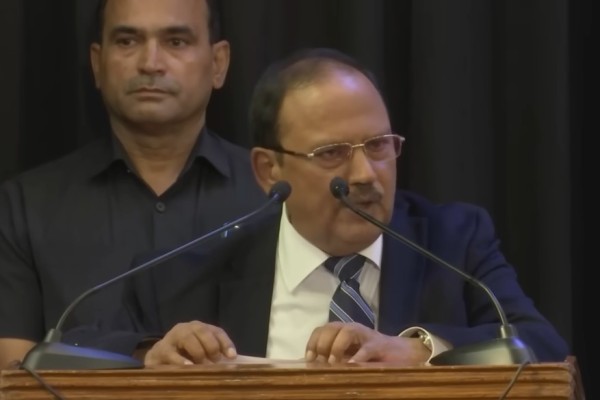
With these words, National Security Advisor Ajit Doval set the tone for his address at the Sardar Patel Memorial Lecture in New Delhi on October 31, where he spoke at length about the meaning, challenges, and purpose of governance in shaping a nation’s destiny.
Doval said governance was not merely about laws or systems but about delivery and trust. “Governance is about delivering on the promises of the state, maintaining order, ensuring justice and fairness, and building faith among the people.” When governance fails, he cautioned, “no power on earth can stop the disintegration of a society.”
Drawing on South Asian examples, Doval noted that differences in governance have defined the fates of neighbouring countries. “If we look around us, in countries like Bangladesh and others in South Asia, we see how the quality of governance decides whether nations progress or stagnate.” These examples, he suggested, underline that political systems may vary, but the essence of governance — competence, fairness, and stability — remains universal.
The NSA said the hallmark of strong governance lies in its continuity and integrity. He described how even visionary leadership is dependent on sound institutions that outlast individuals. “Institutions that are built with honesty and purpose ensure that governance remains steady, even when leadership changes.”
Doval credited Sardar Vallabhbhai Patel for laying the foundations of India’s administrative and institutional framework, saying that Patel’s ability to integrate over 500 princely states into a single nation was “a monumental achievement of governance, not just negotiation.” Patel’s approach, he added, showed that decisive action and fairness can coexist in public life.
At the same time, Doval warned that governance without accountability leads to decline. “When institutions become self-serving or corrupt, when the system stops serving the people, decay sets in.” He said societies that ignore this reality often face instability, regardless of their resources or external strength.
The NSA also drew a distinction between government and governance, noting that the former changes with elections while the latter endures through principles and institutions. “Governance is not what a government does; it is what the system delivers continuously to its citizens, irrespective of who is in power.”
He underscored that trust between citizens and institutions was central to national cohesion. “If people lose faith in the fairness of governance, the foundations of the state begin to weaken.” That trust, he said, cannot be manufactured overnight; it must be built over time through honesty, justice, and efficiency.
Doval spoke of India’s long civilizational ethos that values dharma — a sense of duty and righteousness — as the moral compass of governance. “Our traditions have always stressed that rulers must be guided by the idea of dharma — not as religion, but as moral duty towards the people.”
He reminded the audience that governance is not the responsibility of the state alone, but a shared commitment of every citizen. “Governance is everybody’s business — from the highest in power to the common man. Each has a role in upholding the system.”
Ending on a note of reflection, Doval said the ultimate test of governance lies not in ideology or rhetoric, but in results. “It is not what you promise, but what you deliver that counts. That is what makes people believe in their nation and its future.”
Trump’s LatAm Offensive Holds Stark Lessons for India
The Panama Canal, one of the world’s most vital maritime chokepoints, has once again become the epicentre of geopolitical turbulence. In an interview with StratNews Global, Nilanthan Niruthan, Executive Director of the Center for Law and Security Studies in Colombo, warned that President Donald Trump’s aggressive posture in Latin America—marked by U.S. naval strikes on Venezuelan vessels—signals the return of old-style American militarism cloaked in new justifications.
“The Panama Canal is indispensable to the United States,” said Niruthan. About 6% of global trade and roughly $300 billion worth of cargo pass through it every year, with nearly three-quarters of that traffic linked to American ports. Though control of the canal was officially handed to Panama in 1999, a 1977 treaty still permits Washington to intervene militarily if its interests are threatened. “It’s arguably America’s most important chokepoint,” he noted, “and central to its geopolitical imagination.”
Trump’s campaign against “narco-terrorism” in the region, Niruthan argued, offers a convenient pretext to militarize the Caribbean and reassert dominance over what Washington has always viewed as its “backyard.” The recent targeting of Venezuela fits that pattern. “Trump’s supporters expect him to act tough,” he said. “He sees the Panama Canal as property America built with its blood and sweat—and he wants to reclaim control.”
China’s investments—over $2.5 billion in Panama’s infrastructure—have heightened U.S. anxiety. “That’s clearly a factor driving Trump’s moves,” said Niruthan, adding that Latin America is now another flashpoint in a world already on edge from conflicts stretching from Gaza to Ukraine and the Taiwan Strait.
For India and South Asia, he said, the implications are sobering. “New Delhi must ask itself: are we ready to acknowledge that Latin America is Washington’s sphere of influence, just as South Asia is ours?” He pointed out that the U.S. routinely engages with Pakistan and smaller South Asian states without regard to India’s sensitivities. “So should India now reciprocate and engage Latin American countries on its own terms, even if that irritates Washington?”
There are also military lessons. Transnational drug trafficking, which the U.S. cites as justification for its operations, could one day pose similar challenges in South Asia. “If the region doesn’t get its act together, we could face the same problems Latin America does—becoming a hub or transit point for global crime networks,” Niruthan warned.
Ultimately, he said, the episode underscores a harsh truth: “Might makes right—and the world had better adapt.”
Germany I: Asylum-Seekers, Refugees Driving Anti-Foreigner Sentiment
In this the first of a two-part series, the author writes on Germany’s experience of allowing refugees and asylum-seekers that has contributed to a growing anti-foreigner mindset among common people
It was called the ‘refugee summer’. That year, 2015, saw two sides of Germany on display. One was the Willkommenskultur or ‘welcome culture’ wherein volunteers greeted asylum-seekers arriving at German railway stations with refreshments. Another was a four-fold spike in attacks on refugee shelters, as social anxiety surged about the new mouths to feed.
Over the two year period of 2015-16, a total of 1.2 million asylum-seekers entered Germany, the largest movement of conflict refugees into the country since World War II. On 31 August 2015, then German Chancellor Angela Merkel memorably told her fellow-citizens, ‘We can do it’.
She was referring to Germany’s capacity to absorb the economic strain that a refugee influx would pose. In July, the country had received 76,000 asylum-seekers. The following month, the number jumped to 170,000. Merkel was echoing the confident assessment of her own finance minister, who a day earlier, had used the same words.
Her critics alleged that the chancellor’s message to Germans was ‘you can do it’. They insisted she foisted an unfair burden on millions of ordinary Germans, while scoring narrow political points for herself. The real issue, according to this view, was not whether the country could bear the financial strain of the refugee crisis. Highlighting the healthy state of the German economy in 2015 was after all, a not-so-subtle way of trumpeting Merkel’s own achievements.
Rather, the question was how German citizens could plan for their physical safety in an environment flooded by potentially millions of undocumented persons? There was no answer, other than to dispute whether the refugee presence would lead to a deterioration of public safety.
Politics of Fear
To understand the deep psychological insecurity which opponents of Merkel spoke to, it is necessary to appreciate how regulated life is in many European states. Carrying a form of personal identification, although not strictly required by law, is advisable if one is over a certain age (16 years in the case of Germany) and wishes to avoid detainment during a random police check.
This applies especially to persons of non-European appearance, such as Africans, Arabs and Asians, regardless of their citizenship status. Back in 2012, a German court ruled that police who patrolled trains operating along certain routes, could demand to see identification documents from foreign-looking persons even if there was no suspicion that such persons were involved in wrongdoing.
The concept of ‘stranger-danger’ is therefore embedded in the European consciousness, due to how the state surveils (and controls) residents who do not look local. This sense of vulnerability was underscored on New Years Eve 2015, when over 500 crimes, 40% of a sexual nature, were committed in the city of Cologne by men.
The attackers were predominantly of Middle Eastern or North African appearance. Across Germany, 900 sex crimes were committed that evening, with perpetrators operating in large mobs that overwhelmed the capacity of law enforcement agencies to later identify and prosecute offenders.
What happened in Cologne gave wings to the political fortunes of a far-right party, the Alternative für Deutschland (AfD), which has since gone on to become Germany’s second-largest party in 2025. Despite having 152 seats in the 630-member Bundestag (federal parliament), the party has been controversially described by the German domestic intelligence service as being ‘right wing extremist’.
The current German Chancellor, Friedrich Merz, recently landed himself in a controversy when he implied that the presence of migrants in German cities was a threat to local womenfolk. Under pressure to retract, he doubled down but with an important qualification, making clear that he was opposed to undocumented migrants, not foreign workers who were in Germany on valid visas, and whose services the country needed.
Observers speculate that Merz was trying to dent the popularity of the AfD by adopting some of its rhetoric. They suggest that such tactics are doomed because emulation serves as the sincerest form of flattery, fostering an impression that the far-right is actually correct (or, in the right) when criticizing migration.
A Catch-Call Term
In part, the issue is over how ‘migrant’ is used in German political discourse. In the context of debates surrounding crime levels in Germany, it is used to mean ‘asylum-seekers’. Unofficially, the term has been applied to ‘foreigners’, regardless of whether they have a legal authorization to live and work in Germany or not. A few numbers are in order to explain the difference.
Roughly 26% of people living in Germany have a ‘migration background’. This broad category includes asylum-seekers, as well as foreign workers who may or may not require entry visas (depending on whether they are citizens of another European country which has an agreement permitting free movement of labour with Germany, such as the other European Union states), and lastly, German citizens with one non-German parent.
A smaller proportion of the total resident population in Germany, 17%, are foreigners who do not hold German passports. A very small number are actually asylum-seekers, around 4%. Yet, the 17% who can be labeled ‘foreigners’ have been disproportionately represented in criminal cases where suspects could be identified. Around 42% of all crimes have featured the involvement of foreign nationals, with asylum-seekers specifically making up 18% of the total number of criminal suspects.
One explanation offered for why migrants (here, referring only to asylum-seekers) are over-represented in crime statistics is that many migrants reside in urban areas where crime rates are already high. According to this theory, it is less the non-German identity of the migrants which is the problem and more the specific localities where they live, which pull them towards criminal activities.
Another theory is that a crime is more likely to be registered when the offender is a migrant, compared to when the offender is a native-born German. Uncertain about how to navigate cultural and linguistic differences, many Germans prefer to involve the police right from the outset instead of dealing with the conflict situation privately.
The Unspeakable
The problem with such explanations is that they do not address trends which have been observed in cases of sexually-motivated crime. Between 2004 and 2015, the rate of such crimes slightly decreased in Germany, but in 2016-17, when Germany was struggling to absorb the refugee flood stemming from the Syrian Civil War, a significant increase was recorded.
One explanation, provided by the German authorities, was that the definition of sexual crimes was widened in 2016 to include other offences. However, this was only offered as a partial explanation and no further attempt was made at accounting for the 2016 surge. The rate of sex crimes decreased slightly in 2018 but thereafter continued rising, with a sharp increase in 2022.
Coincidentally, that same year the Ukraine war led to another massive refugee crisis across Europe. One sensationalist claim is that in the following year, 2023, there were almost two-gang rapes occurring daily in Germany and in just under 48% of cases, the suspects were foreigners.
It is difficult therefore, to escape the conclusion that the possibility of a correlation between levels of illegal (some prefer the term ‘irregular’) immigration and that of sexually-motivated crimes must at least be explored. However, German bureaucratic discourse does not venture into this politically dangerous territory, meaning that the task of asking awkward questions is left to vigilante journalism.
One study holds that following the 2015 Cologne attacks, German electronic media focused six times as much on the ethnic origin of criminals as it did before. This might possibly have been because in the immediate aftermath of the attacks, either due to a failure of internal communication within the Cologne police department or in a clumsy effort to hide the truth of what had happened, the authorities released a misleading statement that the New Year’s festivities had passed off without incident. They only undermined their own credibility.
Things became worse when journalists with some of the leading media houses attempted to project the attacks as a result of failed efforts at assimilating earlier waves of migrants, rather than due to the mis-behaviour of the most recently-arrived migrants themselves. Their efforts to deflect blame from the Merkel government seem to have been motivated by alarm over the AfD’s rise, and how the party could see its popular support boosted by what had happened in Cologne.
Even before the events of New Year’s Eve 2015, a narrow majority of Germans (53% according to a survey) had started to feel that media projections of the refugees’ suitability for the German labour market were over-stated. Such skepticism played to the message of the AfD, which argued that political correctness had gripped the country’s media establishment.
Since then, the pendulum might have swung in the other direction. An October 2025 study has found that media reporting mentioned foreign-origin suspects three times more than their actual share in official statistics on violent crimes. Considering that the recorded level of foreign suspects in violent crimes was 34.3%, this would suggest that as per the impression generated by German news coverage, practically all serious crimes are perpetrated by foreigners.
A journalism professor associated with the second study claimed that when stories are selected, ‘many intuitive decisions result in a pattern of reporting that follows a right-wing populist agenda.’
Prem Mahadevan is Senior Analyst, Global Initiative Against Transnational Organized Crime, in Switzerland
How North Korea Blinds U.S. Intelligence
When North Korea tested an intercontinental ballistic missile on July 4, 2017, followed weeks later by a hydrogen bomb, the speed of its progress caught U.S. intelligence by surprise. That shock, as Lauren Cho explains in her analysis for the Bulletin of the Atomic Scientists, was not a one-off failure but part of a recurring pattern that has left Washington reacting rather than anticipating.
Cho writes that North Korea has repeatedly outmanoeuvred U.S. agencies through two main tactics — deception and exploitation of bureaucracy. The regime shows what it wants the world to see, hides what it must, and manipulates timing to shape foreign perceptions. Meanwhile, U.S. intelligence, slowed by rigid systems and old assumptions, often misreads the signals.
This is not new. From the 1994 Agreed Framework to the later Six-Party Talks, Washington believed it had frozen Pyongyang’s nuclear ambitions. Yet as international inspectors watched symbolic gestures like the demolition of the Yongbyon cooling tower, North Korean scientists quietly advanced uranium-enrichment elsewhere. Each cycle ended the same way: partial disclosure, misplaced optimism, and eventual surprise.
According to Cho, this happens because U.S. intelligence relies heavily on what can be counted or photographed — satellite images, missile parts, launch sites. North Korea, knowing this, manages visibility itself. It reveals just enough to mislead. “The less they show, the more confident the U.S. becomes in its incomplete picture,” Cho notes in the Bulletin piece.
The issue also runs deeper inside U.S. institutions. Analysts tend to favour established assessments and are hesitant to challenge them without overwhelming evidence. Once a consensus forms — such as the 2017 belief that Pyongyang was years away from an operational ICBM — it becomes hard to revise. This “institutional inertia”, Cho says, blinds intelligence agencies to fast-moving realities.
Pressure from policymakers makes it worse. Decision-makers often demand clear answers and timelines, leaving little room for uncertainty. To satisfy them, intelligence reports can overstate confidence in unclear data. For a country like North Korea, whose entire strategy is built on secrecy and confusion, that overconfidence works perfectly.
Cho argues that the U.S. needs to rethink how it gathers and interprets intelligence. She outlines three priorities. First, build flexible systems that reward questioning and tolerate changing assessments. Second, expand expertise beyond technology — analysts need to understand North Korea’s culture, language, and leadership style to decode its moves. And third, be open about uncertainty so that policymakers prepare for multiple outcomes rather than one neat prediction.
The article points out that deception is not unique to North Korea. Russia and China also use strategic ambiguity to hide or distort their capabilities. But Pyongyang has refined it into a survival tool — controlling uncertainty to deter attack while maintaining leverage in negotiations.
The lesson, Cho concludes, is that intelligence failure is not inevitable but preventable. “Deception will always exist,” she writes, “but surprise doesn’t have to.” For that, the U.S. must learn to adapt faster than its adversary and question its own habits of thought as sharply as it questions others’.
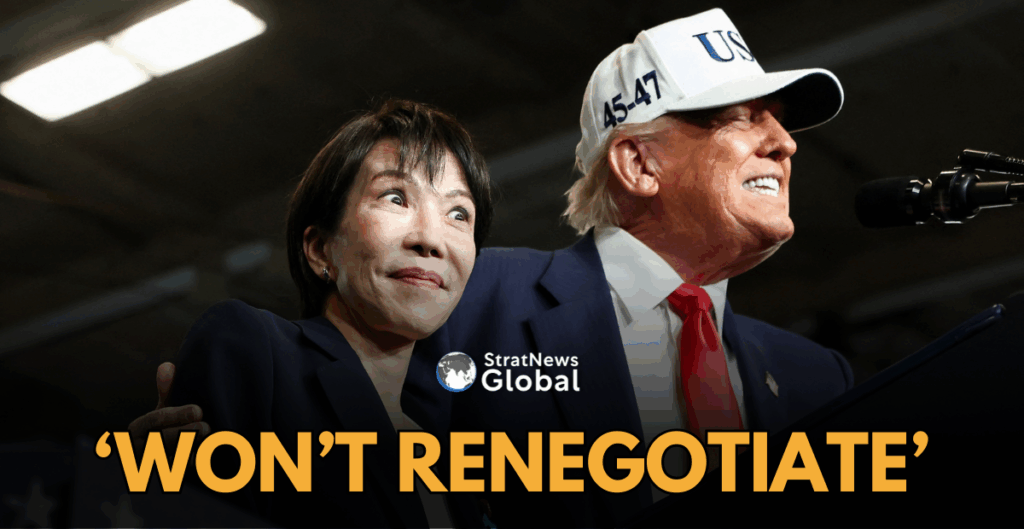
Japan Won’t Renegotiate $550 Bln Investment Deal With U.S, Says PM Takaichi
Japanese Prime Minister Sanae Takaichi said on Saturday that she had no plans to renegotiate a $550 billion investment package deal reached with the United States.
“I believe that even if the prime minister changes, promises made between governments should not be altered,” Takaichi told reporters at the end of a week of diplomatic events, including a summit with U.S. President Donald Trump.
Takaichi declined to comment on a trade deal that South Korea had inked with the United States, as details of the deal have not been disclosed yet.
Before becoming prime minister last month, Takaichi had said that tariff renegotiation with Washington was not off the table if something came up that seemed unfair and hurt Japan’s national interests.
Takaichi’s China Approach
Hardline conservative Takaichi was elected as Japan’s first female prime minister, breaking a political glass ceiling for women while also setting the country up for a decisive turn to the right.
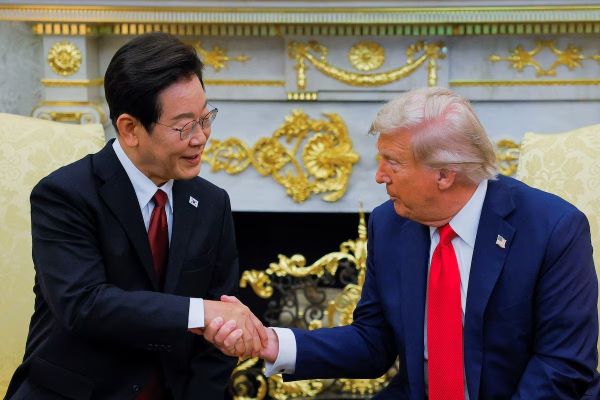
In Gyeongju, South Korea, Takaichi joined other leaders from around the Asia-Pacific region for an annual gathering and met Chinese President Xi Jinping and South Korean President Lee Jae Myung.
Takaichi said on Saturday that she and Xi had agreed to build a constructive and stable relationship.
Xi told Takaichi that the two countries should not be a threat to each other, according to Chinese state media.
At the meeting, Takaichi said she had “spoken frankly” with Xi about several pending issues, including Beijing’s export controls on rare earths.
But her agenda largely mirrored that of her predecessor, Shigeru Ishiba. It included concerns over Chinese activity in the East China Sea, the safety of Japanese nationals in China, stability in the Taiwan Strait, ending curbs on Japanese seafood and beef imports and the protection of human rights for Uyghurs and people in Hong Kong.
Before her South Korea trip, Takaichi also held her first bilateral meeting with Trump in Tokyo. She said she had “frank, direct discussions and built personal relationships” with Trump.
(with inputs from Reuters)
South Korea To Build N-Subs: What It Means For India And The Region
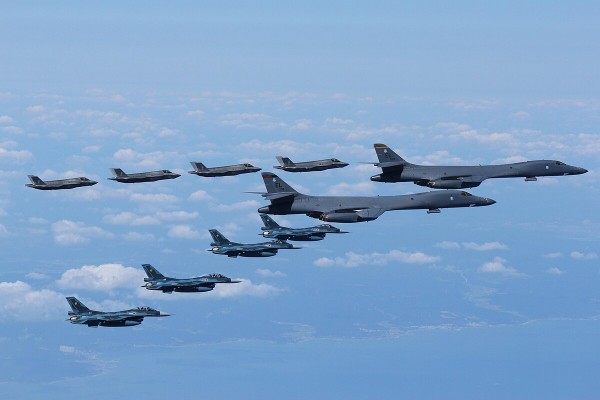
“Our (US South Korea) military alliance is stronger than ever before and based on that I have given them approval to build a Nuclear Powered Submarine.”
That post by Donald Trump on Truth Social (where else) has drawn a fair degree of interest here in India.
“South Korea has a mature civil nuclear power industry so the technology and expertise is there,” Rear Admiral Monty Khanna (Retd) told StratNewsGlobal. “It is also a major ship-building and submarine building nation although until now it has only designed and built conventional submarines.
“If it starts building nuclear powered submarines, it challenges the only other nuclear player native to the region, China. To that extent, it may constrain China’s naval movement towards the Indian Ocean,” he said.
Admiral Khanna, who commissioned two submarines for the Indian Navy, also pointed to a robust Delhi-Seoul relationship: the two are special strategic partners, bilateral trade now at around $27 billion is expected to hit $50 billion by the end of the decade.
In recent years, India has emerged as a major buyer of Korean military hardware including the K9 Vajra self-propelled guns, loitering munitions and there are plans to jointly build naval and land systems.
But there are other aspects to to the US-South Korea deal that merit mention. For one, it doesn’t appear likely that the nuclear powered submarines will be built in South Korea. Check out Trump’s post on Truth Social, which says:
“South Korea will be building its Nuclear Powered Submarine in the Philadelphia Shipyard, right here in the good ol’ USA. Shipbuilding in our country will soon be making a big comeback.”
The Philadelphia shipyard is one owned by the South Korean firm Hanwha. This arrangement ensure US security agencies control the environment in which the yard operates and thereby limits the possibility of nuclear and other technologies being leaked.
The Hanwha shipyard will add to US submarine-building capacities. Currently, there are two shipyards building nuclear submarines: General Dynamics Electric Boat facility in Groton, Connecticut and Newport News in Virginia.
There are some caveats: there’s a view in South Korea that it doesn’t need nuclear submarines given that the enemy is right next door (North Korea) and conventional subs should be adequate deterrence.
The other caveat concerns Japan, which won’t be comfortable if South Korea goes nuclear. There could be pressure on Tokyo to do the same, with or without Trump’s blessings is not clear.
Finally, the US Navy brass is reportedly against the idea of handing over its nuclear “crown jewels” to a country that it considers an ally (28,000 US troops defend South Korea against North Korea), but not of the stature of the UK or Australia.
Could Trump persuade them otherwise?