

Support us by contributing to StratNewsGlobal on the following UPI ID
ultramodern@hdfcbank

Strategic affairs is our game, South Asia and beyond our playground. Put together by an experienced team led by Nitin A. Gokhale. Our focus is on strategic affairs, foreign policy and international relations, with higher quality reportage, analysis and commentary with new tie-ups across the South Asian region.
You can support our endeavours. Visit us at www.stratnewsglobal.com and follow us on YouTube, Twitter, Facebook and Instagram.
र 500 per month
र 1000 per month
र 5000 per year
र 10000 per year
Donate an amount of your choice
र 500 per month
Donate र 500 per month

र 1000 per month
Donate र 1000 per month
र 5000 per year
Donate र 5,000 per year
र 10000 per year
Donate र 10,000 per year
Donate an amount of your choice
Donate an amount of your choice


India, Bahrain To Fast-Track Comprehensive Economic Partnership
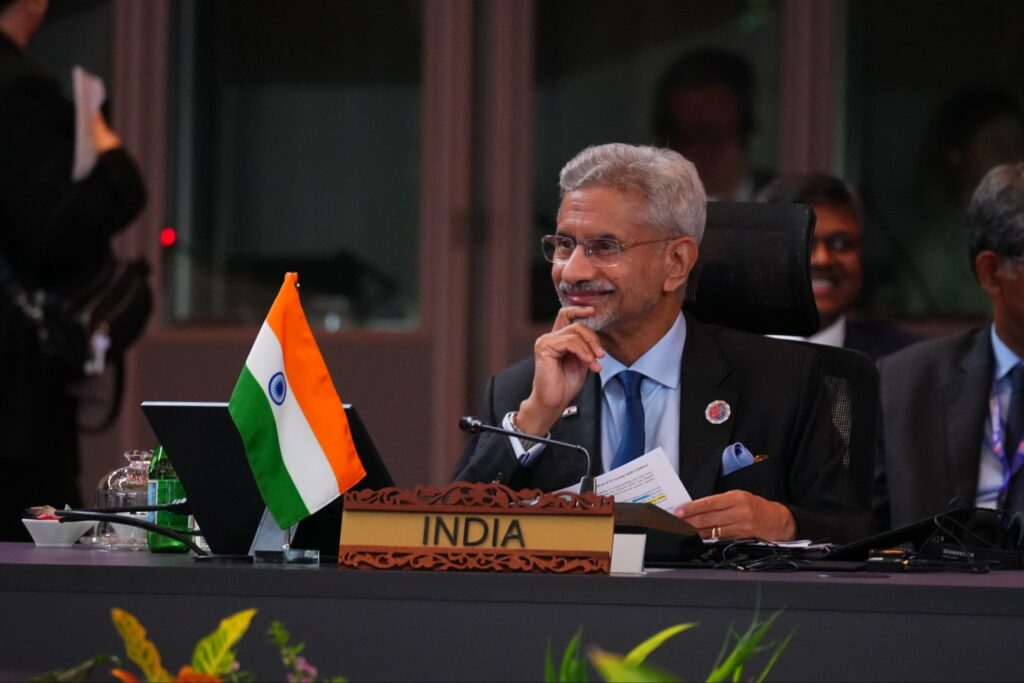
India and Bahrain on Monday announced a series of measures to deepen trade and economic engagement, enhance cooperation in emerging sectors, and expand people-to-people links as the two countries prepare to celebrate 55 years of diplomatic relations in 2026.
At the Fifth Meeting of the India–Bahrain High Joint Commission, co-chaired by India’s External Affairs Minister S. Jaishankar and Bahrain’s Foreign Minister Dr. Abdullatif bin Rashid Alzayani, both sides agreed to fast-track negotiations on a Comprehensive Economic Partnership Agreement (CEPA), conclude a Bilateral Investment Treaty, and commence discussions on a Double Taxation Avoidance Agreement (DTAA).
Economic Outcomes
The two ministers welcomed the steady rise in bilateral trade, which has reached $ 1.64 billion in FY 2024–25, and reaffirmed their commitment to further diversify trade in electronics, processed foods, petroleum products, base metals, and gems and jewellery.
The two countries also committed to strengthening institutional links between their investment authorities and private sectors to stimulate cross-border investments. The Bahrain Economic Development Board reiterated its intent to support Indian businesses investing in sectors such as manufacturing, logistics, ICT, tourism, and healthcare.
Jaishankar, in his opening remarks, highlighted that “India and Bahrain share centuries-old ties rooted in trade and friendship,” adding that the evolving global economic landscape presents “new opportunities in fintech, infrastructure, and renewable energy” for both sides.
The two governments also welcomed the growing role of Mumtalakat, Bahrain’s sovereign wealth fund, in exploring investment opportunities in India’s high-growth sectors.
Both sides expressed satisfaction with ongoing collaboration between the Bahrain Space Agency and New Space India Limited, which is expected to be formalized through an MoU.
In health, the second Joint Working Group meeting earlier this year identified new areas for partnership — including digital health, medical research, and medical value travel — building on the countries’ long-standing cooperation in pharmaceuticals and healthcare delivery.
Peace and Security
The two sides strongly condemned terrorism in all its forms, specifically the April 2025 Pahalgam attack, and expressed solidarity with the victims. They pledged to deepen cooperation on intelligence sharing, cyber security, and counter-terrorism capacity building.
On regional developments, India and Bahrain welcomed progress toward easing tensions in Gaza, stressing the need for a durable peace based on the agreed framework. Jaishankar reiterated India’s support for a “lasting and inclusive peace that ensures stability in the region.
People-to-People Bonds
Highlighting the “living bridge” between the two countries, both sides lauded the introduction of India’s electronic visa system for Bahraini nationals across nine categories in July 2025, a move expected to boost tourism, business, and cultural exchanges.
The ministers also welcomed Bahrain’s continued support for the Indian diaspora, with Jaishankar thanking the Bahraini leadership for pardoning 248 Indian nationals over the past two years.
The next meeting of the High Joint Commission will be held in Bahrain, with dates to be finalized through diplomatic channels.
“The progress we have achieved, from trade and technology to healthcare and space, reflects the strength and future promise of our partnership,” Jaishankar said. “Together, India and Bahrain are building a relationship that is economically vibrant, strategically relevant, and people-centric.”
Hong Kong Rejects Plea to Drop Tiananmen Vigil Case
Hong Kong’s High Court rejected an application by pro-democracy activist Chow Hang-tung on Monday to terminate a subversion trial involving herself and a group that once organised commemorations of the Tiananmen crackdown.
Chow, 40, the former vice-chair of the now-disbanded Hong Kong Alliance in Support of Patriotic Democratic Movements of China, and two other former leaders, Lee Cheuk-yan and Albert Ho, face up to 10 years’ imprisonment for “inciting subversion of state power”, under a China-imposed National Security Law.
She and others were accused of inciting others “to organise, plan, commit, or participate in acts by unlawful means with a view to subverting state power” between July 1, 2020, and September 8, 2021.
One-Party Rule
Chow, who represented herself, said she could not understand what those unlawful means were.
Prosecutor Ned Lai said “unlawful means” referred to any means aimed at ending the Chinese Communist Party’s leadership that would violate China’s constitution – particularly the Preamble and Article One, which enshrine the socialist system and the fundamental system of China.
Chow argued that ending the Chinese Communist Party’s leadership could be a goal or a result, but not a means. She also argued that the prosecution’s accusations were vague and insubstantial, amounting to a “catch-all” crime that made a fair trial difficult.
One of the three judges, Alex Lee, said the prosecution’s allegations were “just broadly defined”.
“Basically, any attempt to end one-party rule is considered unconstitutional. That’s their position,” Lee said.
The three judges rejected Chow’s application and will give their reasons one day before the trial starts on January 22.
Tiananmen Commemorations Blocked
The Alliance had for decades led annual commemorations in Hong Kong of the 1989 Tiananmen Square crackdown in Beijing. The ruling Communist Party has never released a figure for the number of deaths during the crackdown, but rights groups and witnesses say the figure could run into the thousands.
Since 2020, and with the enactment of the National Security Law, Hong Kong authorities have effectively blocked all public commemorations of the anniversary.
Chow and Lee Cheuk-yan have indicated they will plead not guilty to the charge, while Ho has indicated he will change his plea to guilty. All three remain in custody.
Fernando Cheung, a spokesperson for Amnesty International Hong Kong Overseas, said, “This court decision once again exposes how the Hong Kong authorities are weaponising the overly broad concept of ‘national security’ to suppress freedom of expression with impunity”.
The Hong Kong government has said people charged with a criminal offence have the right to a fair hearing.
(with inputs from Reuters)
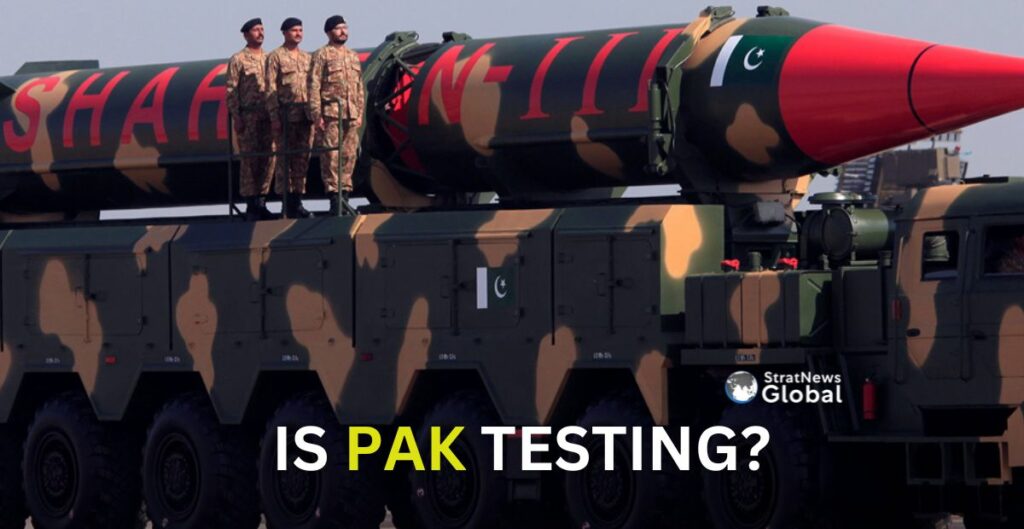
Pakistan Testing Nukes: Trump Claim Has Islamabad On Edge
In a bold and startling statement, Donald Trump has alleged that Pakistan is actively conducting underground nuclear tests. This came as Donald Trump is trying to justify his push for resuming U.S. nuclear testing amid rising global military tensions.
Speaking in an interview with CBS News, Trump asserted that Russia, China, North Korea and Pakistan were all conducting tests, and added that U.S. simply cannot remain the only major power abstaining from nuclear-testing.
Trump’s recent push to restart U.S. nuclear weapons testing after more than thirty years is being criticized as dangerous. Defending his decision to resume nuclear testing, Trump said the move is needed to verify the reliability of U.S. weapons, citing Russia’s recent tests of advanced nuclear systems.
No independent verification of recent Pakistani nuclear-explosion tests has surfaced, and Pakistan has not publicly acknowledged such activity.
Trump claims that U.S. has more nuclear weapons than any other country. “Enough nuclear weapons to blow up the world 150 times” he said.
US Energy Secretary Chris Wright has clarified the testing as ‘non-critical testing and not full nuclear explosions. It was the first clarification from the Trump administration since the president declared on social media last week that he had ordered the Department of War to resume nuclear testing “on an equal basis.”
Commenting on China, he said: “they’re makin’ ’em (nuclear arsenals) rapidly, and I think we should do something about de-nuclearisation”. Acknowledging China’s dominance over rare earth minerals, he said: “we have to fight back.” He acknowledged that he has discussed de-nuclearization with both China and Russia.
Donald Trump and Xi Jinping met on 30 October during the 32nd APEC Economic Ministers’ Meeting in South Korea, marking their first in-person meeting in over six years.
Trump’s comment puts Pakistan in an uncertain strategic position and raises apprehensions in India about Islamabad’s undisclosed nuclear activities.
Thailand, Cambodia Withdraw Heavy Weapons From Border Areas
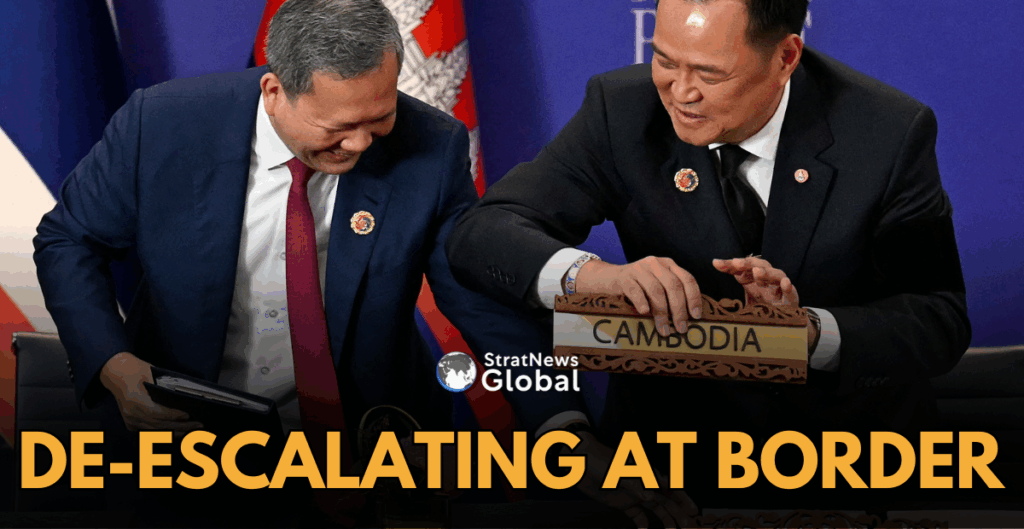
Thailand and Cambodia have begun withdrawing heavy weapons and conducting de-mining operations along their contested border as part of steps to de-escalate tensions following last week’s signing of an extended truce, Thai officials said on Monday.
The leaders of Thailand and Cambodia signed an enhanced ceasefire deal last week in Kuala Lumpur in the presence of the U.S.
President Donald Trump, three months after border tensions between the two countries exploded into a deadly five-day conflict.
Government spokesman Siripong Angkasakulkiat said Thailand would not release 18 Cambodian soldiers it has held since the conflict or reopen border checkpoints until it assessed that Cambodia was adhering to the agreement.
De-Mining Operations Underway
Rear Admiral Surasant Kongsiri, a Thai defence ministry spokesman, told a press conference that de-mining operations along the border have started, with Thailand proposing the removal of land mines in 13 areas and Cambodia in one.
On Friday, the two countries said in a joint statement that they had agreed to withdraw heavy weapons from the border in three phases, starting with rocket systems, followed by artillery and then tanks and other armoured vehicles.
On Saturday, the Cambodian defence ministry said the first phase of the withdrawal was scheduled to take three weeks from November 1.
“We expect the withdrawal of heavy weapons to be concluded by the end of the year,” Surasant said on Monday.
Thailand-Cambodia Conflict
The two countries have also stepped up joint efforts to combat transnational cybercrime and were working on an urgent joint demarcation effort at disputed border areas, he said.
The five-day war in July killed at least 48 people and temporarily displaced hundreds of thousands on both sides in what was the worst fighting between the two countries in decades. An initial ceasefire brokered in Malaysia with U.S. involvement was signed on July 28.
(with inputs from Reuters)
Nepal’s Supreme Court Stops Recall of 11 Ambassadors
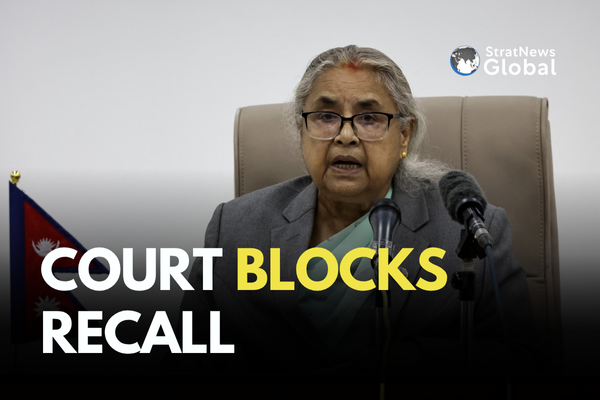
Nepal’s Supreme Court has ordered an immediate halt to the government’s decision to recall nearly a dozen ambassadors, a move seen as a setback for Prime Minister Sushila Karki and her interim administration.
Court Ruling Challenges Government Decision
According to lawyer Ananta Raj Luitel, who brought the case against the government, the court found that the administration failed to justify its claims of poor performance against the ambassadors. Karki’s government had announced the recall of 11 envoys, including those posted to China, the United States, Britain and Japan.
“The government could not justify its charges against the ambassadors in the court,” Luitel told Reuters. He confirmed that all ambassadors would continue their duties as usual.
Communications and Information Technology Minister Jagdish Kharel said the government would fully comply with the court’s decision. “The government will respect the order of the Supreme Court,” he stated.
Political Setback For Prime Minister Karki
Prime Minister Karki, aged 73, became Nepal’s first woman leader in September after a wave of anti-corruption protests turned deadly. Her administration has been under pressure from the Gen Z movement, whose young supporters have demanded sweeping reforms and the removal of officials appointed by former Prime Minister K.P. Sharma Oli.
Political analyst Puranjan Acharya described the court ruling as a significant challenge for Karki. “She recalled the ambassadors under pressure from the Gen Z people, fully aware that it would be difficult for the government to defend it in the court,” he said. However, he added that in the long term, the ruling could strengthen Karki’s position by helping her resist future political pressure.
Karki’s Reform Agenda And Public Pressure
Karki has formed a small cabinet of reform-minded figures with strong anti-corruption records. She is responsible for conducting fresh parliamentary elections by 5 March. Despite her reform agenda, she faces increasing public pressure to dismiss other officials, including the head of the anti-corruption commission, who was also appointed by her predecessor.
The Gen Z movement’s protests in early September left 76 people dead and over 1,300 injured, marking one of the most turbulent political moments in recent years. The Supreme Court’s decision now places additional limits on Karki’s authority as she seeks to balance reform promises with legal and political realities.
(with inputs from Reuters)
Afghanistan: 6.3-Magnitude Earthquake Kills 20, Injures Hundreds
A 6.3-magnitude earthquake struck near the northern Afghan city of Mazar-e Sharif early on Monday, killing at least 20 people, injuring hundreds and damaging the city’s historic Blue Mosque, authorities said, with the death toll likely to rise.
The U.S. Geological Survey said the quake hit at a depth of 28 km (17.4 miles) near Mazar-e Sharif, which has a population of about 523,000.
At least 20 people were killed and around 320 were injured, Health Ministry spokesperson Sharfat Zaman said, but officials warned the toll could rise as rescue teams reached remote villages in the worst-hit provinces of Balkh and Samangan.
Videos shared on the social media platform X showed emergency responders searching the rubble for survivors. One video showed rescuers pulling what appeared to be dead bodies from collapsed buildings. Reuters could not immediately verify the footage of rescue efforts.
“Our rescue and health teams have arrived in the area, and all nearby hospitals have been put on standby by the leadership to treat the injured,” Zaman said.
Holy Shrine Damaged
The earthquake damaged part of the Blue Mosque, the holiest shrine in Mazar-e Sharif, Balkh province spokesperson Haji Zaid said.
The mosque is considered one of the holiest sites in Afghanistan and is believed to be the burial site of the cousin and son-in-law of the Prophet Mohammad. The current structure was built in the 15th century.
Footage shared on social media and verified by Reuters showed broken masonry and tiles lying in the courtyard of the mosque, though the main structure remained standing.
The disaster is the latest challenge for war-torn Afghanistan’s Taliban administration, already grappling with crises including an August quake that killed thousands, a sharp drop in foreign aid and mass deportations of Afghan refugees by neighbouring countries.
The quake disrupted power across the country, including in the capital Kabul, national power supplier Da Afghanistan Breshna Company said in a statement.
The USGS said “significant casualties are likely and the disaster is potentially widespread”.
Active Faults
Afghanistan is particularly vulnerable to quakes as it lies on two active faults that have the potential to rupture and cause extensive damage.
More than 2,200 people were killed and thousands more injured after a quake and strong aftershocks in the southeast of the war-shattered Islamic country at the end of August.
Past events with this alert level have required a regional or national level response, the system’s alert added.
(with inputs from Reuters)
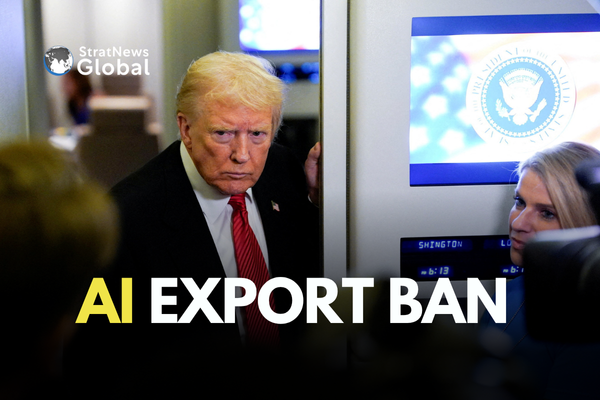
Trump Bars China From Accessing Nvidia’s Blackwell AI Chips
US President Donald Trump has said that Nvidia’s most advanced artificial intelligence chips will be kept exclusively for American companies, blocking China and other nations from accessing the high-end technology.
Tightened Restrictions on AI Chip Exports
In a televised interview aired on CBS’ 60 Minutes and in comments made aboard Air Force One, Trump stated that the United States would not allow other countries to obtain Nvidia’s Blackwell chips — currently the company’s most powerful AI semiconductors.
“The most advanced, we will not let anybody have them other than the United States,” he told CBS. He added during the flight, “We don’t give the Blackwell chip to other people.”
The statement indicates that Trump could tighten export rules beyond previous US policy, which already limited the sale of advanced AI chips to China. The decision could also impact other nations relying on American semiconductor technology.
Balancing AI Leadership and Export Policy
Earlier this year, the Trump administration introduced a new artificial intelligence strategy aimed at expanding AI exports to allied nations while maintaining America’s technological lead over China. However, the latest comments suggest a shift toward stricter control of critical hardware.
Last week, Nvidia announced plans to deliver more than 260,000 Blackwell AI chips to South Korea, supplying major companies such as Samsung Electronics. Yet, questions remain about whether any version of these chips could be exported to China.
Trump clarified that while Chinese firms might have limited access to less powerful Nvidia products, they would not receive the top-tier Blackwell models. “We will let them deal with Nvidia but not in terms of the most advanced,” he said.
Political Concerns Over China’s Access
The possibility of selling even downgraded chips to China has drawn strong criticism from lawmakers in Washington. Republican Congressman John Moolenaar, who chairs the House Select Committee on China, warned that allowing such exports “would be akin to giving Iran weapons-grade uranium.”
Trump said he had considered discussing the chip issue with Chinese President Xi Jinping before their recent meeting in South Korea but confirmed that the subject did not arise.
Nvidia CEO Jensen Huang has also stated that the company has not sought US export licences for China, noting that Beijing has shown little interest in dealing with Nvidia under current restrictions.
(with inputs from Reuters)
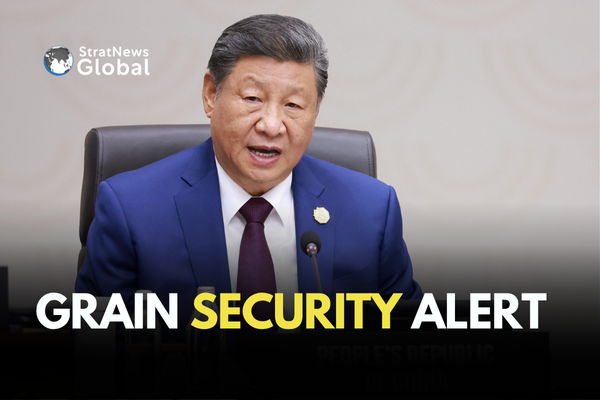
China Tightens Security As Foreign Spies Target Agricultural Data
China’s Ministry of State Security (MSS) has warned that foreign intelligence agencies are intensifying efforts to illegally obtain genetic data and seed resources from the nation’s grain industry. The ministry described these actions as a growing threat to national food security.
Ministry Cites Escalating Espionage Risks
According to a statement released on the MSS’s official WeChat account, foreign agents have been increasingly targeting China’s agricultural sector in recent years. The ministry said they have sought to steal genetic information from key crops such as soybeans, corn, and rice. Officials warned that such thefts could undermine China’s ability to protect its grain supply and agricultural research.
Food security has long been viewed by Beijing as an essential element of national security. Analysts note that China’s stance mirrors the US approach to energy security, where economic and resource stability are closely tied to national safety.
Case of Seed Smuggling and Foreign Surveys
The ministry cited the case of a Chinese businessperson, identified only by the surname Zhu, who sold restricted “parental seeds” to a foreign entity under a supposed “joint seed cooperation” project. These seeds, which are used in hybrid experiments and banned from export, were hidden in containers falsely declared for other products.
Zhu was sentenced to one and a half years in prison. Seventeen others connected to the case received administrative punishments.
In another incident, the MSS said foreign consular staff and agricultural experts from “a certain country” conducted unauthorised field surveys in one of China’s key farming provinces. They reportedly collected information on crop yields and reserves while using counter-surveillance tactics, such as switching vehicles and travelling along rural backroads to avoid detection.
Public Urged to Stay Alert
The ministry said it had intervened in both cases and continues to monitor foreign activities in the sector. Authorities called on the public to report suspicious behaviour through official hotlines or online channels, emphasising that protecting agricultural resources is vital to national stability.
(with inputs from Reuters)
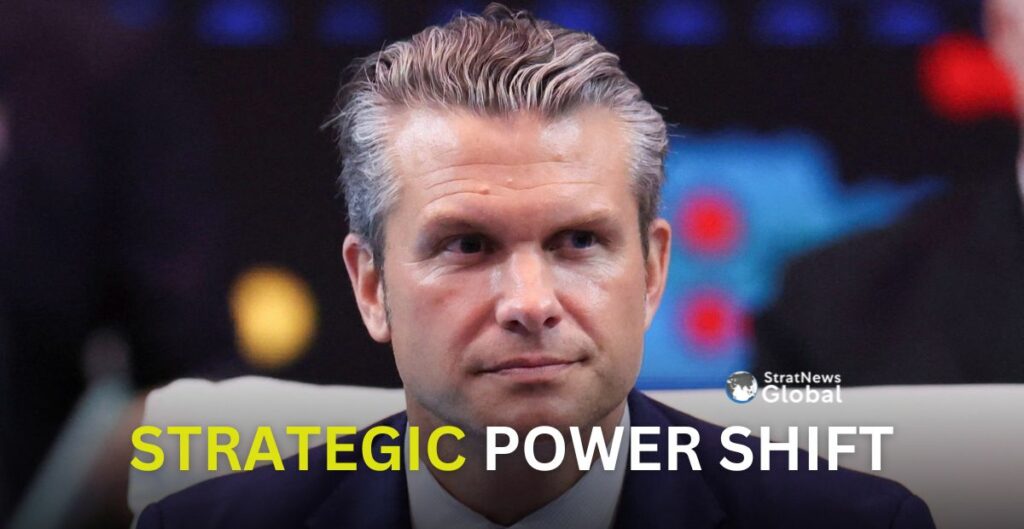
US Mulls ‘Flexible Use’ Of Its Troops In South Korea
U.S. Defense Secretary Pete Hegseth arrived in South Korea on Monday for talks on redefining the role of American forces amid shifting regional security dynamics. He is also expected to visit the DMZ border with North Korea.
The defence chiefs are scheduled to hold the annual Security Consultative Meeting (SCM) on Tuesday, the highest-level forum where the two countries chart the course of their military alliance and South Korea’s defence against nuclear-armed North Korea.
Balance of Power
South Korean Defense Minister Ahn Gyu-back and Hegseth will discuss combined defence readiness against North Korea and cooperation on regional security and cyber and missile defence, the South’s ministry said.
The two are expected to discuss plans to respond to the “changing security environment and threats” by developing the alliance between the two countries, it said.
Washington is considering making the role of the 28,500 U.S. troops in South Korea more flexible with an eye on maintaining the balance of power in Asia amid concerns about Chinese activities in the South China Sea and around Taiwan.
U.S. officials have signalled a plan to make the U.S. forces more flexible to potentially operate outside the Korean peninsula in response to a broader range of threats such as the defence of Taiwan and to check China’s growing military reach.
Growing Defence Capabilities
South Korea has opposed changing the U.S. troop role but has expanded its defense capacity over two decades to eventually lead combined forces in wartime.
South Korea plans the largest defence budget increase in years for 2026 partly to address U.S. President Donald Trump’s demand that its allies pay more for U.S. military presence in their countries.
Hegseth is expected to visit the Panmunjom truce village on the Demilitarized Zone (DMZ) border with North Korea with South Korea’s Ahn.
Nuclear-armed North Korea has ignored overtures from Trump and South Korean President Lee Jae Myung for dialogue and has dramatically advanced its missile and conventional military capabilities.
(With inputs from Reuters)
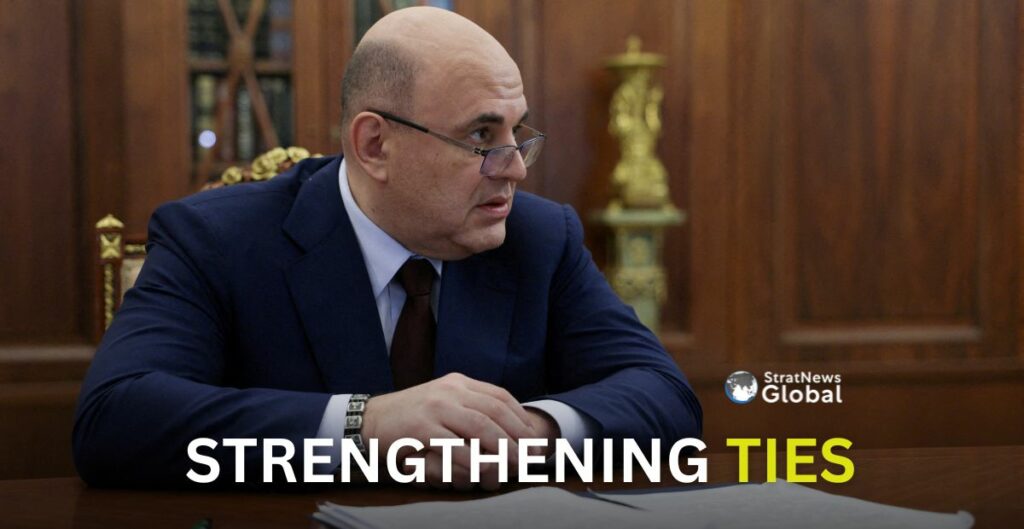
Russia PM Mishustin In China As US Sanctions Bite
Russian Prime Minister Mikhail Mishustin began a two-day visit to China on Monday, where he is set to meet President Xi Jinping and Premier Li Qiang to discuss economic and technological cooperation amid Western pressure.
Mishustin is scheduled for a regular heads-of-government meeting with Li in Hangzhou on Monday, and will travel to Beijing on Tuesday for talks with Xi, TASS agency reported, citing the Russian government’s press service.
The last heads-of-government meeting between China and Russia took place in Moscow in August 2024, where Li praised the “new vigor” and “vitality” in bilateral ties.
The Kremlin attached “very great” importance to Mishustin’s visit to China, spokesman Dmitry Peskov said on Friday, Interfax agency reported.
Trade Amid Sanctions
Putin and Xi signed a “no limits” partnership in February 2022, just before Russia’s invasion of Ukraine. Since then, Moscow has turned to Beijing to mitigate the impact of Western sanctions, highlighting record bilateral trade, increased settlements in yuan and deepening energy cooperation.
U.S.–China friction over trade and technology under U.S. President Donald Trump, which strained relations between Washington and Beijing, has also encouraged both Moscow and Beijing to strengthen cross-border commerce to counter Western pressure.
However, China-Russia trade has been declining in recent months, which the Russian Industry and Trade Minister Anton Alikhanov attributed to “external” economic pressure and “market saturation” of Chinese products in Russia.
Strengthening Partnership
Mishustin’s talks in China were expected to focus on trade and economic ties, transport and industrial cooperation, enhanced energy partnerships and expanded collaboration in advanced technology and agriculture, TASS reported.
Moscow views industrial and technological cooperation with Beijing as a more sustainable format for long-term cooperation, being less dependent on market conditions, according to Russian state media.
On Sunday, Russia’s Deputy Prime Minister Dmitry Chernyshenko and China’s Vice Premier He Lifeng chaired a commission meeting in Ningbo that flagged growth in copper and nickel exports and wider farm-goods access, the Russian government said on its Telegram channel.
(With inputs from Reuters)