

Support us by contributing to StratNewsGlobal on the following UPI ID
ultramodern@hdfcbank

Strategic affairs is our game, South Asia and beyond our playground. Put together by an experienced team led by Nitin A. Gokhale. Our focus is on strategic affairs, foreign policy and international relations, with higher quality reportage, analysis and commentary with new tie-ups across the South Asian region.
You can support our endeavours. Visit us at www.stratnewsglobal.com and follow us on YouTube, Twitter, Facebook and Instagram.
र 500 per month
र 1000 per month
र 5000 per year
र 10000 per year
Donate an amount of your choice
र 500 per month
Donate र 500 per month

र 1000 per month
Donate र 1000 per month
र 5000 per year
Donate र 5,000 per year
र 10000 per year
Donate र 10,000 per year
Donate an amount of your choice
Donate an amount of your choice


Nepal Turns To Neighbours For Support As Election Nears
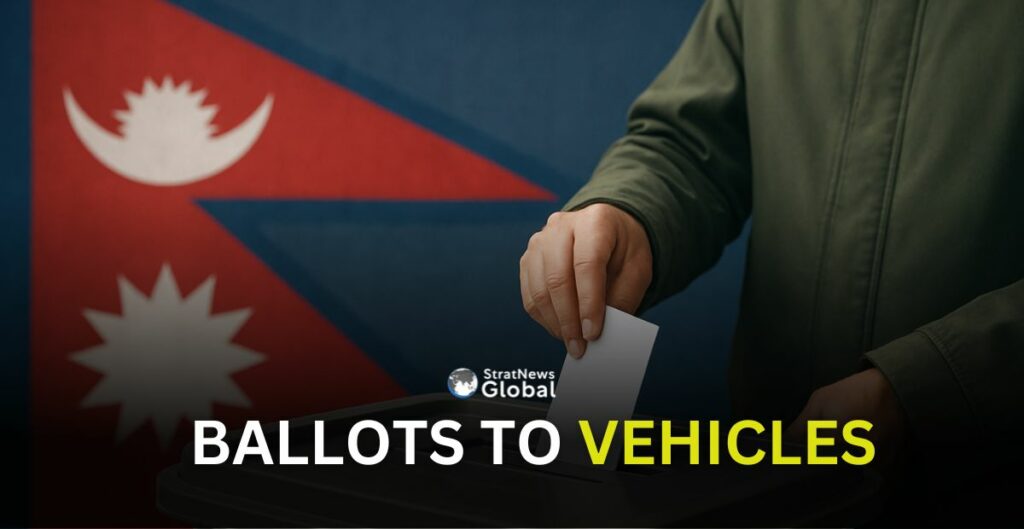
With a little over two months to go for elections, key agencies of the Nepali government including the Election Commision and the police, have underscored major logistical deficits that need to be filled immediately. Required are vehicles of every kind to move ballot boxes, personnel and equipment over hilly terrain and in inhospitable conditions.
Nepal will be calling upon its immediate neighbours India and China to help and the Election Commission has confirmed that it has forwarded a detailed list of what it requires to the finance ministry.
According to a report in the Kathmandu Post, Acting Chief Election Commissioner Ram Prasad Bhandari emphasised “The commission has sent the list to the government to be handed over to the two countries through diplomatic channels.”
The paper said the International Economic Cooperation Division of the Finance Ministry will liase with external governments to take forward the requests. Earlier Prime Minister Sheila Karki said neighbours were pitching in with vehicles and financial assistance.
A report in Rising Nepal said “The Nepal Police remains the most affected since the GenZ protests … during which a significant portion of its vehicles and logistics were destroyed. The police now face a critical shortage of both vehicles and weapons for the upcoming elections and everyday security of the public.”
During the protests in September, demonstrators torched or vandalised more than 600 vehicles belonging to security agencies. Nepal Police alone lost over 500 vehicles, while the Armed Police Force saw dozens destroyed. With the Election Commission planning a single-phase vote on March 5, authorities say restoring transport and communication capacity is critical to maintaining peace and order.
India, which provided 200 vehicles for the 2022 elections, is expected to respond positively again. Chinese officials have also indicated their readiness to contribute.
To bridge the shortfall, the government has allocated funds to purchase 251 new vehicles — 175 for the Nepal Police, 70 for the Armed Police Force, and six for the National Intelligence Department. The Finance Ministry has approved Rs 1.27 billion (INR 75.11 cr) for the procurement.
In addition to this, the Election Commission has estimated a total budget of Rs 7.8 billion for the polls, most of which will go toward managing human resources. Security costs are expected to rise further as the government plans to recruit thousands of temporary police personnel to bolster forces during the election period.
Australia HC Blocks Russia From Building New Embassy
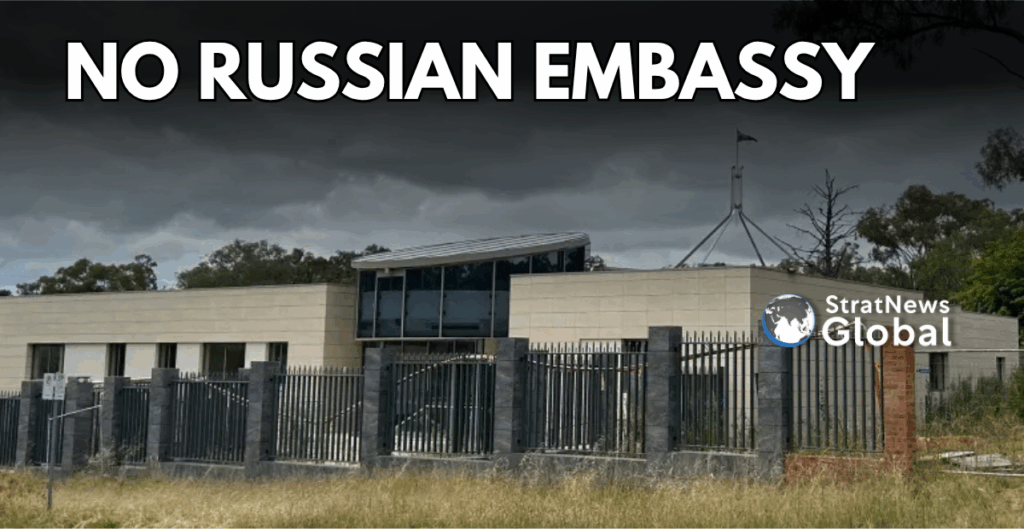
Australia ‘s highest court on Wednesday blocked Russia from building a new embassy in the nation’s capital, unanimously upholding a law that cancelled its lease on national security grounds.
Russia owned a lease to a plot of land that is about 300 metres (984 feet) from Parliament House in Canberra, Australia, and intended to build a new embassy building there to replace an older building elsewhere in the capital.
But in 2023, the Australian government introduced a law to cancel the lease after receiving “very clear security advice as to the risk presented by a new Russian presence so close to Parliament House,” Prime Minister Anthony Albanese said at the time.
Russia challenged the law in front of the High Court of Australia, arguing that parliament was not authorised under the constitution to pass such a law.
Compensation For Moscow
On Wednesday, the court ruled unanimously that the Home Affairs Act 2023 validly invoked the parliament’s constitutional power to seize land on “just terms,” though it said Moscow was entitled to compensation.
The Russian government secured a 99-year lease for diplomatic use of the site in 2008, paying A$2.75 million ($1.79 million).
Construction on the new site kicked off, but was never completed. Russia’s existing embassy is in Griffith, a suburb.
Australia’s government argued that the lease’s cancellation was supported by parliament’s power to make laws for the nation’s territories, including the Australian Capital Territory, where Canberra is located.
It added that it did not need to pay Russia “just terms” because the constitution only required compensation in cases where property was acquired for a specific use case, which it said did not exist in this instance.
It also argued that compensation should not extend to paying a foreign state, as it would be “incongruous” with the Home Affairs Act.
The court said the absence of a proposed use or application for the land was “irrelevant” and compensation “is what the constitution requires.”
Australian Attorney-General Michelle Rowland welcomed the High Court’s decision.
“Australia will always stand up for our values and we will stand up for our national security,” she said in a statement.
“The government will closely consider the next steps in light of the court’s decision.”
The Russian embassy did not immediately respond to a request for comment.
(with inputs from Reuters)
China: Media Continues To Attack Japan PM After Taiwan Spat
A spat between China and Japan over Japanese PM Sanae Takaichi’s Taiwan comments showed no signs of abating on Wednesday after a series of vitriolic articles in Chinese state media and calls in Tokyo to expel a Chinese diplomat.
Japan PM Takaichi sparked the furore with remarks in parliament last week that an attack by China on Taiwan could amount to a “survival-threatening situation” and trigger a potential military response from Tokyo.
That drew a formal protest from China and a threatening post from China’s Consul General in Osaka, Xue Jian, aimed at the Japanese PM, which Tokyo said was “extremely inappropriate” and complained to Beijing about.
While Takaichi has since said she would refrain from making such comments again and Tokyo called for mutual efforts to reduce friction on Tuesday, a brace of editorials in Chinese state media suggest the furore could rumble on.
‘Troublemaker’
State broadcaster CCTV said in an editorial late Tuesday that Takaichi’s remarks were of “extremely malicious nature and impact” and have “crossed the line” with China.
A post on a social media account affiliated with CCTV called Takaichi a “troublemaker”, using the word as a play on the pronunciation of her family name in Chinese.
“Has her head been kicked by a donkey?” the post on the Yuyuan Tantian account challenged.
“If she continues to spew shit without any boundaries like this, Takaichi might have to pay the price!”
The CCTV editorial also likened Takaichi’s reference to “survival-threatening situations” to Japan’s 1931 invasion of northeast China’s Manchuria.
Japan’s foreign ministry did not immediately respond to a request for comment.
Calls To Expel Chinese Diplomat
Japan’s leaders have until now avoided mentioning Taiwan when publicly discussing such scenarios, maintaining a strategic ambiguity also favoured by Tokyo’s main security ally, the United States.
Beijing claims Taiwan, and has not ruled out using force to take control of the island, which sits just over 110 km (68 miles) from Japanese territory. Taiwan’s government rejects Beijing’s sovereignty claims.
Meanwhile, some senior political figures in Tokyo have called for Japan to consider expelling the Chinese diplomat Xue, who shared a news article about Takaichi’s remarks on Saturday and commented: “the dirty head that sticks itself in must be cut off”.
Takayuki Kobayashi, the ruling party’s policy chief, urged the government on Tuesday to expel Xue if Beijing showed no effort to resolve the situation. Prominent opposition lawmaker Kenta Izumi also called for Xue’s quick expulsion.
(with inputs from Reuters)
In A First, Thai King To Visit China, Signaling Closer Ties
When King Maha Vajiralongkorn arrives in Beijing on Thursday, he will become the first reigning Thai monarch to make a state visit to China, in what analysts say is a sign of the Asian giant’s increasing influence on his kingdom.
A constitutional monarchy since 1932, Thailand has used royal visits as foreign policy tools, including two U.S. trips by King Vajiralongkorn’s father, King Bhumibol Adulyadej, during the height of the Cold War in the 1960s.
Beijing and Bangkok established diplomatic relations in 1975, and their bilateral ties have evolved from the post-Cold War years, with a significant expansion in two-way trade and investment.
China is the largest import market for Thailand, which shipped in Chinese goods worth $80 billion last year, as well as a top source of visitors for its vital tourism sector and a major investor in industries such as automobiles.
Migration from China to Thailand also spans centuries, and many Thai families, including captains of industry, business, and politics, have Chinese ancestry.
Deep-Rooted Friendship
“Thailand and China share a special bond; we see them as siblings and they see us as family,” said former Thai foreign minister Tej Bunnag, who also served as ambassador to Beijing.
In a statement announcing the visit by King Vajiralongkorn and his wife Queen Suthida, the Thai government said it was a reflection of “the deep-rooted friendship and mutual understanding shared between Thailand and China at all levels.”
In Beijing, the king is scheduled to meet with Chinese President Xi Jinping and Premier Li Qiang, although no agreements are expected to be signed between the two countries.
Since his ascension to the throne in 2016, King Vajiralongkorn has only made one official trip abroad, to Bhutan in April.
“China is the first major country that His Majesty King Maha Vajiralongkorn officially visits,” Chinese Foreign Ministry spokesperson Mao Ning said in a briefing last week.
“This fully demonstrates the great importance that the two sides attach to growing bilateral relations.”
Official Mourning
Despite invitations, the late King Bhumibol – who spent seven decades on the throne – did not visit China. Instead, he sent representatives, including the current king when he was Crown Prince in 1987, said Sitthiphon Kruarattikan, an international relations scholar at Bangkok’s Thammasat University.
“Look at all the countries that China has diplomatic relations with, the heads of state of most of those countries have been to China, with Thailand an exception for a long time,” he said.
“To have a reigning Thai monarch visiting, this is what the Chinese wanted,” Sitthiphon said.
The visit comes during an official mourning period, just weeks after the death of the king’s mother, signifying the importance the royal court gives to Beijing.
China’s Presence In Thailand
As in other parts of Southeast Asia, China has grown increasingly assertive in Thailand, pressing the government to intensify efforts against cross-border cyber scams and repeatedly discouraging the legalization of gambling, citing concerns about the possible impact on Chinese tourists.
In February, Beijing also succeeded in persuading the Thai government to deport 40 Uyghurs in detention in Bangkok, an issue that had been stalled for a decade.
Although a robust long-term relationship with China is vital, Thailand must also look out for its own interests, said former foreign minister Tej.
Thai officials have flagged the flare-up in trade tensions between the United States and China as a big risk to Southeast Asia’s economy.
“China is a big country and they look at things at a global level,” Tej said.
“We are a small country in Southeast Asia, and we have to maintain a balance in our foreign relations.”
(with inputs from Reuters)
Australia, Indonesia Agree On New Security Pact
Australia and Indonesia have agreed on a new security pact committing them to consult each other if either faces a threat, Australian Prime Minister Anthony Albanese said in Sydney on Wednesday alongside President Prabowo Subianto.
Albanese, who accompanied Prabowo on a visit to an Australian naval base in the city, said the treaty was a major extension of previous security deals, and commits to regular security dialogue between leaders.
“If either or both countries’ security is threatened, to consult and consider what measures may be taken either individually or jointly to deal with those threats,” he said.
Indonesia’s Commitment to Close Ties
Prabowo told reporters that the treaty committed to close cooperation between the neighbours in defence and security fields.
“Our determination is to maintain the best of relationships in order to enhance and guarantee security for both of our countries,” he said.
Indonesia has a non-aligned foreign policy, pledging to befriend any country without joining any military bloc.
Treaty Expected in 2026
Australia’s Foreign Minister Penny Wong said in a statement the treaty was expected to be signed next year. It was modelled on a 1995 security agreement between the two countries, she added.
The 1995 deal was withdrawn in 1999, after Australia led a United Nations peacekeeping force in East Timor, which was plunged into violence as it sought independence from Indonesia.
Balancing Regional Relationships
Australia has recently sought to boost defence ties with its neighbours, striking a mutual defence treaty with Papua New Guinea to its north last month.
Unlike the PNG treaty, the Indonesia agreement does not commit to acting to meet common danger, said Euan Graham, a senior analyst for defence strategy at the Australian Strategic Policy Institute.
Albanese could show he had put the Indonesia relationship back on track, while for Prabowo it was “classic balancing behaviour”, showing he was keeping Australia happy if concerns were raised that Indonesia was tilting too much towards Russia or China, he added.
(With inputs from Reuters)
China-Linked Hackers Targeted Australia’s Telecom, Warns Spy Chief
Australia’s spy chief said on Wednesday that the hackers linked to the Chinese government and military had targeted the country’s telecommunications systems and critical infrastructure, cautioning that a sabotage attack could seriously harm the nation’s economy.
Cost Of Cyber Sabotage
The Australian Security Intelligence Organisation’s director general of security, Mike Burgess, told a business conference in Melbourne that espionage was estimated to have cost Australia A$12.5 billion ($8.1 billion) last year, including the loss of A$2 billion in trade secrets and intellectual property.
Burgess highlighted the threat of cyber sabotage, describing the activities of the Salt Typhoon and Volt Typhoon Chinese hacking groups, which he said were “hackers working for Chinese government intelligence and their military”.
Salt Typhoon had not only penetrated U.S. telecommunications systems in a strategic spying operation but also “have been probing our telecommunication networks here in Australia too,” he said.
Volt Typhoon had intention to disrupt, he said, compromising U.S. critical infrastructure to pre-position for potential sabotage.
“We have seen Chinese hackers probing our critical infrastructure as well,” he added.
Impact of Hacking
Burgess warned of the potential impact on the community of widespread telecommunications disruption, including to banks and transport, and through cut-off water supplies and power.
“I assure you; these are not hypotheticals – foreign governments have elite teams investigating these possibilities right now,” he said.
Other potential scenarios included an Australian company being crippled as a trade competitor, or causing panic during an election, he added.
Chinese officials made multiple complaints to the Australian government and private sector about ASIO whenever he spoke publicly about China, Burgess said last week during a speech at the Lowy Institute in Sydney. “It won’t stop my resolve,” he said.
(With inputs from Reuters)
Vietnam Eyes Tariff Cuts As US Seeks Deficit Cut In Trade Deal
Vietnam aims to sign a trade agreement with the United States soon, Deputy Prime Minister Bui Thanh Son said on Wednesday as a fresh round of talks begins in Washington.
In October, the two countries agreed to finalise a trade deal within weeks that would maintain U.S. tariffs of 20% on its imports of Vietnamese goods, but exempt some unspecified products from the new duty imposed by U.S. President Donald Trump in August.
Reducing Trade Deficit
Assistant Secretary of State for East Asian and Pacific Affairs, Michael DeSombre, told the conference that the trade deal should rebalance commercial flows between the two countries, reducing the U.S. deficit with Hanoi, which is the largest after China and Mexico.
Vietnam has recorded a $111 billion trade surplus with the U.S. in the first 10 months, likely setting a new annual record, according to Vietnamese data.
Talks On Exemption List
A Vietnamese delegation led by Trade Minister Nguyen Hong Dien is in Washington this week for a new round of talks with U.S. officials to work on finalising the trade agreement, the Vietnamese trade ministry said on its web portal.
According to the sources, negotiations would focus on identifying Vietnamese items that could be exempted from U.S. tariffs, such as coffee, and on the scope of the preferential access to the Vietnamese market that Hanoi has pledged for U.S. products, such as cars and farm goods.
The Vietnamese side aimed to finalise the deal ideally after the U.S. Supreme Court decides on the legality of U.S. tariffs imposed by Trump, and possibly by December.
Son urged U.S. businesses at a conference on Wednesday to support Vietnam’s efforts to set up the high-level meeting and to encourage Washington to recognise Vietnam as a market economy and lift its restrictions on the export of high-tech products, such as advanced semiconductors.
(With inputs from Reuters)
America Returns to Central Asia
The last time all five Central Asian leaders met a U.S. president in Washington was never.
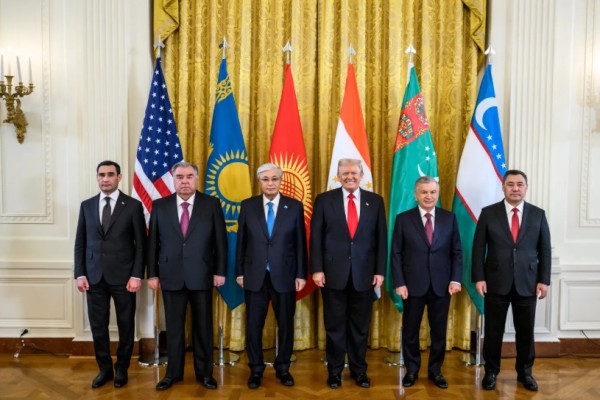
That changed on November 6, when the presidents of Kazakhstan, Kyrgyzstan, Tajikistan, Turkmenistan and Uzbekistan gathered in the American capital for the tenth C5+1 summit – the official dialogue between the United States and the five post-Soviet republics.
“It’s the first time the region’s leaders travel to Washington for a summit with President Trump carrying a diverse agenda that extends beyond trade topics,” The Moscow Times reported.
Trump, in his signature style, declared the meeting a “new chapter” in U.S.–Central Asia relations. He promised “fantastic numbers” and announced that Uzbekistan would invest over $100 billion in the American economy over the next decade—a figure about equal to the country’s GDP.
Whether that number was accurate or not, behind the flourish was a more serious shift.
For years, U.S. engagement with Central Asia tended to be reactive and security-led. Now, the focus is economic. The State Department’s joint statement emphasised trade, investment and cooperation on critical minerals — signalling a strategic effort to diversify supply chains that have long been dominated by China.
Central Asia is suddenly valuable.
Kazakhstan is among the world’s leading uranium producers, Uzbekistan and Kyrgyzstan hold rare-earth deposits, and Turkmenistan’s gas reserves make it a candidate for energy exports to Europe.
The summit’s agenda also featured discussions of the Trans-Caspian, or “Middle Corridor”—a route linking Central Asia to Europe via the Caspian Sea and the Caucasus, bypassing Russia.
Commerce Secretary Howard Lutnick announced deals spanning aviation, agriculture and resource processing: Uzbekistan will buy 22 Boeing aircraft, import American soybeans and meal, and collaborate with U.S. firms on rare earths and energy. Trump said these multi-billion-dollar projects would create jobs for Americans and deepen economic ties.
The meeting also fits a broader pattern: Central Asia is being courted not just by the U.S., but by other major powers.
India participates in two distinct regional frameworks that include the Central Asian republics: the Shanghai Cooperation Organization (SCO) and its own India–Central Asia, or “India + C5,” dialogue.
The SCO, which also includes China, Russia and Pakistan, serves as a broader platform for a multipolar world order, while the India + C5 format is a more focused partnership between New Delhi and the five Central Asian states — Kazakhstan, Kyrgyzstan, Tajikistan, Turkmenistan and Uzbekistan.
In June, India hosted the 4th India–Central Asia Dialogue in New Delhi. India and the five republics agreed to expand cooperation in rare earth exploration, digital infrastructure and the International North–South Transport Corridor linking India to Central Asia via Iran’s Chabahar port. They also reaffirmed a joint stance against terrorism and pledged deeper financial and infrastructural linkages.
In a new phase of global competition driven by supply chains and resources rather than ideology, this renewed attention offers fresh leverage to Central Asian nations.
Russia’s war in Ukraine has disrupted trade routes and exposed the risks of over-dependence on Moscow. China remains the dominant investor, but concerns about debt and dependency are rising. Having both Washington and New Delhi in the mix expands options and strengthens bargaining power.
Uzbekistan’s President Shavkat Mirziyoyev was especially enthusiastic, calling Trump “a president of peace” and suggesting only he could help end the war in Ukraine. His exuberant praise indicated that Tashkent is positioning itself as Washington’s gateway to Central Asia.
With its focus on deals, not lectures, the summit marked a clear departure from previous U.S. administrations that emphasised governance and human rights.
Geopolitically, the timing works in America’s favour. Russia’s grip on Central Asia has loosened since Kyiv, while China’s growing clout has stirred some pushback in the region.
However, as AsiaNews pointed out, the path to deeper U.S. involvement remains uncertain. The countries of the region still depend heavily on Russian trade routes and Chinese financing, while Washington’s promises have yet to materialise into sustained engagement. The article noted that “Central Asia has often been treated as a secondary theatre of U.S. foreign policy” and that whether this summit marks a true strategic shift or another short-lived initiative remains to be seen.
Central Asia is landlocked. Its main transit and energy routes still run through either Russia or China. The much-discussed Trans-Caspian corridor remains expensive and underdeveloped. Building the infrastructure and creating the investment climate to support large-scale cooperation will take years. Additionally, corruption, weak institutions and opaque legal systems remain obstacles to serious American investment.
India faces similar challenges. The New Delhi dialogue produced promising declarations, but trade volumes remain tiny—under US$2 billion annually. Cabinet ministers admitted logistics and infrastructure continue to lag.
But India’s strategy appears more steady and development-centred compared to Trump’s bold, rapid and deal-driven attitude.
Russia and China, meanwhile, are watching closely. Washington’s move adds a third player into what was a binary game — and for the Central Asians, that is an outcome in itself.
If Washington can translate promise into mining ventures, logistics hubs, transport corridors and more transparent investment regimes, it could shift the balance in the region.
But Trump’s grand announcements often outpace delivery, and Central Asian leaders know the difference between press-release figures and hard cash.
Even so, the symbolism matters. Hosting all five Central Asian presidents in Washington was itself a message—that geography no longer guarantees Russian dominance.
India’s parallel outreach indicates the outlines of a multipolar tussle shaping the region’s future.
Central Asia’s rulers, long adept at balancing great-power interests, are unlikely to pick sides. Their aim is clear: secure as much investment, technology and political cover as possible from all available partners.
In private, Central Asian diplomats say they welcome the competition. “It keeps everyone honest,” quipped one Kazakh official to a regional outlet. “When China builds a railway, Russia lowers its tariffs, and the U.S. offers an investment fund—it’s good for us.”
Modi Visit To Bhutan: Bilateral Ties Turbocharged By Hydro-Power
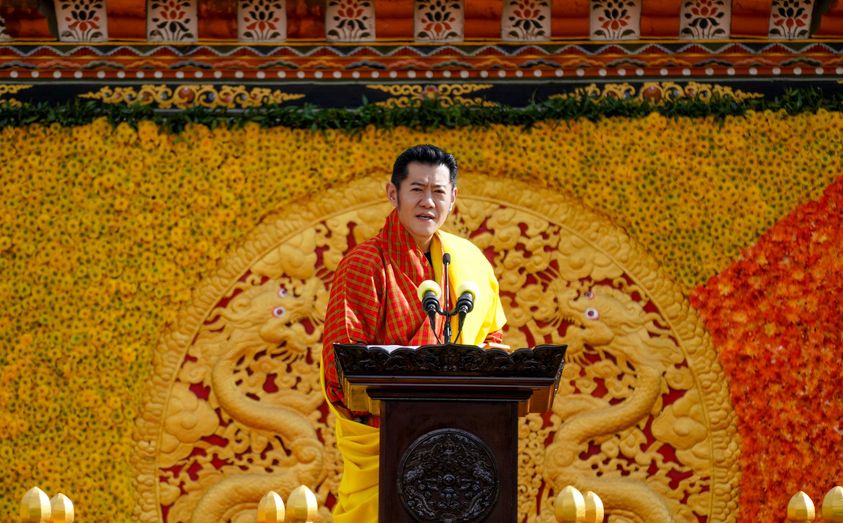
India and Bhutan reinforced their longstanding partnership with the commissioning of the 1,020 MW Punatsangchhu-II Hydroelectric Project, inaugurated jointly by Prime Minister Narendra Modi and His Majesty King Jigme Khesar Namgyel Wangchuck in Thimphu.
The ceremony was held in the presence of the sacred Holy Relics of Lord Buddha and marked another step forward in cooperation in the hydro-power sector, which remains the foundation of their bilateral engagement.
Fully funded by India through a mix of grants and soft loans, Punatsangchhu-II raises Bhutan’s total installed capacity by 40 percent. The electricity generated will support Bhutan’s domestic demand and be exported to India, contributing to regional energy security and development in India’s northeastern states.
The two governments also decided to resume construction on the 1,200 MW Punatsangchhu-I Hydroelectric Project, underscoring their continued commitment to collaborative energy generation.
During the visit, both sides signed MoUs to strengthen cooperation across sectors:
- Renewable Energy Cooperation, covering solar, wind, biomass, green hydrogen, and energy storage, as well as capacity building and technology transfer.
- Health and Medicine, providing for collaboration in drugs, diagnostics, maternal and child health, traditional medicine, disease prevention, telemedicine, and research.
- Mental Health, between Bhutan’s PEMA Secretariat and India’s NIMHANS, to develop in-country training and research programs for mental health professionals.
India announced a Rs 4,000 crore line of credit, allocation of land in Varanasi for a Bhutanese temple and guest house, and the establishment of an immigration check post at Hatisar across Gelephu to improve cross-border mobility.
Ahead of the visit, Bhutanese Prime Minister Tshering Tobgay noted that the ongoing Global Peace Prayer Festival, led by the King, was being supported by the Government of India. During the visit, His Majesty offered condolences and led prayers for the victims of the terror attack in Delhi.
Prime Minister Modi expressed gratitude for Bhutan’s solidarity, stating that India would always remember the compassion shown by the Bhutanese people at a time of national grief.
India and Bhutan have developed five major hydroelectric projects to date including Chukha (336 MW), Kurichhu (60 MW), Tala (1,020 MW), Mangdechhu (720 MW), and Punatsangchhu-II (1,020 MW), with Punatsangchhu-I (1,200 MW) under construction.
A joint vision for future energy partnership, agreed in 2024, provides a framework for further collaboration in hydro-power and renewable sectors, including participation by Indian private companies.
India continues to facilitate market access for Bhutan’s electricity exports through its power exchanges, while also supplying power to Bhutan during lean seasons.
Connectivity was another area of progress during the visit. Under a new intergovernmental MoU signed in September 2025, two cross-border rail links, Kokrajhar–Gelephu (69 km) and Banarhat–Samtse (20 km), will be developed at a combined cost of Rs 4,033 crore.
These will complement other recent initiatives, including the inauguration of an Immigration Check Post at Darranga, Assam (November 2024) and the Jogighopa Inland Waterway Terminal (January 2025), aimed at strengthening trade and transit networks.
The two countries had jointly launched the India–Bhutan SAT in November 2022 and inaugurated the South Asia Satellite Ground Station in Thimphu in 2019. In the fintech domain, Bhutan became the first country to adopt India’s BHIM-UPI system (2021) and implement the RuPay Card scheme (launched in 2019 and expanded in 2020), promoting seamless cross-border digital transactions.
India has also supported Bhutan’s Gyalsung National Service Programme, extending Rs 200 crore in grants and a Rs 1,500 crore concessional loan for academy infrastructure. In addition, India reaffirmed its support for the Gelephu Mindfulness City project, a royal initiative envisioned as a service-sector-led special administrative region to generate sustainable employment and regional connectivity.
India continues to be Bhutan’s largest trading partner, accounting for nearly 80 percent of Bhutan’s total trade. In 2024, bilateral trade stood at Rs 12,669 crore, with India’s exports to Bhutan amounting to Rs 9,538 crore and imports from Bhutan at Rs 3,131 crore. India provides Bhutan duty-free transit and exemption from export restrictions on essential commodities. A recent B2B agreement on fertilizer supply further strengthened agricultural cooperation.
Prime Minister Modi’s decision to proceed with the Bhutan visit despite the Delhi attack conveyed India’s steadfast commitment to its closest Himalayan partner and Neighbourhood First policy.
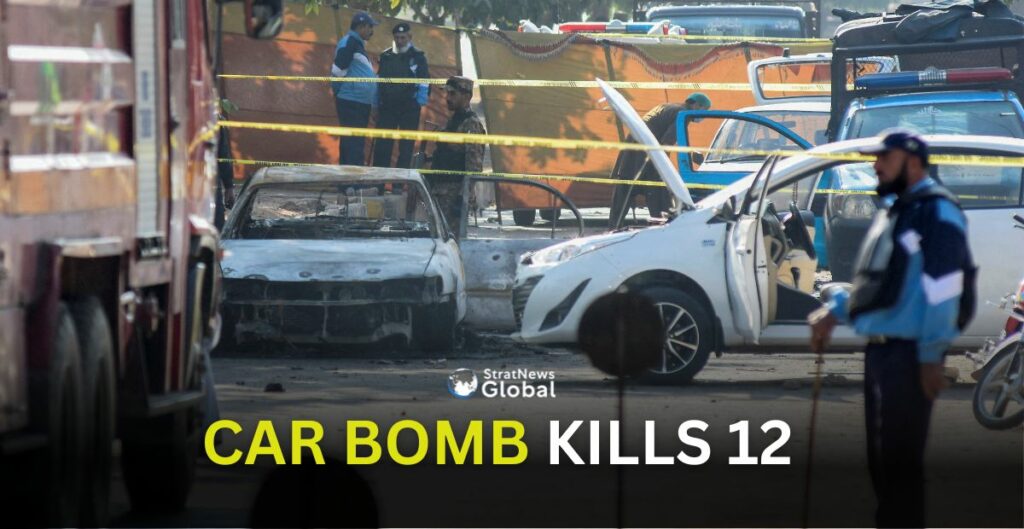
Suicide Blast Kills 12 Outside Islamabad District Court
At least 12 people were killed and several others injured in a suicide bombing outside a local court in Pakistan’s capital Islamabad on Tuesday, Interior Minister Mohsin Naqvi said.
According to officials and state-run media, a powerful car bomb exploded at the entrance of the District Judicial Complex. The attacker, who attempted to enter the court building on foot, detonated the explosives near a police vehicle after waiting outside for 10 to 15 minutes, Naqvi told reporters at the site.
“We are investigating this incident from different angles. It is not just another bombing. It happened right in Islamabad,” the minister said.
A hospital source said some of the wounded were in critical condition. The blast occurred near the main entrance of the court complex, an area usually crowded with litigants and lawyers.
Videos circulating on social media showed a car engulfed in flames and thick smoke rising behind a security barrier, Dawn reported. State-run Pakistan Television (PTV) confirmed the explosion was a suicide attack, noting that “the bomber’s head was found lying on the road.”
No group has claimed responsibility for the attack so far.
The bombing came just hours after Pakistani security forces said they had repelled an overnight assault by armed militants on a cadet college in Wana, in Khyber Pakhtunkhwa province near the Afghan border.
Calling the Islamabad attack a “wake-up call”, Defence Minister Khawaja Asif described Pakistan as being “in a state of war.”
Posting on X, Asif wrote, “In this environment, it would be futile to hold out greater hope for successful negotiations with the rulers of Kabul.”
(With inputs from Reuters/agencies)