

Support us by contributing to StratNewsGlobal on the following UPI ID
ultramodern@hdfcbank

Strategic affairs is our game, South Asia and beyond our playground. Put together by an experienced team led by Nitin A. Gokhale. Our focus is on strategic affairs, foreign policy and international relations, with higher quality reportage, analysis and commentary with new tie-ups across the South Asian region.
You can support our endeavours. Visit us at www.stratnewsglobal.com and follow us on YouTube, Twitter, Facebook and Instagram.
र 500 per month
र 1000 per month
र 5000 per year
र 10000 per year
Donate an amount of your choice
र 500 per month
Donate र 500 per month

र 1000 per month
Donate र 1000 per month
र 5000 per year
Donate र 5,000 per year
र 10000 per year
Donate र 10,000 per year
Donate an amount of your choice
Donate an amount of your choice
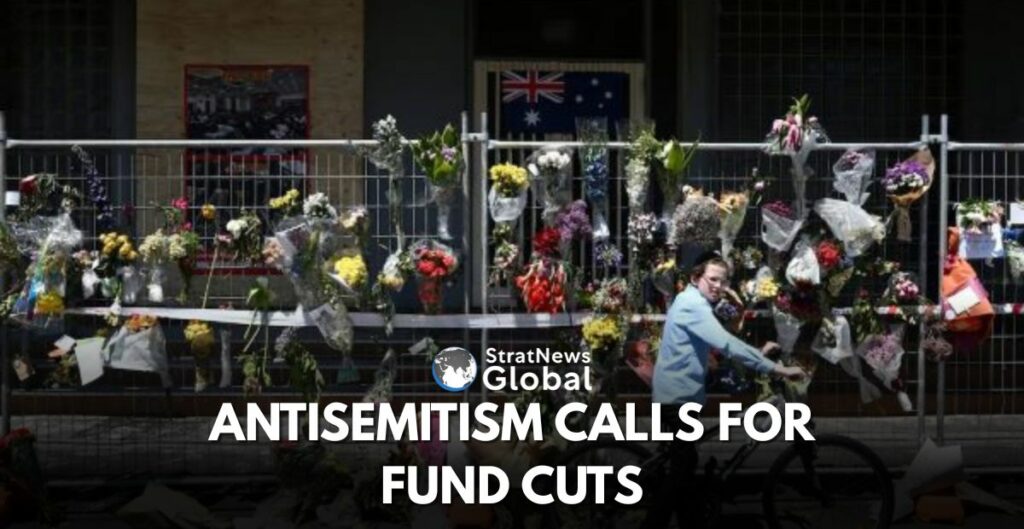


Australian Antisemitism Report Recommends University Funding Cuts And Visa Screenings
A new Australian report on tackling antisemitism has proposed slashing funding to universities that do not safeguard Jewish students. It also calls for stricter screening of visa applicants and non-citizens to identify and prevent the entry of individuals with extremist views.
The plan, led by Australia’s special envoy on antisemitism Jillian Segal, responds to a sharp rise in antisemitic incidents across Australia since the beginning of Israel’s war in Gaza in late 2023.
The report proposes a sweeping set of reforms across education, public institutions, online spaces, media and immigration to “push (antisemitism) to the margins of society”.
“The plan is an overarching one covering many areas where urgent action is needed,” Segal said in a news conference on Thursday.
“We have seen cars being torched, synagogues being torched, individual Jews harassed and attacked. That is completely unacceptable.”
The Government Welcomes The Plan
Prime Minister Anthony Albanese said the government welcomed the plan and would consider Segal’s recommendations.
“There’s a number of things that can be implemented quickly,” he said. “There are a number of things that will require work over a period of time.”
“This is something that government needs to work with civil society on at all levels.”
Segal was appointed as Australia’s special envoy in July 2024 to develop strategies to combat antisemitism and her report comes days after an arson attack on a Melbourne synagogue.
The report singled out universities as a central focus of reform, warning antisemitism had become “ingrained and normalised” within academia, university courses and campuses.
It recommended universities face a “report card” system that assessed whether their campuses were safe for Jewish students and staff.
It said universities that failed to act on antisemitism should have funding withheld, and public grants to researchers or academics should also be terminated if they engaged in antisemitic conduct or hate speech.
Universities Australia, which represents the 39 universities in the country, did not immediately respond to a request for comment. In February, its members agreed to adopt a new definition of antisemitism after consultation with Segal.
The report also said funding for cultural bodies and festivals should be cut “where the institution or festival promotes, facilitates or does not deal effectively with hate or antisemitism”.
It also called for visa applicants to be screened for antisemitic affiliations. “Non-citizens involved in antisemitism should face visa cancellation and removal from Australia,” it said.
(With inputs from Reuters)
Europe Eyes Nordic Space Race To Reduce Reliance On US
Two small spaceports in northern Sweden and Norway are competing to launch mainland Europe’s first satellites, as the region seeks to scale back its dependence on U.S. space providers.
U.S. President Donald Trump’s “America First” policies and the war in Ukraine have prompted Europe to ramp up its independent capabilities in a variety of areas, including defence and space operations.
Two small spaceports in the far north of Sweden and Norway are racing to launch the first satellites from mainland Europe into space as the region looks to reduce its reliance on U.S. players.
Amid fears that Elon Musk – Trump’s one-time ally – could limit Ukraine’s access to SpaceX’s 7,000 Starlink satellites that are vital for the country’s communications, Europe has been rushing to find alternatives.
But there’s a mountain to climb.
Europe Lags In Launches
In 2024, the U.S. carried out 154 launches of hardware into orbit, while Europe managed just three. Out of $143 billion in global public investment in space ventures last year, Europe accounted for only 10%, an EU study shows.
The trend towards lower Earth orbit satellites – which are cheaper and offer better connections but need to be deployed in larger numbers to maximise coverage – also poses challenges.
A Goldman Sachs report estimates that 70,000 LEO satellites could be launched in the next five years, a tenfold increase.
“We’ve lost (in) competition to, let’s say, Elon Musk … and definitely we need to have our (own) autonomous launching possibilities,” Andrius Kubilius, European Commissioner for Defence and Space, told Reuters.
“That’s why the development of launching possibilities on the European continent, both in Sweden and Norway, is very important.”
Europe’s only spaceport is in French Guiana, South America, some 7,000 kilometres (4,350 miles) from Paris. Europe successfully launched its new Ariane 6 rocket from there earlier this year, more than 10 years after it was commissioned and five years later than originally planned.
While it can carry a bigger payload per rocket than SpaceX’s Falcon 9, Ariane 6 is not reusable and has a higher cost per launch. It is also not nearly enough to meet Europe’s commercial and military needs in the coming years.
That’s where the budding Nordic spaceports come in.
Rare Advantage
Situated 200 kilometres above the Arctic Circle, near where the borders of Sweden, Finland, Norway and Russia converge, the Esrange Space Centre is unusual in Europe in offering 5,200 square kilometres (2,008 square miles) of uninhabited land.
Surrounded by boglands, rivers and with the snow-clad peaks of Sweden’s tallest mountain in the distance, Esrange is close to Kiruna, home to one of the world’s largest underground iron ore mines, providing ready access to railroads and an airport.
The area, more than three times the size of London, is shared only by the spaceport and the reindeer herds of Sweden’s indigenous Sami, making it suitable for recovering rocket parts. It has little light pollution and is easy to close to air traffic.
“It is unique, having a large land-based area such as the one we have here,” said Lennart Poromaa, head of the Esrange Space Centre, which has about 130 employees.
Esrange, part of the state-owned Swedish Space Corporation, was established in 1964 and launched its first sounding rocket – a research rocket that does not go into orbit – a couple of years later. It was inaugurated as mainland Europe’s first orbital launch site by European Commission President Ursula von der Leyen in 2023.
Orbital Launch Preparations Underway
Preparations for orbital launches are well underway, with a new set of bigger launch pads, hangars and research facilities being readied.
Together with Andoya Spaceport, an island base in northern Norway, it represents Europe’s best hope of securing independent access to space in the coming years. Andoya is majority-owned by the Norwegian state, with defence firm Kongsberg holding a 10% stake.
In March, Andoya conducted the first test launch of a small rocket made by German startup ISAR Aerospace that can carry a payload of around 1,000 kilograms (2,205 pounds). It flew for 30 seconds before falling into the sea in what was deemed a success.
Daniel Metzler, CEO and co-founder of ISAR, said interest from defence ministries in the last six months had been huge and that ISAR’s flights were being filled for the coming years, even before a first successful orbital launch.
“Frankly, I think probably the biggest driver was Trump getting elected once again. And as such, Trump probably did more for European defence than any European politician before him. It really created a huge sense of urgency,” he said.
ISAR is aiming for the first commercial flights to take place next year.
Aggressive Timelines
Andoya, visited by a NATO delegation this month, has a licence for 30 launches per year. Esrange has not set a fixed target but will also fill an important need for NATO in providing rapid launch capacity.
Unlike Andoya, Esrange has opted for existing hardware, signing contracts with U.S. rocket manufacturer Firefly and South Korea’s Perigee, giving it multiple potential options.
Firefly, which plans to launch from Esrange in 2026, has a rapid response service that aims to be able to send rockets into space at 24 hours’ notice to meet urgent needs, such as replacing a failing satellite.
“I think Europe needs to look at similar or even more aggressive timelines,” a NATO official told Reuters, speaking on condition of anonymity.
All of the rocket suppliers are developing partially reusable rockets, with ISAR’s due to be tested at Esrange.
But there is much work to do across the board.
“You need to get all the technical systems in place, and then there will be quite a lot of testing and trialling,” said Esrange’s Poromaa. “Within a year or so, we’ll probably have the entire base ready.”
(With inputs from Reuters)
Rubio Visits Asia For First Time Amid Rising Tensions Over Trump’s Tariff Plans
U.S. Secretary of State Marco Rubio is set to meet Southeast Asian leaders on Thursday during his first official trip to Asia. His visit aims to reaffirm Washington’s commitment to the region, even as President Donald Trump’s expanding tariff campaign increasingly targets the region.
Washington’s top diplomat will meet foreign ministers of the 10-member Association of Southeast Asian Nations gathered in Kuala Lumpur, and also hold talks with Russian Foreign Minister Sergei Lavrov who is in the Malaysian capital, according to the U.S. State Department.
Rubio’s trip is part of an effort to renew U.S. focus on the Indo-Pacific and look beyond the conflicts in the Middle East and Europe that have consumed much of the Trump administration’s attention, with Rubio balancing dual responsibilities as secretary of state and national security adviser.
Trump’s Tariff Strategy
However, Trump’s global tariff strategy is likely to cast a shadow over the trip, after the president announced steep tariffs to take effect on August 1 on six ASEAN members, including Malaysia, as well as on close Northeast Asian allies Japan and South Korea.
Rubio will nevertheless seek to firm up U.S. relationships with partners and allies, who have been unnerved by the tariffs, and is likely to press the case that the United States remains a better partner than China, Washington’s main strategic rival, experts said.
“This is significant, and it’s an effort to try to counter that Chinese diplomatic and economic offensive,” said Victor Cha, president of the geopolitics and foreign policy department at Washington’s Center for Strategic and International Studies.
Rubio will also meet with Lavrov later on Thursday, according to the U.S. State Department schedule. It would be the second in-person meeting between Rubio and Lavrov, and comes at a time when Trump has grown increasingly frustrated with Russian President Vladimir Putin as the war in Ukraine drags on.
China’s Foreign Minister Wang Yi is also expected to join talks from Thursday, but it was unclear if Rubio would meet with him.
‘Better Late Than Never’
A senior U.S. State Department official told reporters on Monday that among Rubio’s priorities on the trip was reaffirming Washington’s commitment to the region, not just for its sake but because it promotes American prosperity and security.
“It’s kind of late, because we’re seven months into the administration,” Cha said of Rubio’s trip. “Usually, these happen much sooner. But then again, it is extraordinary circumstances. But I guess better late than never.”
Security cooperation is a top priority, including the strategic South China Sea, and combating transnational crime, narcotics, scam centers, and trafficking in persons, said the State Department official, speaking on the condition of anonymity.
As well as their unease about Trump’s tariff policies, many in the Indo-Pacific have doubts about the willingness of his “America First” administration to fully engage diplomatically and economically with the region.
Trump said this week he would impose a 25% tariff on Japan and South Korea and also took aim at ASEAN nations, announcing a 25% levy on Malaysia, 32% on Indonesia, 36% on Cambodia and Thailand, and 40% on Laos and Myanmar.
Trump has also upset another key Indo-Pacific ally, Australia, which said on Wednesday it was “urgently seeking more detail” on his threat to raise tariffs to 200% on pharmaceutical imports.
‘Concern Over Trade Tensions’
According to a draft joint communique, ASEAN foreign ministers will express “concern over rising global trade tensions and growing uncertainties in the international economic landscape, particularly the unilateral actions relating to tariffs.”
The draft, dated Monday, before the latest U.S. tariff rates were announced, did not mention the United States and used language similar to an ASEAN leaders’ statement in May. Both said tariffs were “counterproductive and risk exacerbating global economic fragmentation.”
The State Department official said Rubio would be prepared to discuss trade and reiterate that the need to rebalance U.S. trade relationships is significant.
The export-reliant ASEAN is collectively the world’s fifth-biggest economy, with some members beneficiaries of supply chain realignments from China. Only Vietnam has secured a deal with Trump, which lowers the levy to 20% from 46% initially.
(With inputs from Reuters)
China-Pakistan-Bangladesh Convergence Of Interests Possible: CDS
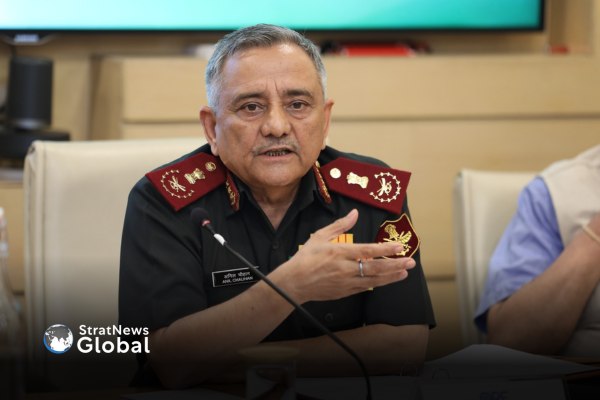
“The international security environment is transitioning between two competing world orders,” was the sober message from Gen Anil Chauhan, Chief of Defence Staff, while addressing an event organised by the Observer Research Foundation on Tuesday evening. “India must be ready to respond across the entire conflict spectrum,” he warned, pointing to the shifts in the US strategic posture that was complicating the situation.
He also pointed to India’s immediate neighbourhood where “There is a possible convergence of interests between China, Pakistan and Bangladesh that may impact India’s stability and security dynamics.”
Nearly 80% of Pakistan’s military hardware has been sourced from China in the last five years, he noted and “it’s reasonable to assume that Chinese OEMs have ongoing commercial and a physical footprint within Pakistan.”
Calling for year round operational readiness, Gen Chauhan stressed that “There is currently no foolproof defence against ballistic missiles, hypersonic weapons, cruise missiles or large scale drone attacks.”
India’s less than cordial relationship with the interim administration in Dhaka, it’s overtures to Pakistan and the uncertainty over what shape the future political dispensation in Bangladesh could take, underscores Delhi’s growing concern over its eastern frontiers. The civil war in Myanmar is another issue.
In his view, even as India focuses on the modernisation of its defence and security, “A resilient and dynamic economy is the bedrock of national power. It ensures sustainable development and strategic autonomy.”
He had a word of caution for India’s political leadership. “For a multilingual, multiethnic and multireligious country like India, internal security is paramount. It must be embedded into our broader social security architecture.”
He touched on Operation Sindoor which, he said, demonstrated India’s ability to conduct integrated operations across domains, and while it was “non-contact warfare” in the sense that there was no physical contact between the two armies, “it is a unique example of conventional conflict between two nuclear weapon states.”
In his view, India’s nuclear doctrine and the principle of No First Use, “gives us the strength to act, and Pakistan’s escalatory response pushed the conflict into a conventional domain, limiting its own nuclear response.”
The fact that China did nothing on the borders with India could be attributed to the short duration of the conflict. There is however enough evidence of China providing satellite intelligence to Pakistan.
Gen Chauhan released the ORF Foreign Policy Survey 2024: Young India And The China Challenge authored by six scholars including Harsh Pant, Vice-President of Studies & Foreign Policy at the ORF. The survey revealed broad support among India’s youth for the foreign policy being pursued by the government. The survey showed China as India’s biggest challenge and the need to align with the US, also concern about the direction of Russia-China relations. Details can be had at Foreign Policy Survey 2024: Young India and the China Challenge.
Glacial Lake Outburst In Tibet Triggered Nepal Flood That Killed 9
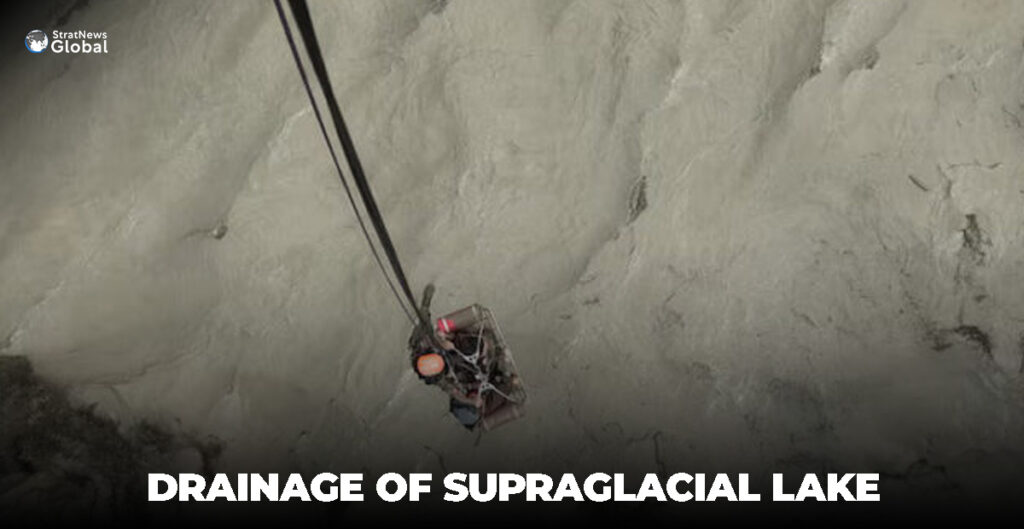
The recent deadly flood in Nepal’s Bhote Koshi River, which claimed at least nine lives and left over two dozen missing, was caused by the sudden drainage of a supraglacial lake in Tibet, a regional climate monitoring body said on Wednesday.
At least 19 people, including six Chinese workers at the Beijing-aided Inland Container Depot, remain missing in Nepal after Tuesday’s floods that also washed away the ‘Friendship Bridge’ that links Nepal and China.
China’s official Xinhua news agency has said 11 people were unaccounted for on the Chinese side of the mountainous border region.
Preliminary Analysis Based On Satellite Images
The Kathmandu-based International Centre for Integrated Mountain Development (ICIMOD) said satellite imagery showed the flood originated from the draining of the lake north of Nepal’s Langtang Himal range.
“This is based on the preliminary analysis based on the available satellite images,” Sudan Maharjan, a remote sensing analyst and expert of glaciers at ICIMOD, told Reuters.
A supraglacial lake is formed on the surface of glaciers, particularly in debris-covered areas. It often begins as small meltwater ponds that gradually expand and sometimes merge to form a larger supraglacial lake, experts say.
‘Unprecedented’ Pace
Saswata Sanyal, another ICIMOD official, said such events were increasing at an “unprecedented” pace in the Hindu Kush mountains that are spread across Afghanistan, Bangladesh, Bhutan, China, India, Myanmar, Nepal and Pakistan.
“We need to delve deeper into the triggers that are resulting in cascading impacts,” Sanyal said.
The June-September monsoon causes massive floods and landslides in mountainous Nepal which, officials and experts say, is vulnerable to effects of climate change like extreme weather patterns, inconsistent rainfall, flash floods, landslides and glacial lake outburst floods.
This year’s early monsoon rains have inflicted deadly damage elsewhere in Nepal where at least 38 people have been killed or are missing since May 29, according to data from the government’s National Disaster Relief, Reduction and Management Authority.
(With inputs from Reuters)
Two Killed In Russian Strike On Kyiv As U.S. Resumes Military Aid To Ukraine
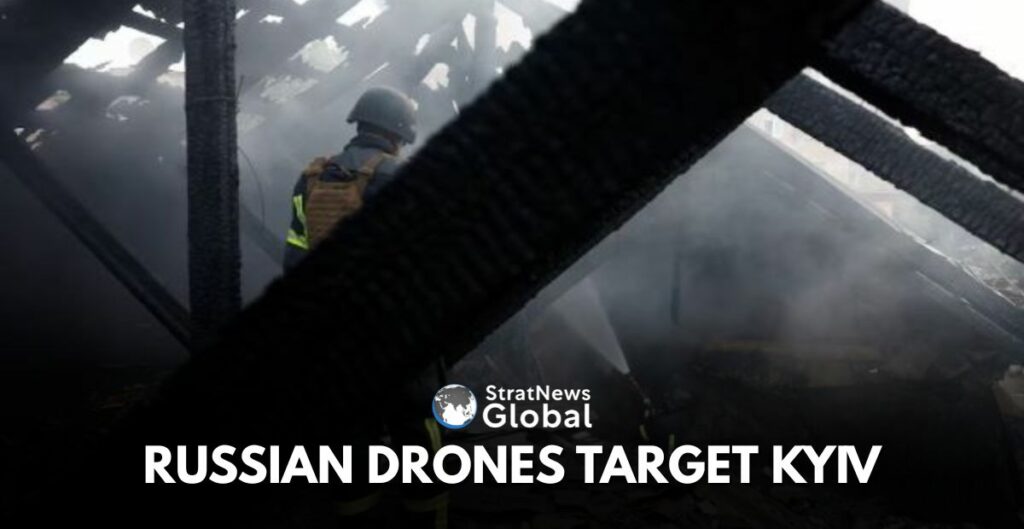
Kyiv came under heavy attack from Russian drones and missiles early Thursday, leaving two dead, 13 injured, and sparking fires in both residential and commercial buildings, according to officials. The assault came as the United States resumed its weapons deliveries to support Ukraine.
It was also the latest in Russia’s escalating attacks with hundreds of drones and missiles straining Ukrainian air defences at a perilous moment in the war and forcing thousands of people to frequently seek bomb shelters overnight.
“Residential buildings, vehicles, warehouse facilities, office and non-residential buildings are on fire,” head of Kyiv’s military administration, Tymur Tkachenko, said on the Telegram messaging app.
The full scale of the attack was not immediately clear. There was no comment from Moscow about the attack that came a day after Russia launched a single-night record number of drones targeting its smaller neighbour.
U.S. To Send More Weapons
After U.S. President Donald Trump pledged earlier this week to send more defensive weapons to Kyiv, Washington was already delivering artillery shells and mobile rocket artillery missiles to Ukraine, two U.S. officials said on Wednesday.
Ukrainian President Volodymyr Zelenskyy held a “substantive” meeting on Wednesday with Trump’s Ukraine envoy, Keith Kellogg, in Rome ahead of a Ukrainian recovery conference.
Trump has been growing increasingly frustrated with President Vladimir Putin, saying that the Russian leader was throwing a lot of “bullshit” at the U.S. efforts to end the war that Moscow launched against Ukraine in February 2022.
U.S. Secretary of State Marco Rubio will meet with Russian Foreign Minister Sergei Lavrov on the sidelines of the ASEAN foreign ministers’ meeting in Kuala Lumpur on Thursday, the U.S. State Department and Russia’s foreign ministry said.
Russia’s attack on Kyiv on Thursday rattled the city with explosions, witnesses said. Videos showed windows blown out, devastated facades and cars burned down. Kyiv’s officials said that damage was reported in six of the city’s 10 districts.
Kyiv’s Shevchenkivskyi district, known for elegant restaurants, art galleries and vibrant student bars, suffered significant damage to residential buildings, the district’s head said on Telegram.
A thick smoke covered parts of Kyiv, darkening the red hues of a sunrise over the city of three million, witnesses reported. Air raids in the capital lasted more than four hours, according to Ukraine’s air force data.
“After returning home from shelters, keep your windows closed — there is a lot of smoke,” Tkachenko said.
Closer to the battle zone, a Russian air strike killed three people and injured one late on Wednesday in the front-line town of Kostiantynivka in Ukraine’s east, the national emergency services said.
(With inputs from Reuters)
Taiwan Showcases US-Made Abrams Tanks During War Games
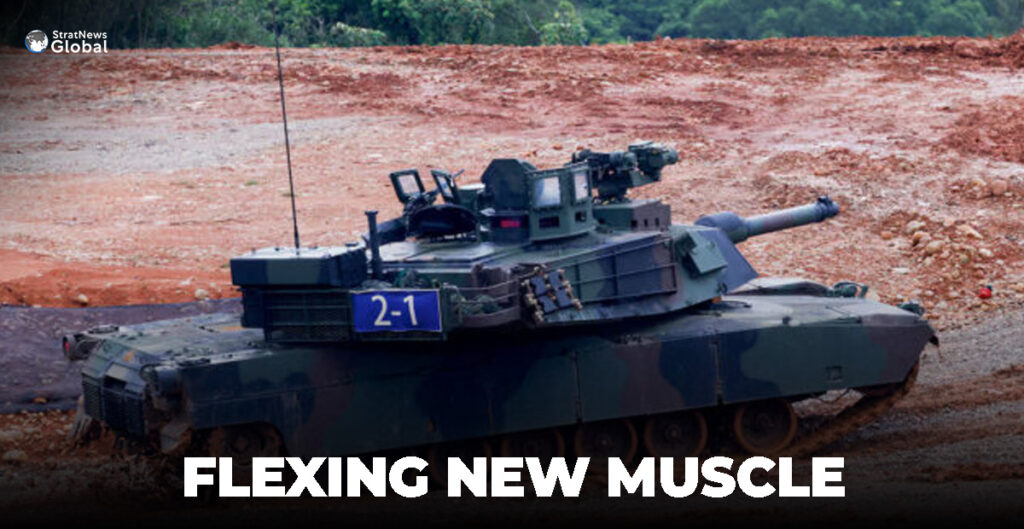
Taiwan’s army on Thursday showcased the firepower of its newly acquired US-made M1A2T Abrams tanks, a conventional weapon that, analysts say, will require stronger defence against drones in future conflicts — drawing lessons from the Ukraine war.
Four Abrams tanks were shown manoeuvring across a mud-choked army training ground in Hsinchu county, firing at moving and static targets, on the second day of Taiwan’s annual military exercises that are designed to test the island’s resilience in a conflict with China.
Wearing a combat helmet, President Lai Ching-te observed the firing, saying later that with “every increase in the military’s combat power, the nation and its people gain an extra layer of security”.
‘Extremely Powerful’
“Whether in terms of strike capability or mobility, it was extremely powerful — undoubtedly the strongest tank on the battlefield,” Lai said.
Senior military officials in Lai’s government say they intend the comprehensive 10-day drills to show both China and the international community, including its key weapons supplier the US, that Taiwan is determined to defend itself against any China attack or invasion.
China views the democratically governed island as its own and has intensified military pressure around Taiwan over the last five years.
Lai’s comments also come ahead of a recall parliamentary election on July 26 that could see his ruling Democratic Progressive Party (DPP) take back control of the legislature.
New Tanks
The tanks are among the first batch of 38 Abrams main battle tanks delivered in December, with the rest of the 108 ordered by Taiwan due to be delivered later this year and next year.
They marked Taiwan’s first new tanks for 24 years.
Analysts and regional military attaches say that while the Abrams remains a potent and highly adaptable weapon that would help Taiwan defend its cities and coasts in an invasion scenario, Taiwan will have to leverage its counter-drone technology to protect them.
Both Russian and Ukrainian tanks, including US Abrams supplied to Kyiv, have reportedly proven vulnerable to drones and advanced anti-tank weapons.
The tanks have yet to be fully commissioned and Wednesday’s test firing was not a formal part of the drills, which are designed to replicate full battle conditions at sea, on land and in the skies, military officials said.
‘Nothing But A Bluff’
Singapore-based military scholar Thomas Lim said he expected Taiwan would attempt in a war scenario to cover their “prized assets” with counter drone elements, or also deploy them from high positions for extra protection.
“This isn’t straightforward…but it isn’t a problem unique to Abrams,” said Lim, of Singapore’s S. Rajaratnam School of International Studies.
President Lai said that he believed that through “realistic combat training”, the M1A2T tank will “be able to integrate with drones and innovative tactics to more effectively fulfill the nation’s strategic objectives”.
China’s defence ministry on Tuesday said that Taiwan’s drills were “nothing but a bluff”.
(With inputs from Reuters)
Israel-Hamas Ceasefire Possible Within Weeks: Official
A senior Israeli official on Wednesday said a Gaza ceasefire and hostage-release deal with Hamas could be reached within one or two weeks, though not as early as within a day.
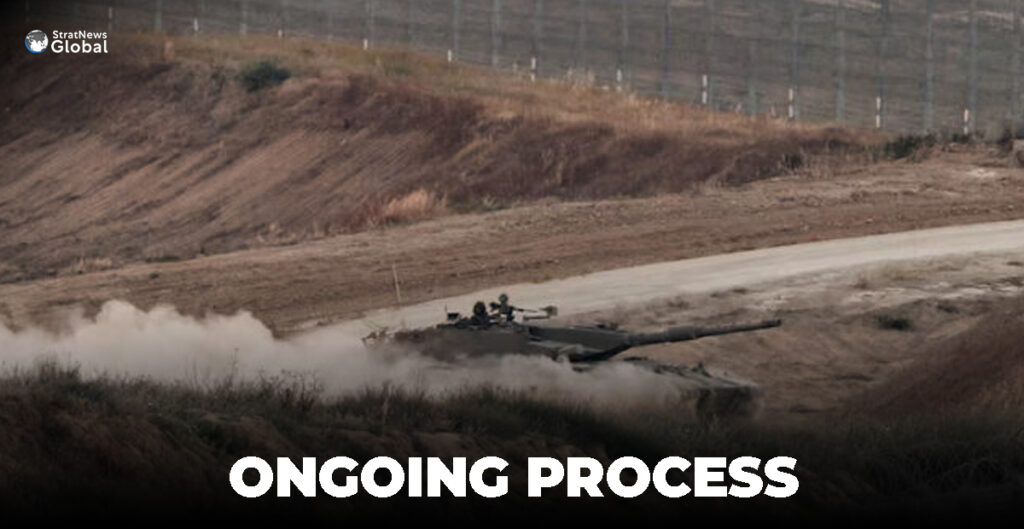
Speaking during Israeli Prime Minister Benjamin Netanyahu’s visit to Washington, the official said that if the two sides agree to a proposed 60-day ceasefire, Israel would use that time to offer a permanent ceasefire that would require the Palestinian militant group to disarm.
If Hamas refuses, “we’ll proceed” with military operations in Gaza, the official said on condition of anonymity.
Trump-Netanyahu Meeting
Trump met Netanyahu on Tuesday for the second time in two days to discuss the situation in Gaza, with the president’s Middle East envoy indicating that Israel and Hamas were nearing an agreement on a US-brokered ceasefire proposal after 21 months of war.
Trump had previously predicted that a deal could be reached this week, raising speculation about a possible announcement before Netanyahu leaves for Israel on Thursday.
On Wednesday, however, Trump appeared to extend the timeframe somewhat, telling reporters that while an agreement was “very close”, it could happen this week or even next – though “not definitely”.
No Breakthrough
A source familiar with Hamas’ thinking said four days of indirect talks with Israel in Qatar did not produce any breakthroughs on main sticking points.
The Israeli official, who briefed reporters in Washington, declined to provide details on the negotiations.
Trump’s Middle East special envoy Steve Witkoff told reporters at a Cabinet meeting on Tuesday that the anticipated agreement would involve the release of 10 living and nine deceased hostages.
Netanyahu’s visit came just over two weeks after the president ordered the bombing of Iranian nuclear sites in support of Israeli air strikes. Trump then helped arrange a ceasefire in the 12-day Israel-Iran war.
Trump and his aides have tried to seize on any momentum created by the weakening of Iran, which backs Hamas, to push both sides for a breakthrough to end the Gaza war.
Gaza Conflict
The Gaza conflict began with a Hamas attack on southern Israel in October 2023 that killed approximately 1,200 people and saw 251 hostages taken, according to Israeli figures. Around 50 hostages remain in Gaza, with 20 believed to be alive.
Israel’s retaliatory war has killed more than 57,000 Palestinians, Gaza’s health ministry says, and reduced much of Gaza to rubble.
Netanyahu has used his US visit to publicly thank Trump for joining with Israel in striking Iran.
Trump has repeatedly declared that the US bombing of three of Iran’s nuclear sites had “obliterated” them, though some experts have questioned the extent of the damage and raised the possibility that Iran had secreted away part of its enriched uranium stockpile before the strikes.
The Israel official said Israeli intelligence indicated that Iran’s enriched uranium remained at Fordo, Natanz and Isfahan, the sites that the US hit last month, and had not been moved.
The official suggested, however, that the Iranians might still be able to gain access to Isfahan but it would be hard to remove any of the material there.
Iran has always denied seeking a nuclear weapon.
(With inputs from Reuters)
US Sanctions UN Gaza Rapporteur Over Criticism Of Israel
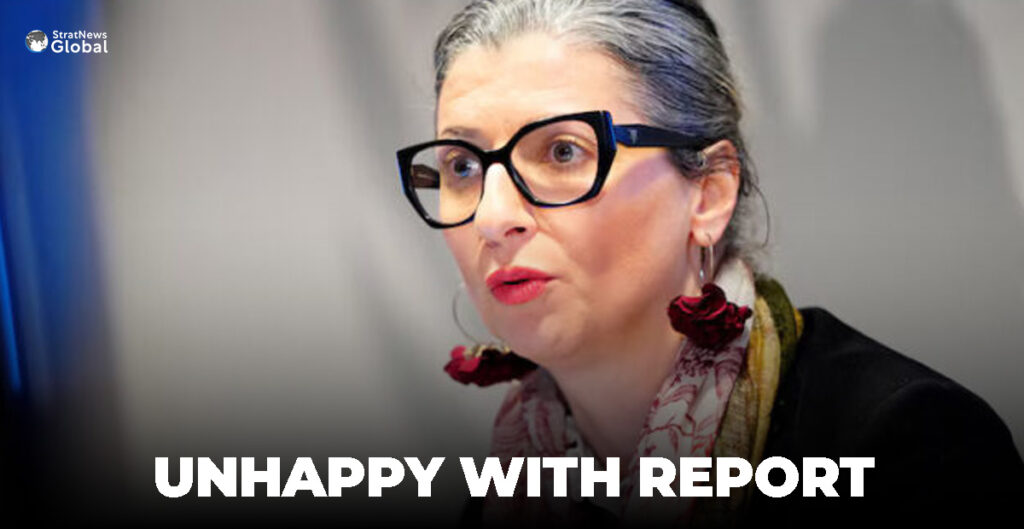
The United States on Wednesday announced sanctions against Francesca Albanese, the UN special rapporteur on human rights in the occupied Palestinian territories, over her sharp criticism of Israel’s actions in Gaza.
“Today I am imposing sanctions on UN Human Rights Council Special Rapporteur Francesca Albanese for her illegitimate and shameful efforts to prompt (International Criminal Court) action against US and Israeli officials, companies, and executives,” Secretary of State Marco Rubio said in a statement.
‘Mafia Style Intimidation Techniques’
In a post on X late on Wednesday, Albanese wrote that she stood “firmly and convincingly on the side of justice, as I have always done”, without directly mentioning the US sanctions. In a text message to Al Jazeera, she was quoted as dismissing the US move as “mafia style intimidation techniques”.
Albanese, an Italian lawyer and academic, has called on states at the UN Human Rights Council to impose an arms embargo and cut off trade and financial ties with Israel while accusing the US ally of waging a “genocidal campaign” in Gaza.
Israel has faced accusations of genocide at the International Court of Justice and of war crimes at the ICC over its devastating military assault on Gaza. Israel denies the accusations and says its campaign amounts to self-defence after a deadly October 2023 Hamas attack.
Albanese’s Report
In a report published earlier this month, Albanese accused over 60 companies, including major arms manufacturers and technology firms, of involvement in supporting Israeli settlements and military actions in Gaza. The report called on companies to cease dealings with Israel and for legal accountability for executives implicated in alleged violations of international law.
Albanese is one of dozens of independent human rights experts mandated by the United Nations to report on specific themes and crises. The views expressed by special rapporteurs do not reflect those of the global body as a whole.
‘Rogue State Behaviour’
Rights experts slammed the US sanctions against Albanese. Dylan Williams, vice president for government affairs at the Center for International Policy think tank, labeled them as “rogue state behaviour” while Amnesty International said special rapporteurs must be supported and not sanctioned.
“Governments around the world and all actors who believe in the rule-based order and international law must do everything in their power to mitigate and block the effect of the sanctions against Francesca Albanese and more generally to protect the work and independence of Special Rapporteurs,” Amnesty International’s Secretary General Agnes Callamard, a former UN special rapporteur, said.
Since returning to office in January, President Donald Trump has stopped US engagement with the UN Human Rights Council, extended a halt to funding for the Palestinian relief agency UNRWA and ordered a review of the UN cultural agency UNESCO.
He has also announced US plans to quit the Paris climate deal and the World Health Organization.
His administration imposed sanctions on four judges at the ICC in June in retaliation over the war tribunal’s issuance of an arrest warrant for Israeli Prime Minister Benjamin Netanyahu and a past decision to open a case into alleged war crimes by US troops in Afghanistan.
(With inputs from Reuters)
Trump Slaps 50% Tariff On Brazil After War Of Words With Lula
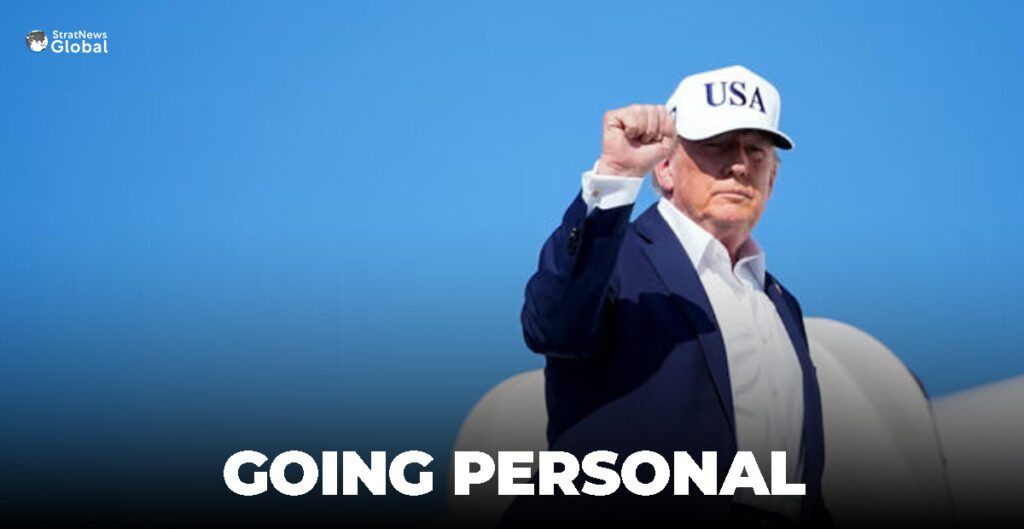
US President Donald Trump on Wednesday announced a 50% tariff on all imports from Brazil, following a row with his Brazilian counterpart, who had earlier referred to him as an unwanted “emperor”.
Brazil’s President Luiz Inacio Lula da Silva fired back on Wednesday, saying new tariffs would be met with reciprocal measures.
More Personal, Less Rational
In a letter, Trump linked the tariffs to Brazil’s treatment of former President Jair Bolsonaro, who is on trial over charges of plotting a coup to stop Lula from taking office in 2023.
The levies were imposed due “in part to Brazil’s insidious attacks on Free Elections, and the fundamental Free Speech Rights of Americans”, the letter said.
Brazil’s real currency added to earlier losses to fall over 2% against the dollar after the announcement, and companies such as planemaker Embraer and oil major Petrobras also suffered setbacks in the stock market.
Lula, his vice-president, his finance minister, and others held an emergency meeting in Brasilia on Wednesday night to discuss the new levies.
‘Don’t Want An Emperor’
In a lengthy post to social media after the meeting, Lula said Trump’s accusations that trade between the two countries was unfair to the US were false, stressing the US runs a trade surplus against Brazil.
“Sovereignty, respect, and the unwavering defence of the interests of the Brazilian people are the values that guide our relationship with the world,” Lula wrote.
The US is Brazil’s second-largest trading partner after China and the tariffs are a major increase from the 10% announced in April. Trump’s letter said the 50% tariff will start August 1 and will be separate from all sectoral tariffs.
On Monday, Lula pushed back against Trump after the US leader threatened to impose an additional 10% tariff on the BRICS group of developing nations, which he called “anti-American”.
In light of the public statement made by U.S. President Donald Trump on social media on the afternoon of Wednesday (9), it is important to highlight the following:
Brazil is a sovereign nation with independent institutions and will not accept any form of tutelage.
The judicial…
— Lula (@LulaOficial) July 9, 2025
“The world has changed. We don’t want an emperor,” Lula told reporters when asked at a BRICS summit in Rio de Janeiro about the possible BRICS tariff.
Bolsonaro ‘Witch Hunt’
Tensions between the United States and Brazil had already intensified on Wednesday after Brazil’s foreign ministry summoned the US Embassy chargé d’affaires over a statement defending Bolsonaro.
Around the same time, Trump, speaking to reporters at an event with West African leaders at the White House, said Brazil “has not been good to us, not good at all,” adding the tariff rates would be based on “very, very substantial facts” and past history.
The US Embassy in Brasilia confirmed on Wednesday its chargé d’affaires had a meeting with officials from Brazil’s foreign ministry, though it declined to share details about the conversation.
Trump’s support for Bolsonaro echoed his support for other global leaders who have faced domestic legal cases like French far-right leader Marine Le Pen and Israeli Prime Minister Benjamin Netanyahu. Trump has called cases against those leaders a “witch hunt,” a term he used for cases he faced himself in the US after the end of his first term in office.
Trump said in a social media post on Monday that Bolsonaro was the victim of such a “witch hunt.” The US Embassy in Brasilia issued a statement on Wednesday to the local press echoing his remarks.
“The political persecution of Jair Bolsonaro, his family and his supporters is shameful and disrespectful of Brazil’s democratic traditions,” it said.
In a post on social media, Bolsonaro did not mention Trump, but said he “is persecuted because he remains alive in the public consciousness. Even out of power, he remains the most remembered—and most feared—name.”
In his letter, Trump also directed US Trade Representative James Greer to initiate a probe into what he called unfair trade practices by Brazil, particularly on US companies’ digital trade. Trump also criticized decisions from Brazil’s Supreme Court that he said censored social media firms.
Brazil’s Supreme Court has long been criticized by Bolsonaro’s allies for ordering social media websites to take down content from leaders of their far-right movement. The court also imposed more responsibilities on those companies last month.
In his post on Wednesday, Lula rebuffed Trump’s accusations of a witch hunt and said the case against Bolsonaro was up for the courts to decide and not subject to any “threats that could compromise the independence of national institutions.”
Lula also defended his country’s Supreme Court and its ruling on social media and said “freedom of expression must not be confused with aggression or violent practice.”
Impact On Food Exports
The tariffs on Brazil could have a significant impact on food prices in the United States. Around a third of the coffee consumed in the US, the world’s largest drinker of the beverage, comes from Brazil, which is the world’s largest coffee grower. Annual Brazilian coffee exports to the US are close to 8 million bags, according to industry groups.
More than half of the orange juice sold in the US comes from Brazil, which has an 80% share of the juice’s global trade. The South American agricultural powerhouse also sells sugar, beef and ethanol to the US, among other products.
“This measure impacts not only Brazil, but the whole US juice industry that employs thousands of people and has had Brazil as its main supplier for decades,” said Ibiapaba Netto, the executive director of Brazilian orange juice industry group CitrusBR.
(With inputs from Reuters)