

Support us by contributing to StratNewsGlobal on the following UPI ID
ultramodern@hdfcbank

Strategic affairs is our game, South Asia and beyond our playground. Put together by an experienced team led by Nitin A. Gokhale. Our focus is on strategic affairs, foreign policy and international relations, with higher quality reportage, analysis and commentary with new tie-ups across the South Asian region.
You can support our endeavours. Visit us at www.stratnewsglobal.com and follow us on YouTube, Twitter, Facebook and Instagram.
र 500 per month
र 1000 per month
र 5000 per year
र 10000 per year
Donate an amount of your choice
र 500 per month
Donate र 500 per month

र 1000 per month
Donate र 1000 per month
र 5000 per year
Donate र 5,000 per year
र 10000 per year
Donate र 10,000 per year
Donate an amount of your choice
Donate an amount of your choice





UN Migration Chief Says Global Fatigue Growing Over Ukraine War
Fatigue over the war in Ukraine, coupled with U.S.-led foreign aid cuts, is threatening efforts to assist those fleeing hardship, the U.N. migration chief warned on Friday.
International Organisation for Migration (IOM) Director General Amy Pope was speaking a day after a Ukraine recovery conference in Rome mobilised over 10 billion euros ($11.69 billion) for the country.
“It’s three-and-a-half years into the conflict. I think it’s fair to say that everybody is tired, and we hear that even from Ukrainians who’ve been experiencing the ongoing attacks in their cities and often have been displaced multiple times,” she told Reuters.
“The response to it, though, has to be peace, because ultimately, without peace, there won’t be an end, not only to the funding request, but also to the support for the Ukrainian people.”
Russia’s invasion has triggered Europe’s biggest refugee crisis this century, with 5.6 million Ukrainian refugees globally and 3.8 million uprooted in their country, according to U.N. data.
The IOM and other U.N. agencies are hampered by major funding shortages as U.S. President Donald Trump slashes foreign aid and European donors like Britain shift funds from development to defence.
U.S. decisions will give the IOM a $1 billion shortfall this year, Pope said, saying budget reductions should be phased gradually or else Trump and others risk stoking even worse migration crises.
“It doesn’t work to have provided assistance and then just walk away and leave nothing. And what we see happening when support falls is that people move again … So (the cuts) can ultimately have a backlash,” she said.
Warning For US, Praise For Italy
Pope, 51, is the first woman to lead the IOM and a former adviser to the Obama and Biden administrations who is now working with Trump’s White House on so-called “self-deportations”.
She said the IOM has decades of experience with such programmes in Europe and they take time to implement, especially to prepare returnees and check they are going voluntarily.
“That doesn’t always move as quickly as governments would like,” Pope said.
Asked whether the IOM would stop working with the U.S. if the returns turned out to be forced, she said: “We’ve made clear to them what our standards are, and as with every member state, we outline what we can do and what we can’t do, and they understand that, and it is part of the deal.”
After Rome, Pope was on her way to Washington to meet with Trump administration officials and U.S. lawmakers.
Turning to Europe, she praised Italy’s decision to increase migrant work permits to nearly 500,000 for 2026-2028, coming from a right-wing government otherwise pursuing tough border policies.
“What Italy is doing is taking a realistic look at what labour they need, what skills they need, what talent they need. And then they’re designing a system to allow people to come in through a safe and legal channel,” Pope said.
($1 = 0.8557 euros)
(With inputs from Reuters)
Nigeria Accuses US Of Pressuring Africa To Take Venezuelan Deportees
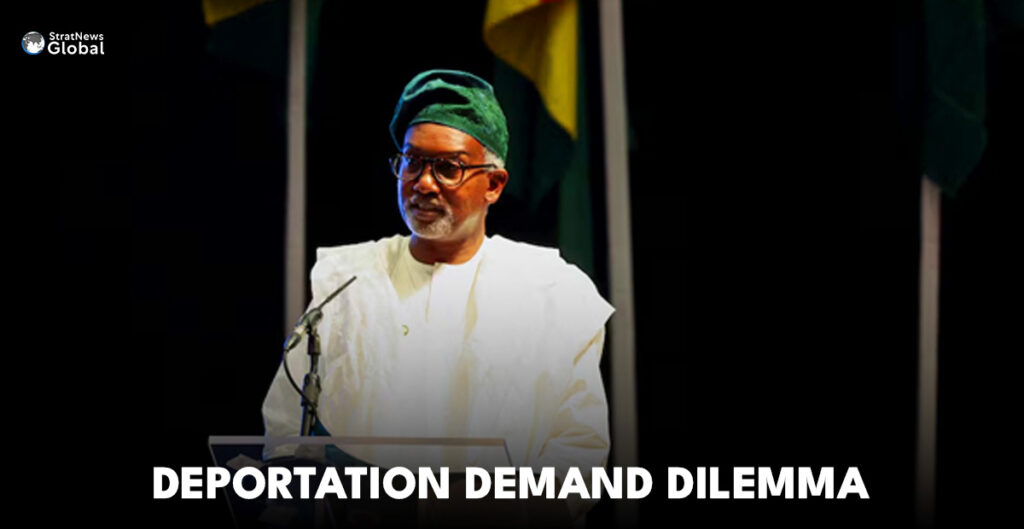
The foreign minister of Nigeria stated that the United States is pressuring African nations to accept Venezuelan deportees, including some released directly from prison, but emphasised that Nigeria, as Africa’s most populous country, cannot take them in due to its own domestic challenges.
President Donald Trump’s administration this week asked five African presidents visiting the White House to take in migrants from other countries when deported by the U.S., two officials familiar with the discussions told Reuters.
Yusuf Tuggar, the Nigerian foreign minister, told local Channels TV late on Thursday that Nigeria could not accept that.
“You have to also bear in mind that the U.S. is mounting considerable pressure on African countries to accept Venezuelans to be deported from the U.S., some straight out of prison,” he said from Brazil, where he was at a BRICS summit.
“It will be difficult for a country like Nigeria to accept Venezuelan prisoners into Nigeria. We have enough problems of our own,” noting his nation’s 230 million-strong population.
The White House did not respond to requests for comment.
Trump’s Deportation Drive
Since returning to the office in January, Trump has been pressing to speed up deportations, including by sending migrants to third countries when there are problems or delays over sending them to their home nations.
This week, he hosted the presidents of Liberia, Senegal, Guinea-Bissau, Mauritania and Gabon at the White House.
According to a U.S. and a Liberian official, he presented the plan for African countries to take in migrants from other countries when they are deported by the U.S.
The Wall Street Journal reported on Wednesday that an internal State Department document sent to the African governments before the meeting called on them to agree to the “dignified, safe, and timely transfer from the United States” of third-country nationals.
(With inputs from Reuters)
Trump To Visit Texas Flood Site As Disaster Response Faces Scrutiny
U.S. President Donald Trump will travel to central Texas on Friday to assess damage from the July 4 flash flood that killed at least 120 people and left dozens missing.
His visit comes amid intense focus on the government response, a week after the storm, and as thousands of first responders comb through muddy debris, with hopes diminished of finding additional survivors.
Torrential rains sent a wall of water raging down the Guadalupe River in the predawn hours of the U.S. Independence Day holiday. The disaster is the deadliest of the Republican president’s nearly six-month term in office.
Trump is expected to speak with family members of the victims and emergency responders, according to a White House official.
He will also receive a briefing from local elected officials and see sites in Kerr County, the centre of the damage. The county is located in what is known as “flash flood alley”, a region that has seen some of the country’s deadliest floods.
More than a foot of rain fell in less than an hour on July 4. Flood gauges showed the river’s height rose from about a foot to 34 feet (10.4 meters) in a matter of hours, cascading over its banks and sweeping away trees and structures in its path.
The dead include at least 36 children, many of whom were campers at Camp Mystic, an all-girls Christian summer retreat on the banks of the river.
Response Faces Scrutiny
Local and federal officials have faced scrutiny for their response, including questions about whether they could have done more to warn people of the rising floodwaters. The county declined to install an early-warning system years ago after failing to secure state grant money to cover the cost. Officials have said their current focus is on rescue and recovery.
The state legislature will convene in a special session later this month to investigate the flooding and provide disaster relief funding.
The Trump administration has supported the disaster response through the Federal Emergency Management Agency, sending funds for disaster recovery, temporary housing and property losses.
Trump has largely sidestepped questions about his prior plans to shrink or abolish the agency and for its key functions to be carried out by state and local government.
“I’ll tell you some other time,” Trump said on Tuesday, when asked by a reporter about FEMA.
The U.S. Senate’s top Democrat, Chuck Schumer, on Monday asked a government watchdog to investigate whether cuts at the National Weather Service affected the forecasting agency’s response. The NWS has defended its forecasting and emergency management, noting it assigned extra forecasters to two Texas offices over the holiday weekend.
The Trump administration has said the agency was sufficiently staffed and responded adequately to “an act of God.”
On Sunday, Trump was asked by a reporter whether government cuts hobbled the disaster response.
“It didn’t,” Trump responded.
(With inputs from Reuters)
From Galwan to Sindoor: Doval Maps India’s War for Tech Sovereignty
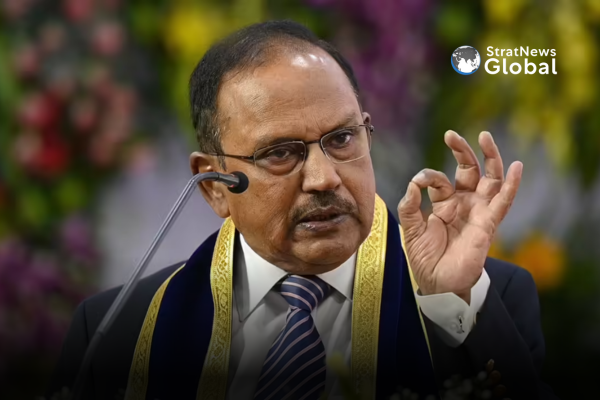
The 2020 Galwan clash with China was a turning point for India, pushing the nation to accelerate its drive toward indigenous technologies, National Security Advisor Ajit Doval said while addressing graduates at IIT Madras on Friday.
Speaking at the 62nd convocation of the institute, Doval highlighted how the urgency of national security challenges, exposed during the border crisis with China, forced India to rethink its dependence on foreign technology in critical areas like secure communications.
“The Chinese have taken 12 years and $300 billion to develop 5G. We don’t have such time and money. We wanted trusted sources. Within two and a half years, we were indigenous. We owe it to our private sector,” Doval said, emphasising India’s resolve to completely indigenise its communication systems for data protection and security needs.
Highlighting the role of Artificial Intelligence, Doval called it a “game-changer” and stressed that India must rapidly adopt emerging technologies without depending on foreign sources.
The push for indigenous technologies is not limited to communications alone. Doval underscored their role during Operation Sindoor, where India precisely targeted nine terrorist sites deep inside Pakistan in a swift 23-minute operation.
“We are proud of the role played by indigenous technologies in Operation Sindoor, right from BrahMos, radars, integrated air control and command systems, and other surveillance tech,” he noted.
Responding to scepticism around the operation, Doval challenged detractors to show evidence of Indian damage. “They claimed all sorts of things… But show me one image of any Indian damage—even a broken glass pane? They had nothing,” he said.
Doval encouraged the graduating students to embrace a spirit of “passion for your nation” and leverage their skills to further India’s journey toward technological self-reliance. Framing the 2020 clash with China as a critical clash, he noted that challenges often become opportunities to build a secure, sovereign future.
“You are part of a nation and civilisation that has faced invasions, suffering, and indignities for a thousand years. It was through the sacrifices, struggles, and resilience of our ancestors that the idea of this nation and its civilisation was kept alive,” he said.
Doval also laid out a bold vision for India’s economic and geopolitical future. “By 2047, I am confident that India will be a $30 trillion economy and among the top three global powers,” he said.
Bharat Utsav On In Moscow, Major Tourism Dialogue Scheduled Next Week
Moscow is currently hosting Bharat Utsav, a week-long festival spotlighting Indian culture through music, dance, wellness and traditional crafts. As the event draws large crowds to Manezhnaya Square, attention is also turning towards a key tourism industry meeting scheduled next week.
On July 15, the city will host the OTOAI Convention, a gathering of hospitality and travel professionals from both India and Russia. Organised by the Association of Outbound Tourism Operators of India, with support from the local government, the convention aims to expand cooperation between the two countries’ tourism sectors.
Industry representatives, including tour operators, hotel chains and tourism boards are expected to attend. Discussions will focus on boosting travel flows, launching new joint initiatives and strengthening India-Russia ties in outbound and inbound tourism.
A Cultural Lead-Up
The ongoing Bharat Utsav festival, which is open till Sunday, has provided a strong cultural backdrop ahead of the business-focused convention. Visitors to the square near Red Square can take part in a host of activities. Be it joining yoga classes, exploring Indian folk art, witnessing traditional dance performances or joining interactive sessions on India’s cultural diversity.
Artistes from across India are performing throughout the week. Meanwhile, an exhibition of Indian handicrafts, clothing and regional artwork is showcasing creative traditions.
Strengthening Bilateral Engagement
With India ranking among Moscow’s top non-CIS sources of international visitors, both sides see continued potential in tourism exchange. Moscow city officials say the upcoming OTOAI meeting will be an opportunity to explore practical steps for increasing visitor numbers and building long-term cooperation.
“There’s a growing interest in Indian culture and tourism in Moscow,” said Bulat Nurmukhanov, Deputy Chairman of the Moscow City Tourism Committee. “We view the upcoming industry meeting as a chance to deepen our collaboration and support new partnerships.”
As Bharat Utsav wraps up this weekend, the focus will shift to next week’s tourism summit. A timely follow-up to a cultural celebration that has already brought India and Russia a little closer.
Under Pressure, Germany’s Far-Right AfD Softens Its Rhetoric
Last weekend, Germany‘s far-right lawmakers pledged to adopt a more polished appearance, curb disruptive behaviour in parliament, and back a brief manifesto that notably dropped earlier calls for the repatriation of some immigrants—a stance that had bolstered their February election gains.
The Alternative for Germany (AfD) is trying a tactical pivot away from the mix of attention-grabbing shock policies and provocative rowdiness that helped it become the second-largest parliamentary party, in a bid to go more mainstream and translate popularity into power, political commentators and a party insider said.
Being the largest opposition party has conferred privileges like being able to respond first to the government in parliament, but in Germany, power comes from being in coalitions, and every other party rules out governing with the AfD.
Other parties have also prevented it from taking key positions on parliamentary committees as calls grow across the political spectrum for a ban on the AfD on account of its extremism.
So far, conservative Chancellor Friedrich Merz has opposed such a ban, which must be requested by either house of parliament or the government, and then examined by the Constitutional Court. The court has only banned a party twice in 1952 and 1956.
A senior party official who declined to be named said the new rules were all about “professionalising” the party – although some, especially founding figures in the party’s eastern heartlands who are not members of the national parliament, oppose changing a successful formula.
At stake is the 2029 election, which the party, four points behind Merz’s conservatives in some polls, could have a credible shot of winning. In the weeks following February’s election which it won 20.8% of the vote, it briefly surged to first place.
Mainstreaming The Far-Right
The AfD leadership hopes to follow hard-right parties like Italian Prime Minister Giorgia Meloni’s Brothers of Italy into the political mainstream, from where they could reshape the politics of Germany and Europe.
Far-right essayist Goetz Kubitschek, a mentor and close ally to Bjoern Hoecke, leader of the party’s most radical wing from the eastern state of Thuringia, said on his podcast: “I don’t understand why a party polling at 20% should change its agenda.”
The manifesto or position paper agreed to by all 152 legislators omitted the word “remigration” – used heavily by leader Alice Weidel in the election campaign and widely understood as a call for unassimilated non-ethnic-German citizens and migrants to leave the country.
The word was cited as evidence by a court that recently upheld a security service assessment that the AfD might be an extremist and therefore an unconstitutional party. To be banned in Germany, a political party must not only be deemed to take a position that undermines the functioning of Germany’s democratic order, but it must also be acting on it with a chance of success.
The remigration phrase had become “toxic”, said one legislator present at the weekend gathering, who did not want to be named, adding that averting a ban was another goal.
An official spokesperson for the AfD did not immediately respond to a request for comment on any connections between the policy document and a desire to professionalise or head off a ban.
“The word remigration has been found to be unconstitutional and has no future,” wrote AfD legislator Maximilian Krah, once considered one of the party’s most radical figures. “Case closed. The court has spoken.”
Nevertheless, Weidel still lashed out at Germany’s migration policies in parliament this week.
A Real Change?
Many commentators are sceptical that the shift is any more than cosmetic.
“This ongoing discourse about a possible ban is getting under their skin,” said political scientist Oliver Lembcke, adding: “They are trying to be more palatable to other parties: it’s about getting a share of the power and seeking not to be marginalised.”
The AfD reorganised its youth organisation last year when its campaigns were criticised for being racist.
The regional politician Matthias Helferich, who was shown in leaked emails to have used language associated with the Nazis, was expelled from the party this week. He said he was a victim of a “show trial” by the party tribunal that expelled him. He denied being an extremist.
Merz’s conservatives remain committed to a policy of never governing with the AfD, but conservative parliamentary leader Jens Spahn suggested it was time to treat the AfD as an “ordinary” opposition party, which could see it get more access to non-partisan steering committees.
Merz, having concluded that former Chancellor Angela Merkel’s strategy of ignoring them was a failure, has started attacking Weidel in parliament directly, on Tuesday, accusing her of trying to spread “bitterness” and “despair”.
It is unclear if all members will follow the party through its pivot. Hoecke pointedly posted an essay on remigration the day after the new strategy document was floated. “The AfD has given up the fight against population replacement,” wrote Paul Brandenburg, a prominent activist, on Telegram. “This is causing uproar among sympathisers.”
(With inputs from Reuters)
Australian PM To Depart For China For Talks Focused On Security, Economic Ties
Australia‘s Prime Minister Anthony Albanese is scheduled to depart for Shanghai on Saturday for an official visit to China, where discussions are expected to focus on regional security tensions and strengthening economic ties.
Australia’s exports to China, its largest trading partner, span agriculture and energy but are dominated by iron ore, and Albanese will travel with executives from mining giants Rio Tinto, BHP and Fortescue and hold business events in three cities over six days.
“The relationship in China means jobs in Australia, it’s as simple as that,” Albanese told reporters on Friday.
Tensions, Trade, And Trust
Albanese’s second visit to Beijing, where he will meet President Xi Jinping, comes after Canberra stepped up screening of Chinese investment in critical minerals and as U.S. President Donald Trump rattles the global economy with sweeping import tariffs.
Albanese is yet to meet Trump, after scheduled talks at the G7 were cancelled when the U.S. president left early. The United States, Australia’s major security ally, is reviewing the AUKUS nuclear submarine partnership amid concern that selling submarines to Australia could weaken U.S. deterrence to China.
Foreign Minister Penny Wong warned in a speech in Malaysia on Thursday that China continues to project military power regionally with an objective to change the balance of power, saying Beijing’s nuclear and conventional military build-up was “worrying”.
AUKUS contributed to “collective deterrence in our region,” she said.
Richard Maude, an Asia Society non-resident fellow and former Australian intelligence chief, said Albanese needed to expand the economic relationship with China but also “get through the visit in a way that makes clear to Australia’s close partners and to the Australian public that Australia is talking clearly and frankly to China about aspects of China’s behaviour that concern us”.
The Chinese navy held live-fire exercises in the Tasman Sea between Australia and New Zealand with no advance warning in February, and there have been tense encounters between Australian and Chinese military aircraft in the disputed South China Sea.
While Beijing is keen to move ties forward, its proposals for cooperation on artificial intelligence, for example, have already met with a cool response, said Maude, who wrote Australia’s 2017 foreign policy white paper.
Australia-China Trade
Australia’s two-way trade with China was worth A$312 billion last year, or a quarter of all Australian trade.
Ties have stabilised since 2020, when China imposed unofficial bans on A$20 billion in Australian exports.
Direct engagement with Chinese leaders was important for Australia’s security, Albanese told reporters on Friday.
“We cooperate where we can and we disagree where we must, and we’re able to have those honest conversations about some of the disagreements that are there,” he said.
Treasurer Jim Chalmers has said economic ties with China are a priority, but also complex.
Australia’s increased screening of Chinese investment in critical minerals, renewable energy and key infrastructure is likely to be raised by Beijing, company executives told Reuters, although on Tuesday, Chalmers said Australia would not ease its scrutiny.
“The government understands it is not in Australia’s national interest to further increase China’s stranglehold on the critical minerals supply chain,” said Maude.
Geoff Raby, a former Australian ambassador to China, said China would probably raise its ambition to join the 11-member regional trade pact, the Comprehensive and Progressive Agreement for Trans-Pacific Partnership (CPTPP), which Australia chairs.
“The most harmful thing is to adopt policies that force China to become more isolationist or which encourage those domestic forces in China who favour more inward-looking policies,” Raby said.
Albanese will meet businesses in Shanghai on Monday, before travelling to Beijing for an annual leaders’ dialogue with Premier Li Qiang, and a company roundtable, and then head to the southwestern Chinese city of Chengdu.
(With inputs from Reuters)
Rubio Meets Chinese Foreign Minister In Malaysia Amid Escalating Trade Tensions
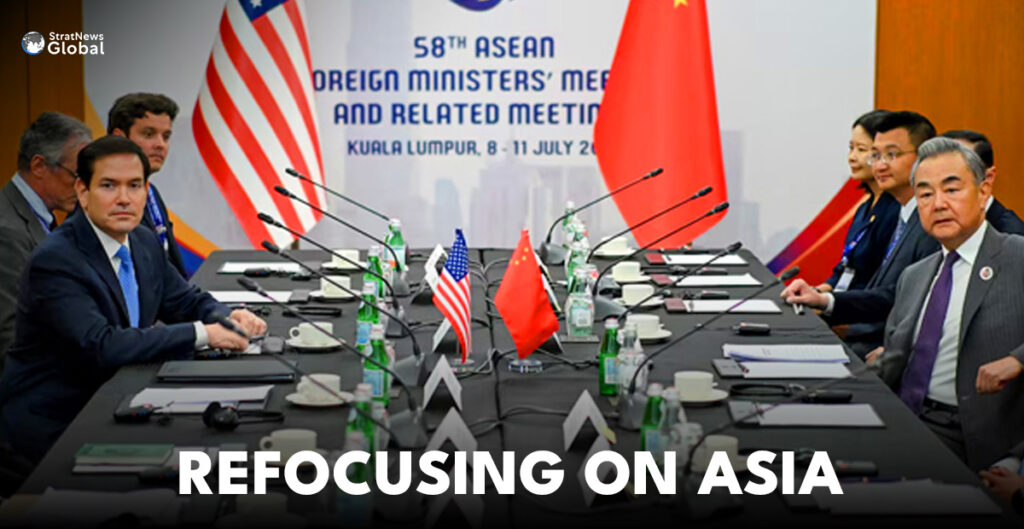
U.S. Secretary of State Marco Rubio held his first face-to-face meeting with Chinese Foreign Minister Wang Yi in Kuala Lumpur on Friday, amid ongoing trade tensions between the two global powers.
Washington’s top diplomat is in Malaysia on his first trip to Asia since taking office, attending the East Asia Summit and ASEAN Regional Forum alongside counterparts from Japan, China, South Korea, Russia, Australia, India, the European Union and Southeast Asian states.
His meeting with Wang comes amid escalating friction globally over U.S. President Donald Trump’s tariffs offensive, with China this week warning the United States against reinstating hefty levies on its goods next month.
Beijing has also threatened to retaliate against nations that strike deals with the United States to cut China out of supply chains.
Refocusing On Asia
Rubio’s visit is part of an effort to renew the U.S. focus on the Indo-Pacific region and look beyond conflicts in the Middle East and Europe that have consumed much of the Trump administration’s attention.
But that has been overshadowed by this week’s announcement of steep U.S. tariffs on many Asian countries and U.S. allies that include 25% on Japan, South Korea and Malaysia, 32% for Indonesia, 36% for Thailand and Cambodia and 40% on Myanmar and Laos.
Analysts said Rubio would be looking to press the case that the United States remains a better partner than China, Washington’s main strategic rival, during the visit. The State Department said Rubio met counterparts of Thailand, Cambodia and Indonesia on Friday.
A day earlier, he told Southeast Asian foreign ministers the Indo-Pacific remained a focal point of U.S. foreign policy.
China, initially singled out with tariffs exceeding 100%, has until August 12 to reach a deal with the White House to keep Trump from reinstating additional import curbs imposed during tit-for-tat tariff exchanges in April and May.
‘Bullying Behaviour’
China’s Wang has been fierce in his criticism of the United States in Kuala Lumpur and told Malaysia’s foreign minister the U.S. tariffs were “typical unilateral bullying behavior” that no country should support or agree with, according to remarks released by Beijing on Friday.
He told Thailand’s foreign minister the tariffs had been abused and “undermined the free trade system, and interfered with the stability of the global production and supply chain”. During a meeting with his Cambodian counterpart, he said the U.S. levies were an attempt to deprive Southeast Asian countries of their legitimate right to development.
“We believe that Southeast Asian countries have the ability to cope with complex situations, adhere to principled positions, and safeguard their own interests,” Wang said, according to China’s foreign ministry.
The foreign secretary of U.S. ally the Philippines told Reuters on Friday that President Ferdinand Marcos Jr would meet Trump in Washington this month, and discussions would include the increase in the U.S. tariff on its former colony.
Rubio told reporters on Thursday he would also likely raise with Wang U.S. concerns over China’s support for Russia in its war against Ukraine.
“The Chinese clearly have been supportive of the Russian effort, and I think that generally, they’ve been willing to help them as much as they can without getting caught,” he said.
Rubio met together with the Japanese foreign minister and South Korea’s first vice foreign minister in Malaysia on Friday, at a time of concerns about the tariffs.
According to a U.S. State Department statement, they discussed regional security and a strengthening of their “indispensable trilateral partnership”, including security and resilience of critical technologies and supply chains, energy, trusted digital infrastructure, and shipbuilding.
(With inputs from Reuters)
South Korea, Japan, And U.S. Stage Joint Air Drill As Defence Chiefs Meet
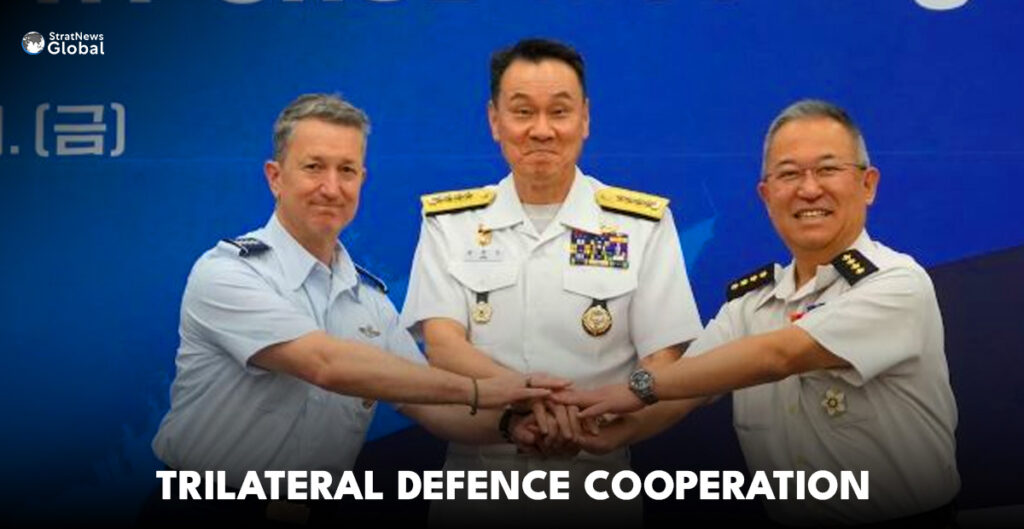
South Korea, Japan, and the United States carried out a joint air drill on Friday, featuring a U.S. B-52 strategic bomber alongside fighter jets from all three nations. The exercise took place over international waters, according to South Korea’s defence ministry.
It was the first time this year that a U.S. B-52H strategic bomber was deployed to the Korean Peninsula for an air drill, conducted to improve deterrence against North Korea’s increasing nuclear and missile threats, it said.
The three countries’ defence chiefs also held an annual meeting in Seoul on Friday, where they recognised the importance of close trilateral cooperation in addressing security challenges posed by North Korea, in the Indo-Pacific and beyond, the defence ministry said in a statement.
“We’re illuminating a future path together, a path where partnerships can evolve through persistent and regular engagement from building capacity to really sharing responsibility,” U.S. Chairman of the Joint Chiefs of Staff General Dan Caine said in opening remarks before the meeting.
“(North Korea) and China are undergoing an unprecedented military build-up with a clear and unambiguous intent to move forward with their own agendas. We need to be mindful of that,” Caine said.
Defence And Security Cooperation
The three countries have boosted security cooperation in recent years, as tensions have increased stemming from North Korea’s military developments and Pyongyang’s deepening military ties with Russia.
Russian Foreign Minister Sergei Lavrov’s scheduled visit to North Korea starting on Friday is the latest high-level meeting between the two countries amid a dramatic upgrading of their strategic cooperation that now includes a mutual defence pact.
Russian news agency RIA reported that the Russian foreign ministry is looking into when North Korea’s leader Kim Jong Un might visit Russia although Kremlin spokesman Dmitry Peskov had said there were no immediate plans for a visit by either of the leaders from the two countries.
Caine, South Korea’s Chairman of the Joint Chiefs of Staff Kim Myung-soo and Japanese Chief of Staff Yoshihide Yoshida “discussed the deployment” of North Korean troops to Russia, their joint statement said.
South Korean intelligence service has said North Korea may be preparing to deploy additional troops in July or August, after sending more than 10,000 soldiers to fight with Russia in the war against Ukraine.
North Korea has agreed to dispatch 6,000 military engineers and builders for reconstruction in Russia’s conflict-hit Kursk region.
(With inputs from Reuters)
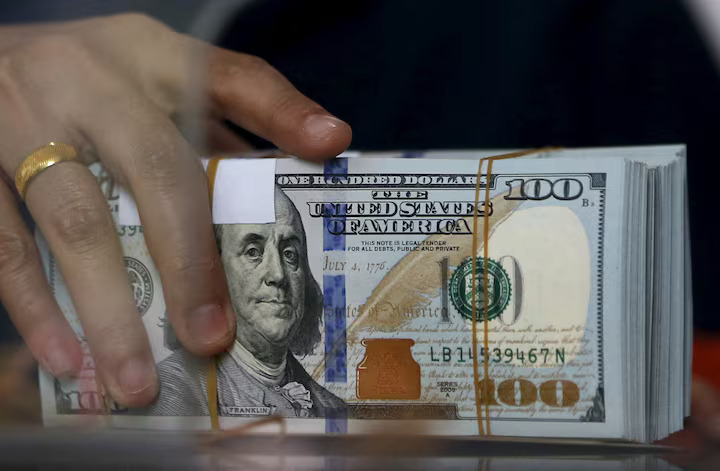
By Weaponising Dollar U.S. Is Forcing World To Seek Alternatives
U.S. President Donald Trump’s call for a 10% tariff on all BRICS nations—Brazil, Russia, India, China, and South Africa—is based on the accusation that they are sabotaging the U.S. dollar by trading in local currencies.
But the reality is, countries didn’t choose to abandon the dollar—they were forced to after Washington weaponized it. By blocking access to dollar-based payments through sanctions and cutting off nations like Russia, Iran, and Venezuela from the SWIFT system, the U.S. left many countries with no choice but to seek alternatives.
The dollar wasn’t pushed out—it shut the door on itself. Now, Washington blames others for walking away from a system it deliberately locked them out of.
Over the last decade, the U.S. has turned the dollar into a political weapon by using SWIFT, the global messaging system that routes payment instructions between banks worldwide. SWIFT connects over 11,000 banks in 200+ countries and was designed to be a neutral platform for trade-related payments.
But under U.S. pressure, SWIFT has blocked access to countries under American sanctions, like Iran, Venezuela, and Russia. In 2022, when Russian banks were cut off from SWIFT and $300 billion in Russian central bank reserves—20% of its GDP—were frozen, it sent a clear warning: disobey the U.S., and your financial lifeline can be shut off.
As a result, countries importing oil and gas from sanctioned suppliers had no option but to bypass the dollar. India pays for Russian crude in rupees and UAE dirhams through non-SWIFT channels. China uses yuan to settle Russian gas trade. This isn’t an anti-dollar strategy—it’s a survival mechanism triggered by U.S. sanctions.
Details of local currency and non-dollar trade:
- Russia and China now settle over 90% of their trade in rubles or yuan—up from 30% before 2022. Gazprom now accepts yuan for gas exports to China.
- India imports oil from Russia with most payment settled in local currencies. In 2022, the RBI allowed trade settlements in Indian rupees, helping countries with dollar shortages. Russian banks opened rupee accounts in India for oil payments. India has rejected China’s call for a BRICS common currency.
- Brazil has set up a yuan clearing system and promotes local currency finance through the BRICS Bank.
- China operates the Shanghai Petroleum and Natural Gas Exchange, where more energy trade is being settled in yuan.
- Even Saudi Arabia—the original architect of the 1970s petrodollar pact—has said it is open to oil payments in non-dollar currencies.
- Other countries like Iran, UAE, Turkey, and Kazakhstan are also turning to local currencies or barter to keep trade going under U.S. sanctions.
Trading in local currencies is not a threat—it is a country’s sovereign right. With proper planning, local currency trade can cut transaction costs by up to 4% by avoiding double dollar conversions at both the buyer’s and seller’s ends. As more countries realize these savings, local currency trade is likely to grow.
As part of crude oil trade—valued at over $4 trillion annually—begins to decouple from the dollar, U.S. dominance over global payments is slipping. The dollar still holds 60% of global reserves and is used in 70% of trade, but its monopoly is weakening. Trump’s tariff threat may accelerate, not stop, this shift. It is not BRICS that undermined the dollar—but Washington’s own use of it as a weapon that triggered this pushback.
The dollar’s global dominance is not backed by any treaty, only by historical trust and power. That trust has eroded due to U.S. overreach.
India Must Be Cautious
India must tread carefully and avoid rushing into a one-sided trade deal under U.S. pressure. Washington’s recent actions make it clear that what it offers are not traditional free trade agreements, but MASAL deals—Mutually Agreed Settlements Achieved through Leveraged Arm-twisting.
While pushing India to sign such a deal, the U.S. has simultaneously proposed a 10% tariff on all BRICS nations, including India, accusing them of undermining the dollar. It has also introduced a bipartisan bill to impose 500% tariffs on countries that continue buying Russian oil and gas—directly targeting India’s energy security.
These aggressive moves indicate that even after a deal, the U.S. may still impose new tariffs on political grounds. India must factor in these risks, safeguard its strategic and economic autonomy, and ensure that any agreement genuinely serves long-term national interests.
The author is founder of the Global Trade Research Initiative