

Support us by contributing to StratNewsGlobal on the following UPI ID
ultramodern@hdfcbank

Strategic affairs is our game, South Asia and beyond our playground. Put together by an experienced team led by Nitin A. Gokhale. Our focus is on strategic affairs, foreign policy and international relations, with higher quality reportage, analysis and commentary with new tie-ups across the South Asian region.
You can support our endeavours. Visit us at www.stratnewsglobal.com and follow us on YouTube, Twitter, Facebook and Instagram.
र 500 per month
र 1000 per month
र 5000 per year
र 10000 per year
Donate an amount of your choice
र 500 per month
Donate र 500 per month

र 1000 per month
Donate र 1000 per month
र 5000 per year
Donate र 5,000 per year
र 10000 per year
Donate र 10,000 per year
Donate an amount of your choice
Donate an amount of your choice







Modi’s Maldives Visit: A Strategic Reset Amid China’s Regional Push
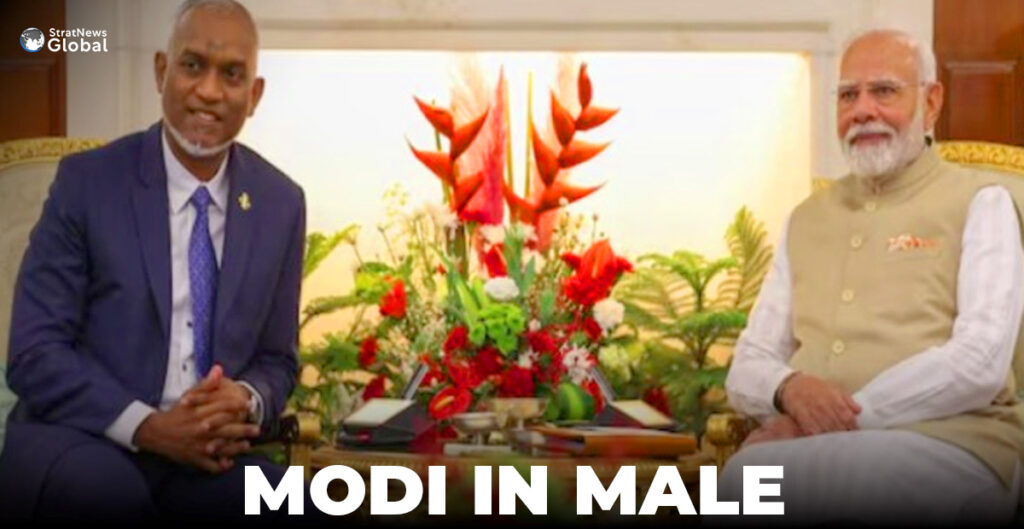
When Prime Minister Narendra Modi lands in the Maldives on July 25 for a state visit, it will mark more than a ceremonial moment on a neighbour’s national day.
His presence as Guest of Honour at the island nation’s 60th Independence Day celebrations signals a reset in relations, and a pushback against deeper, more structural shifts in the region.
At stake is not just the future of India–Maldives ties, but India’s position in a rapidly evolving Indian Ocean geopolitical order.
The visit comes amid fresh Chinese moves to cobble together an alternative to SAARC—one that includes Pakistan, Bangladesh, and possibly even Nepal, Bhutan, Sri Lanka and the Maldives—essentially freezing India out of the regional multilateral frame it once led.
In that context, Modi’s trip is both symbolic and strategic. It also comes at the tail end of a broader diplomatic sweep: just days before heading to Malé, the Prime Minister will be in the United Kingdom (July 23–24), where he is expected to sign the long-awaited India–UK Free Trade Agreement.
Modi’s third visit to the Maldives as Prime Minister (but the first since Muizzu assumed office in 2023) underlines not only India’s global diplomatic ambition but also its determination to secure strategic ground in its own backyard.
Relations between New Delhi and Malé had hit a rough patch under Muizzu’s leadership, with the “India Out” campaign, controversial public remarks by Maldivian ministers, and a clear pivot toward China defining the early phase of his administration.
But recent months have seen a quiet reversal. India’s decision to replace military personnel with civilian technical staff, extend a $400 million currency swap, and increase credit lines helped cool tensions. Meanwhile, Muizzu’s government has visibly moderated its tone, actively seeking Indian investment and cooperation to shore up its struggling economy.
Modi’s visit is set to consolidate this rapprochement. Talks between the two leaders will review progress under the India–Maldives Joint Vision for a Comprehensive Economic and Maritime Security Partnership, and the two sides are expected to sign several MoUs in areas ranging from infrastructure and health to digital payments and trade.
This bilateral warmth comes against the backdrop of a far more ambitious and potentially destabilising regional trend.
China, with support from Pakistan and encouragement from segments in Bangladesh, is reportedly attempting to stitch together a new regional forum that could rival or replace SAARC, which has been effectively defunct due to India–Pakistan tensions.
This emerging grouping, sometimes dubbed an “Alternative Asian Forum,” aims to sideline India’s centrality in South Asian affairs, while embedding Chinese influence through economic integration and strategic alignments.
For the Maldives, which has received extensive Chinese investment through the Belt and Road Initiative (BRI), the temptation to align with such a grouping is real, even if fraught with risk.
Modi’s visit to the Maldives is a pointed reminder that New Delhi will not vacate space in its own extended neighbourhood, even as China tries to redraw the diplomatic map. It also demonstrates India’s preference for bilateral partnerships grounded in transparency, infrastructure delivery, and regional security cooperation over opaque, debt-heavy alternatives.
While much of the coverage will focus on ceremonial moments and photo-ops, the visit is expected to produce tangible outcomes:
Infrastructure & Connectivity: The flagship Greater Malé Connectivity Project (GMCP), funded by India, is expected to see a progress review, possibly along with announcements related to housing, sanitation, and water projects.
Economic & Digital Cooperation: Expansion of UPI-based digital payments in the Maldives is on the table, along with new trade facilitation measures.
Maritime Security: Enhanced cooperation on coastal surveillance, maritime domain awareness, and disaster response will feature in bilateral talks.
Political Optics: A joint statement will likely reiterate commitment to regional peace, democratic values, and non-interference, implicitly pushing back against China’s coercive diplomacy.
Modi’s decision to prioritise the Maldives immediately after a major diplomatic engagement with the UK is carefully calculated. It sends a clear signal not just to Malé, but also to Colombo, Dhaka, and Kathmandu, that India remains the most stable, consistent, and responsive partner in the region.
It also reinforces New Delhi’s twin doctrines of Neighbourhood First and Vision MAHASAGAR (Security and Growth for All in the Region), anchoring India’s regional leadership on the basis of mutual respect, connectivity, and trust.
Crucially, it tells Beijing that attempts to reshape the South Asian regional architecture without India will be challenged: not through sabre-rattling, but through sustained diplomacy, infrastructure delivery, and strategic outreach.
Prime Minister Modi’s visit may not erase all the irritants of the past year, but it marks a new phase—more pragmatic, less sentimental—in India–Maldives relations.
For Muizzu, it’s a recognition of Maldives’ economic and geopolitical realities. For Modi, it’s a reaffirmation of India’s centrality in South Asia, and a timely counter-move to a growing Chinese footprint.
Sectarian Violence Escalates In Syria’s Druze After Ceasefire Fails
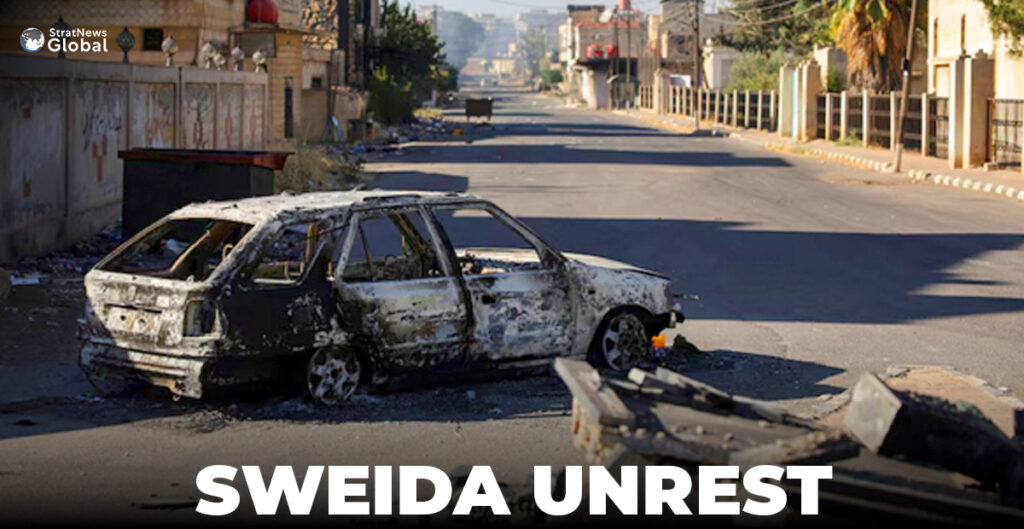
Following the failure of the Islamist-led government’s attempt to execute a ceasefire, sectarian disputes in Syria’s Druze region of Sweida worsened on Saturday, with machine gun fire and mortar bombardment following days of violence.
Heavy Casualties
Reuters reporters heard gunfire from inside the city of Sweida and saw shells land in nearby villages. There were no immediate, confirmed reports of casualties.
The government had said security forces were deploying in the southern region to try to keep peace and urged all parties to stop fighting after nearly a week of factional bloodshed in which hundreds have been killed.
Late on Saturday, the interior ministry said clashes in Sweida city had been halted and the area cleared of Bedouin tribal fighters following the deployment.
The Syrian Observatory for Human Rights, a British-based monitoring group, said clashes since last week around Sweida had killed at least 940 people. Reuters could not independently verify the toll.
Interim President Ahmed al-Sharaa said “Arab and American” mediation had helped restore calm before the clashes escalated. He criticised Israel for airstrikes during the week.
Violence In Druze Challenges Damascus
The fighting is the latest challenge to the control of Sharaa’s Islamist-dominated government, which took over after rebels toppled autocratic president Bashar al-Assad in December.
It started last week as clashes between the Druze – a religious minority native to southern Syria, the Israeli-occupied Golan Heights and parts of Lebanon and Jordan – and Syrian Bedouin tribes.
Government forces then arrived to try to quell tensions, clashing with Druze gunmen and attacking the Druze community.
Saturday’s violence once again pitted Druze against Bedouin, witnesses said.
The fighting has drawn in neighbouring Israel, which carried out airstrikes in southern Syria and on the defence ministry in Damascus this week while government forces were fighting with the Druze.
Israel says it is protecting the Druze, who also form a significant minority in Israel.
But Israel and Washington differ over Syria. The U.S. supports a centralised Syria under Sharaa’s government, which has pledged to rule for all citizens, while Israel says the government is dominated by jihadists and a danger to minorities.
In March, Syria’s military was involved in mass killings of members of the Alawite minority, to which much of Assad’s elite belonged.
Israel-Syria Tensions
In a statement on Saturday, the Syrian presidency announced an immediate ceasefire and urged an immediate end to hostilities.
Sharaa said Syria would not be a “testing ground for partition, secession, or sectarian incitement”. “The Israeli intervention pushed the country into a dangerous phase that threatened its stability,” he said in a televised speech.
Sharaa appeared to blame Druze gunmen for the latest clashes, accusing them of revenge attacks against Bedouins.
Israeli Foreign Minister Gideon Saar said Sharaa was siding with the perpetrators.
“In al-Shara’s Syria, it is very dangerous to be a member of a minority — Kurd, Druze, Alawite, or Christian,” he posted on X.
U.S. envoy Tom Barrack announced on Friday that Syria and Israel had agreed to a ceasefire.
Barrack, who is both U.S. ambassador to Turkey and Washington’s Syria envoy, urged Druze, Bedouins and Sunnis, together with other minorities, to “build a new and united Syrian identity”.
Israel has attacked Syrian military facilities in the seven months since Assad fell and says it wants areas of southern Syria near its border to remain demilitarised.
On Friday, an Israeli official said Israel had agreed to allow Syrian forces limited access to Sweida for two days.
Sweida Hospital Fills With Casualties
Mansour Namour, a resident of a village near Sweida city, said mortar shells were still landing near his home on Saturday afternoon and that at least 22 people had been wounded.
A doctor in Sweida said a local hospital was full of bodies and wounded people from days of violence.
“All the injuries are from bombs, some people with their chests wounded. There are also injuries to limbs from shrapnel,” said Omar Obeid, director of the hospital.
(With inputs from Reuters)
Cypriots Mark 51 Years Since Turkey’s Invasion Divided The Island
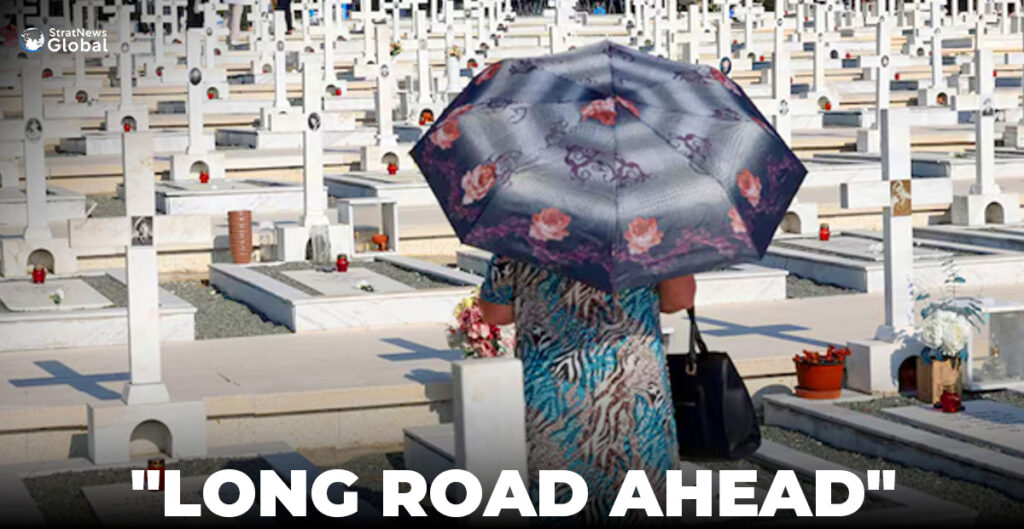
Greek and Turkish Cypriots on Sunday marked the 51st anniversary of Turkey’s 1974 invasion of Cyprus, an event that split the island and continues to shape geopolitics in the region.
Air raid sirens wailed across the southern Greek Cypriot-populated parts of Cyprus at 0530 local time (0230 GMT), the hour Turkish troops landed on the northern coast in a military intervention triggered by a brief Greece-inspired coup.
Turkish President Tayyip Erdogan was due to attend celebrations in North Cyprus, a breakaway state recognised only by Ankara.
Cyprus President Nikos Christodoulides attended a memorial service in the south for people who died.
Efforts to reunify Cyprus as a bizonal, bicommunal federation have repeatedly failed amid deep-rooted mistrust and competing visions for the island’s future.
The simmering conflict is a source of tension between NATO partners Greece and Turkey and complicates Turkey’s ambitions to foster closer ties with the European Union, of which both Cyprus and Greece are members.
UN Secretary-General Antonio Guterres said on Thursday the two sides would continue discussions on trust-building measures. “There is a long road ahead,” he said.
(With inputs from Reuters)
Azerbaijan Urges Russia To Admit Plane Downing, Punish Those Responsible
Azerbaijani President Ilham Aliyev on Saturday called on Russia to publicly admit that it accidentally shot down an Azerbaijani passenger plane last December, killing all 38 people on board, and to hold those responsible accountable.
President Vladimir Putin apologised at the time to Aliyev for what the Kremlin called a “tragic incident” over Russia in which an Azerbaijan Airlines plane crashed after Russian air defences opened fire against Ukrainian drones.
But he stopped short of saying Russia had shot down the aircraft.
Aliyev Confronts Russia
Aliyev, speaking at a news conference in the city of Khankendi during an event called the Global Media Forum, made clear that he wanted much more from Moscow, whom he accused of inaction following the downing of the airliner.
“We know exactly what happened — and we can prove it. Moreover, we are confident that Russian officials also know what happened,” Aliyev said.
“The real question is: why didn’t they do what any responsible neighbour should do?”
He said Azerbaijan expected the incident to be formally acknowledged, for those responsible to be held accountable, for compensation to be paid to victims’ families and those injured, and for Moscow to reimburse the cost of the destroyed aircraft.
“These are standard expectations within the framework of international law and good-neighbourly relations,” he said.
Flight J2-8243, en route from Baku to the Chechen capital Grozny, crash-landed near Aktau in Kazakhstan after diverting from southern Russia, where Ukrainian drones were reported to be attacking several cities. Thirty-eight people were killed and 29 survived.
Rising Tensions
Ties between Moscow and Baku have seriously deteriorated in recent months after Russian police detained a group of ethnic Azerbaijanis living in Russia and accused them of various historic crimes.
Speaking at the same event, Aliyev said he wanted a transit corridor to be opened between Azerbaijan and its exclave of Nakhchivan that would run via Armenia.
Aliyev said, “We are talking about unimpeded state access from Azerbaijan to Azerbaijan. And we understand this literally — we are talking about a connection between parts of one country.”
He said that, if and when it is set up, Azerbaijani train passengers should not be exposed to physical danger from Armenian civilians, whom he accused of throwing stones at such trains in the Soviet era and called for “reliable and verifiable” security guarantees.
“This is an absolutely legal and fair demand,” Aliyev said.
Armenia-Azerbaijan Corridor
Armenian Prime Minister Nikol Pashinyan said on July 16 that the U.S. had offered to manage the potential transport corridor.
The potential corridor, which Baku is keen to secure, would run roughly 32 km (20 miles) through Armenia’s southern Syunik province, linking the majority of Azerbaijan to Nakhchivan, an Azerbaijani exclave that borders Baku’s ally Turkey.
The transit link is one of several stumbling blocks to a peace deal between Azerbaijan and Armenia, neighbours in the South Caucasus region who have fought a series of wars since the late 1980s and remain arch-rivals.
The countries said in March they had finalised a draft peace deal, but the timeline for signing it remains uncertain.
(With inputs from Reuters)
Microsoft Halts Use Of China-Based Engineers On U.S. Military Projects After Scrutiny
Microsoft on Friday said it will stop using China-based engineers to provide technical support to the U.S. military.
The move follows a ProPublica report that raised concerns from a U.S. senator and led Defense Secretary Pete Hegseth to order a two-week review of Pentagon cloud contracts.
The report detailed Microsoft’s use of Chinese engineers opens new tab to work on U.S. military cloud computing systems under the supervision of U.S. “digital escorts” hired through subcontractors who have security clearances but often lacked the technical skills to assess whether the work of the Chinese engineers posed a cybersecurity threat.
Microsoft, a major contractor to the U.S. government, has had its systems breached by Chinese and Russian hackers.
It told ProPublica it disclosed its practices to the U.S. government during an authorisation process.
On Friday, Microsoft spokesperson Frank Shaw said on social media website X that the company changed how it supports U.S. government customers “in response to concerns raised earlier this week … to assure that no China-based engineering teams are providing technical assistance” for services used by the Pentagon.
Earlier on Friday, Senator Tom Cotton, an Arkansas Republican who chairs the chamber’s intelligence committee and also serves on its armed services committee, sent a letter to Defense Secretary Pete Hegseth about Microsoft’s reported practices.
Cotton asked the U.S. military for a list of contractors that use Chinese personnel and more information on how U.S. “digital escorts” are trained to detect suspicious activity.
“The U.S. government recognises that China’s cyber capabilities pose one of the most aggressive and dangerous threats to the United States, as evidenced by infiltration of our critical infrastructure, telecommunications networks, and supply chains,” Cotton wrote in the letter.
The U.S. military “must guard against all potential threats within its supply chain, including those from subcontractors,” he wrote.
In a video posted on X on Friday, Hegseth said he was initiating a two-week review to ensure China-based engineers were not working on any other cloud services contracts across the Defense Department.
“I’m announcing that China will no longer have any involvement whatsoever in our cloud services, effective immediately,” Hegseth said in the video. “We will continue to monitor and counter all threats to our military infrastructure and online networks.”
(With inputs from Reuters)
China’s Rare Earth Magnet Exports To U.S. Surge Sevenfold
China’s exports of rare earth magnets to the United States rose more than seven times in June compared to May, following a Sino-US trade agreement.
This signals a significant recovery in the flow of essential minerals needed for electric vehicles and wind turbines.
Outbound shipments to the United States from the world’s largest producer of rare earth magnets surged to 353 metric tonnes in June, up 660% from May, data from the General Administration of Customs showed on Sunday.
Sino-US Deal
That came after pacts were reached in June to resolve issues around shipments of rare earth minerals and magnets to the United States, with chipmaker Nvidia’s plan to resume sales of its H20 AI chips to China as part of the talks.
China, which provides more than 90% of the global supply of rare earth magnets, decided in early April to add several rare earth items to its export restriction list in retaliation for U.S. tariffs.
The subsequent sharp falls in shipments in April and May, due to the lengthy times required to secure export licences, had rattled global suppliers, forcing some automakers outside China to halt partial production due to a shortage of rare earths.
In total, China exported 3,188 tonnes of rare earth permanent magnets last month, up 157.5% from 1,238 tonnes in May, although the June volume was still 38.1% lower than the corresponding month in 2022.
Shipments of magnets are likely to recover further in July as more exporters obtained licences in June, analysts said.
During the first half of 2025, exports of rare earth magnets fell 18.9% on the year to 22,319 tonnes.
(With inputs from Reuters)
Myanmar: ‘All I Can See In My Crystal Ball Is Blood’
Myanmar is in turmoil. Since the 2021 military coup, the country has fractured into a chaotic battleground of state forces and armed ethnic resistance. Border regions have become ungoverned spaces—fertile ground for insurgent groups, including anti-India factions like ULFA-I and NSCN-K offshoots. With Myanmar’s junta barely holding on and China expanding its influence, regional powers, including India, are being forced to reassess their strategies.
Recently, reports emerged of a high-precision strike on insurgent camps along the India-Myanmar border—possibly involving over 150 drones. While India has officially denied involvement, the operation’s sophistication suggests otherwise. It comes amid growing frustration in New Delhi over repeated cross-border attacks by insurgents and the Myanmar regime’s inability—or unwillingness—to act.
To understand this evolving picture, StratNewsGlobal spoke with Nilanthan Niruthan, Executive Director of the Centre for Law and Security Studies in Colombo, who offers a sharp, strategic take on the situation.
According to Niruthan, the groups targeted in the strikes are not the main insurgent outfits but their radical breakaway factions, which oppose negotiated peace and remain ideologically hardened. These groups operate with impunity in Myanmar’s lawless frontier, exploiting the vacuum left by a crumbling state.
If India did execute the strikes, Niruthan suggests a deliberate strategy of “plausible deniability” is at play—avoiding international noise while neutralizing threats quietly.
But the bigger story is China’s deep entrenchment in Myanmar. From state actors to rebels, all sides avoid damaging Chinese assets, especially in rare earth-rich regions. Myanmar currently holds around 50% of the world’s known heavy rare earth reserves—vital to modern technology and a key reason for Beijing’s grip.
While the West watches from the sidelines, Niruthan notes that India has both hard and soft power stakes in Myanmar—civilizational ties, security concerns, and strategic connectivity via its Act East policy. In his view, India’s best long-term play may be less about firepower and more about forging deeper cultural and economic engagement—a front where China’s money can’t compete.
But for now, he warns, Myanmar’s future looks grim. “All I see in the crystal ball,” he says, “is blood.”
Nights Of Fear In Kyiv: How The Capital Lives Through Russia’s Repeated Strikes
On most nights, 27-year-old Daria Slavytska loads a stroller with essentials—blankets, a yoga mat, and food—and makes her way into the Kyiv subway with her two-year-old son Emil. As air raid sirens pierce the night air above, she seeks refuge underground, hoping to catch a few hours of sleep in relative safety.
For the past two months, Russia has unleashed drone and missile assaults at nights on Kyiv in a summer offensive that is straining the city’s air defences, and has its 3.7 million residents exhausted and on edge.
Other towns and villages have seen far worse since Russia launched its full-scale invasion in early 2022 – especially those close to the frontline far to the east and south.
Many have been damaged or occupied as Russia advances, and thousands of people have fled to the capital, considered the best-defended city in the country.
But recent heavy attacks are beginning to change the mood. At night, residents rush to metro stations deep underground in scenes reminiscent of the German “Blitz” bombings of London during World War Two.
Slavytska has started nervously checking Telegram channels at home even before the city’s alarms sound, after she found herself in early July running into the street to reach the metro with explosions already booming in the sky.
Underground Refuge
The number of people like Slavytska taking refuge in the cavernous Soviet-era ticket halls and drafty platforms of Kyiv’s 46 underground stations soared after large-scale bombardments slammed the city five times in June.
Previously, the loud air raid alert on her phone sent Emil into bouts of shaking and he would cry “Corridor, corridor, mum. I’m scared. Corridor, mum,” Slavytska said. Now, accustomed to the attacks, he says more calmly “Mum, we should go”.
“We used to come here less often, about once a month,” Slavytska said, sheltering in Akademmistechko station in western Kyiv. “That was six months ago. Now we come two or three times a week.” She spent the night curled up on her pink mat with Emil by a column lining the subway tracks.
The subway system recorded 165,000 visits during June nights, more than double the 65,000 visits in May and nearly five times the number in June last year, its press service said.
More people were heading to the shelter because of “the scale and lethality” of attacks, the head of Kyiv’s military administration, Tymur Tkachenko, said. He said strikes killed 78 Kyiv residents and injured more than 400 in the first half of the year.
U.S. President Donald Trump cited Russia’s strikes on Ukrainian cities when announcing his decision on Monday to offer Kyiv more weapons, including Patriot missiles to boost its air defences.
“It’s incredible that (people) stay, knowing that a missile could be hitting your apartment,” Trump said.
Russia launched more than 30 missiles and 300 drones during an overnight assault on Saturday that affected 10 regions of Ukraine, President Volodymyr Zelenskiy said, including a mass drone attack on the Black Sea port city of Odesa.
Exhaustion And Terror
In April, a strike in Kyiv destroyed a residential building a couple of kilometres from Slavytska’s apartment block.
“It was so, so loud. Even my son woke up and I held him in my arms in the corridor,” she said. “It was really scary.”
With the threat of losing her home suddenly more tangible, she now takes her identity documents with her underground.
After seeing how stressed Emil became after the air alerts, Slavytska sought help from a paediatrician, who recommended she turn off her phone’s loud notifications and prescribed a calming medication. Slavytska tells Emil the loud sound during attacks is thunder.
Scientists and psychologists say that the lack of sleep is taking its toll on a population worn down by more than three years of war.
Kateryna Holtsberh, a family psychologist who practices in Kyiv, said sleep deprivation caused by the attacks was causing mood swings, extreme stress and apathy, leading to declined cognitive functions in both kids and adults.
“Many people say that if you sleep poorly, your life will turn into hell and your health will suffer,” said Kateryna Storozhuk, another Kyiv region resident. “I didn’t understand this until it happened to me.”
Anton Kurapov, post-doctoral scholar at the University of Salzburg’s Laboratory for Sleep, Cognition and Consciousness Research, said it was hard to convey to outsiders what it felt like to be under attack.
“Imagine a situation where you go out into the street and a person is shot in front of you … and what fear you experience, your heart sinks,” he said. “People experience this every day, this feeling.”
Kurapov warned that the impact of such stress could result in lifetime consequences, including chronic illnesses.
Lack Of Sleep
A study he led that was published in the European Journal of Psychotraumatology in August 2024 showed that 88% of Ukrainians surveyed reported bad or very bad sleep quality.
Lack of sleep can significantly impact economic performance and soldiers’ ability to fight, said Wendy Troxel, senior behavioural scientist at RAND Corporation, a U.S. think-tank.
RAND research in 2016 which Troxel co-authored showed that lack of sleep among the U.S. working population was costing the economy up to $411 billion a year.
As she tries to squeeze out more hours of sleep in the subway, Slavytska is looking into buying a mattress to bring underground that would be more comfortable than her mat. Danish retailer JYSK says the air strikes prompted a 25% jump in sales of inflatable mattresses, camp beds and sleep mats in Kyiv in three weeks of June.
Others are taking more extreme measures. Small business owner Storozhuk, who had no shelter within three km of her home, invested over $2,000 earlier this year in a Ukrainian-made “Capsule of Life” reinforced steel box, capable of withstanding falling concrete slabs.
She climbs in nightly, with her Chihuahua, Zozulia.
“I developed a lot of anxiety and fear,” Storozhuk said. “I realized that in order to be able to sleep peacefully in Ukraine, I needed some kind of safe shelter.”
(With inputs from Reuters)
Trump’s Funding Cuts Halt Water Projects, Endangering Millions
The Trump administration’s sweeping cuts to U.S. foreign aid have left numerous global water and sanitation projects unfinished, posing new risks to intended beneficiaries, Reuters has found.
Reuters has identified 21 unfinished projects in 16 countries after speaking to 17 sources familiar with the infrastructure plans. Most of these projects have not previously been reported.
With hundreds of millions of dollars in funding cancelled since January, workers have put down their shovels and left holes half-dug and building supplies unguarded, according to interviews with U.S. and local officials and internal documents seen by Reuters.
As a result, millions of people who were promised clean drinking water and reliable sanitation facilities by the United States have been left to fend for themselves.
Water towers intended to serve schools and health clinics in Mali have been abandoned, according to two U.S. officials who spoke on condition of anonymity.
In Nepal, construction was halted on more than 100 drinking water systems, leaving plumbing supplies and 6,500 bags of cement in local communities. The Himalayan nation will use its own funds to finish the job, according to the country’s water minister, Pradeep Yadav.
In Lebanon, a project to provide cheap solar power to water utilities was scrapped, costing some 70 people their jobs and halting plans to improve regional services. The utilities are now relying on diesel and other sources to power their services, said Suzy Hoayek, an adviser to Lebanon’s energy ministry.
In Kenya, residents of Taita Taveta County say they are now more vulnerable to flooding than they had been before, as half-finished irrigation canals could collapse and sweep away crops. Community leaders say it will cost $2,000 to lower the risk – twice the average annual income in the area.
“I have no protection from the flooding that the canal will now cause; the floods will definitely get worse,” said farmer Mary Kibachia, 74.
Bipartisan Support
Trump’s dismantling of the U.S. Agency for International Development has left life-saving food and medical aid rotting in warehouses and thrown humanitarian efforts around the world into turmoil. The cuts may cause an additional 14 million deaths by 2030, according to research published in The Lancet medical journal.
The Trump administration and its supporters argue that the United States should spend its money to benefit Americans at home rather than sending it abroad, and say USAID had strayed from its original mission by funding projects like LGBT rights in Serbia.
With an annual budget of $450 million, the U.S. water projects accounted for a small fraction of the $61 billion in foreign aid distributed by the United States last year.
Before Trump’s reelection in November, the water projects had not been controversial in Washington. A 2014 law that doubled funding passed both chambers of Congress unanimously.
Advocates say the United States has, over the years, improved the lives of tens of millions of people by building pumps, irrigation canals, toilets and other water and sanitation projects. That means children are less likely to die of water-borne diseases like diarrhoea, girls are more likely to stay in school, and young men are less likely to be recruited by extremist groups, said John Oldfield, a consultant and lobbyist for water infrastructure projects.
“Do we want girls carrying water on their heads for their families? Or do you want them carrying school books?” he said.
The U.S. State Department, which has taken over foreign aid from USAID, did not respond to a request for comment about the impact of halting the water projects.
The agency has restored some funding for life-saving projects, but Secretary of State Marco Rubio has said American assistance will be more limited going forward.
At least one water project has been restarted. Funding for a $6 billion desalination plant in Jordan was restored after a diplomatic push by King Abdullah.
But funding has not resumed for projects in other countries, including Ethiopia, Tanzania, and the Democratic Republic of the Congo, say people familiar with those programs who spoke on condition of anonymity.
That means women in those areas will have to walk for hours to collect unsafe water, children will face increased disease risk, and health facilities will be shuttered, said Tjada D’Oyen McKenna, CEO of Mercy Corps, a nonprofit that worked with USAID on water projects in Congo, Nigeria and Afghanistan that were intended to benefit 1.7 million people.
“This isn’t just the loss of aid — it’s the unravelling of progress, stability, and human dignity,” she said.
(With inputs from Reuters)
Japan Votes In Crucial Election Seen As Major Test For PM Ishiba
Voters in Japan head to the polls on Sunday for a closely fought upper house election that could spark political upheaval, as growing public frustration over rising prices and immigration issues threatens Prime Minister Shigeru Ishiba’s hold on power.
Opinion polls suggest Ishiba’s Liberal Democratic Party and coalition partner Komeito may fall short of the 50 seats needed to retain control of the 248-seat upper house of parliament in an election where half the seats are up for grabs.
The polls show smaller opposition parties pushing for tax cuts and increased public spending are set to gain, among them the right-wing Sanseito, which vows to curb immigration, oppose foreign capital inflows and reverse gender equality moves.
A poor showing by the coalition could shake investor confidence in the world’s fourth-largest economy and disrupt critical trade talks with the United States, analysts said.
Ishiba may have to choose between making way for a new LDP leader or scrambling to secure the backing of some opposition parties with policy compromises, said Rintaro Nishimura, an associate at the Asia Group in Japan.
“Each scenario requires the LDP and Komeito to make certain concessions, and will be challenging, as any potential partner has leverage in the negotiations.”
Deadline For Trade Deal
After the election Japan faces a deadline of August 1 to strike a trade deal with the United States or face punishing tariffs in its largest export market.
Such import levies could squeeze the economy and further pressure the government to give financial relief to households already reeling from inflation, such as a doubling of rice prices since last year.
With an eye on a jittery government bond market, the LDP has called for fiscal restraint, rejecting opposition calls for major tax cuts and welfare spending to soften the blow.
Ishiba’s administration lost its majority in the more powerful lower house in October.
As the LDP’s worst showing in 15 years, the outcome roiled financial markets and left the prime minister vulnerable to no-confidence motions that could topple his administration and trigger a fresh general election.
Ruled by the LDP for most of the post-war period, Japan has so far largely avoided the social division and fracturing of politics seen in other industrialised democracies.
Voting ends at 8 p.m. (1100 GMT), when media are expected to project results based on exit polls.
(With inputs from Reuters)