

Support us by contributing to StratNewsGlobal on the following UPI ID
ultramodern@hdfcbank

Strategic affairs is our game, South Asia and beyond our playground. Put together by an experienced team led by Nitin A. Gokhale. Our focus is on strategic affairs, foreign policy and international relations, with higher quality reportage, analysis and commentary with new tie-ups across the South Asian region.
You can support our endeavours. Visit us at www.stratnewsglobal.com and follow us on YouTube, Twitter, Facebook and Instagram.
र 500 per month
र 1000 per month
र 5000 per year
र 10000 per year
Donate an amount of your choice
र 500 per month
Donate र 500 per month

र 1000 per month
Donate र 1000 per month
र 5000 per year
Donate र 5,000 per year
र 10000 per year
Donate र 10,000 per year
Donate an amount of your choice
Donate an amount of your choice


3 Dead, Thousands Affected As Wipha Hits Central Vietnam
In a tragic turn of events, relentless heavy rains brought on by tropical storm Wipha have unleashed severe flooding across Vietnam’s central Nghe An province, claiming the lives of at least three individuals and leaving one person missing.
Owing to its long and vulnerable coastline along the South China Sea, Vietnam frequently finds itself in the path of powerful typhoons, which often lead to devastating floods and landslides, claiming lives and damaging infrastructure. Tropical storm Wipha marks the first major weather system to strike the country this year, bringing with it significant rainfall and widespread disruption.
Wipha made landfall in Vietnam on Tuesday, after battering Hong Kong and China and worsening monsoon rains and flooding in the Philippines.
Hundreds Of Properties Damaged
According to a report by the Kinh Te Moi Truong newspaper, which cited details from the People’s Committee of Nghe An province, one of the victims tragically lost their life after being buried under a landslide, while another was swept away by powerful floodwaters caused by the strong current.
More than 3,700 houses in the province have been inundated by flood waters, and another 459 were damaged by strong winds, according to the report.
Photos on state media show homes in villages in the province submerged to the roofs.
‘We Have Nothing Left’
“Our rice, our clothing and our money are all gone,” Dang Thi Ngoc, a local flood victim, told state broadcaster VTV. “We have nothing left except for our bare hands.”
Flood waters have also damaged 1,600 hectares of rice plantations and 1,290 hectares of cash crops in the province, the report said.
The government’s official weather forecasting agency has warned that several northern regions of Vietnam are likely to witness continuous heavy rainfall, with precipitation levels expected to reach up to 250 millimetres on Thursday and Friday.
The downpour may persist into Saturday, significantly increasing the risk of further flooding, landslides, and disruption to daily life, especially in low-lying and mountainous areas already affected by tropical storm Wipha.
(With inputs from Reuters)
China Urges EU To Make ‘Correct Strategic Choices’ At Beijing Summit
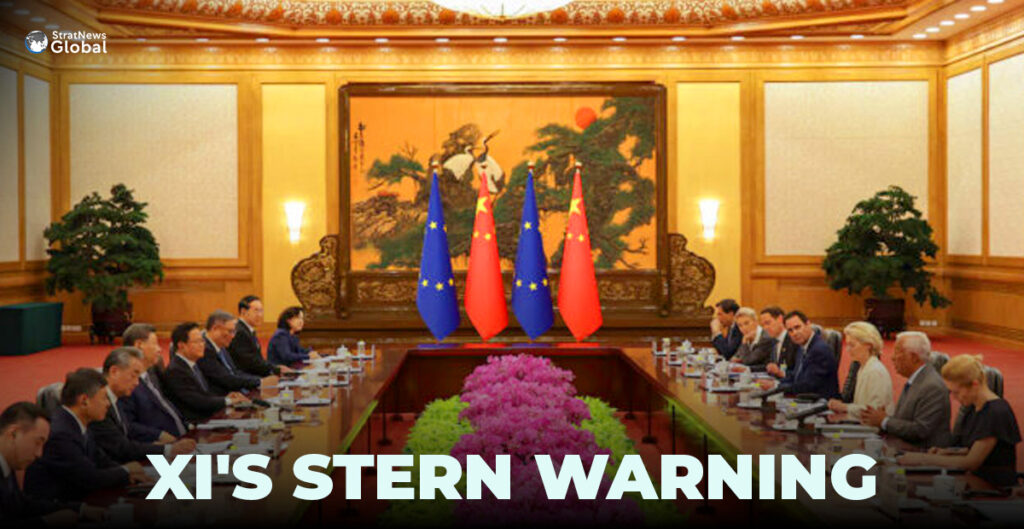
In a significant diplomatic message, Chinese President Xi Jinping on Thursday urged top European Union leaders to “make correct strategic choices”, according to state media, during a crucial summit in Beijing expected to focus on contentious issues such as trade tensions and the Ukraine conflict.
Expectations were low for the summit marking 50 years of diplomatic ties after weeks of escalating tension and wrangling over its format, with the duration abruptly halved to a single day at Beijing’s request.
Issues of trade imbalance, market access and rare earths are on the agenda as Xi and Premier Li Qiang meet visitors Ursula von der Leyen, the president of the European Union Commission, and Antonio Costa, the European Council president.
‘Mutually Beneficial Cooperation’
“The more severe and complex the international situation, the more China and the EU must strengthen communication, enhance mutual trust and deepen cooperation,” Xi told von der Leyen and Costa, state broadcaster CCTV said.
“Chinese and European leaders should … make correct strategic choices that meet the expectations of the people,” he added.
The weeks leading up to the summit had been dominated by tit-for-tat trade disputes and hawkish rhetoric from European officials.
Shortly before the summit, von der Leyen struck a more conciliatory tone, calling it an opportunity to “both advance and rebalance our relationship” in a post on X on Thursday.
“I’m convinced there can be a mutually beneficial cooperation,” von der Leyen added.
‘Critical Partner To Europe’
State news agency Xinhua also appeared to downplay Beijing’s rivalry with the 27-member bloc, saying China was a “critical partner” for Europe, with a range of shared interests.
“China is a critical partner to Europe, not a systemic rival,” it said in a commentary on Thursday.
The two shared interests in trade, climate, and global governance, it said, adding, “These areas of common ground should not be eclipsed by isolated points of friction.”
‘Systemic Rival’
The EU defines China as a “partner, competitor and systemic rival”, which frames its strategic approach to China policy.
At the summit, European leaders are also expected to raise topics such as electric vehicles and Chinese industrial overcapacity.
China launched rare earth export controls in April that disrupted supply chains worldwide, leading to temporary stoppages in European automotive production lines the following month.
But its exports of rare earth magnets to the EU surged in June by 245% from May, to stand at 1,364 metric tons, though that was still 35% lower than the year-earlier figure, customs data showed.
The EU is likely to seal a trade deal with the United States for a broad tariff of 15% on its exports after intense negotiations, avoiding a harsher 30% figure threatened by President Donald Trump.
(With inputs from Reuters)
Trump Tariff Talks Postponed Amid US-South Korea Scheduling Conflict
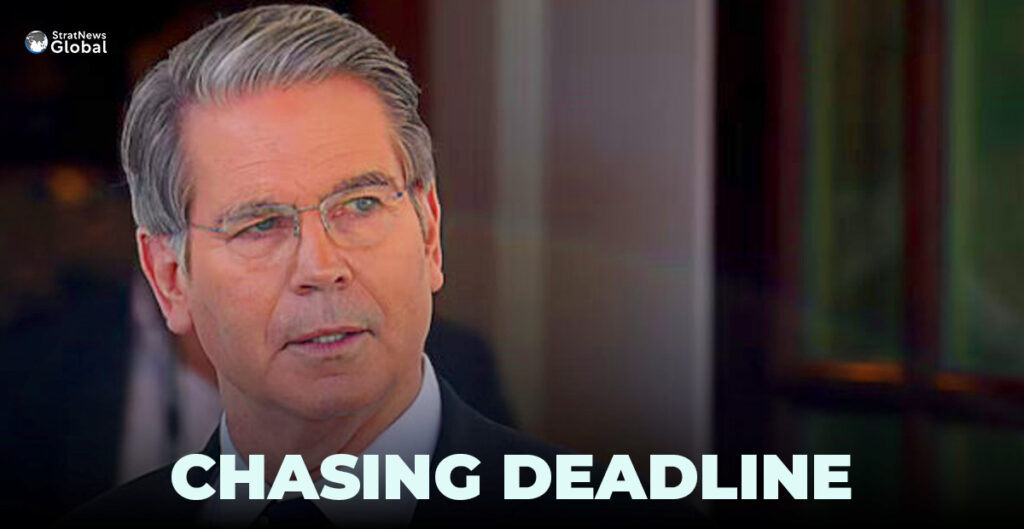
In a diplomatic setback, high-level talks between South Korean and US officials over President Donald Trump’s tariffs have been postponed due to a scheduling conflict involving US Treasury Secretary Scott Bessent, South Korea’s finance ministry said on Thursday.
The two sides will reschedule the meeting between Bessent and South Korean Finance Minister Koo Yun-cheol, as well as the top trade envoys of both countries, as soon as possible, the ministry said.
Last Minute Changes
Koo was set to board a flight for Washington on Thursday to attend the meeting on Friday in the hope of hammering out a deal that would spare Asia’s fourth-largest economy from Trump’s punishing 25% tariffs set to take effect on August 1.
The sudden announcement by the finance ministry an hour before Koo’s departure cast fresh doubts about whether Seoul would be able to pull off an agreement to avert US import duties that could hit some of its major exporting industries.
Markets Hit
The benchmark KOSPI stock index trimmed early gains to trade up 0.7% as of 0134 GMT, as auto and auto parts makers fell on news of the postponed talks, with Hyundai Motor dropping as much as 1.8%.
Washington gave no further details for postponing Friday’s meeting, the finance ministry said, though US officials are embroiled in a flurry of different negotiations.
Bessent was set to meet China’s Vice Premier He Lifeng in Sweden for a new round of trade talks ahead of the August 12 deadline set for Beijing. Washington is also moving towards a deal with the European Union.
Minister for Trade Yeo Han-koo and Industry Minister Kim Jung-kwan, who have travelled to Washington this week, have been meeting with US officials as scheduled, the South Korean government said.
Yeo will hold a meeting with US Trade Representative Jamieson Greer, the industry ministry said.
More Pressure After Japan Move
Pressure on South Korea heightened this week after Japan clinched a deal with the United States, which Trump said would see Tokyo allowing greater market access for American products including autos and some agricultural products.
The two major Asian security allies of the United States compete in areas such as autos and steel, and Japan’s deal was seen by investors as a benchmark for the type of agreement Seoul should try to squeeze out in negotiations, analysts have said.
The involvement of a range of ministerial-level officials from Seoul in broad discussions with US officials in recent days suggested the two sides were at work on a trade package that could potentially involve a range of sectors, including South Korea’s sensitive farm markets.
Access To US Markets Key
South Korean officials have said access to US markets is key to industrial cooperation between the allies that would help rebuild American manufacturing industries.
Finance ministry officials in Seoul declined to comment on media reports that Washington is asking South Korea to set up a large-scale investment fund in the United States to support the reconstruction of its manufacturing industry.
South Korea has been reviewing the feasibility of joining a $44 billion gas pipeline project in Alaska floated by Trump.
(With inputs from Reuters)
Thailand-Cambodia Border Clashes Erupt Amid Landmine, Drone Dispute
In a worrying escalation of cross-border tensions, armed clashes erupted between Thailand and Cambodia early Thursday along a long-disputed stretch of their shared frontier, with both sides trading blame over who fired the first shots after weeks of growing hostility.
In a statement, the Thai military said Cambodian troops had opened fire in an area near the disputed Ta Moan Thom temple. It said Cambodia had deployed a surveillance drone before sending troops to the area with heavy weapons.
Cambodia Alleges Unprovoked Incursion
A spokesperson for Cambodia’s defence ministry said there had been an unprovoked incursion by Thai troops and Cambodian forces had responded in self-defence.
The clash came after Thailand recalled its ambassador to Cambodia on Wednesday and said it would expel Cambodia’s envoy in Bangkok, after a second Thai soldier in the space of a week lost a limb to a landmine in the disputed area.
Thailand has said the landmines had been placed in the area recently, which Cambodia has described as baseless allegations.
Cambodia has many landmines left over from its civil war decades ago, numbering in the millions according to de-mining groups.
Thailand Lodges Formal Protest
The Thai Foreign Ministry has lodged a formal protest with Cambodia, saying the landmines found in the area were newly deployed and had not been encountered during previous patrols, the party said on social media.
Thailand has downgraded diplomatic relations with Cambodia, it said.
Cambodia’s government did not immediately respond to a request for comment. Its government spokesperson referred Reuters to the foreign ministry.
Thailand’s foreign ministry said it had yet to be informed of the decision to recall the Thai envoy and the plan to expel Cambodia’s ambassador.
The government has also ordered the closure of all border checkpoints under the jurisdiction of Thailand’s Second Army, the Pheu Thai Party said.
“Tourists are strictly prohibited from entering these border areas,” it said.
In the landmine incident on Wednesday, the soldier sustained injuries and lost his right leg, the party said.
(With inputs from Reuters)
Deadly Cyprus Wildfire Kills 2, Forces Mass Evacuations Amid Heatwave
Amid a relentless heatwave gripping the region, a devastating wildfire swept through southern Cyprus, leaving two people dead and forcing the evacuation of hundreds. The fast-moving blaze destroyed several homes and posed a serious threat to multiple communities, as firefighters battled to bring the flames under control.
Firefighters were struggling to contain the blaze after it erupted in mountainous terrain north of the southern city of Limassol midday Wednesday, driven by strong winds and searing temperatures.
Overnight, two people were found dead in a burned-out vehicle, while authorities continued to struggle to evacuate people trapped in the village of Lofou, about 26 kilometres (16 miles) from Limassol.
‘Very Difficult’ Situation
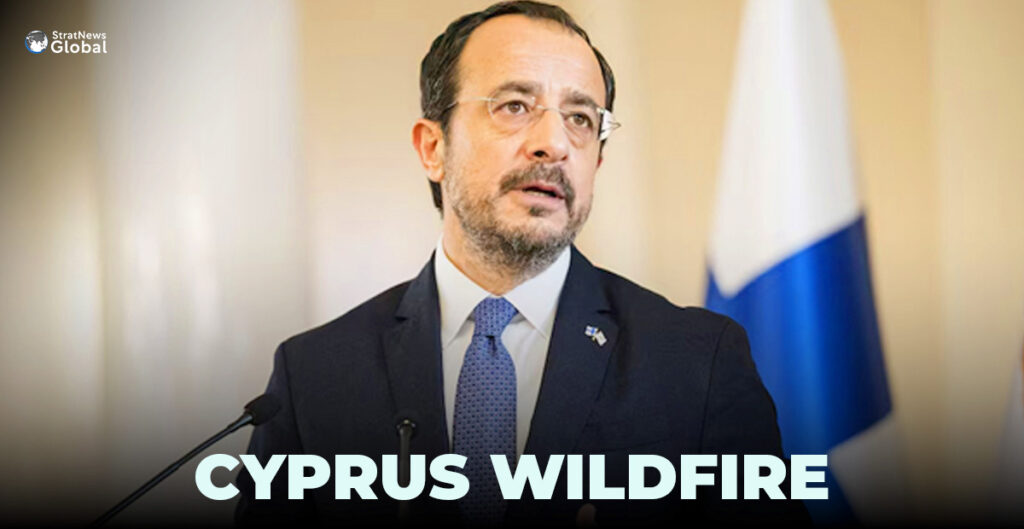
“The situation is very difficult and the fire front is huge. All forces have been mobilised,” Cypriot President Nikos Christodoulides told reporters from the scene earlier.
Temperatures across the island soared to a scorching 43 degrees Celsius (109.4 degrees Fahrenheit) on Wednesday, prompting the Cyprus Meteorological Department to issue an amber weather alert.
Authorities have warned that conditions are expected to deteriorate further on Thursday, with forecasts predicting a blistering high of 44 degrees Celsius — potentially making it the hottest day of the year so far. The extreme heat has added to the challenges faced by emergency services battling wildfires and has heightened concerns over public safety, especially among the elderly and vulnerable sections of society.
Firefighting aircraft were expected to be redeployed at first light after darkness forced a pause. Homes were burning in the Souni-Zanakia communities early Thursday, the fire brigade said.
Cyprus Asks For EU’s Help
Cyprus has requested help through the European Union’s civil protection mechanism, with Spain expected to send two aircraft on Thursday, government spokesperson Konstantinos Letymbiotis said. Jordan has also pledged assistance.
Cyprus has struggled with a protracted drought, pushing scarce water resources to critically low levels. The affected area sits just north of Cyprus’s Kouris reservoir, the island’s largest. It was at just 15.5% of its capacity on Wednesday.
(With inputs from Reuters)
Crypto, Drugs, Donations and Some Non-Profits Fund Terror: FATF
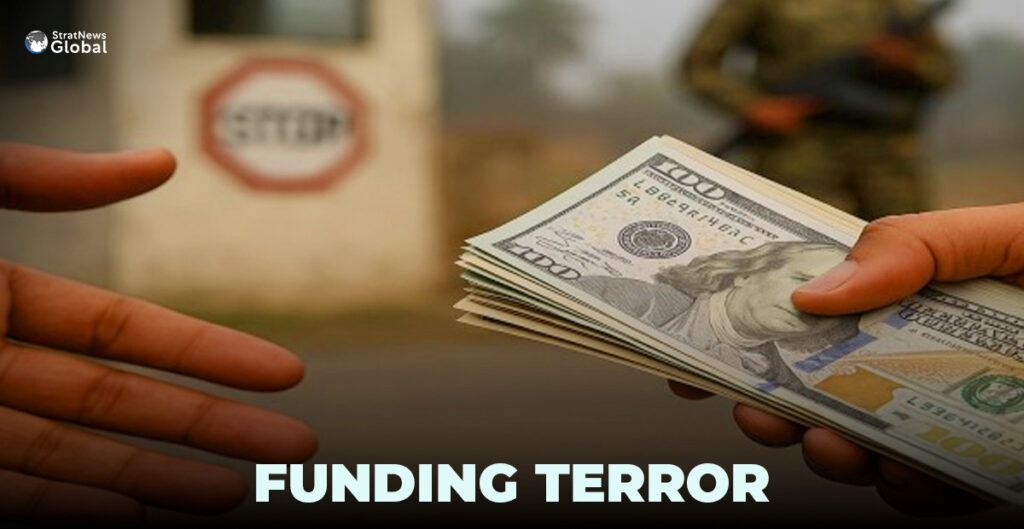
The Financial Action Task Force (FATF) has released its latest Comprehensive Update on Terrorist Financing Risks, warning of an increasingly complex and decentralised terror financing landscape.
Key concerns include the abuse of virtual assets, the misuse of non-profit organisations (NPOs), and the ongoing use of informal value transfer systems such as hawala. The report outlines how groups affiliated with ISIL, Al Qaeda, and the Taliban continue to access funding through both traditional and digital means.
While FATF avoids naming specific countries or entities, its language clearly signals frustration with jurisdictions failing to clamp down on known terror financiers—a point widely interpreted as applicable to long-standing concerns about Pakistan.
According to the report, terrorist groups continue to exploit revenue streams such as donations, looting, extortion, investment returns, and drug trafficking.
ISIL and Al Qaeda affiliates remain active and are adapting their financial operations across regions, including West Africa, the Sahel, and South Asia, it notes.The Taliban regime in Afghanistan draws funding from mineral extraction, customs duties and the drug trade, creating serious challenges for counter-terror financing (CTF) frameworks.
A growing number of terrorists and their supporters are turning to cryptocurrencies, privacy coins, mixers, and decentralised finance (DeFi) tools to obscure financial flows, it warns.
The FATF emphasises the misuse of NPOs, particularly in conflict zones. While most are legitimate, some are vulnerable to infiltration and abuse, it says.
The report also highlights the role of diaspora communities and informal financial systems, especially hawala, in funnelling funds to extremist groups.
While the FATF report does not name Pakistan, its language—particularly references to “jurisdictions where designated terrorist groups and their facilitators continue to access financial systems”—is consistent with long-standing Indian reports against Islamabad.
India has repeatedly accused Pakistan of allowing sanctioned groups like Lashkar-e-Taiba (LeT) and Jaish-e-Mohammed (JeM) to operate under new names, a practice sometimes referred to as “name-laundering.”
Similarly, while the report does not mention Pakistan-based entities using cryptocurrency, analysts believe such groups are likely adapting to the same methods FATF identifies globally.
Pakistan was first grey-listed by FATF in 2008, removed in 2010, and re-listed in June 2018 for “strategic deficiencies” in countering terror financing, particularly its inaction against UN-designated groups. Given a 27-point action plan, it remained under scrutiny for over four years, with multiple deadlines extended due to slow enforcement—especially regarding financial sanctions.
Although Pakistan completed the original plan by 2021, a second 7-point action plan on money laundering was added, which was ”addressed” by mid-2022.
In October 2022, FATF removed Pakistan from the grey list after confirming “significant progress” in strengthening its Anti-Money Laundering and Countering the Financing of Terrorism (AML/CFT) systems, while encouraging continued regional monitoring via the Asia/Pacific Group (APG).
No new formal action has been taken since, but international concerns persist, particularly about the operational freedom of designated individuals and the role of unregulated charities and financial channels.
India has long accused Pakistan of harbouring and financing cross-border terrorist groups. Following earlier FATF reviews, the Ministry of External Affairs (MEA) has frequently demanded “credible and irreversible action” from Islamabad.
In March 2024, MEA spokesperson Randhir Jaiswal reiterated India’s position: “There is sufficient evidence in the public domain, including through previous FATF findings, that Pakistan has not taken credible action against key terror financing operatives. This remains a serious concern.”
The next FATF Plenary, scheduled for October 2024, will further assess how jurisdictions are addressing these evolving threats.
Chinese Engines Disguised As ‘Cooling Units’ Power Russian Drones In Ukraine
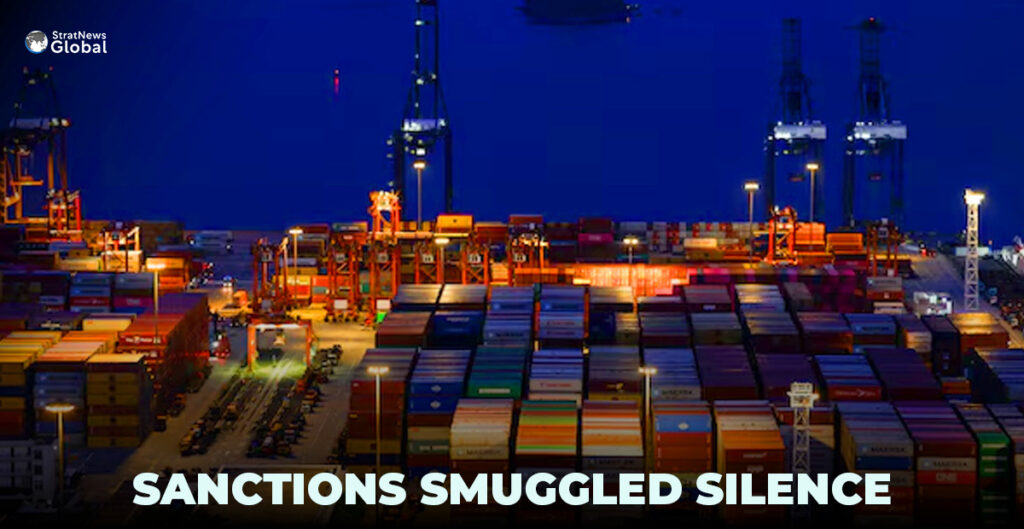
Chinese-made engines are secretly routed through front companies to a state-owned drone maker in Russia, falsely labelled as “industrial refrigeration units” to evade Western sanctions, according to documents and three European security officials cited by Reuters.
The shipments have allowed Russian weapons-maker IEMZ Kupol to increase its production of the Garpiya-A1 attack drone, despite the U.S. and E.U. sanctions imposed in October designed to disrupt its supply chain, according to the sources and documents, which included contracts, invoices and customs paperwork.
An internal Kupol document, reviewed by Reuters, showed it signed a contract with the Russian defence ministry to produce more than 6,000 Garpiya this year, up from 2,000 in 2024. The document stated that more than 1,500 drones had already been delivered by April.
The long-range drone is being deployed to attack civilian and military targets deep within Ukrainian territory, with around 500 being used by Russia per month, the Ukrainian military intelligence agency said in a statement to Reuters.
The European security officials asked that neither they nor their organisation be identified due to the sensitivity of the information. They also requested that some specific details in the documents be withheld, such as their dates and the cost of contracts.
In September, Reuters reported that Kupol was producing the Garpiya using Chinese technology, including L550E engines made by Xiamen Limbach Aviation Engine Co. A month after the Reuters’ report, the European Union and the U.S. sanctioned several companies involved in producing the drones, including Xiamen.
In the wake of the sanctions, a new Chinese firm called Beijing Xichao International Technology and Trade has started supplying the L550E engines to Kupol, according to invoices, a Kupol internal letter and transportation documents reviewed by Reuters.
The increase in production of Garpiya, as well as the new intermediaries supplying parts for the drones, is reported by Reuters for the first time.
The news agency could not determine how Xichao obtained the engines from the maker Xiamen Limbach. Xiamen Limbach did not respond to a request for comment, and Reuters was unable to reach Xichao.
IEMZ Kupol, Russia’s trade and industry ministry and the defence ministry also did not respond to a request for comment.
In a statement to Reuters, China’s foreign ministry said it was unaware of the export of parts for the Garpiya, and it has controlled foreign sales of dual-use goods in line with China’s own laws and international obligations.
“China has always opposed unilateral sanctions that lack basis in international law and are not authorised by the U.N. Security Council,” the statement said.
The European Commission did not immediately respond to a request for comment.
Both the U.S. and E.U. have repeatedly imposed sanctions on companies in third-party countries, including China, alleged to have provided dual-use technology to Russia. Kupol has been sanctioned since December 2022 by the EU and December 2023 by the U.S. for its involvement in Russia’s defence sector.
Diplomatic Warnings
European Commission President Ursula von der Leyen is due to travel to China for a summit with Chinese President Xi Jinping and Premier Li Qiang on Thursday, amid tensions over Beijing’s support for Russia’s war effort.
The European Union’s top diplomat, Kaja Kallas, told Chinese Foreign Minister Wang Yi on July 2 that Chinese firms’ support for Russia in the war posed a threat to European security, and she urged China to cease trade that sustains Russia’s military machine, the EU said in a statement.
Meia Nouwens, senior fellow for Chinese security and defence policy at the London-based International Institute for Strategic Studies (IISS), said China’s prime concern was to help sustain Russia’s war effort to ensure the United States remained focused on Ukraine.
“This does not help China and Europe come closer together, diplomatically,” she said.
China says it imposes strict controls on the export of drones and their parts and has never provided either side of the war in Ukraine with lethal weapons.
A person familiar with Beijing’s thinking on the issue said that China produces around 75% of the world’s drones, with the majority not for military purposes; if Russia was using them as weapons, then the same was also true of Ukraine, the person added.
Ahead of Thursday’s summit, one European official said the EU was not asking China to cut economic ties with Russia but to strengthen customs and financial controls to reduce the flow of specific dual-use goods.
The Garpiya, which means harpy in Russian, is based on the Iranian-made Shahed drones but relies on Chinese technology, the three European sources said. The Ukrainian military intelligence agency said the Chinese-made components in the drone included the engine, control systems, and navigation equipment.
The engines were shipped by Xichao to a Russian front company identified as SMP-138, which then forwarded them to a second Russian firm, LIBSS, according to another internal Kupol document, seen by Reuters.
Abram Goldman, registered as the owner of SMP-138, did not respond to an emailed request for comment. LIBSS also did not respond to Reuters’ questions.
A contract for LIBSS to supply Kupol with the engines, reviewed by Reuters, stated they would be described as cooling units in shipping documents because of their sensitivity. The delivery route was from Beijing to Moscow, then to Izhevsk, where Kupol has manufacturing facilities.
Describing them as cooling units allowed the goods to be exported to Russia without alerting Chinese authorities, the three security officials said.
Transportation documents reviewed by Reuters showed that Sichuan Airlines and China Southern Airlines, China’s largest carrier, had transported components for the drones to sanctioned Russian companies since October.
China Southern did not respond to Reuters’ questions, and Sichuan could not be reached for comment.
(With inputs from Reuters)
Germany Plans High-Tech Future Warfare With AI Robots And Spy Cockroaches
For Gundbert Scherf, co-founder of Helsing in Germany—Europe’s most valuable defence start-up—Russia’s invasion of Ukraine marked a turning point. Four years ago, Scherf struggled to secure investment for his company, which develops battlefield AI systems and military strike drones.
Now, that’s the least of his problems. The Munich-based company more than doubled its valuation to $12 billion at a fundraising last month.
“Europe this year, for the first time in decades, is spending more on defence technology acquisition than the U.S.,” said Scherf.
The former partner at McKinsey & Company says Europe may be on the cusp of a transformation in defence innovation akin to the Manhattan Project – the scientific push that saw the U.S. rapidly develop nuclear weapons during World War Two.
“Europe is now coming to terms with defence.”
Chancellor Friedrich Merz’s government views AI and start-up technology as key to its defence plans and is slashing bureaucracy to connect startups directly to the upper echelons of its military, the sources said.
Shaped by the trauma of Nazi militarism and a strong postwar pacifist ethos, Germany long maintained a relatively small and cautious defence sector, sheltered by U.S. security guarantees.
Germany’s business model, shaped by a deep aversion to risk, has also favoured incremental improvements over disruptive innovation.
No more. With U.S. military support now more uncertain, Germany – one of the biggest backers of Ukraine – plans to nearly triple its regular defence budget to around 162 billion euros ($175 billion) per year by 2029.
Much of that money will go into reinventing the nature of warfare, the sources said.
Defence Start-Ups
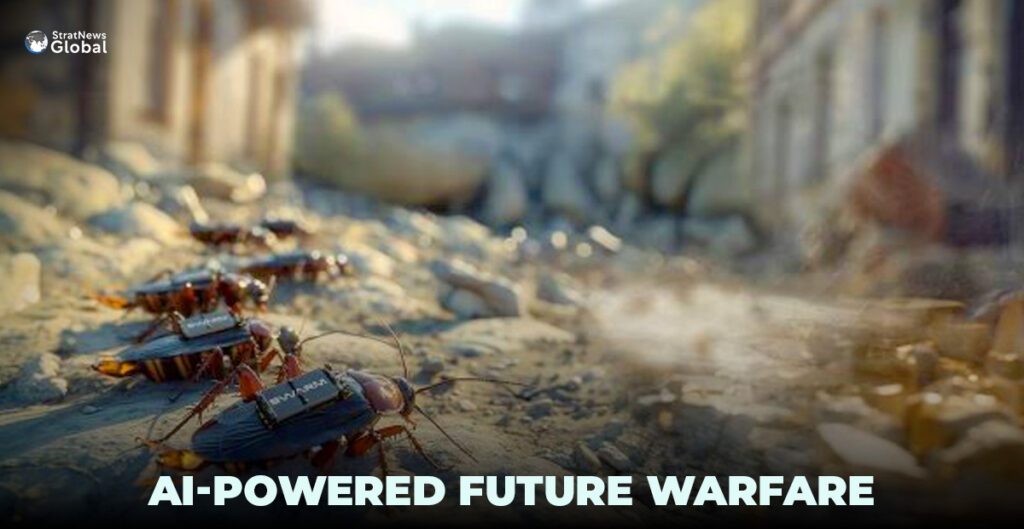
Helsing is part of a wave of German defence start-ups developing cutting-edge technology, from tank-like AI robots and unmanned mini-submarines to battle-ready spy cockroaches.
“We want to help give Europe its spine back,” said Scherf.
Some of these smaller firms are now advising the government alongside established firms – so-called primes such as Rheinmetall and Hensoldt – that have less incentive to focus primarily on innovation, given their long backlogs for conventional systems, one of the sources said.
A new draft procurement law, approved by Merz’s cabinet on Wednesday, aims to reduce hurdles for cash-strapped start-ups to join tenders by enabling advance payment to these firms.
The law would also entitle authorities to limit tenders to bidders inside the European Union.
Marc Wietfeld, CEO and founder of autonomous robots maker ARX Robotics, said a recent meeting with German defence minister Boris Pistorius hammered home how deep the rethink in Berlin goes.
“He told me: ‘Money is no longer an excuse – it’s there now’. That was a turning point,” he said.
Since Donald Trump’s return to the political stage and his renewed questioning of America’s commitment to NATO, Germany has committed to meet the alliance’s new target of 3.5% of GDP onspending by 2029 – faster than most European allies.
Officials in Berlin have emphasized the need to foster a European defence industry rather than rely on U.S. companies. But the hurdles towards scaling up industry champions in Germany – and Europe more broadly – are considerable.
Germany In The Lead
Unlike in the United States, the market is fragmented in Europe. Each country has its own set of procurement standards to fulfill contracts.
The United States, the world’s top military spender, already has an established stable of defence giants, like Lockheed Martin and RTX, and an advantage in key areas, including satellite technology, fighter jets and precise-guided munitions.
Washington also began boosting defence tech startups in 2015 – including Shield AI, drone maker Anduril and software company Palantir – by awarding them parts of military contracts.
European startups until recently languished with little government support.
But an analysis by Aviation Week in May showed Europe’s 19 top defence spenders – including Turkey and Ukraine – were projected to spend 180.1 billion this year on military procurement compared, to 175.6 billion for the United States. Washington’s overall military spending will remain higher.
Hans Christoph Atzpodien, head of Germany’s security and defence sector association BDSV, said one challenge was that the military’s procurement system was geared toward established suppliers and not well suited to the fast pace that new technologies require.
Germany’s defence ministry said in a statement it was taking steps to accelerate procurement and to better integrate startups in order to make new technologies quickly available to the Bundeswehr.
Annette Lehnigk-Emden, head of the armed forces’ powerful procurement agency, highlighted drones and AI as emerging fields that Germany needs to develop.
“The changes they’re bringing to the battlefield are as revolutionary as the introduction of the machine gun, tank, or airplane,” she said.
Spy Cockroaches
Sven Weizenegger, who heads up the Cyber Innovation hub, the Bundeswehr’s innovation accelerator, said the war in Ukraine was also changing social attitudes, removing a stigma towards working in the defence sector.
“Germany has developed a whole new openness towards the issue of security since the invasion,” he said.
Weizenegger said he was receiving 20-30 Linkedin requests a day, compared to maybe 2-3 weekly back in 2020, with ideas for defence technology to develop.
Some of the ideas under development feel akin to science fiction – like Swarm Biotactics’ cyborg cockroaches that are equipped with specialised miniature backpacks that enable real-time data collection via cameras for example.
Electrical stimuli should allow humans to control the insects’ movements remotely. The aim is for them to provide surveillance information in hostile environments – for example information about enemy positions.
“Our bio-robots – based on living insects – are equipped with neural stimulation, sensors, and secure communication modules,” said CEO Stefan Wilhelm. “They can be steered individually or operate autonomously in swarms.
German Innovations
In the first half of the 20th century, German scientists pioneered many military technologies that became global standards, from ballistic missiles to jet aircraft and guided weapons. But following its defeat in World War II, Germany was demilitarized and its scientific talent was dispersed.
Wernher von Braun, who invented the first ballistic missile for the Nazis, was one of hundreds of German scientists and engineers transported to the United States in the wake of World War II, where he later worked at NASA and developed the rocket that took Apollo spacecraft to the Moon.
In recent decades, defence innovation has been a powerful driver of economic progress. Tech like the internet, GPS, semiconductors and jet engines originated in military research programs before transforming civilian life.
Hit by high energy prices, a slowdown in demand for its exports and competition from China, Germany’s $4.75 trillion economy contracted over the last two years. Expanding military research could provide an economic fillip.
“We just need to get to this mindset: a strong defence industrial base means a strong economy and innovation on steroids,” said Markus Federle, managing partner at defence-focused investment firm Tholus Capital.
Escaping ‘The Valley Of Death’
Risk aversion among European investors had in the past disadvantaged startups, which struggled to get the capital they need to survive the ‘valley of death’ – the critical early stage when costs are high and sales low.
But a boost in defence spending by European governments following Russia’s invasion of Ukraine has investors looking for opportunities.
Europe now boasts three start-ups with a unicorn valuation of more than $1 billion: Helsing, German drone maker Quantum Systems, and Portugal’s Tekever, which also manufactures drones.
“There’s a lot of pressure now on Germany being the lead nation of the European defence,” said Sven Kruck, Quantum’s chief strategy officer.
Germany has become Ukraine’s second-biggest military backer after the United States. Orders that might once have taken years to approve now take months and European startups have had the opportunity to test their products quickly in the field, several sources said.
Venture capital funding of European defence tech hit $1 billion in 2024, up from a modest $373 million in 2022, and is expected to surge even more this year.
“Society has recognized that we have to defend our democracies,” said Christian Saller, general partner at HV Capital, an investor in both ARX and Quantum Systems.
No One Better Than Germany
Venture capital funding has grown faster in Germany than elsewhere, according to a data analysis by Dealroom. German defence startups have received $1.4 billion in the last five years from investors, followed by UK, the data shows.
Jack Wang, partner at venture capital firm Project A, said many German defence startups – rooted in the country’s engineering prowess – are good at integrating established components into scalable systems.
“Quality of talent in Europe is extremely high, but as a whole, there’s no better country, no better talent that we’ve seen other than in Germany,” he said.
Weakness in Germany’s automotive industry means there is production capacity to spare, including in the Mittelstand: the small and medium-sized enterprises (SMEs) that form the backbone of Germany’s economy.
Stefan Thumann, CEO of Bavarian startup Donaustahl, which produces loitering munitions, said he receives 3 to 5 applications daily from workers at automotive companies.
“The startups just need the brains to do the engineering and prototyping,” he said. “And the German Mittelstand will be their muscles.”
($1 = 0.8560 euros)
(With inputs from Reuters)
Rwandan Rebels Complicate Trump’s Vision For Resource-Rich Congo
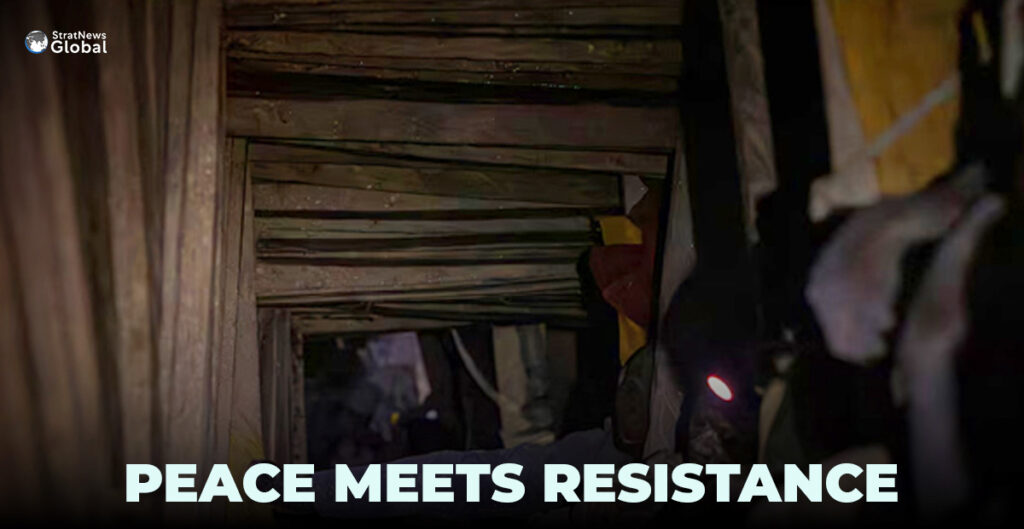
Efforts to end fighting in eastern Congo—crucial to President Donald Trump’s mining ambitions—are set to begin by Sunday, but a small rebel group’s fate remains a key obstacle.
A U.S.-brokered peace agreement signed last month by the Congolese and Rwandan foreign ministers was designed to halt violence that escalated this year with a lightning advance in the Democratic Republic of Congo by M23 rebels.
Rwanda denies allegations from the U.N. and Western governments that it is fighting alongside the M23 rebels to gain access to Congo’s minerals. Rwanda says its troops are there to tackle what it describes as an existential threat from thousands of Rwandan Hutu rebels known as the Democratic Forces for the Liberation of Rwanda (FDLR).
Security experts and diplomats say the FDLR, which includes remnants of Rwanda’s former army and militias that carried out the 1994 Rwandan genocide, boasts only a few hundred combatants and is not a significant battlefield force.
But the peace agreement explicitly requires Congo to “neutralise” the FDLR as Rwanda withdraws from Congolese territory, underscoring the group’s importance to the fate of Trump’s diplomacy.
Both the Congolese operations against the FDLR and the Rwandan withdrawal are supposed to start by Sunday and conclude by the end of September.
Rival Claims Collide
U.N. experts said in a report this month that Rwanda, along with M23, is trying to seize control of mineral-rich territory. Kigali responded that the presence of the “genocidal” FDLR “necessitates the defence posture in our border areas”.
The U.N. experts also accused the Congolese military of relying on the FDLR in its fight against M23. A spokesperson for Congo’s government did not respond to a request for comment on that question, but Kinshasa has said it is on board with ensuring any threat posed by the FDLR is “definitively eradicated”, including by voluntary disarmament. It has also accused Rwanda of using the FDLR as a pretext for deploying on Congolese territory.
Congolese researcher Josaphat Musamba said it was not possible for Congo to rid the region of FDLR fighters, given that M23 holds much of the territory where the FDLR now operates.
“It would be feasible if the Rwandan-backed rebellion were not active and threatening to conquer other territories,” said Musamba, a Ph.D. candidate at Ghent University who is from eastern Congo and studies the conflict there.
Jason Stearns, a political scientist at Simon Fraser University in Canada who specialises in Africa’s Great Lakes region, said the lack of progress against the FDLR could be cited by Rwanda as a reason to keep its troops deployed in eastern Congo past September, throwing off Washington’s timeline.
“It would be fairly easy for Rwanda to claim that Congo is not abiding by its side of the deal – that its operations against the FDLR are not serious enough, have not been successful enough – and therefore to drag its feet,” Stearns said.
A spokesperson for Rwanda’s government did not respond to a request for comment on its approach to the FDLR. Rwandan President Paul Kagame said on July 4 that Rwanda was committed to implementing the deal, but that it could fail if Congo did not live up to its promises to neutralise the FDLR.
Appeal To Trump
Trump said on July 9 that the Congolese and Rwandan presidents would travel to the United States in the “next couple of weeks” to sign the peace agreement. They are also expected to sign bilateral economic packages that would bring billions of dollars of investment into countries rich in tantalum, gold, cobalt, copper, lithium and other minerals. There has been no further word on a date.
While Washington has hosted negotiations between Congo and Rwanda, Qatar has hosted separate direct talks between Congo and M23. On Saturday, the two sides agreed to sign a separate peace deal by August 18. M23 currently has no concrete plans to withdraw from the territory it controls.
The FDLR has urged Trump not to green-light a Congolese offensive against it.
A July 2 letter to Trump from Victor Byiringiro, the FDLR’s acting president, said attacking the FDLR would jeopardise the safety of Congolese civilians as well as more than 200,000 Rwandan refugees.
In written responses to questions from Reuters, FDLR spokesperson Cure Ngoma said only “a frank, sincere, and inclusive dialogue among Rwandans” could bring peace, though Rwanda has repeatedly ruled out such talks with the group.
Trump expects Congo and Rwanda to abide by the peace deal, “which will foster lasting stability and prosperity in the region,” Anna Kelly, a White House spokesperson, said in response to Reuters questions about the FDLR’s future.
“All armed groups must lay down their arms and work within the framework of the peace process.”
The fighting has killed thousands and displaced hundreds of thousands more this year, while escalating the risk of a return to the kind of full-scale regional war which led to the deaths of millions of Congolese in 1998-2003.
(With inputs from Reuters)
Trump Unveils AI Plan Easing Rules, Boosting Tech Exports Globally
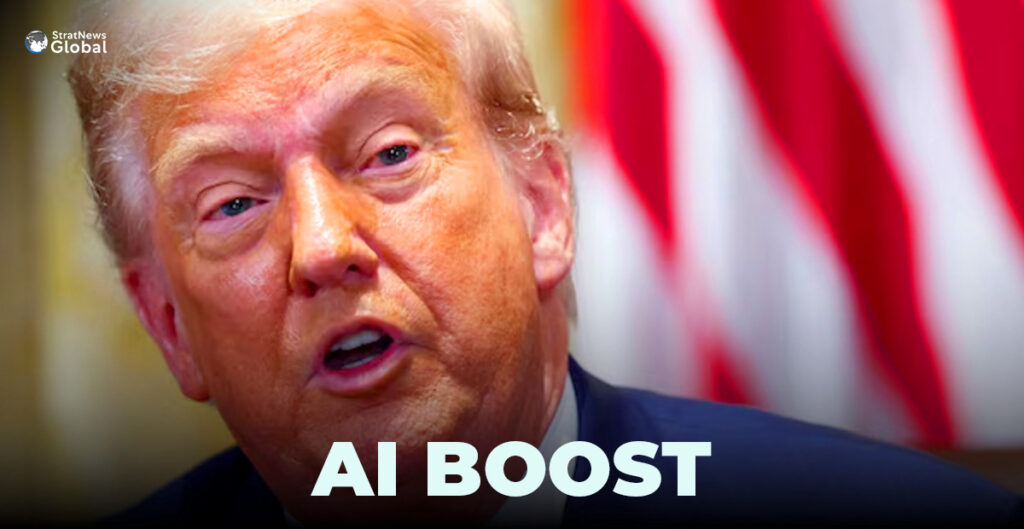
In a move to boost American competitiveness, the Trump administration on Wednesday unveiled a new artificial intelligence (AI) blueprint aimed at easing environmental regulations and reducing export risks for US tech firms.
President Donald Trump will mark the plan’s release with a speech outlining the importance of winning an AI race that is increasingly seen as a defining feature of 21st-century geopolitics, with both China and the United States investing heavily in the industry to secure economic and military superiority.
The plan, which includes some 90 recommendations, calls for the export of US AI technology abroad and a crackdown on state laws deemed too restrictive to let it flourish, a marked departure from predecessor Joe Biden’s “high fence” approach that limited global access to coveted AI chips.
New Programme
The administration said it plans to partner with the AI industry to create export packages of chips and software for America’s friends and allies.
“We’re establishing a programme led by the departments of Commerce and State to partner with industry to deliver secure full-stack AI export packages, including hardware models, software applications and standards to America’s friends and allies around the world,” said Michael Kratsios, head of the Office of Science and Technology Policy.
The AI plan, according to a senior administration official, does not address national security concerns around Nvidia’s H20 chip, which powers AI models and was designed to walk right up to the line of prior restrictions on Chinese AI chip access.
Trump blocked the export of the H20 to China in April but allowed the company to resume sales earlier this month, sparking rare public criticism from fellow Republicans.
New Exclusions
The plan also calls for fast tracking the construction of data centers by loosening environmental regulations and utilizing federal land to expedite development of the projects, including any power supplies.
The administration will seek to establish new exclusions for data centers under the National Environmental Policy Act and streamline permits under the Clean Water Act.
Trump will incorporate some of the plan’s recommendations into executive orders that will be signed ahead of his speech, according to two sources familiar with the plans. Trump directed his administration in January to develop the plan.
Top administration officials such as Secretary of State Marco Rubio and White House National Economic Adviser Kevin Hassett are also expected to join the event titled “Winning the AI Race”, organised by White House AI and crypto czar David Sacks and his co-hosts on the “All-In” podcast, according to a schedule reviewed by Reuters.
The event will be hosted by the Hill and Valley Forum, an informal supper club whose deep-pocketed members helped propel Trump’s campaign and sketched out a road map for his AI policy long before he was elected.
Trump is expected to take additional actions in the upcoming weeks that will help Big Tech secure the vast amounts of electricity it needs to power the energy-guzzling data centers needed for the rapid expansion of AI, Reuters previously reported.
Surge In Demand
US power demand is hitting record highs this year after nearly two decades of stagnation as AI and cloud computing data centers balloon in number and size across the country.
Trump wants to remove barriers to AI expansion, in stark contrast to Biden, who feared US adversaries like China could harness AI chips produced by companies like Nvidia and AMD to supercharge its military and harm allies.
Biden, who left office in January, imposed a raft of restrictions on US exports of AI chips to China and other countries that it feared could divert the semiconductors to America’s top global rival.
Trump rescinded Biden’s executive order aimed at promoting competition, protecting consumers and ensuring AI was not used for misinformation. He also rescinded Biden’s so-called AI diffusion rule, which capped the amount of American AI computing capacity some countries were allowed to obtain via US AI chip imports.
Trump announced deals in May with the United Arab Emirates that gave the Gulf country expanded access to advanced artificial intelligence chips from the United States after previously facing restrictions over Washington’s concerns that China could access the technology.
(With inputs from Reuters)