

Support us by contributing to StratNewsGlobal on the following UPI ID
ultramodern@hdfcbank

Strategic affairs is our game, South Asia and beyond our playground. Put together by an experienced team led by Nitin A. Gokhale. Our focus is on strategic affairs, foreign policy and international relations, with higher quality reportage, analysis and commentary with new tie-ups across the South Asian region.
You can support our endeavours. Visit us at www.stratnewsglobal.com and follow us on YouTube, Twitter, Facebook and Instagram.
र 500 per month
र 1000 per month
र 5000 per year
र 10000 per year
Donate an amount of your choice
र 500 per month
Donate र 500 per month

र 1000 per month
Donate र 1000 per month
र 5000 per year
Donate र 5,000 per year
र 10000 per year
Donate र 10,000 per year
Donate an amount of your choice
Donate an amount of your choice



Brazil Finalising Move To Join South Africa’s Gaza Genocide Case Against Israel At ICJ
Brazil is preparing its submission to join South Africa’s genocide case against Israel over Gaza at the International Court of Justice (ICJ), its foreign ministry said on Wednesday.
South Africa filed a case in 2023 asking the ICJ to declare that Israel was in breach of its obligations under the 1948 Genocide Convention.
The case argues that in its war against Hamas militants, Israel’s military actions go beyond targeting Hamas alone by attacking civilians, with strikes on schools, hospitals, camps and shelters.
Other countries – including Spain, Turkey and Colombia – have also sought to join the case against Israel.
In its statement, the Brazilian government accused Israel of violations of international law “such as the annexation of territories by force,” and it expressed “deep indignation” at the violence suffered by the civilian population.
Israel denies deliberately targeting Palestinian civilians, saying its sole interest is to annihilate Hamas. Lawyers for Israel have dismissed South Africa’s case as an abuse of the genocide convention.
Ties Under Strain
The Israeli embassy in Brasilia said the Brazilian statement used “harsh words that do not fully portray the reality of what is currently happening in Gaza,” while Brazil also “completely ignored” the role of Hamas within Gaza’s reality.
Brazil’s National Israeli association CONIB said in a statement in response to Wednesday’s decision: “The breaking of Brazil’s long-standing friendship and partnership with Israel is a misguided move that proves the extremism of our foreign policy.”
Brazilian President Luiz Inacio Lula da Silva has long been an outspoken critic of Israel’s actions in Gaza, but Wednesday’s decision carries added significance amid heightened tensions between Brazil and Israel ally the United States. The Trump administration announced 50% tariffs on all Brazilian goods this month.
A diplomat familiar with the thinking of the Lula administration told Reuters that Brazil does not believe its decision to join South Africa’s case will impact its relationship with Washington.
The United States has opposed South Africa’s genocide case under both Democratic former President Joe Biden and Trump, a Republican. In February, Trump signed an executive order to cut U.S. financial assistance to South Africa, citing in part its ICJ case.
(With inputs from Reuters)
Wrongfully Deported Migrant Abrego Wins Key Legal Battles, Still Held In Custody
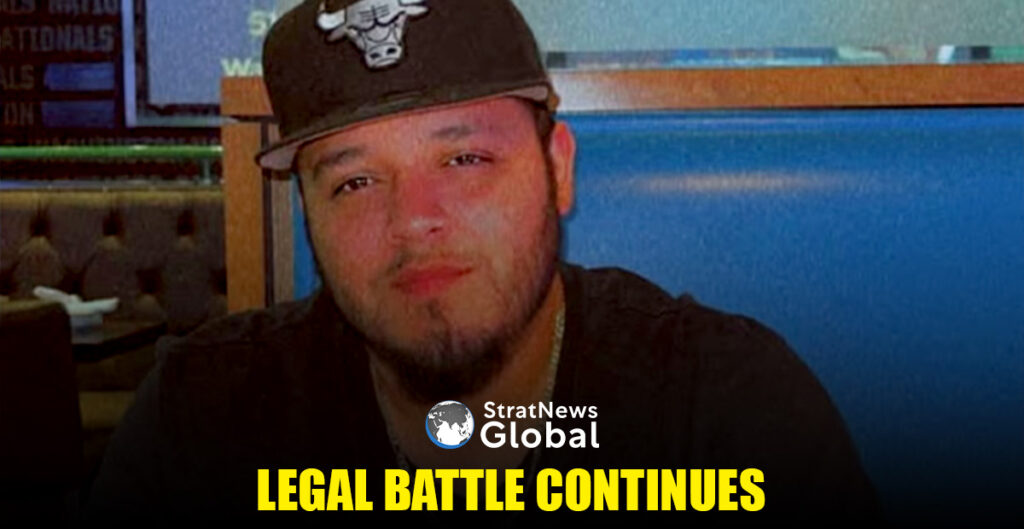
Kilmar Abrego, the migrant wrongfully deported to El Salvador and seen as a symbol of President Donald Trump‘s hardline immigration stance, secured two major victories in U.S. courts on Wednesday—but will remain in custody for now on human smuggling charges.
In dual rebukes to the Trump administration after Abrego was brought back to the U.S. to face the charges, one federal judge ruled that he must be released on bail, and another ruled that authorities must give his lawyers three days’ notice before they try to deport him again to a different country.
“These rulings are a powerful rebuke of the government’s lawless conduct and a critical safeguard for Kilmar’s due process rights,” Abrego’s lawyer Simon Sandoval-Moshenberg said in a statement.
Still Behind Bars
Still, Abrego will remain in criminal custody in Tennessee for at least 30 days. His lawyers, while pushing for his release on bail, had asked that any such order be delayed given the risk that immigration authorities could swiftly detain and deport him upon his exit from jail.
Department of Homeland Security spokeswoman Tricia McLaughlin, in a statement, accused Abrego of being a member of the Salvadoran gang MS-13 and said he “will never walk America’s streets again.” Abrego denies being part of the gang.
Abrego, 29, a Salvadoran migrant who had been living in Maryland, was deported and imprisoned in El Salvador in March despite a 2019 judicial ruling that he could not be sent there because of a risk of gang persecution. That prompted Trump’s critics to argue that his administration was infringing on legal rights as it moved aggressively to deport millions of migrants living illegally in the U.S.
Abrego then challenged that deportation in a civil lawsuit before U.S. District Judge Paula Xinis in Greenbelt, Maryland. The U.S. Supreme Court in April upheld Xinis’ order that the administration facilitate Abrego’s return.
Legal Battle Continues
In June, U.S. officials brought Abrego back to the U.S. after securing an indictment accusing him of transporting migrants in the U.S. illegally as part of a smuggling ring.
Abrego has pleaded not guilty to the charges and has been held in criminal custody in Tennessee since his return. His lawyers have accused the Trump administration of bringing the charges to cover up violations of his rights.
U.S. Magistrate Judge Barbara Holmes in Nashville, Tennessee, granted Abrego’s request to be released ahead of his trial last month. But Abrego’s lawyers later asked Holmes not to release Abrego right away, citing the risk he would be detained and deported to a country other than El Salvador.
Federal prosecutors challenged Holmes’ ruling.
On Wednesday, U.S. District Judge Waverly Crenshaw rejected that challenge, writing that prosecutors had not shown sufficient evidence that Abrego posed a public safety threat or was a flight risk to justify his continued detention ahead of trial. But he said the government was entitled to another hearing over whether to detain Abrego due to their allegation that he sometimes transported children.
After Crenshaw’s order on Wednesday, Holmes said she would delay her order for release by at least 30 days.
In a simultaneous decision on Wednesday, Xinis ruled that if Abrego is released from criminal custody, U.S. Immigration and Customs Enforcement could not detain him in Tennessee. She also ruled that his immigration case must be returned to Maryland, and that he must be notified at least three days before any deportation to a third country.
On Xinis’ ruling, McLaughlin said, “The fact this unhinged judge is trying to tell ICE they can’t arrest someone who is subject to immigration arrest under federal law is insane.”
Xinis’ order did not bar immigration authorities in Maryland from taking him into custody.
(With inputs from Reuters)
Vietnam To Buy Two Lockheed Martin Helicopters In Landmark Security Deal: Sources
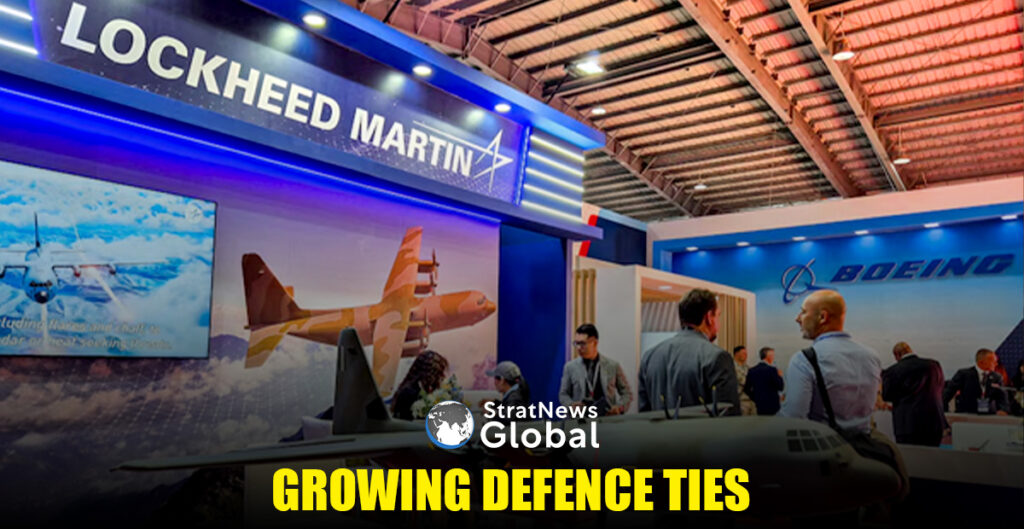
Vietnam’s police ministry has agreed to purchase two helicopters from Lockheed Martin, marking a significant security deal since the U.S. lifted its arms embargo on the Communist-led nation a decade ago, according to three sources familiar with the discussions.
The deal would come after the country’s ministry of public security held protracted talks since at least 2022 with multiple U.S. defence companies to acquire helicopters. Lockheed Martin is also negotiating with Vietnam’s defence ministry the sale of C-130 military transport planes, multiple officials have said.
The Southeast Asian country, which relies heavily on Russian weapons, has been looking for years to diversify its arsenal. It is also currently negotiating with the Trump administration on key elements of a tariff deal that is crucial to maintain access to its largest export market.
Vietnamese pilots have already been training with Lockheed Martin’s Sikorsky helicopters, one of the sources with direct knowledge said, noting the deal was worth more than $100 million and could include more choppers at a later stage.
The source did not specify the chopper model under discussion but said pilots were training with S-92 helicopters, which are employed in several countries for both civilian and military uses.
Another two sources briefed on the talks confirmed Vietnam had agreed to buy two Lockheed Martin helicopters but gave no information about the cost and the model.
All sources declined to be named because the information was not public.
Reuters could not establish when the deal could be completed and whether there were contractual aspects to be defined.
Growing Defence Ties
Since an arms embargo on Vietnam was lifted in 2016, U.S. security deals with its former foe have been limited to coastguard ships and trainer aircraft, which could lead to the procurement of military planes.
Lockheed Martin said queries on procurement should be directed to the Vietnamese government.
Calls to Vietnam’s Ministry of Public Security went unanswered. The foreign ministry did not reply to a request for comment.
Vietnam’s parliament approved in June 2022 the establishment of a mobile police unit to tackle crime, terrorism and riots, which would need helicopters to operate, according to the government and the text of the 2022 legislation.
U.S. officials have said Washington sees Vietnam as a key player on regional security and would be willing to boost Vietnam’s defence, especially in the South China Sea, where it is often at odds with China over disputed boundaries.
Support for the police could be more controversial. The latest U.S. State Department’s report on human rights in Vietnam, released in 2023, warned of significant violations and abuses by security forces.
Vietnam’s foreign ministry has said the report was biased and inaccurate.
The sources did not explicitly link the possible procurement deal to tariff talks, but Vietnamese and U.S. officials have repeatedly said purchases of U.S. military equipment would strengthen Hanoi’s position in negotiating a fully-fledged trade agreement.
U.S. President Donald Trump announced earlier in July a deal on 20% tariffs for Vietnamese goods imported into the United States, 40% levies on transshipped products and no duties for U.S. exports to Vietnam.
However, Hanoi has instead talked of a preliminary framework agreement. Talks are still underway to finalise the agreement.
(With inputs from Reuters)
India, UK Sign Trade Deal, Launch Vision 2035 For Strategic Partnership
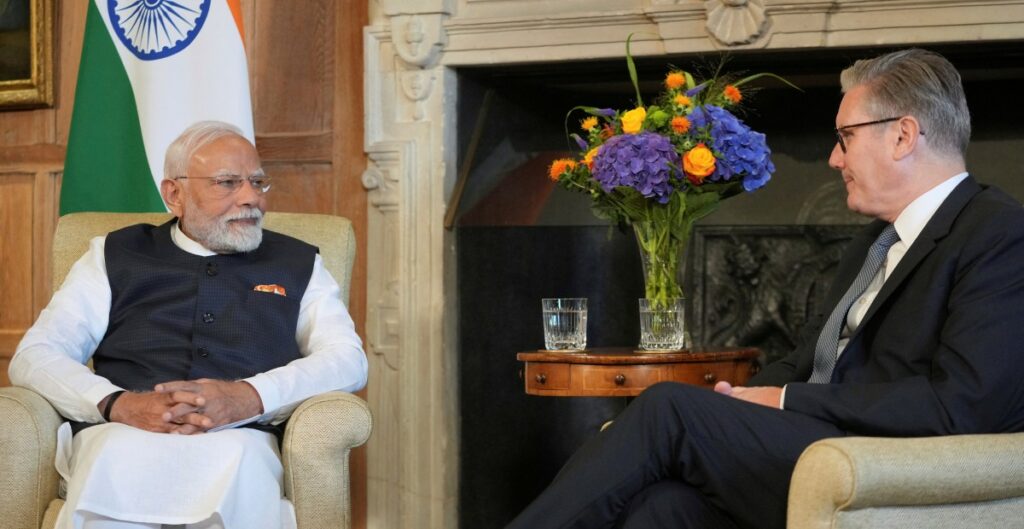
India and the UK have signed a Free Trade Agreement (FTA) and unveiled a forward-looking bilateral framework titled UK-India Vision 2035. Signed in the presence of Prime Minister Narendra Modi and his British counterpart Keir Starmer in London, the pact will enhance trade and investment besides spurring defence ties and technology collaboration.
The trade deal is expected to increase bilateral trade by £25.5 billion annually, marking India’s most comprehensive trade agreement to date. And it’s the UK’s most significant bilateral trade deal since exiting the European Union. It aims to generate thousands of jobs, reduce tariffs and deepen access to each other’s markets.
“Our landmark trade deal with India is a major win for Britain,” said Prime Minister Keir Starmer. “It will create thousands of British jobs, unlock new opportunities for businesses and drive growth across the country—delivering on our Plan for Change.”
The partnership is not limited to commerce. The UK-India Vision 2035 outlines a decade-long roadmap for cooperation spanning defence, clean energy, innovation, border security, climate action and education. The agreement also includes a new Defence Industrial Roadmap, which will foster closer military and industrial collaboration.
Business and Trade Secretary Jonathan Reynolds emphasised the strategic importance of the pact. “India is one of the fastest-growing global economies and a rising economic superpower. This historic deal places the UK in a strong position to work alongside India over the next decade,” he said. “The nearly £6 billion in new investments and export agreements announced today are just the beginning. Collaboration will now extend into advanced technologies, critical minerals and green finance.”
Trade Deal Highlights
- Tariff reductions: Average tariffs on British exports to India, including cars, medical devices, soft drinks and cosmetics will drop from 15% to 3%, making British goods more accessible to Indian consumers.
- Market access for UK firms: The deal ensures equal treatment for UK companies operating in India, particularly in the insurance and financial services sectors, by binding India’s foreign investment caps.
- Energy sector gains: The UK’s clean energy firms will gain unprecedented access to India’s public procurement, supporting India’s shift to renewable energy amid rising demand.
- Boost to UK exports: Liberalised tariffs will also make it easier and more cost-effective for British consumers and businesses to import goods from India.
Business Deals And Investments
A total of 26 UK companies have announced new ventures in India. Aviation giant Airbus will soon begin deliveries of aircraft to Indian airlines, under contracts worth around £5 million. Over half of the aircraft will be powered by Rolls-Royce engines.
In addition, the UK and India have pledged to step up collaboration on security challenges. That includes fight against corruption, fraud, organised crime and illegal migration through increased intelligence sharing and joint operations.
The UK government will now prepare the trade deal for ratification in Parliament, allowing businesses to begin reaping its benefits.
This summit also marks the first anniversary of the UK-India Technology Security Initiative. And both countries reaffirmed their commitment to harnessing emerging technologies to safeguard national interests and build future-ready economies.
Chinese Netizens Mock India’s Tourist Attractions, Cite High Visa Cost
India is unsafe, unclean and lacking appealing tourist attractions say some Chinese netizens while others claim “a deep-rooted hatred towards China among Indians, and travelling to India may be dangerous”.
These are some of the reactions to India’s decision to resume issuing tourist visas for Chinese nationals.
Others balked at the documents required for visas including a bank guarantee of 100,000 yuan (more than INR 12 lakhs) or a bank statement showing a minimum balance of 100,000 yuan over the last six months. Netizens argued that they would rather visit France and Italy if they had that kind of money.
“I won’t go for a million dollars”, one user posted on Weibo.
The crash of an Air India flight in Ahmedabad also figured in the discourse on Weibo, with concerns being raised about aviation safety standards in India and training of pilots.
Adding to this, Chinese social media platforms are often seen circulating some bizarre or sensational incidents from Indian streets in an apparent attempt to portray India in a negative light. Many of these posts and comments from netizens suggest limited and often stereotypical understanding of India within Chinese society, even in the 21st century.
This may be deliberate and intended to put India down, show it in a poor light.
Microsoft: Server Hack Escalates To Ransomware Attacks
In a concerning development, Microsoft said late Wednesday that a cyber-espionage campaign targeting outdated versions of its server software has now escalated to include ransomware attacks.
In the post, citing “expanded analysis and threat intelligence”, Microsoft said a group it dubs “Storm-2603” is using the vulnerability to seed the ransomware, which typically works by paralysing victims’ networks until a digital currency payment is made.
The disclosure marks a potential escalation in the campaign, which has already hit at least 400 victims, according to Netherlands-based cybersecurity firm Eye Security. Unlike typical state-backed hacker campaigns, which are aimed at stealing data, ransomware can cause widespread disruption depending on where it lands.
‘There Are Many More’
The figure of 400 victims represents a sharp rise from the 100 organizations cataloged over the weekend. Eye Security says the figure is likely an undercount.
“There are many more, because not all attack vectors have left artifacts that we could scan for,” said Vaisha Bernard, the chief hacker for Eye Security, which was among the first organizations to flag the breaches.
The details of most of the victim organisations have not yet been fully disclosed, but on Wednesday a representative for the National Institutes of Health confirmed that one of the organisation’s servers had been compromised.
“Additional servers were isolated as a precaution,” he said. The news of the compromise was first reported by the Washington Post.
Multiple Govt Agencies Hit
Other outlets said the hacking campaign had breached an even broader range of US agencies. NextGov, citing multiple people familiar with the matter, reported the Department of Homeland Security had been hit, along with more than five to 12 other agencies.
Politico, which cited two US officials, said multiple agencies were believed to have been breached.
DHS’ cyber defence arm, CISA, did not immediately return a message seeking comment on the reports. Microsoft did not immediately return a message seeking further details on the ransomware angle of the hacking or the reported government victims.
The spy campaign began after Microsoft failed to fully patch a security hole in its SharePoint server software, kicking off a scramble to fix the vulnerability when it was discovered.
Microsoft and its tech rival, Google-owner Alphabet, have both said Chinese hackers are among those taking advantage of the flaw. Beijing has denied the claim.
(With inputs from Reuters)
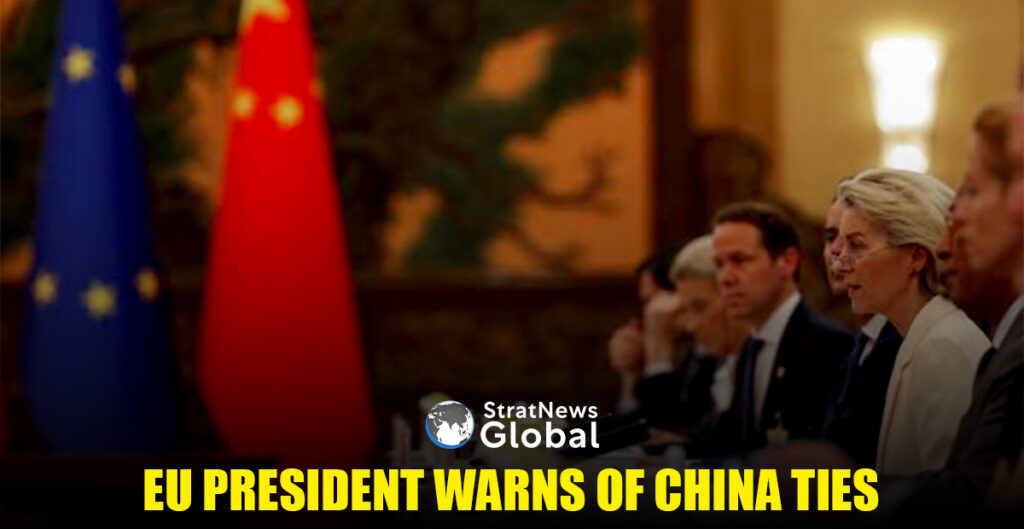
At Tense Summit, EU President Von Der Leyen Says China Relations Have Reached An ‘Inflection Point’
European Commission President Ursula von der Leyen urged a crucial reset in trade relations with China during a tense summit with President Xi Jinping on Thursday, describing the current state of ties as an “inflection point,” according to a pool report.
Expectations were low for the summit marking 50 years of diplomatic ties after weeks of escalating tension and wrangling over its format, with the duration abruptly halved to a single day at Beijing’s request.
Von der Leyen and European Council President Antonio Costa met Xi at the start of an event set to be dominated by thorny issues ranging from trade frictions to the Ukraine war.
“As our cooperation has deepened, so have imbalances. We have reached an inflection point,” von der Leyen told Xi during the meeting in the Great Hall of the People.
She was referring to the EU’s trade deficit with China, which ballooned to a historic 305.8 billion euros ($360 billion) last year.
“Rebalancing of our bilateral relation is essential … It is vital for China and Europe to acknowledge our respective concerns and come forward with real solutions.”
Bilateral Relation And Strategic Choices
However, Xi urged the EU to “make correct strategic choices” during the meeting, state broadcaster CCTV said, in a veiled criticism of Brussels’ hawkish stance on China.
“The more severe and complex the international situation, the more China and the EU must strengthen communication, enhance mutual trust and deepen cooperation,” Xi told von der Leyen and Costa, it said.
“Chinese and European leaders should … make correct strategic choices that meet the expectations of the people.”
The weeks before the summit were dominated by tit-for-tat trade disputes and hawkish European rhetoric, such as a July 8 accusation by von der Leyen that China was flooding global markets as a result of its overcapacity and “enabling Russia’s war economy”.
Shortly before the summit, however, von der Leyen struck a more conciliatory tone, describing it as an opportunity to “both advance and rebalance our relationship” in a post on X on Thursday.
“I’m convinced there can be a mutually beneficial cooperation,” von der Leyen added.
The two EU officials are set to meet Chinese Premier Li Qiang later. Both sides are hoping to reach a modest joint statement on climate, currently one of the only bright spots in EU-China cooperation.
State news agency Xinhua also appeared to downplay Beijing’s rivalry with the 27-member bloc, saying China was a “critical partner” for Europe, with a range of shared interests.
“China is a critical partner to Europe, not a systemic rival,” it said in a commentary.
‘Common Grounds’
The two shared interests in trade, climate, and global governance, it said, adding, “These areas of common ground should not be eclipsed by isolated points of friction.”
The EU defines China as a “partner, competitor and systemic rival”, which frames its strategic approach to China policy.
At the summit, European leaders are also expected to raise topics such as electric vehicles and Chinese industrial overcapacity.
China launched rare earth export controls in April that disrupted supply chains worldwide, leading to temporary stoppages in European automotive production lines the following month.
But its exports of rare earth magnets to the EU surged in June by 245% from May, to stand at 1,364 metric tons, though that was still 35% lower than the year-earlier figure, customs data showed.
The EU is likely to seal a trade deal with the United States for a broad tariff of 15% on its exports after intense negotiations, avoiding a harsher 30% figure threatened by President Donald Trump.
($1=0.8492 euros)
(With inputs from Reuters)
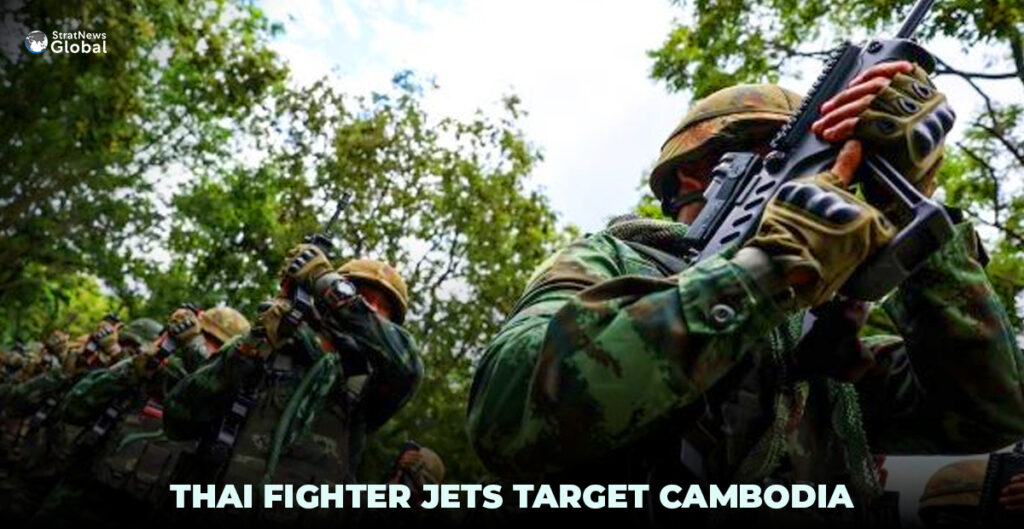
Thailand Deploys F-16 Fighter Jet As Border Conflict With Cambodia Intensifies
A Thai F-16 fighter jet launched bombs on Cambodian targets on Thursday, according to statements from both countries, as border disputes flared into violent clashes that have already claimed the lives of at least two civilians.
Of the six F-16 fighter jets that Thailand readied to deploy along the disputed border, one of the aircraft fired into Cambodia and destroyed a military target, the Thai army said. Both countries accused each other of starting the clash early on Thursday.
“We have used air power against military targets as planned,” Thai army deputy spokesperson Richa Suksuwanon told reporters. Thailand also closed its border with Cambodia.
Cambodia Condemns Military Aggression
Cambodia’s defence ministry said the jets dropped two bombs on a road, and that it “strongly condemns the reckless and brutal military aggression of the Kingdom of Thailand against the sovereignty and territorial integrity of Cambodia”.
The skirmishes came after Thailand recalled its ambassador to Cambodia late on Wednesday and said it would expel Cambodia’s envoy in Bangkok, after a second Thai soldier in the space of a week lost a limb to a landmine that Bangkok alleged had been laid recently in the disputed area.
Thai residents in the Surin border province fled to shelters built of concrete and fortified with sandbags and car tires as the two countries exchanged fire.
“How many rounds have been fired? It’s countless,” an unidentified woman told the Thai Public Broadcasting Service (TPBS) while hiding in the shelter with gunfire and explosions heard intermittently in the background.
For more than a century, Thailand and Cambodia have contested sovereignty at various undemarcated points along their 817 km (508 miles) land border, which has led to skirmishes over several years and at least a dozen deaths, including during a weeklong exchange of artillery in 2011.
Tensions were reignited in May following the killing of a Cambodian soldier during a brief exchange of gunfire, which escalated into a full-blown diplomatic crisis and now has triggered armed clashes.
Violent Clashes
The clashes began early on Thursday near the disputed Ta Moan Thom temple along the eastern border between Cambodia and Thailand, around 360 km from the Thai capital Bangkok.
“Artillery shell fell on people’s homes,” Sutthirot Charoenthanasak, district chief of Kabcheing in Surin province, said, describing the firing by the Cambodian side.
“Two people have died,” he said, adding that district authorities had evacuated 40,000 civilians from 86 villages near the border to safer locations.
Thailand’s military said Cambodia deployed a surveillance drone before sending troops with heavy weapons to an area near the temple.
Cambodian troops opened fire and two Thai soldiers were wounded, a Thai army spokesperson said, adding Cambodia had used multiple weapons, including rocket launchers.
A spokesperson for Cambodia’s defence ministry, however, said there had been an unprovoked incursion by Thai troops and Cambodian forces had responded in self-defence.
Thailand’s acting Prime Minister Phumtham Wechayachai said the situation was delicate.
“We have to be careful,” he told reporters. “We will follow international law.”
Rising Border Tensions
An attempt by Thai premier Paetongtarn Shinawatra to resolve the recent tensions via a call with Cambodia’s influential former Prime Minister Hun Sen, the contents of which were leaked, kicked off a political storm in Thailand, leading to her suspension by a court.
Hun Sen said in a Facebook post that two Cambodian provinces had come under shelling from the Thai military.
Thailand this week accused Cambodia of placing landmines in a disputed area that injured three soldiers. Phnom Penh denied the claim and said the soldiers had veered off agreed routes and triggered a mine left behind from decades of war.
Cambodia has many landmines left over from its civil war decades ago, numbering in the millions according to de-mining groups.
But Thailand maintains landmines have been placed at the border area recently, which Cambodia has described as baseless allegations.
(With inputs from Reuters)
Ukraine: Zelenskyy Pledges To Safeguard Anti-Corruption Bodies Amid Protests
Ukrainian President Volodymyr Zelenskyy on Wednesday promised to uphold the independence of the country’s anti-corruption agencies, responding to mounting pressure from Ukraine’s first street protests since the war began and unusual criticism from European allies.
For a second day in a row, thousands of people across the country – from Kharkiv in the northeast to the capital Kyiv to Lviv in the west – took to the streets demanding reversal of the law curbing the independence of anti-graft agencies.
In his evening address to the nation on Wednesday, Zelenskyy said he would submit a new bill to ensure the rule of law and retain the independence of the anti-corruption agencies.
“Of course, everyone has heard what people are saying these days… on social media, to each other, on the streets. It’s not falling on deaf ears,” Zelenskyy said.
Thousands of people turned up for a second day of protests in central Kyiv, close to Zelenskyy’s office.
In the first such demonstrations of the war, the youth, activists, and war veterans chanted ‘Shame’ and ‘Veto the Law’.
“It’s like a knife in the back, to be honest,” Maryna Mykhalchuk, 26, who has friends killed in the war and plans to join the army soon, said.
Opposition lawmakers and European officials also called for reversal of the law, which Zelenskyy signed overnight.
The law gives the Prosecutor General appointed by Zelenskyy more power over two investigative anti-corruption agencies. It was rushed through parliament on Tuesday, a day after the security services arrested two anti-corruption officials for suspected Russian ties.
In a joint statement, both agencies – the anti-corruption bureau NABU and the specialised prosecutors SAPO – said they wanted their independence restored through legislation.
Parliament is expected to hold an emergency session next week to consider the new draft bill from Zelenskyy’s office, several lawmakers said.
Strongest Criticism Since The War Began
The law prompted some of Ukraine’s European allies to deliver their strongest criticism of Zelenskyy’s government since Russia’s invasion in February 2022.
European Commission President Ursula von der Leyen expressed her strong concern to Zelenskyy and asked for an explanation, said the spokesman.
The law’s critics say the government appears to be trying to rein in anti-corruption agencies to protect officials.
After decades of endemic corruption in Ukraine, cleaning up its government has been held up as the key condition for the country to join the EU, tap billions of dollars in foreign aid, and integrate more broadly with the West.
The issue risks antagonising Kyiv’s most loyal allies at a time when it is trying to smooth over the relationship with the administration of U.S. President Donald Trump, who has frequently criticised Zelenskyy.
Trust In Zelenskyy
“Ukraine’s anti-corruption institutions are vital to its reform path. Restricting them would be a significant setback,” Dutch Foreign Minister Caspar Veldkamp said in a post on X.
Benjamin Haddad, France’s European Affairs minister, said it was not too late to reverse the decision.
Ukrainian political analysts said the legislation risked undermining society’s trust in Zelenskyy during a critical stage of the war against Russia.
Fierce fighting rages along more than 1,000 kilometres (621 miles) of the frontline. Russian troops continue their grinding advance in the east and have stepped up near daily attacks on Ukrainian cities with hundreds of drones.
Hundreds of protesters, some clad in military uniforms, in the city of Zaporizhzhia, close to the frontline in the southeast, demanded overturning the law with chants of “Ukraine is not Russia.” Similar rallies took place in other major cities across the country.
The public’s European aspirations are vital to sustaining the war effort, said Valerii Pekar, a Kyiv-based analyst: “Only democracy and the European choice give us a chance to win,” he posted on Facebook.
(With inputs from Reuters)
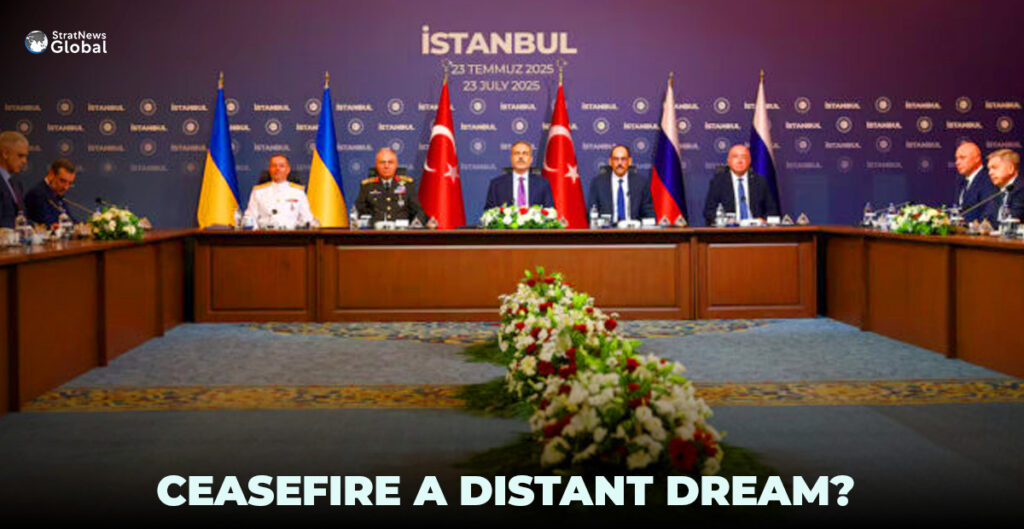
Russia-Ukraine Talks Focus On POW Swaps, No Ceasefire Deal Yet
In a brief session of peace talks held in Istanbul on Wednesday, Russia and Ukraine discussed further prisoner swaps, though they remain far apart on ceasefire terms and a potential leaders’ meeting.
“We have progress on the humanitarian track, with no progress on a cessation of hostilities,” Ukraine’s chief delegate Rustem Umerov said after talks that lasted just 40 minutes.
He said Ukraine had proposed a meeting before the end of August between Ukraine’s President Volodymyr Zelenskyy and Russian President Vladimir Putin. He added: “By agreeing to this proposal, Russia can clearly demonstrate its constructive approach.”
Russia’s chief delegate Vladimir Medinsky said the point of a leaders’ meeting should be to sign an agreement, not to “discuss everything from scratch”.
Ceasefire Duration Disagreement
He renewed Moscow’s call for a series of short ceasefires of 24-48 hours to enable the retrieval of bodies. Ukraine says it wants an immediate and much longer ceasefire.
The talks took place just over a week after US President Donald Trump threatened heavy new sanctions on Russia and countries that buy its exports unless a peace deal was reached within 50 days.
There was no sign of any progress towards that goal, although both sides said there was discussion of further humanitarian exchanges following a series of prisoner swaps, the latest of which took place on Wednesday.
Medinsky said the negotiators agreed to exchange at least 1,200 more prisoners of war from each side, and Russia had offered to hand over another 3,000 Ukrainian bodies.
He said Moscow was working through a list of 339 names of Ukrainian children that Kyiv accuses it of abducting. Russia denies that charge and says it has offered protection to children separated from their parents during the war.
“Some of the children have already been returned back to Ukraine. Work is under way on the rest. If their legal parents, close relatives, representatives are found, these children will immediately return home,” Medinsky said.
Umerov said Kyiv was expecting “further progress” on POWs, adding: “We continue to insist on the release of civilians, including children.” Ukrainian authorities say at least 19,000 children have been forcibly deported.
Shortest Talks Yet
Before the talks, the Kremlin had played down expectations, describing the two sides’ positions as diametrically opposed and saying no one should expect miracles.
At 40 minutes, the meeting was even shorter than the two sides’ previous encounters on May 16 and June 2, which lasted a combined total of under three hours.
Oleksandr Bevz, a member of the Ukrainian delegation, said Kyiv had proposed a Putin-Zelenskyy meeting in August because that would fall within the deadline set by Trump for a deal.
Putin turned down a previous challenge from Zelenskyy to meet in person and has said he does not see him as a legitimate leader because Ukraine, which is under martial law, did not hold new elections when Zelenskyy’s five-year mandate expired last year.
Trump has patched up relations with Zelenskyy after a public row with him at the White House in February, and has lately expressed growing frustration with Putin.
Three sources close to the Kremlin told Reuters last week that Putin, unfazed by Trump’s ultimatum, would keep fighting in Ukraine until the West engaged on his terms for peace, and that his territorial demands may widen as Russian forces advance.
More POWs Brought Back
Ukraine brought home a new group of prisoners of war from Russia on Wednesday, Zelenskyy said, saying it brought to more than 1,000, the number of returning soldiers, as agreed at talks in Turkey.
Zelenskyy, writing on the Telegram messaging app, said those returning were ill or seriously wounded.
“The servicemen who are returning today defended Ukraine in different sectors of the front,” Zelenskyy wrote. “A significant number spent more than three years as prisoners. All are receiving key support and medical assistance.”
(With inputs from Reuters)