

Support us by contributing to StratNewsGlobal on the following UPI ID
ultramodern@hdfcbank

Strategic affairs is our game, South Asia and beyond our playground. Put together by an experienced team led by Nitin A. Gokhale. Our focus is on strategic affairs, foreign policy and international relations, with higher quality reportage, analysis and commentary with new tie-ups across the South Asian region.
You can support our endeavours. Visit us at www.stratnewsglobal.com and follow us on YouTube, Twitter, Facebook and Instagram.
र 500 per month
र 1000 per month
र 5000 per year
र 10000 per year
Donate an amount of your choice
र 500 per month
Donate र 500 per month

र 1000 per month
Donate र 1000 per month
र 5000 per year
Donate र 5,000 per year
र 10000 per year
Donate र 10,000 per year
Donate an amount of your choice
Donate an amount of your choice
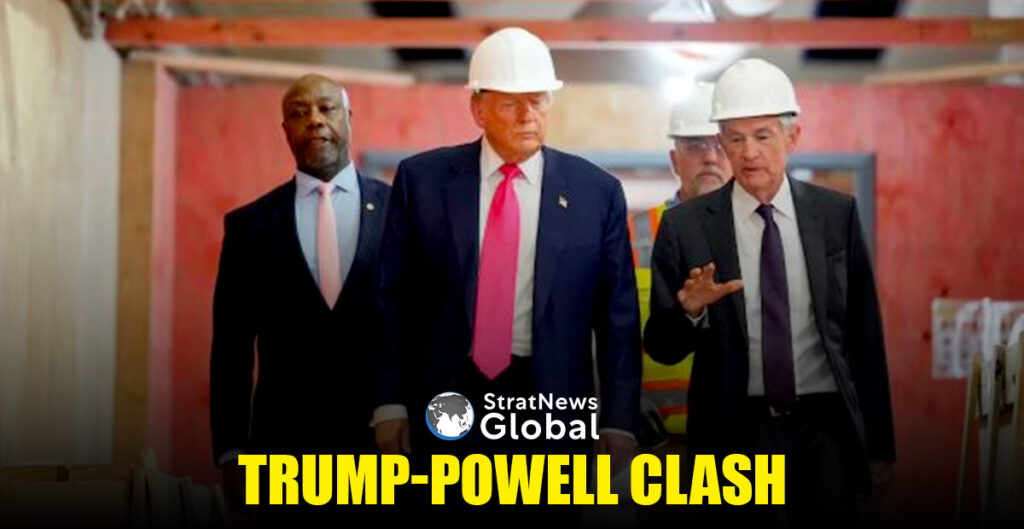


Trump Urges Powell On Rate Cuts During Heated Federal Reserve Meeting
President Donald Trump clashed with Federal Reserve Chair Jerome Powell on Thursday during a rare visit to the central bank, criticizing the expenses for renovating two historic buildings and pushing for a reduction in interest rates.
Trump, who called Powell a “numbskull” earlier this week for failing to heed the White House’s demand for a large reduction in borrowing costs, wrapped up his visit to the Fed’s $2.5 billion building project in Washington by saying he did not intend to fire Powell, as he has frequently suggested he would.
“To do so is a big move and I just don’t think it’s necessary,” Trump told reporters after the visit.
In a post on his Truth Social media site, Trump later said of the renovation, “it is what it is and, hopefully, it will be finished ASAP. The cost overruns are substantial but, on the positive side, our Country is doing very well and can afford just about anything.”
Tense Interaction
The visibly tense interaction at the Fed’s massive construction site marked an escalation of White House pressure on the central bank and Trump’s efforts to get Powell to “do the right thing” on rates. It happened less than a week before the central bank’s 19 policymakers are due to gather for a two-day rate-setting meeting, where they are widely expected to leave their benchmark interest rate in the 4.25%-4.50% range.
The president has repeatedly demanded Powell slash rates by 3 percentage points or more.
“I’d love him to lower interest rates,” Trump said as he wrapped up the tour, as Powell stood by, his face expressionless.
Powell typically spends the Thursday afternoon before a rate-setting meeting doing back-to-back calls with Fed bank presidents as part of his preparations for the session.
The encounter between the two men became heated as Trump told reporters the project was now estimated to cost $3.1 billion.
“I am not aware of that,” Powell said, shaking his head. Trump handed him a piece of paper, which Powell examined. “You just added in a third building,” the Fed chief said, noting that the Martin Building had been completed five years ago.
Renovation Plan Criticised
White House budget director Russell Vought and Trump’s deputy chief of staff, James Blair, who have spearheaded criticism of the renovation as overly costly and ostentatious, later told reporters they still have questions about the project. The two men, who joined Trump during the visit, have suggested poor oversight and potential fraud in connection with it.
Senate Banking Committee Chair Tim Scott, a Republican who sent Powell a letter on Wednesday demanding answers to his own questions about the renovation, also took part in the visit.
Elevated by Trump to the top Fed job in 2018 and then reappointed by former President Joe Biden four years later, Powell last met with the current president in March when Trump summoned him to the White House to press him to lower rates.
The visit on Thursday took place as Trump battles to deflect attention from a political crisis over his administration’s refusal to release files related to convicted sex offender Jeffrey Epstein, reversing a campaign promise. Epstein died in 2019.
‘Unexpected Challenges’
The Fed, in letters to Vought and lawmakers backed up by documents posted on its website, said the project – the first full rehab of the two buildings since they were built nearly a century ago – ran into unexpected challenges including toxic materials abatement and higher-than-estimated costs for materials and labor.
Speaking outside of the construction site, Trump said there was “no tension” at his meeting with Powell and that they had a productive conversation about rates.
Ahead of Trump’s visit, Fed staff escorted a small group of reporters around the two construction sites. They wove around cement mixers and construction machines, and spoke over the sound of drills, banging, and saws.
Fed staff pointed out security features, including blast-resistant windows, that they said were a significant driver of costs in addition to tariffs and escalations in material and labor costs.
Fed Independence
The project started in mid-2022 and is on track to be completed by 2027, with the move-in planned for March of 2028.
A visit to the roof of the Eccles Building, a point of particular scrutiny by critics like Scott, who has complained about “rooftop garden terraces,” revealed an impressive view of the Lincoln Memorial and the National Mall, according to the pool report.
Staff explained that rooftop seating, although inexpensive, had been removed because of the appearance of it being an amenity and was one of only two deviations from the original plan. The other was the scrapping of a couple of planned fountains.
Market reaction to Trump’s visit was subdued. The yield on benchmark 10-year Treasury bonds ticked higher after data showed new jobless claims dropped in the most recent week, signaling a stable labor market not in need of support from a Fed rate cut. The S&P 500 equities index closed largely flat on the day.
Trump’s criticism of Powell and flirtation with firing him have previously upset financial markets and threatened a key underpinning of the global financial system – that central banks are independent and free from political meddling.
His trip contrasts with a handful of other documented presidential visits to the Fed. Then-President Franklin Delano Roosevelt visited the central bank in 1937 to dedicate the newly-built headquarters, one of the two buildings now being renovated. Most recently, former President George W. Bush went there in 2006 to attend the swearing-in of Ben Bernanke as Fed chief.
(With inputs from Reuters)
French Move To Recognise Palestinian State Sparks Criticism From Israel And U.S.
France will seek to formally recognise a Palestinian state at the United Nations General Assembly in September, President Emmanuel Macron announced on Thursday, expressing hope for regional peace. However, the plan was met with sharp criticism from Israel and the United States.
Macron, who unveiled the decision on X, published a letter sent to Palestinian Authority President Mahmoud Abbas confirming France’s intention to press ahead with Palestinian recognition and work to convincing other partners to follow suit.
“True to its historic commitment to a just and lasting peace in the Middle East, I have decided that France will recognise the state of Palestine,” Macron said.
“I will make this solemn announcement at the United Nations General Assembly next September.”
Home to Europe’s largest Jewish and Muslim communities, France will become the first major Western country to recognise a Palestinian state, potentially fuelling a movement so far dominated by smaller nations generally more critical of Israel.
U.S., Israel Condemn The Move
The news sparked anger in Israel and Washington.
Israeli Prime Minister Benjamin Netanyahu condemned the decision by one of Israel’s closest allies and a G7 member, saying such a move “rewards terror and risks creating another Iranian proxy.”
In a post on X, he added, “A Palestinian state in these conditions would be a launch pad to annihilate Israel — not to live in peace beside it.
“Let’s be clear: the Palestinians do not seek a state alongside Israel; they seek a state instead of Israel.”
Israeli Defence Minister Israel Katz described the move as “a disgrace and a surrender to terrorism,” adding that Israel would not allow the establishment of a “Palestinian entity that would harm our security, endanger our existence.”
In response, U.S. Secretary of State Marco Rubio said the United States “strongly rejects (Macron’s) plan to recognize a Palestinian state at the UN general assembly.”
In a post on X, he said, “This reckless decision only serves Hamas propaganda and sets back peace. It is a slap in the face to the victims of October 7th.”
Canada Urges Peace
Earlier, Canada also pressed Israel to seek peace, with Prime Minister Mark Carney condemning its “failure to prevent the rapidly deteriorating humanitarian disaster in Gaza” and reiterating support for a two-state solution.
Carney also accused Israel of violating international law over the blocking of Canadian-funded aid to civilians in the war-torn Palestinian enclave.
“Canada calls on all sides to negotiate an immediate ceasefire in good faith,” he added.
“We reiterate our calls for Hamas to immediately release all the hostages, and for the Israeli government to respect the territorial integrity of the West Bank and Gaza.”
In a diplomatic cable in June, the United States said it opposed steps to unilaterally recognise a Palestinian state, even saying it could go against U.S. foreign policy interests and draw consequences.
In June, Washington’s ambassador to Israel, Mike Huckabee, said he did not think an independent Palestinian state remained a U.S. foreign policy goal.
Trump Doubts ‘Two-State Solution’
President Donald Trump has himself expressed doubts about a two-state solution, proposing a U.S. takeover of Gaza in February, that was condemned by rights groups, Arab states, Palestinians and the U.N. as a proposal of “ethnic cleansing”.
Macron had been leaning towards recognising a Palestinian state for months as part of a bid to keep the idea of a two-state solution alive, despite the pressure not to do so.
French officials initially weighed up the move ahead of a United Nations conference, which France and Saudi Arabia had planned to co-host in June to lay out parameters for a roadmap to a Palestinian state, while ensuring Israel’s security.
The conference was postponed under U.S. pressure and after the 12-day Israel-Iran air war began, during which the closure of regional airspace made it hard for representatives of some Arab states to attend.
It was rescheduled and downgraded to a ministerial event on July 28 and July 29, with a second event taking place with heads of state and government on the sidelines of the United Nations General Assembly in September.
Creating Momentum
The decision to make the announcement ahead of next week’s conference aimed to give the French team at the United Nations a framework to work with other countries that are also considering recognising a Palestinian state or have misgivings in doing so.
Diplomats say Macron has faced resistance from allies such as Britain and Canada over his push for the recognition of a Palestinian state. About 40 foreign ministers will be in New York next week.
Israeli officials have spent months lobbying to prevent what some have called “a nuclear bomb” for bilateral ties.
Sources familiar with the matter say Israel’s warnings to France have ranged from scaling back intelligence sharing to complicating Paris’ regional initiatives – even hinting at possible annexation of parts of the West Bank.
Israel has been waging a devastating war in Gaza since the Palestinian terrorist group Hamas’ deadly attack on Israel in October 2023 and says recognising a Palestinian state now would be equivalent to rewarding Hamas.
Thanking France, the Palestinian Authority’s Vice President Hussein Al Sheikh said on X that Macron’s decision reflected “France’s commitment to international law and its support for the Palestinian people’s rights to self-determination and the establishment of our independent state.”
(With inputs from Reuters)
UK-Australia Defence Ties Deepen Under AUKUS Deal
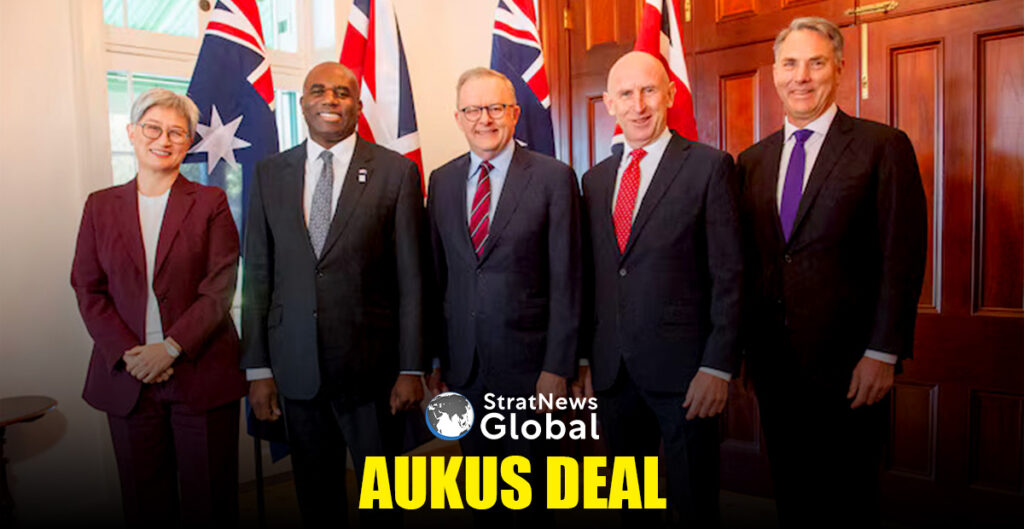
Reaffirming close strategic ties, Britain’s Defence Secretary John Healey on Friday called the UK’s commitment to Australia “absolute” as defence and foreign ministers from both countries met in Sydney to strengthen cooperation, including advancing their shared AUKUS nuclear submarine pact.
Healey and Britain’s Foreign Minister David Lammy were met by Prime Minister Anthony Albanese in Sydney, ahead of talks focussed on boosting trade ties and progressing the AUKUS partnership for Britain and Australia to build a new class of nuclear-powered submarine.
The United States is reviewing the trilateral agreement struck in 2021, and has pressed Australia to increase defence spending to counter China’s military build-up in the Indo Pacific region.
New Treaty
Healey said on Friday that AUKUS is one of Britain’s most important defence partnerships, and a treaty to be signed with Australia confirms Britain’s commitment for the next half century.
The new British-Australian treaty will underpin each country’s submarine programmes for 50 years, creating tens of thousands of jobs, and is expected to be worth up to 20 billion pounds ($27 billion) to Britain in exports over the next 25 years, Britain’s Ministry of Defence said.
‘New Era Of Defence’
In opening remarks, Australia’s Foreign Minister Penny Wong said the two countries were working to shape collective security in the Indo-Pacific region.
“Our UK commitment to Australia is absolute,” Healey told the meeting.
The two militaries were deepening ties amid increasing uncertainty and threats, he said.
“This demands a new era of defence, an era in which indivisibility of security in the Indo-Pacifc alongside the security of the Euro-Atlantic, in which the deep relationships like ours with you must be reconfirmed,” he added.
Talisman Sabre Exercise
Following the Australia-United Kingdom Ministerial Consultations (AUKMIN), ministers are scheduled to travel to Melbourne and the northern garrison city of Darwin, where the British aircraft carrier HMS Prince of Wales has arrived for the Talisman Sabre war games.
As many as 40,000 troops from 19 countries are taking part in the Talisman Sabre exercises held from July 13 to August 4, which Australia’s military has said are a rehearsal of joint war fighting that contribute to stability in the Indo-Pacific.
Britain has significantly increased its participation in the exercise co-hosted by Australia and the United States, with 3,000 troops taking part.
(With inputs from Reuters)
Software Glitch Triggers Major Starlink Disruption Worldwide
SpaceX’s Starlink internet service experienced a major international outage on Thursday due to an internal software issue, affecting thousands of users.
Users in the US and Europe began experiencing the outage at around 3 p.m. EDT (1900 GMT), according to Downdetector, a crowdsourced outage tracker that said as many as 61,000 user reports to the site were made.
Starlink, which has more than 6 million users across roughly 140 countries and territories, later acknowledged the outage on its X account and said “we are actively implementing a solution”.
Starlink service mostly resumed after 2.5 hours, Michael Nicolls, Starlink vice president of Starlink Engineering, wrote on X.
“The outage was due to failure of key internal software services that operate the core network,” Nicolls said, apologizing for the disruption and vowing to find its root cause.
Longest Outage
Elon Musk had also apologized: “Sorry for the outage. SpaceX will remedy root cause to ensure it doesn’t happen again,” the SpaceX CEO wrote on X.
The outage was a rare hiccup for SpaceX’s most commercially sensitive business that had experts speculating whether the service, known for its resilience and rapid growth, was beset by a glitch, a botched software update or even a cyberattack.
Doug Madory, an expert at the internet analysis firm Kentik, said the outage was global and that such a sweeping interruption was unusual.
“This is likely the longest outage ever for Starlink, at least while it became a major service provider,” Madory said.
Starlink Expansion
As Starlink gained more users, SpaceX has focused heavily in recent months on updating its network to accommodate demands for higher speed and bandwidth.
The company in a partnership with T-Mobile is also expanding the constellation with larger, more powerful satellites to offer direct-to-cell text messaging services, a line of business in which mobile phone users can send emergency text messages through the network in rural areas.
SpaceX has launched more than 8,000 Starlink satellites since 2020, building a uniquely distributed network in low-Earth orbit that has attracted intense demand from militaries, transportation industries and consumers in rural areas with poor access to traditional, fiber-based internet.
‘Bad Software Update’
“I’d speculate this is a bad software update, not entirely dissimilar to the CrowdStrike mess with Windows last year, or a cyberattack,” said Gregory Falco, director of a space and cybersecurity laboratory at Cornell University.
An update to CrowdStrike’s widely used cybersecurity software led to worldwide flight cancellations and impacted industries around the globe in July last year. The outage disrupted internet services, affecting 8.5 million Microsoft Windows devices.
It was unclear whether Thursday’s outage affected SpaceX’s other satellite-based services that rely on the Starlink network. Starshield, the company’s military satellite business unit, has billions of dollars’ worth of contracts with the Pentagon and US intelligence agencies.
(With inputs from Reuters)
US Removes Myanmar Junta Allies From Sanctions List
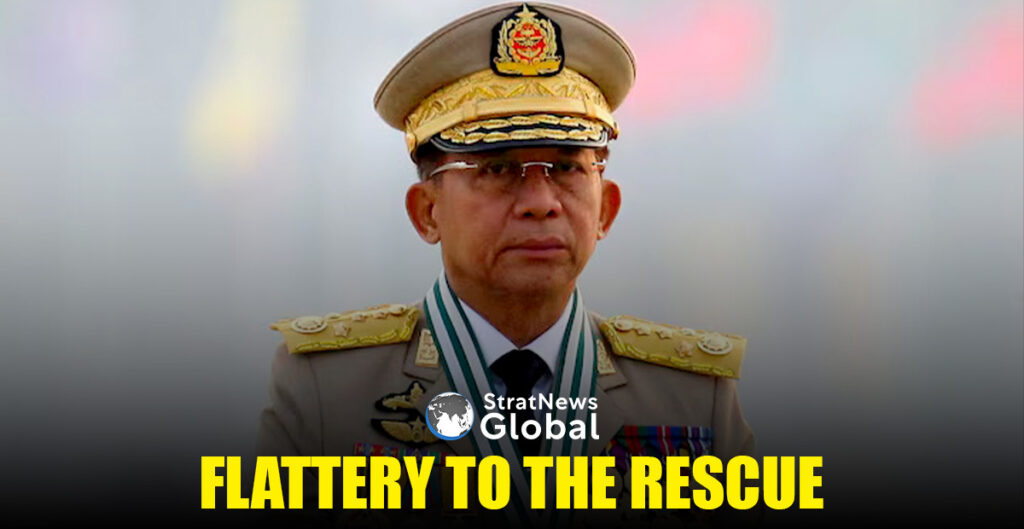
In a notable diplomatic move, the United States on Thursday lifted sanctions designations on several allies of Myanmar’s ruling generals, just two weeks after the country’s junta chief praised President Donald Trump and urged a relaxation of sanctions in a letter responding to a recent tariff warning.
A notice from the US Treasury Department said KT Services & Logistics and its founder, Jonathan Myo Kyaw Thaung; the MCM Group and its owner Aung Hlaing Oo; and Suntac Technologies and its owner Sit Taing Aung; and another individual, Tin Latt Min, were being removed from the US sanctions list.
KT Services & Logistics and Jonathan Myo Kyaw Thaung were added to the sanctions list in January 2022 under the Biden administration in a step timed to mark the first anniversary of the military seizure of power in Myanmar that plunged the country into chaos.
Sit Taing Aung and Aung Hlaing Oo were placed on the sanctions list the same year for operating in Myanmar’s defence sector. Tin Latt Min, identified as another close associate of the military rulers, was placed on the list in 2024 to mark the third anniversary of the coup.
Treasury did not explain the reason for the move, and the White House did not immediately respond to a request for comment.
‘Spirit Of A True Patriot’
On July 11, Myanmar’s ruling military general, Min Aung Hlaing, asked Trump in a letter for a reduction in the 40% tariff rate on his country’s exports to the US and said he was ready to send a negotiation team to Washington if needed.
“The senior general acknowledged the president’s strong leadership in guiding his country towards national prosperity with the spirit of a true patriot,” state media said at the time.
In his response to a letter from Trump notifying Myanmar of the tariff to take effect on August 1, Min Aung Hlaing proposed a reduced rate of 10% to 20%, with Myanmar slashing its levy on US imports to a range of zero to 10%.
Min Aung Hlaing also asked Trump “to reconsider easing and lifting the economic sanctions imposed on Myanmar, as they hinder the shared interests and prosperity of both countries and their peoples”.
Rare Earth Minerals
Myanmar is one of the world’s main sources of sought-after rare earth minerals used in high-tech defence and consumer applications. Securing supplies of the minerals is a major focus for the Trump administration in its strategic competition with China, which is responsible for 90% of rare earth processing capacity.
Most of Myanmar’s rare earth mines are in areas controlled by the Kachin Independence Army (KIA), an ethnic group fighting the junta, and are processed in China.
(With inputs from Reuters)
India-UK Trade Deal Gets Thumbs Up From Industry Bodies
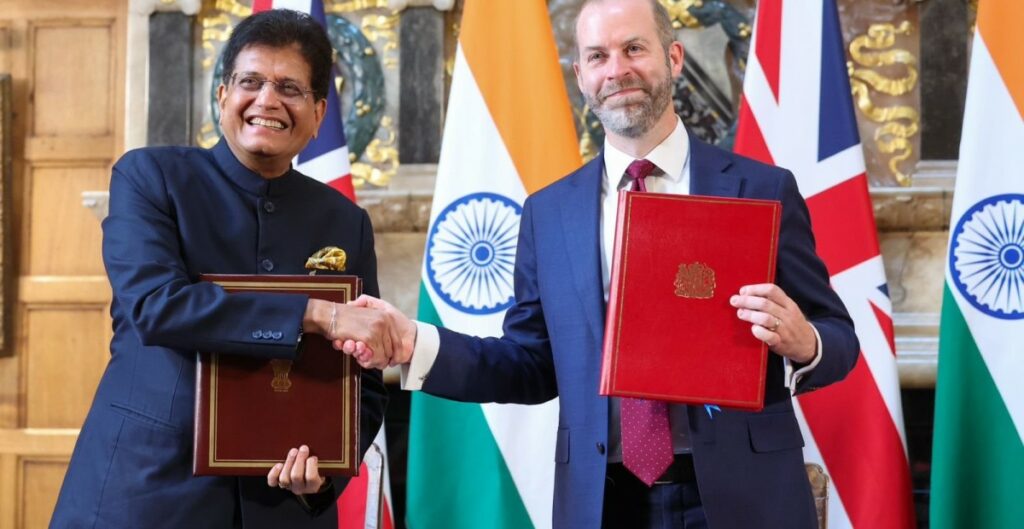
The signing of the India-UK Free Trade Agreement (FTA) has got the thumbs up across India’s business and trade sectors. Leading industry bodies have called the trade deal a landmark development poised to reshape bilateral trade, boost domestic manufacturing and unlock new avenues for Indian exporters.
The comprehensive trade deal, which aims to double India-UK trade to $120 billion by 2030 and expand it by another $40 billion by 2040, arrives at a time India is actively pursuing global trade partnerships.
The FTA is expected to deliver wide-ranging benefits across sectors such as textiles, engineering, IT, agriculture and wellness. The deal will also create pathways for collaboration in digital trade, AI and climate sustainability.
Industry Cheers Economic Boost
A “game-changer for Indian industry,” especially for sectors like textiles and leather, is how Sanjay Nayar, President, Associated Chambers of Commerce and Industry of India (ASSOCHAM), put it. “This agreement will not only enhance export potential but also support innovation-led sectors and services. It aligns closely with India’s vision of becoming a global manufacturing and knowledge hub.”
Manish Singhal, Secretary General of ASSOCHAM, highlighted the recognition of India’s cultural economy. “The inclusion of wellness and cultural sectors adds a fresh layer to trade diplomacy. ASSOCHAM stands fully aligned with the opportunities this deal presents,” he said.
From a broader strategic perspective, the FTA complements India’s recent trade outreach, following the India-EFTA agreement and ongoing talks with the EU and the United States. The reduced tariffs and simplified rules of origin are expected to bolster India’s export competitiveness.
Defining Moment, Says FICCI
The Federation of Indian Chambers of Commerce and Industry (FICCI) lauded the agreement as a defining moment in India’s trade evolution. FICCI President Harsha Vardhan Agarwal remarked: “The FTA aligns with India’s ambition of deeper global economic integration. It reinforces the Atmanirbhar Bharat agenda by helping industries scale globally and compete more effectively.”
FICCI Senior Vice President Anant Goenka noted that the pact “promises enhanced market access and long-term certainty for Indian exporters.”
Dr Anish Shah, former FICCI President, highlighted the deal’s broader implications. “This is not just a trade win—it’s a values-driven blueprint for global cooperation centred on sustainability, innovation and inclusive growth.”
Jyoti Vij, Director General of FICCI, called it “a historic milestone that will energize trade and investment flows between the two countries”. Harish Ahuja, Chairman of FICCI’s Foreign Trade Committee, said the agreement would significantly strengthen India’s labour-intensive manufacturing sectors such as apparel and textiles.
Engineering Exports Set To Surge
India’s engineering sector is also poised to benefit significantly from the FTA. According to the Engineering Export Promotion Council (EEPC) India, the UK currently accounts for over 11% of India’s engineering trade growth, but Indian exports still make up less than 2.2% of the UK’s total engineering imports.
Pankaj Chadha, Chairman of EEPC India, called the FTA a “strategic breakthrough” that could double engineering exports to the UK—reaching over $7.5 billion by 2029–30. “It opens new doors for Indian exporters, particularly MSMEs, and strengthens India’s role in global value chains,” he said.
Adhip Mitra, Executive Director of EEPC India, noted that the pact “goes beyond tariffs” and “lays the foundation for technology partnerships and sustainable growth.” High-potential segments like electric machinery, auto components and construction equipment are projected to register a CAGR of 12–20%, thanks to improved access and streamlined customs procedures.
Key Features Of FTA
• Tariff Elimination: Substantial cuts across key Indian exports, particularly in engineering goods, textiles and agriculture.
• Social Security Exemption: Indian professionals will be exempt from UK social security contributions for up to three years.
• Agricultural Boost: Inclusion of Indian millets and climate-resilient crops under favourable tariff lines.
• Cultural Promotion: Support for ayurveda, yoga and Indian music in the UK.
• Digital and IP Cooperation: Provisions to support digital trade, innovation and IP protection.
Ex-Australia PM Urges US To Deepen Indo-Pacific Economic Push To Counter China
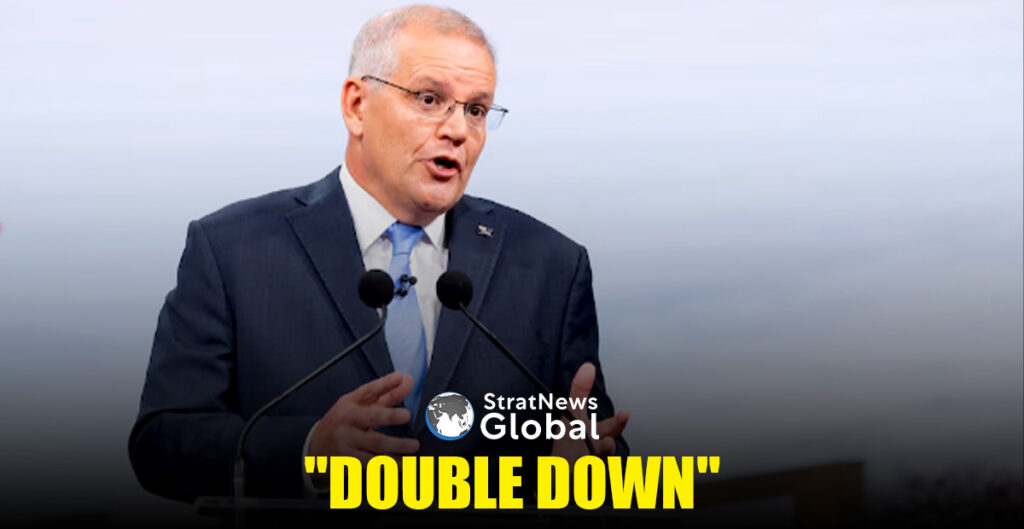
Australia’s former Prime Minister Scott Morrison, speaking at a U.S. congressional panel on countering China, urged Washington to “double down” on economic engagement in the Indo-Pacific, where Beijing is expanding its influence.
Speaking on Wednesday, Morrison said economic security is the main security focus of many countries in Southeast Asia, and U.S. leadership on economic issues and Western investment give the region choice.
“When China is active in a particular country … the response to that is not for the U.S. or other allied interests not to be there, the response is to double down and be there even more strongly to provide them with that choice,” he said.
Morrison was invited to speak to the Select Committee on the Strategic Competition Between the United States and the Chinese Communist Party about his government’s experience of China imposing $20 billion in unofficial trade sanctions after Australia called for an inquiry into the origins of the COVID-19 pandemic in 2020.
The sanctions were lifted by Beijing after Morrison lost a national election in 2022, and Anthony Albanese’s Labour government sought to stabilise ties with Australia’s largest trading partner.
Quad Supply Chain
Morrison said the U.S. should work more with its Quad allies, including Australia and Japan, to build a supply chain for critical minerals and rare earths needed for defence equipment, including the nuclear-powered submarines Australia is buying from the United States under the AUKUS pact.
“The processed rare earths, whether they go into nuclear submarines, F-35s or whatever it happens to be, that is essential for those things to be done,” he said.
Deals similar to that struck this month for the U.S. Department of Defence to back U.S.-based rare earth magnets producer MP Materials “should be extended to allies and partners”, he said.
China recently demonstrated its leverage by withholding exports of rare earth magnets, upending global markets, before reversing course.
The Australian public awareness of the potential threat posed by China is “somewhat in jeopardy”, Morrison said, pointing to a Lowy Institute poll showing more Australians see China as an economic partner than a security threat.
(With inputs from Reuters)
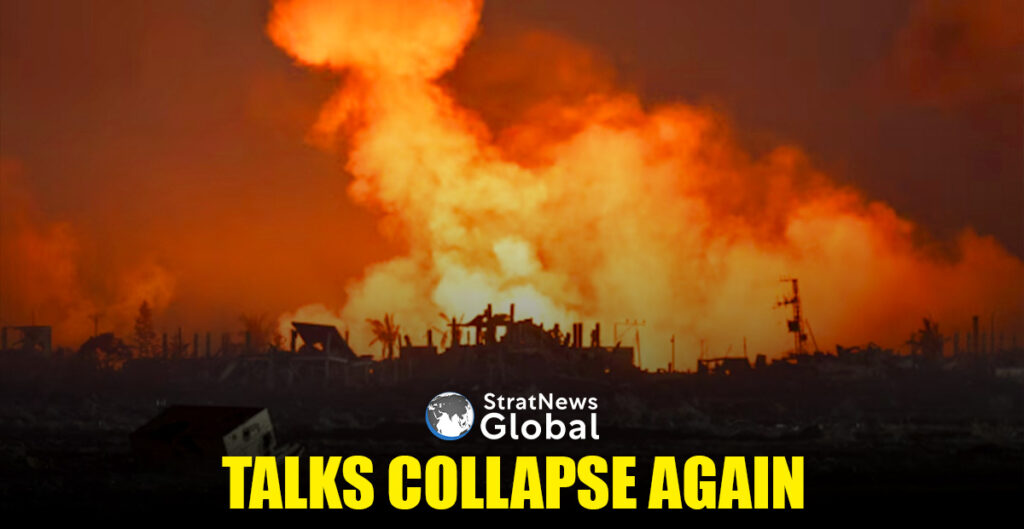
Israel, US Recall Teams From Gaza Ceasefire Talks After Hamas Proposal
Israel and the United States recalled their delegations from the Gaza ceasefire talks on Thursday for consultations, as U.S. envoy Steve Witkoff accused Hamas of not negotiating in good faith.
It marked the latest setback in efforts to secure a deal that would bring a ceasefire to Gaza, secure the release of Israeli hostages held by Hamas, and bring respite to Palestinians suffering a sharply worsening humanitarian crisis.
Witkoff said mediators had made a great effort, but “Hamas does not appear to be coordinated or acting in good faith”. “We will now consider alternative options to bring the hostages home and try to create a more stable environment for the people of Gaza,” he wrote on X.
There was no immediate reaction from Hamas.
An Israeli official with knowledge of the talks said Hamas’ response to the latest ceasefire proposal “does not allow for progress without a concession” by the group, but that Israel intended to continue discussions.
Both Israel and Hamas are facing pressure at home and abroad to reach a deal following almost two years of war, with the humanitarian situation inside Gaza deteriorating and Israelis worried about the conditions in which hostages are being held.
Dozens of people have starved to death in Gaza over the last few weeks as a wave of hunger crashes on the enclave, according to local health authorities.
Gazans Are Starving
British Prime Minister Keir Starmer said the suffering and starvation in Gaza was an “unspeakable and indefensible” humanitarian catastrophe and called on Israel to urgently let in aid.
“While the situation has been grave for some time, it has reached new depths and continues to worsen. We are witnessing a humanitarian catastrophe,” Starmer said in a statement.
He will hold an emergency call with French and German partners on Friday to discuss what could be done to “stop the killing and get people the food they desperately need,” he said.
The Gaza health ministry said two more people had died of malnutrition. The head of Shifa Hospital in Gaza City said the two were patients suffering from other illnesses who died after going without food for several days.
Earlier in the day, there had been some apparent signs of progress in the mediation.
Ceasefire Hopes Still Flicker
A senior Hamas official told Reuters that there was still a chance of reaching a ceasefire deal, but it would take a few days because of what he called Israeli stalling.
A senior Israeli official had been quoted by local media as saying the new text was something Israel could work with.
But, Israel’s Channel 12 said a rapid deal was not within reach, with gaps remaining between the two sides, including over where the Israeli military should withdraw to during any truce.
Witkoff’s team did not immediately respond to a request to explain the Hamas demands that led to his withdrawal of the U.S. negotiators.
The Hostages Families Forum, representing the family members of those held in Gaza, expressed concern at the recall of the Israeli team. “Each day that passes endangers the hostages’ chances of recovery and risks losing the ability to locate the fallen or gain vital intelligence about them,” it said.
(With inputs from Reuters)
DGCA Warns Air India Over ‘Systemic’ Lapses In Fatigue Management And Training
India’s aviation regulator, the Directorate General of Civil Aviation (DGCA), has warned Air India it may face enforcement action for violating safety standards on crew fatigue management and training, according to government notices reviewed by Reuters.
The airline self-reported the problems, which occurred this year and last year, to the DGCA last month, just days after one of its Boeing 787 Dreamliners crashed in Ahmedabad city, killing 260 people.
Four government notices, dated July 23, criticised Air India for repeated failures in safety compliance and follow many other warnings in the past. Potential regulatory action could include fines or ordering that executives be removed from their jobs.
They cite a combined 29 violations, including pilots not being given mandatory rest, poor compliance with simulator training requirements, lack of training for a high-altitude airport and flying on international routes with insufficient cabin crew.
“Despite repeated warnings and enforcement action of non-compliance in the past, systemic issues related to compliance monitoring, crew planning, and training governance remain unresolved,” said one of the notices.
“The recurrence of such violations suggests a failure to establish and enforce effective control mechanisms,” it said.
Air India said in a statement that the notices related to voluntary disclosures made over the past year, and it will respond to the regulator.
“We remain committed to the safety of our crew and passengers,” it added.
The DGCA did not respond to a Reuters request for comment.
Investigations And Warnings
Air India has come under intense scrutiny since the Ahmedabad crash, which was the world’s worst aviation disaster in a decade.
A preliminary report found that the fuel control switches were flipped almost simultaneously after takeoff, and there was pilot confusion in the cockpit. One pilot asked the other why he cut off the fuel, and the other responded that he hadn’t done so, the report said.
Separately, the EU’s aviation agency said this month it will investigate Air India Express, the airline’s budget service, after Reuters reported the carrier did not change the engine parts of an Airbus A320 in a timely manner.
India’s watchdog also found in May that Air India flew three Airbus planes even though they were overdue for checks on emergency equipment.
The crash and the warning notices have increased challenges for Indian conglomerate Tata, which took over the airline from the government in 2022 with the aim of turning it into a world-class airline.
This week’s government notices were addressed to senior executives, including the airline’s director of flight operations, Pankul Mathur, and its director of training, Amar Bhatia.
One of the notices said there had been “weekly rest violations” detected for two pilots in June 2024 and one in June 2025, though it did not say how many extra hours the pilots flew.
Another notice said that last year, two pilots took simulator training but did not start flying within the prescribed time limit, a lapse that requires them to undergo training again.
In April this year, a pilot flew from Kathmandu without the mandatory special simulator training required for the airport, the notice added. Kathmandu has mountainous terrain and a high-altitude table-top runway. Table-top runways have steep drops at one or both ends.
“This is substantially risky because Kathmandu is an airport which requires prior training … in case of any emergency (pilots) will not have the time to peruse a manual,” Vibhuti Singh, a former legal expert at India’s Aircraft Accident Investigation Bureau.
The warnings also included concerns that cabin safety teams has “repeatedly failed to adhere” to rules, as four international flights in April and May this year flew with fewer cabin crew than the 15 required.
One senior Indian government official with direct knowledge of the notices said the administration was concerned that “Air India is taking things for granted”, adding, “we have given them many warnings.”
Air India received nine warning notices in the past six months, the government told parliament this week. Last year, authorities warned or fined airlines in 23 instances for safety violations. Eleven instances involved the Air India group.
(With inputs from Reuters)
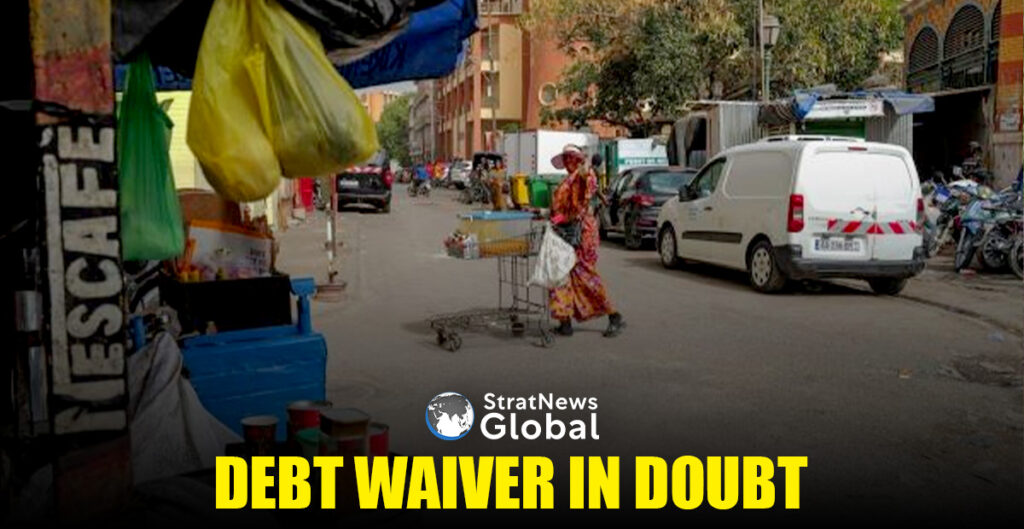
IMF Awaits More Data And Agreement On Remedies For Senegal Debt Waiver
The International Monetary Fund said on Thursday it requires additional data to complete its evaluation of Senegal’s debt situation and must still finalize an agreement with the government on essential corrective actions, according to a Fund spokesperson.
Senegal is grappling with billions in debts hidden by the previous administration – a problem for the cash-strapped country – which has seen its programme with the Fund put on hold over the issue.
The IMF’s executive board must approve either a waiver for misreporting – seen as the base case by many investors – or order Senegal to pay back previous programme disbursements. With a waiver, Senegal would be able to negotiate a new programme.
“Once we have reached agreement on the key corrective measures, the IMF Board will be in a position to consider the Senegal misreporting case and take a decision,” a spokesperson for the Fund said.
An agreement on these measures could be reached “hopefully within the coming weeks,” the spokesperson added.
Senegal’s Hidden Debt
The IMF estimates – based on latest data from Senegalese authorities – that hidden debt stood at $11.3 billion by end-2023, the spokesperson added. This included a portion for state-owned enterprises of about 7.4% of GDP.
There have been a range of estimates.
S&P pegged the total hidden debt discovered since October 2024 at roughly $13 billion.
Concerns over Senegal’s debt situation have escalated since September 2024, when the then newly elected government said an audit of government finances had shown the budget deficit at the end of 2023 stood at over 10% – more than double of what was reported by the previous administration.
Senegal is not the first case of hidden debt, with Mozambique’s infamous “tuna bond” scandal the most recent high-profile example in Africa.
The spokesperson said that the IMF, which has come under fire for not catching the off-books lending during its programme, will present information to the board on how the hidden debt went undetected.
“The IMF is conducting an internal assessment and diagnostic as part of the misreporting process,” the spokesperson added.
(With inputs from Reuters)