

Support us by contributing to StratNewsGlobal on the following UPI ID
ultramodern@hdfcbank

Strategic affairs is our game, South Asia and beyond our playground. Put together by an experienced team led by Nitin A. Gokhale. Our focus is on strategic affairs, foreign policy and international relations, with higher quality reportage, analysis and commentary with new tie-ups across the South Asian region.
You can support our endeavours. Visit us at www.stratnewsglobal.com and follow us on YouTube, Twitter, Facebook and Instagram.
र 500 per month
र 1000 per month
र 5000 per year
र 10000 per year
Donate an amount of your choice
र 500 per month
Donate र 500 per month

र 1000 per month
Donate र 1000 per month
र 5000 per year
Donate र 5,000 per year
र 10000 per year
Donate र 10,000 per year
Donate an amount of your choice
Donate an amount of your choice
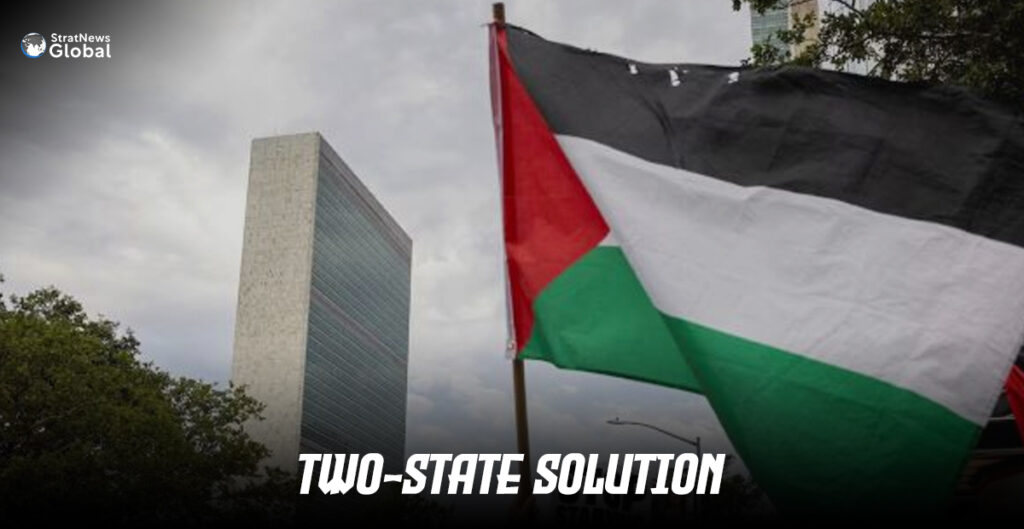

Ministers Meet At UN For Postponed Talks On Israel-Palestinian Two-State Solution
Dozens of ministers will convene at the United Nations on Monday for a rescheduled conference aimed at advancing a two-state solution for Israel and the Palestinians, though the event will be boycotted by both the United States and Israel.
The 193-member U.N. General Assembly decided in September last year that such a conference would be held in 2025. Hosted by France and Saudi Arabia, the conference was postponed in June after Israel attacked Iran.
The conference aims to lay out the parameters for a roadmap to a Palestinian state, while ensuring Israel’s security.
French Foreign Minister Jean-Noel Barrot told newspaper La Tribune Dimanche in an interview published on Sunday that he will also use the conference this week to push other countries to join France in recognizing a Palestinian state.
France Wants A Palestinian State
France intends to recognize a Palestinian state in September at the annual gathering of world leaders at the United Nations General Assembly, President Emmanuel Macron said last week.
“We will launch an appeal in New York so that other countries join us to initiate an even more ambitious and demanding dynamic that will culminate on September 21,” Barrot said, adding that he expected Arab countries by then to condemn Palestinian terrorists Hamas and call for their disarmament.
The conference comes as a 22-month war between Israel and Hamas in Gaza still rages. The war was triggered on October 7, 2023, when Hamas killed 1,200 people in southern Israel and took some 250 hostages, according to Israeli tallies. Since then, Israel’s military campaign has killed nearly 60,000 Palestinians, according to Gaza health authorities.
U.S. Boycotts Conference
The U.S. will not attend the conference at the United Nations, said a State Department spokesperson, describing it as “a gift to Hamas, which continues to reject ceasefire proposals accepted by Israel that would lead to the release of hostages and bring calm in Gaza.”
The State Department spokesperson added that Washington voted against the General Assembly last year calling for the conference and would “not support actions that jeopardize the prospect for a long-term, peaceful resolution to the conflict.”
Israel is also not taking part in the conference, “which doesn’t first urgently address the issue of condemning Hamas and returning all of the remaining hostages,” said Jonathan Harounoff, international spokesperson at Israel’s U.N. mission.
The U.N. has long endorsed a vision of two states living side by side within secure and recognized borders. Palestinians want a state in the West Bank, east Jerusalem and Gaza Strip, all territory captured by Israel in the 1967 war with neighbouring Arab states.
The U.N. General Assembly in May last year overwhelmingly backed a Palestinian bid to become a full U.N. member by recognizing it as qualified to join and recommending the U.N. Security Council “reconsider the matter favourably.” The resolution garnered 143 votes in favour and nine against.
The General Assembly vote was a global survey of support for the Palestinian bid to become a full U.N. member – a move that would effectively recognize a Palestinian state – after the U.S. vetoed it in the U.N. Security Council several weeks earlier.
(With inputs from Reuters)
Ukrainian Drones Strike St. Petersburg While Putin Attends Navy Day Event
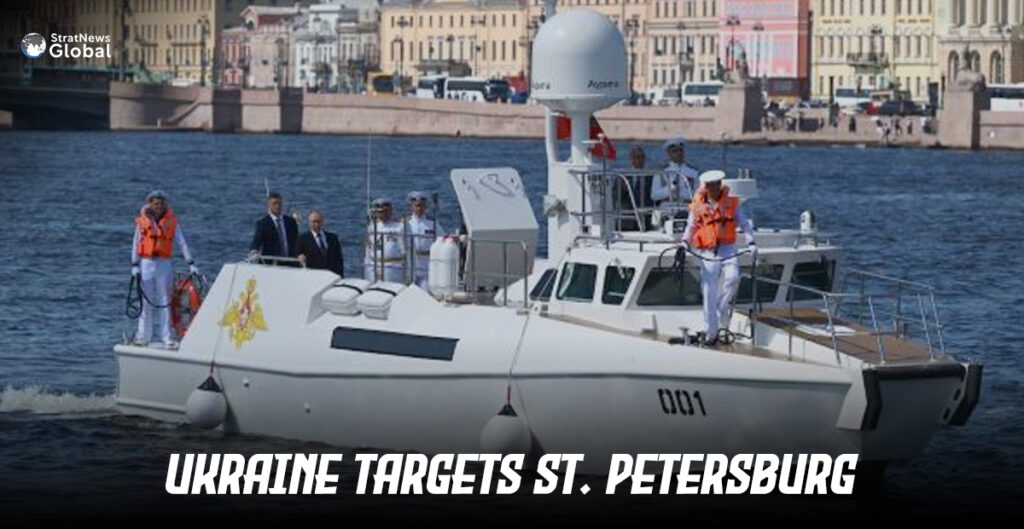
Russian officials said Ukrainian drones struck St. Petersburg on Sunday, prompting a five-hour airport shutdown as President Vladimir Putin attended Navy Day celebrations, though the naval parade had been cancelled earlier over security fears.
St. Petersburg usually holds a large-scale, televised navy parade on Navy Day, which features a flotilla of warships and military vessels sailing down the Neva River and is attended by Putin.
Last year, Russia suspected a Ukrainian plan to attack the city’s parade, according to state television.
Kremlin spokesman Dmitry Peskov confirmed on Sunday that this year’s parade had been cancelled for security reasons, following first reports of its cancellation in early July.
Celebrations
Putin arrived at the city’s historic naval headquarters on Sunday by patrol speed boat, from where he followed drills involving more than 150 vessels and 15,000 military personnel in the Pacific and Arctic Oceans and Baltic and Caspian Seas.
“Today we are marking this holiday in a working setting, we are inspecting the combat readiness of the fleet,” Putin said in a video address.
The Russian Defence Ministry said air defence units downed a total of 291 Ukrainian fixed-wing drones on Sunday, below a record 524 drones downed in attacks on May 7, ahead of Russia’s Victory Day parade on May 9.
Alexander Drozdenko, governor of the Leningrad region surrounding St. Petersburg, said that over ten drones were downed over the area, and falling debris injured a woman. At 0840 GMT on Sunday Drozdenko said that the attack was repelled.
St. Petersburg’s Pulkovo airport was closed during the attack, with 57 flights delayed and 22 diverted to other airports, according to a statement. Pulkovo resumed operations later on Sunday.
Russian blogger Alexander Yunashev, part of an official group of reporters travelling with Peskov, said Peskov had told him their flight from Moscow to St. Petersburg had been delayed by the drone attack for 2 hours on Sunday.
(With inputs from Reuters)
Malaysia To Host Thailand-Cambodia Peace Talks
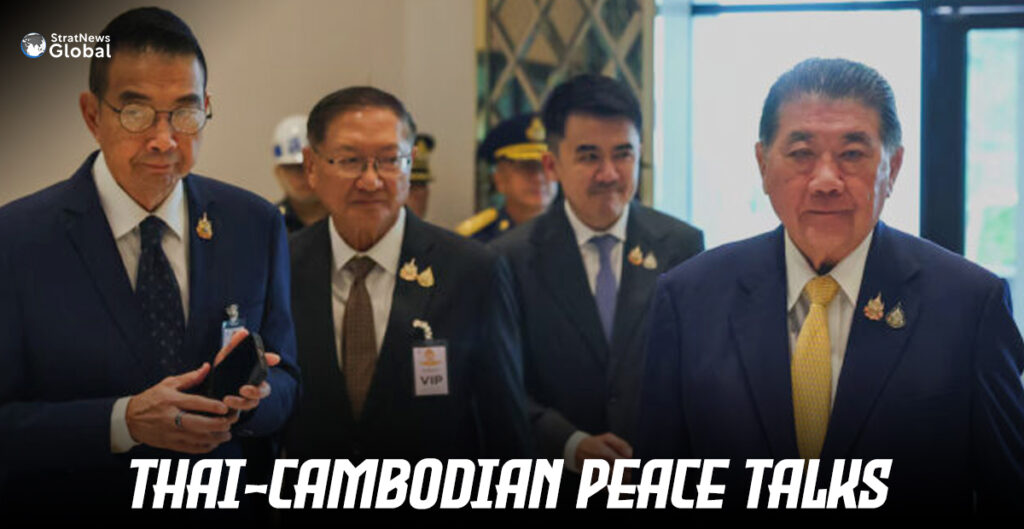
The Prime Ministers of Thailand and Cambodia were scheduled to meet in Malaysia on Monday for talks aimed at securing a ceasefire in their deadly border dispute, with the United States confirming that its officials would assist in the peace process.
Thailand’s government said it was attending talks arranged by Malaysia in its role as chair of the regional ASEAN bloc, while Cambodian Prime Minister Hun Manet said the talks were co-organised by the United States with the participation of China.
US Calls For Quick End To Conflict
US Secretary of State Marco Rubio said State Department officials were in Malaysia to assist peace efforts, after President Donald Trump had earlier said that he thought both leaders wanted to settle the conflict.
“We want this conflict to end as soon as possible,” Rubio said in statement released late on Sunday in the US and early Monday in Asia.
“State Department officials are on the ground in Malaysia to assist these peace efforts.”
Tensions between Thailand and Cambodia have intensified since the killing in late May of a Cambodian soldier during a brief border skirmish. Border troops on both sides were reinforced amid a full-blown diplomatic crisis that brought Thailand’s fragile coalition government to the brink of collapse.
Hostilities broke out last Thursday and have escalated into the worst fighting between the Southeast Asian neighbours in more than a decade.
The death toll has risen above 30, including more than 20 civilians, while authorities report that more than 200,000 people have been evacuated from border areas.
Anwar To Chair Talks
Malaysian Prime Minister Anwar Ibrahim had proposed ceasefire talks soon after the border dispute erupted into conflict on Thursday, and China and the United States also offered to assist in negotiations.
Thailand had said it supported calls for a ceasefire in principle but wanted to negotiate bilaterally, while Cambodia had called for international involvement.
Anwar said he expected to chair the negotiations after being asked by representatives of the two governments to try to find a peace settlement, state media agency Bernama reported.
“So, I’m discussing the parameters, the conditions, but what is important is (an) immediate ceasefire,” he said late on Sunday.
(With inputs from Reuters)
US, China To Resume Talks In Stockholm Ahead Of Tariff Deadline
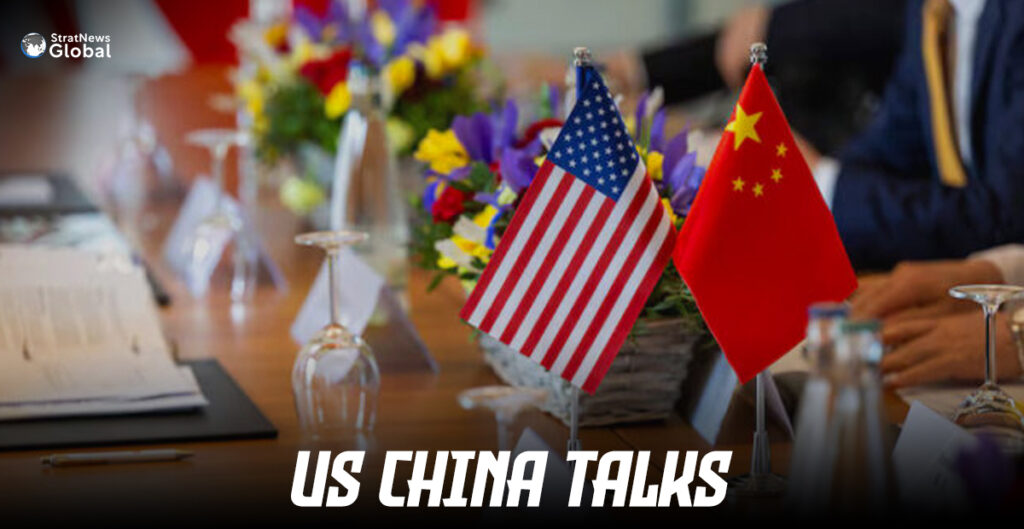
Top economic officials from the US and China are set to resume talks in Stockholm on Monday, aiming to resolve longstanding trade disputes and extend their current truce by three months, thereby avoiding a steep hike in tariffs between the world’s two largest economies.
China is facing an August 12 deadline to reach a durable tariff agreement with President Donald Trump’s administration, after Beijing and Washington reached preliminary deals in May and June to end weeks of escalating tit-for-tat tariffs and a cut-off of rare earth minerals.
Without an agreement, global supply chains could face renewed turmoil from US duties snapping back to triple-digit levels that would amount to a bilateral trade embargo.
Would Trump Strike Another Major Deal?
The Stockholm talks come hot on the heels of Trump’s biggest trade deal yet with the European Union on Sunday for a 15% tariff on most EU goods exports to the US, including autos. The bloc will also buy $750 billion worth of American energy and make $600 billion worth of US investments in coming years.
No similar breakthrough is expected in the US-China talks but trade analysts said that another 90-day extension of a tariff and export control truce struck in mid-May was likely.
An extension of that length would prevent further escalation and facilitate planning for a potential meeting between Trump and Chinese President Xi Jinping in late October or early November.
A US Treasury spokesperson declined comment on a South China Morning Post report quoting unnamed sources as saying the two sides would refrain from introducing new tariffs or other steps that could escalate the trade war for another 90 days.
Trump’s administration is poised to impose new sectoral tariffs that will impact China within weeks, including on semiconductors, pharmaceuticals, ship-to-shore cranes and other products.
“We’re very close to a deal with China. We really sort of made a deal with China, but we’ll see how that goes,” Trump told reporters on Sunday before European Commission President Ursula von der Leyen struck their tariff deal.
Deeper Issues
Previous US-China trade talks in Geneva and London in May and June focused on bringing US and Chinese retaliatory tariffs down from triple-digit levels and restoring the flow of rare earth minerals halted by China and Nvidia’s H20 AI chips and other goods halted by the United States.
So far, the talks have not delved into broader economic issues. They include US complaints that China’s state-led, export-driven model is flooding world markets with cheap goods, and Beijing’s complaints that US national security export controls on tech goods seek to stunt Chinese growth.
“Geneva and London were really just about trying to get the relationship back on track so that they could, at some point, actually negotiate about the issues which animate the disagreement between the countries in the first place,” said Scott Kennedy, a China economics expert at the Center for Strategic and International Studies in Washington.
“I’d be surprised if there is an early harvest on some of these things but an extension of the ceasefire for another 90 days seems to be the most likely outcome,” Kennedy said.
US Treasury Secretary Scott Bessent has already flagged a deadline extension and has said he wants China to rebalance its economy away from exports to more domestic consumption — a decades-long goal for US policymakers.
Analysts say the US-China negotiations are far more complex than those with other Asian countries and will require more time. China’s grip on the global market for rare earth minerals and magnets, used in everything from military hardware to car windshield wiper motors, has proved to be an effective leverage point on US industries.
Trump-Xi Meeting?
In the background of the talks is speculation about a possible meeting between Trump and Xi in late October.
Trump has said he will decide soon on a landmark trip to China, and a new flare-up of tariffs and export controls would likely derail planning.
Sun Chenghao, a fellow at Tsinghua University’s Center for International Security and Strategy in Beijing, said that a Trump-Xi summit would be an opportunity for the US to lower the 20% tariffs on Chinese goods related to fentanyl. In exchange, he said the Chinese side could make good on its 2020 pledge to increase purchases of US farm products and other goods.
“The future prospect of the heads of state summit is very beneficial to the negotiations because everyone wants to reach an agreement or pave the way in advance,” Sun said.
Still, China will likely request a reduction of multi-layered US tariffs totaling 55% on most goods and further easing of US high-tech export controls, analysts said. Beijing has argued that such purchases would help reduce the US trade deficit with China, which reached $295.5 billion in 2024.
(With inputs from Reuters)
15% Tariff Agreed In US-EU Deal, Escalation Avoided
The United States and the European Union on Sunday reached a framework trade agreement, bringing much-needed relief by imposing a 15% import tariff on most EU goods — only half the initially threatened rate — and successfully averting a larger trade conflict between the US and EU, who together account for nearly a third of world trade.
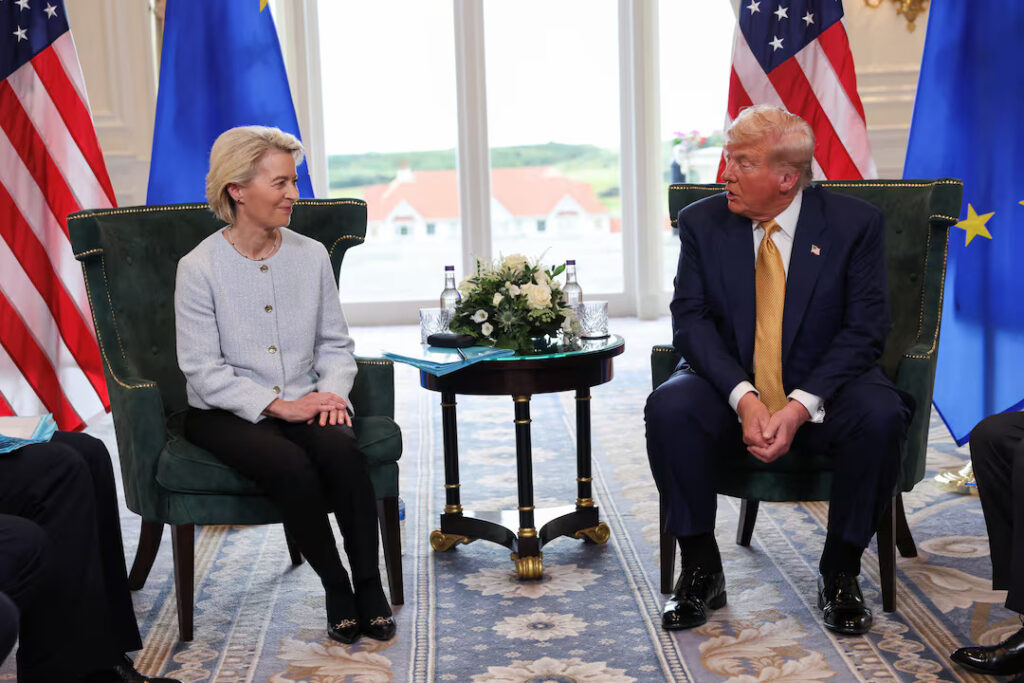
US President Donald Trump and European Commission President Ursula von der Leyen announced the deal at Trump’s luxury golf course in western Scotland after an hour-long meeting that pushed the hard-fought deal over the line, following months of negotiations.
‘Biggest Deal Ever Made’
“I think this is the biggest deal ever made,” Trump told reporters, lauding EU plans to invest some $600 billion in the United States and dramatically increase its purchases of US energy and military equipment.
Trump said the deal, which tops a $550 billion deal signed with Japan last week, would expand ties between the trans-Atlantic powers after years of what he called unfair treatment of US exporters.
Von der Leyen, describing Trump as a tough negotiator, said the 15% tariff applied “across the board”, later telling reporters it was “the best we could get.”
‘It Will Bring Stability’
“We have a trade deal between the two largest economies in the world, and it’s a big deal. It’s a huge deal. It will bring stability. It will bring predictability,” she said.
The agreement mirrors key parts of the framework accord reached by the US with Japan, but like that deal, it leaves many questions open, including tariff rates on spirits, a highly charged topic for many on both sides of the Atlantic.
The deal, which Trump said calls for $750 billion of EU purchases of US energy in coming years and “hundreds of billions of dollars” of arms purchases, likely spells good news for a host of EU companies, including Airbus, Mercedes-Benz and Novo Nordisk, if all the details hold.
Merz Welcomes Deal
German Chancellor Friedrich Merz welcomed the deal, saying it averted a trade conflict that would have hit Germany’s export-driven economy and its large auto sector hard. German carmakers, VW, Mercedes and BMW were some of the hardest hit by the 27.5% US tariff on car and parts imports now in place.
The baseline 15% tariff will still be seen by many in Europe as too high, compared with Europe’s initial hopes to secure a zero-for-zero tariff deal.
Bernd Lange, the German Social Democrat who heads the European Parliament’s trade committee, said the tariffs were imbalanced and the hefty EU investment earmarked for the US would likely come at the bloc’s own expense.
Trump retains the ability to increase the tariffs in the future if European countries do not live up to their investment commitments, a senior US administration official told reporters on Sunday evening.
The euro rose around 0.2% against the dollar, sterling and yen within an hour of the deal’s being announced.
Mirror Of Japan Deal
Carsten Nickel, deputy director of research at Teneo, said Sunday’s accord was “merely a high-level, political agreement” that could not replace a carefully hammered out trade deal: “This, in turn, creates the risk of different interpretations along the way, as seen immediately after the conclusion of the US-Japan deal.”
While the tariff applies to most goods, including semiconductors and pharmaceuticals, there are exceptions.
The US will keep in place a 50% tariff on steel and aluminum. Von der Leyen suggested the tariff could be replaced with a quota system; a senior administration official said EU leaders had asked that the two sides continue to talk about the issue.
Von der Leyen said there would be no tariffs from either side on aircraft and aircraft parts, certain chemicals, certain generic drugs, semiconductor equipment, some agricultural products, natural resources and critical raw materials.
“We will keep working to add more products to this list,” von der Leyen said, adding that spirits were still under discussion.
A US official said the tariff rate on commercial aircraft would remain at zero for now, and the parties would decide together what to do after a US review is completed, adding there is a “reasonably good chance” they could agree to a lower tariff than 15%. No timing was given for when that probe would be completed.
The deal will be sold as a triumph for Trump, who is seeking to reorder the global economy and reduce decades-old US trade deficits, and has already reached similar framework accords with Britain, Japan, Indonesia and Vietnam, although his administration has not hit its goal of “90 deals in 90 days”.
US officials said the EU had agreed to lower non-tariff barriers for automobiles and some agricultural products, though EU officials suggested the details of those standards were still under discussion.
$20 Trillion Economy
“Remember, their economy is $20 trillion … they are five times bigger than Japan,” a senior US official told reporters during a briefing. “So the opportunity of opening their market is enormous for our farmers, our fishermen, our ranchers, all our industrial products, all our businesses.”
Trump has periodically railed against the EU, saying it was “formed to screw the United States” on trade. He has fumed for years about the US merchandise trade deficit with the EU, which in 2024 reached $235 billion, according to US Census Bureau data.
The EU points to the US surplus in services, which it says partially redresses the balance.
Trump has argued that his tariffs are bringing in “hundreds of billions of dollars” in revenues for the US while dismissing warnings from economists about the risk of inflation.
On July 12, Trump threatened to apply a 30% tariff on imports from the EU starting on August 1, after weeks of negotiations failed to reach a comprehensive trade deal.
The EU had prepared countertariffs on 93 billion euros ($109 billion) of US goods in the event a deal to avoid the tariffs could not be struck.
(With inputs from Reuters)
India-China Ties: Don’t Misread Thaw As Transformation
India’s recent move to resume issuing tourist visas to Chinese nationals has triggered a fresh wave of commentary about a potential thaw in bilateral ties.
Diplomatic metaphors abound—the Elephant and the Dragon may now be ready to tango, waltz, or bhangra, depending on who you ask.
Amid all the renewed optimism, it might be worth revisiting a 2024 paper by the Takshashila Institution which reminds us of the hard realities beneath the rhetoric. Titled Contours of a New Modus Vivendi with China and authored by Manoj Kewalramani, the report acknowledges the signs of dialogue but warns against mistaking them for structural change.
“Let’s not get carried away by the headlines,” says Kewalramani. “The challenges in this relationship are deep and difficult to navigate.”
Framed around three fundamental questions—what India wants from its relationship with China, what a stable equilibrium might look like, and what it would take to get there—the paper offers six clear recommendations grounded in strategic realism and national power, not sentiment.
Kewalramani argues that volatility in the India-China relationship is structural and unlikely to dissipate anytime soon. It stems from three interlocking dynamics: the simultaneous rise of both powers and the resulting friction over overlapping spheres of interest; a persistent and widening power asymmetry in China’s favour, with its GDP over five times India’s and a defence budget roughly triple; and a shifting global order marked by US-China rivalry, where India is seen by both sides as a critical swing state.
While Beijing seeks to constrain Indian options, including through coercive diplomacy and military pressure along the LAC, New Delhi has responded with a mix of internal balancing and external alignment, deepening ties with the US, France, Japan and Australia while preserving its strategic autonomy.
Rather than proposing a reset or grand reconciliation, the report recommends a set of carefully calibrated steps to stabilise the relationship on India’s terms.
These include closing the power gap through sustained economic growth and investment in infrastructure, defence, technology and education; refusing to accept the altered ground reality in Eastern Ladakh and restoring lost patrolling rights; and restoring structured political dialogue, not for optics but to clarify red lines and enable pragmatic management of friction.
Kewalramani also advocates for a shift from calls for decoupling to a strategy of de-risking: creating a formal investment review mechanism, maintaining openness to Chinese capital and inputs where they support Indian industrial goals, while cordoning off critical sectors to prevent strategic leverage.
Equally important, he argues, is the need to preserve people-to-people and institutional exchanges—not as a gesture of goodwill, but to prevent dangerous misperceptions and to deepen India’s own understanding of Chinese society and politics.
He warns that India must not allow Beijing to exercise a veto over its foreign partnerships. Strengthening ties with the US and other Indo-Pacific actors must continue, not as part of an anti-China front, but as a reflection of Indian interests and agency.
The report also cautions against misreading China’s recent rhetorical softening. Language around “mutual respect” and “coexistence” may sound conciliatory, but without tangible policy shifts, particularly on the border and in multilateral forums, they amount to little more than a change in tone.
Since 2023, Chinese diplomats have dialled down the Wolf Warrior rhetoric and engaged in more restrained outreach. But as Kewalramani notes, this stylistic shift should not be confused with a strategic rethink. China’s posture remains hierarchical, adversarial, and fundamentally resistant to Indian aspirations for parity.
His central message is blunt: India must not approach China through nostalgia, slogans, or summitry. It must do so through national strength, strategic discipline, and institutional capacity.
Trade Deal With UK: More Challenges Than Gains For India?
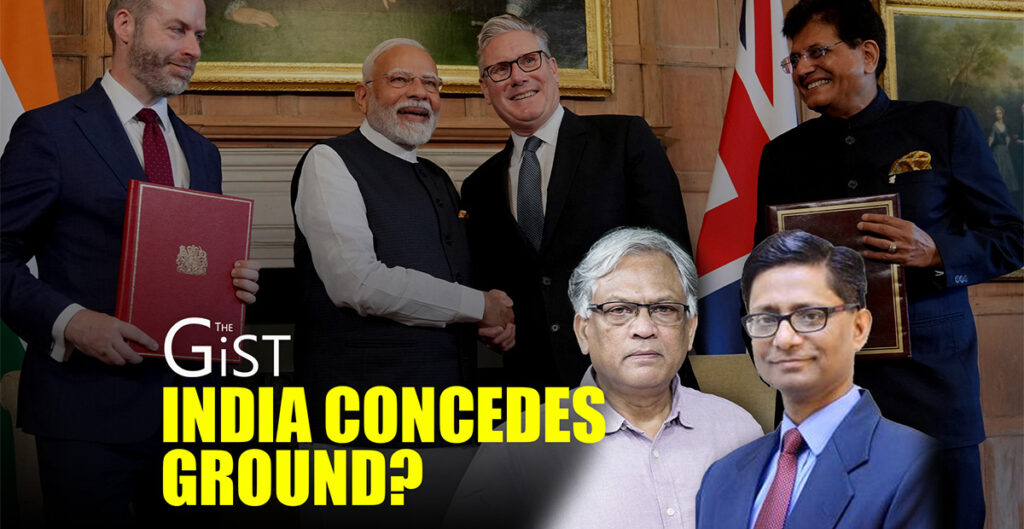
There is euphoria in many quarters in India about the free trade agreement (FTA) with the UK. Abhijit Das, former head of the Centre for WTO Studies in Delhi, believes that there will be gains for labour intensive sectors ranging from textiles and clothing, leather goods, even marine products and spices.
“If we focus just on goods and services there are good reasons to be optimistic about the prospects of Indian exporters, whether they will be able to take advantage of the opportunities will depend on may other factors,” Das said.
He cited a study by the UK Department of Trade, which says that by 2040, bilateral trade with India would increase by 25 billion pounds or over $33 billion dollars because of the FTA. Of this around 15 billion pounds (more than $20 billion) would accrue to the UK and 10 billion pounds (over $13 billion) would accrue to India.
Given that India’s total export of goods and services is around $825 billion, an increase of $13 billion would seem like small change. That apart, Das points to a host of other issues that come up which could prove problematic for India.
“In agriculture we have stuck to our red lines, protected our interests … and managed to get the UK to reduce tariffs on some products, some spices, marine sector as well … provided our exporters are able to meet sanitary and phyto-sanitary requirements imposed by the UK … which can be quite onerous.”
This is where government help becomes crucial to help Indian exporters meet those requirements, he said.
In government procurement, “we have committed to giving non-discriminatory treatment to UK suppliers of goods and services … in other words goods that originate in the UK will be treated at par with Indian Class 2 suppliers. This is a substantial concession.”
This could impact the Make in India programme. The tricky part is India would have to make the same or larger concessions in its negotiations with the European Union and the US going forward.
Tune in for more in this conversation with Abhijit Das, former head of the Centre for WTO Studies.
Sweida Hospital Struggles After Sectarian Clashes Rise In Syria
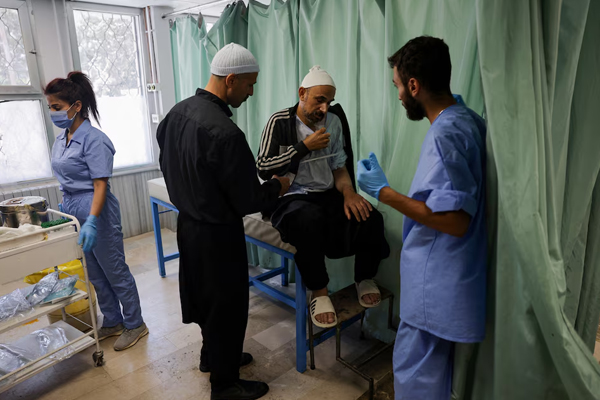
Nearly two weeks after deadly clashes involving the local Druze minority, Bedouin tribes and Syrian government forces, the main hospital in the southern city of Sweida is overwhelmed with trauma patients and struggling to operate due to a lack of power and water.
“Inside of Sweida, it’s a grim picture, with the health facilities under immense strain,” the World Health Organisation’s Christina Bethke told reporters in Geneva via video link from Damascus.
“Electricity and water are cut off, and essential medicine supplies are running out.”
Many medical staff cannot reach their workplace safely, and the main hospital’s mortuary was full at one point this week as it dealt with a surge of trauma cases.
Sectarian Violence
At least 903 people were killed in the sectarian bloodshed, according to the Syrian Network for Human Rights, after clashes between Druze militias and Bedouin tribes spilt into ferocious fighting between the Druze and government forces sent to quell the unrest.
The Network’s head, Fadel Abdulghany, has said the toll is not final and that his group documented field executions by Syrian troops, Bedouin tribal fighters and Druze factions.
Though the WHO has managed to deliver two convoys of aid in the last week, access remains difficult because tensions remain between the groups controlling various parts of the Sweida governorate, it said.
More than 145,000 people have been displaced by the recent fighting, the WHO said, with many sheltering in makeshift reception centres in Daraa and Damascus.
(With inputs from Reuters)
Thai-Cambodian Clashes Persist Despite Trump’s Ceasefire Call
Hours after U.S. President Donald Trump announced that Cambodian and Thai leaders had agreed to pursue a ceasefire, both countries accused each other of launching artillery attacks across contested border areas early Sunday.
Cambodia said it fully endorsed Trump’s call for an immediate ceasefire. Thailand said while it was grateful to the U.S. President, it could not begin talks while Cambodia was targeting its civilians, a claim that Phnom Penh has denied.
“Our condition is that we do not want a third country but are thankful for his (Trump’s) concern,” Thailand’s acting Prime Minister Phumtham Wechayachai told reporters before heading off to visit border areas.
“We’ve proposed a bilateral between our foreign ministers to conclude the conditions for a ceasefire and draw back troops and long-range weapons.”
Cambodia said Thailand had started hostilities on Sunday morning and that Thai forces were mobilising along the border. Thailand said it had responded to attacks from Cambodia.
“I made it clear to Honourable President Donald Trump that Cambodia agreed with the proposal for an immediate and unconditional ceasefire between the two armed forces,” Cambodian Prime Minister Hun Manet posted on Facebook, noting he had also agreed to Malaysia’s earlier ceasefire proposal.
Citizens Cries Peace
Four days after the worst fighting in more than a decade broke out between the Southeast Asian neighbours, the death toll stood above 30, including 13 civilians in Thailand and eight in Cambodia.
More than 200,000 people have been evacuated from border areas in the two countries, authorities said.
Cambodia’s Defence Ministry said Thailand had shelled and launched ground assaults on Sunday morning at a number of points along the border.
The ministry’s spokesperson said heavy artillery was fired at historic temple complexes.
“For me, I think it is great if Thailand agreed to stop fighting so both countries can live in peace,” a Phnom Penh university student, Sreung Nita, told Reuters.
The Thai army said Cambodian forces had fired shots into several areas, including near civilian homes, early on Sunday and were mobilising long-range rocket launchers.
The governor of Surin told Reuters artillery shells had been fired into the province.
“The soldiers will continue to do their job at full steam – so Thais do not worry – until the government has reached a clear agreement that there is no danger for the people and to ensure we maintain the country’s interests in order to bring the peace we want to see,” Phumtham said.
In the Thai province of Sisaket, Reuters reporters heard shelling throughout Sunday and said it was unclear which side of the border it was on.
“If there is a ceasefire, things will be better,” Sisaket resident Thavorn Toosawan told Reuters. “It’s great that America is insisting on the ceasefire because it would bring peace.”
Trump’s Ceasefire Call
Trump said on Saturday that he had spoken with the prime ministers of Thailand and Cambodia and they had agreed to meet immediately to quickly work out a ceasefire to end fighting that began on Thursday.
Bangkok and Phnom Penh each say the other started the hostilities last week.
“Both parties are looking for an immediate ceasefire and peace,” Trump wrote on social media, adding tariff negotiations with both countries were on hold until the fighting stopped.
The countries have faced off since the killing of a Cambodian soldier late in May during a brief skirmish.
Troops on both sides of the border were reinforced amid a full-blown diplomatic crisis that brought Thailand’s fragile coalition government to the brink of collapse.
Thailand-Cambodia Dispute
Thailand and Cambodia have bickered for decades over undemarcated points along their 817-km (508-mile) land border, with ownership of the ancient Hindu temples Ta Moan Thom and the 11th-century Preah Vihear central to the disputes.
Preah Vihear was awarded to Cambodia by the International Court of Justice in 1962, but tension escalated in 2008 after Cambodia attempted to list it as a UNESCO World Heritage site, and skirmishes over several years brought at least a dozen deaths.
Cambodia said in June it had asked the world court to resolve its disputes with Thailand, which says it has never recognised the court’s jurisdiction and prefers a bilateral approach.
(With inputs from Reuters)
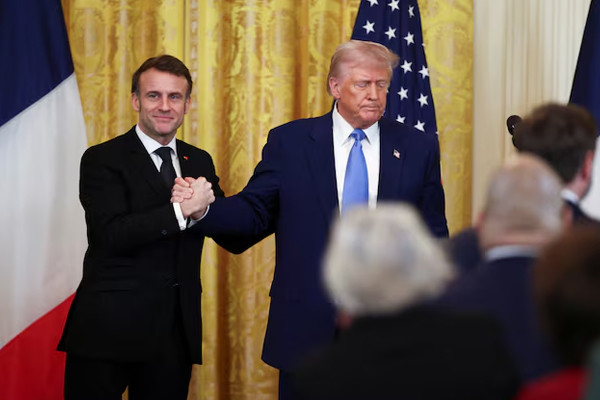
Trump Rejects Macron’s Palestinian Statehood Plan
U.S. President Donald Trump on Friday rejected French President Emmanuel Macron’s plan to recognise a Palestinian state at the United Nations General Assembly in September.
“What he says doesn’t matter,” Trump told reporters at the White House. “He’s a very good guy. I like him, but that statement doesn’t carry weight.”
Macron said on Thursday that France intends to recognise a Palestinian state in September at the United Nations General Assembly in hopes of bringing peace to the region.
“Look, he’s a different kind of a guy. He’s okay. He’s a team player, pretty much. But here’s the good news: what he says doesn’t matter. It’s not going to change anything,” Trump said.
Paris Backs Palestine
When Macron visited the Egyptian town of Al-Arish on the border with Gaza in April, he was struck by the mounting humanitarian crisis and made clear on his return home that Paris would soon opt for recognition.
Working with Saudi Arabia, Macron came up with a plan to have France, plus G7 allies Britain and Canada, recognise Palestinian statehood while pushing Arab states to adopt a softer stance towards Israel through a United Nations conference.
But despite weeks of talks, he failed to get others on board.
Three diplomats said London did not want to face the wrath of the United States, and Ottawa took a similar stance, leaving Macron to go it alone.
“It became increasingly apparent that we could not wait to get partners on board,” said a French diplomat, adding France will work to get more states on board ahead of the conference on a two-state solution in September.
Domestically, Macron was under rising pressure to do something amid widespread anger at the harrowing images coming out of Gaza.
Although with both Europe’s biggest Muslim and Jewish communities and a polarised political landscape, there was no obvious course of action that would satisfy all sides.
Israel and its staunch supporter, the United States, have blasted France’s move, branding it a reward for the Palestinian militant group Hamas, which ran Gaza and whose attack on Israel on October 7, 2023, triggered the current war.
Macron had discussed the matter extensively with both Trump and Israeli Prime Minister Benjamin Netanyahu in advance.
(With inputs from Reuters)