

Support us by contributing to StratNewsGlobal on the following UPI ID
ultramodern@hdfcbank

Strategic affairs is our game, South Asia and beyond our playground. Put together by an experienced team led by Nitin A. Gokhale. Our focus is on strategic affairs, foreign policy and international relations, with higher quality reportage, analysis and commentary with new tie-ups across the South Asian region.
You can support our endeavours. Visit us at www.stratnewsglobal.com and follow us on YouTube, Twitter, Facebook and Instagram.
र 500 per month
र 1000 per month
र 5000 per year
र 10000 per year
Donate an amount of your choice
र 500 per month
Donate र 500 per month

र 1000 per month
Donate र 1000 per month
र 5000 per year
Donate र 5,000 per year
र 10000 per year
Donate र 10,000 per year
Donate an amount of your choice
Donate an amount of your choice



Trump And Starmer Exchange Praise While Standing By Their Differences
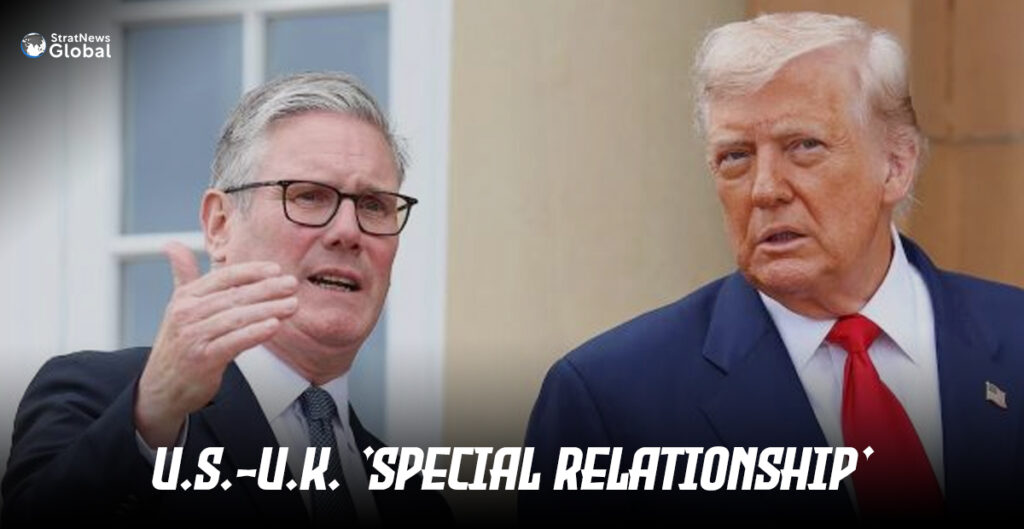
U.S. President Donald Trump on Monday highlighted the “special relationship” with Britain, offering compliments to Prime Minister Keir Starmer, King Charles, and his mother’s Scottish roots while speaking from his Turnberry golf club’s ballroom.
But mixed in with the compliments were warnings for Starmer on energy policy, immigration, and tax, as well as a pointed attack on London Mayor Sadiq Khan, Starmer’s political ally.
Seated side-by-side, Starmer and Trump fielded more than an hour of questions from media in a whirlwind tour of global affairs that included setting a new deadline for Russia to agree a ceasefire in Ukraine and announcing food centres to ease starvation in Gaza.
When it came to the Anglo-American relationship, Trump’s often outspoken – and sometimes confrontational approach – to such media appearances was replaced with a charm offensive.
“The prime minister, he’s been so supportive of us and so strong and so respected, and I respect him much more today than I did before, because I just met his wife and family. He’s got a perfect wife, and that’s never easy to achieve,” Trump said.
Starmer, who spoke for only a small fraction of the 72 minutes the two spent in the gaze of the world’s media, reciprocated the compliments freely in what was the latest chapter of a burgeoning friendship between the two leaders, who hail from opposing sides of the political spectrum.
“It’s fantastic to be here – thank you for your hospitality – and to see this amazing golf course. I’ll invite you to a football ground at some stage, and we can exchange sports,” Starmer joked.
Defending Khan
However, the British leader jumped in when Trump – who argued publicly with London mayor Khan during his first term as president – said Khan was doing a bad job running the British capital and called him a “nasty person”.
“He’s a friend of mine, I should add,” Starmer interjected, before Trump continued: “I think he’s done a terrible job.”
Starmer listened to Trump talk about cutting immigration – an area in which the British leader is seen by the public as failing. Trump said that policy was key to his 2024 U.S. election win, alongside his promises to reduce taxes and boost the economy.
Starmer’s government, only a year after winning a landslide victory, is facing a fiscal crunch caused by a stagnant economy, and many analysts expect tax increases later this year to plug the gap.
On energy, the two talked up the potential of small nuclear reactors, but set out opposing positions on other sources of power.
Trump gently urged Starmer to make more of Britain’s oil and gas resources and renewed criticism of the offshore wind turbines that dot the coast near his golf course, and which form a key part of Starmer’s plans for a carbon-free energy system.
“Wind is a disaster,” Trump said. “It’s a very expensive energy, it’s a very ugly energy and we won’t allow it in the United States.”
Starmer replied: “We believe in a mix.”
State Visit
Smoothing over their differences on policy, the two looked ahead to Trump’s next visit in September when he will be hosted by King Charles for a state visit.
“I hate to say it, but nobody does it like you people in terms of the pomp and ceremony,” Trump said. “I’m a big fan of King Charles. I’ve known him for quite a while. Great guy, great person.”
After accepting an invitation presented to him during Starmer’s visit to the White House in February, Trump will become the first world leader in modern times to undertake two state visits to Britain.
“This is going to be a historic occasion, and we’re all very much looking forward to it,” Starmer said.
In May, Washington and London announced the first bilateral trade deal made in the wake of steep new tariffs on global imports imposed by Trump.
Trump’s visit concludes on Tuesday, when he will open a new golf course near Aberdeen named after his mother, Mary Anne MacLeod, who was born and raised on a Scottish island before emigrating to the United States.
(With inputs from Reuters)
North Korea Rules Out Denuclearisation Talks With US
North Korea on Tuesday said that the United States must recognise the changed ground realities since their previous summit talks, and made it clear that no future dialogue would lead to the dismantling of its nuclear programme, according to state media KCNA.
Kim Yo Jong, the powerful sister of North Korean leader Kim Jong Un who is believed to speak for his brother, said she conceded that the personal relationship between Kim and US President Donald Trump “is not bad”.
But if Washington intended to use a personal relationship as a way to end the North’s nuclear weapons programme, the effort would only be the subject of “mockery,” Kim Yo Jong said in a statement carried by KCNA.
“If the US fails to accept the changed reality and persists in the failed past, the DPRK-US meeting will remain as a ‘hope’ of the US side,” she said. DPRK is short for North Korea’s official name, the Democratic People’s Republic of Korea.
‘Will Be Thoroughly Rejected’
North Korea’s capabilities as a nuclear weapons state and the geopolitical environment have radically changed since Kim and Trump held talks three times during the US president’s first term, she said.
“Any attempt to deny the position of the DPRK as a nuclear weapons state … will be thoroughly rejected,” she said.
‘Great Relationship’
Asked about the North Korean statement, a White House official said Trump was still committed to the goal he had for the three summit meetings he held with Kim in his first term.
“The President retains those objectives and remains open to engaging with Leader Kim to achieve a fully denuclearised North Korea,” the White House official told Reuters.
At their first meeting in Singapore in 2018, Trump and Kim signed an agreement in principle to make the Korean peninsula free of nuclear weapons. The subsequent summit in Hanoi next year broke down due to a disagreement over removing international sanctions that had been imposed against Pyongyang.
Trump has said he has a “great relationship” with Kim, and the White House has said the president is receptive to the idea of communicating with the reclusive North Korean leader.
(With inputs from Reuters)
Manhattan Skyscraper Shooting Kills 5, Including NYPD Officer
A gunman opened fire on Monday inside a high-rise building in Midtown Manhattan that houses the headquarters of the NFL and several major financial firms, including Blackstone, killing four people before taking his own life, according to New York City officials.
One of the four victims slain in the gun violence was a 36-year-old New York Police Department officer who had been on the force for about 3 and a half years. The three others killed by the suspect were civilians.
The officer has been identified as Didarul Islam.
NYPD News tweeted: “Police Officer Didarul Islam represented the very best of our department. He was protecting New Yorkers from danger when his life was tragically cut short today. We join in prayer during this time of incomprehensible pain. We will forever honor his legacy.”
May Police Officer Didarul Islam’s memory be a blessing. https://t.co/CxOFKN5Xo1
— Jessica S. Tisch (@NYPDPC) July 29, 2025
Gunman Likely Acted Alone
New York Police Commissioner Jessica Tisch said the gunman, who resided in Las Vegas and drove cross-country to New York in recent days, fatally shot himself in the chest at the end of his shooting spree.
Tisch said the gunman was believed to have acted alone, and investigators had yet to determine a possible motive for the shooting.
A photo of the suspect that CNN said was shared by police showing a gunman walking into the building carrying a rifle was published by a number of major news media outlets. Preliminary checks of the suspect’s background did not show a significant criminal history, the report added, citing officials.
The skyscraper at 345 Park Avenue houses offices of a number of financial institutions, including Blackstone and KPMG, along with the NFL headquarters.
‘Lot Of Commotion’
A large police presence converged on the area around the tower, according to Reuters journalists near the scene.
“I just saw a lot of commotion and cops and people screaming,” said Russ McGee, a 31-year-old sports bettor who was working out in a gym adjacent to the skyscraper, told Reuters in an interview near the scene.
The FBI said agents from its New York field office were also responding to provide support at the scene.
(With inputs from Reuters)
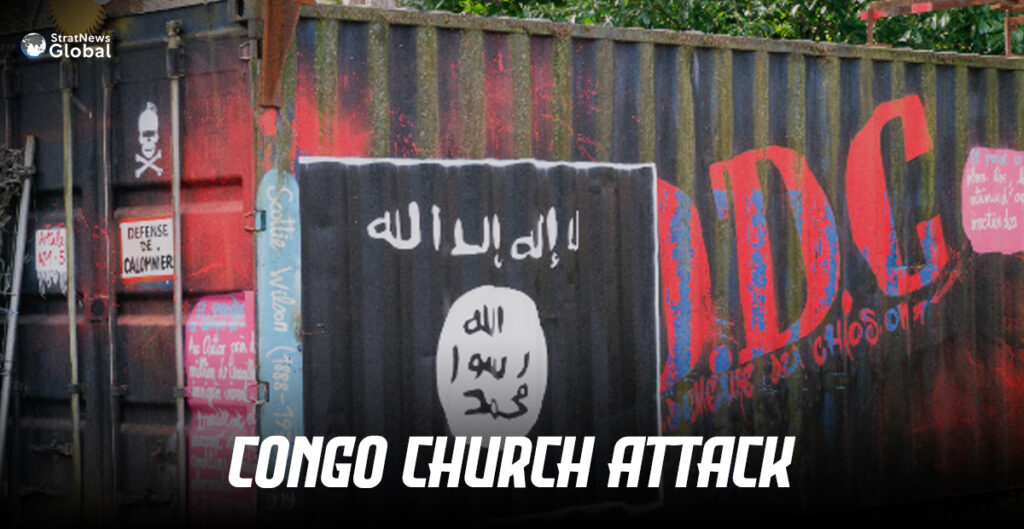
Rebels Kill 43 Christians In Congo Church Attack; IS Claims Role
The Islamic State (IS) militant group on Monday claimed responsibility for a deadly attack in eastern Congo, where at least 43 worshippers were killed during a night mass at a church, according to a statement from a United Nations mission.
At dawn on Sunday, Islamic State-allied rebels stormed the church in Komanda, a village located around 75 kilometers from Ituri’s provincial capital Bunia, killing people with guns and machetes and taking captives.
Islamic State said on its Telegram channel that rebels had killed some 45 churchgoers and burned dozens of homes and shops in the region.
Christians Targeted
Jean Kato, an official in the city administration, said worshippers were taking part in a night mass when the rebels stormed the church in the early hours of Sunday morning.
Christophe Munyanderu, a human rights activist present at the scene in Komanda, said shots were heard overnight but people at first thought it was thieves.
“The rebels mainly attacked Christians who were spending the night in the Catholic church,” said Munyanderu.
“Unfortunately, these people were killed with machetes or bullets.”
Pope Leo Condoles Deaths
The United Nations Organisation Stabilisation Mission in the DR Congo has condemned a recent resurgence in violence in the province where this attack happened.
The UN mission known as MONUSCO said at least 43 people had been killed, including 19 women and nine children, while condemning the attack carried out by the Islamic State-affiliated Allied Democratic Forces (ADF).
The ADF originates in neighbouring Uganda, but is now based in mineral-rich eastern Congo. It mounts frequent attacks, further destabilising a region where many militant groups compete for influence and resources.
Pope Leo on Monday sent a message of condolences to the bereaved families and the Christian community who lost their relatives and friends in the assault, saying he would pray for them.
(With inputs from Reuters)
Beijing Floods Kill 30, Force Over 80,000 To Relocate
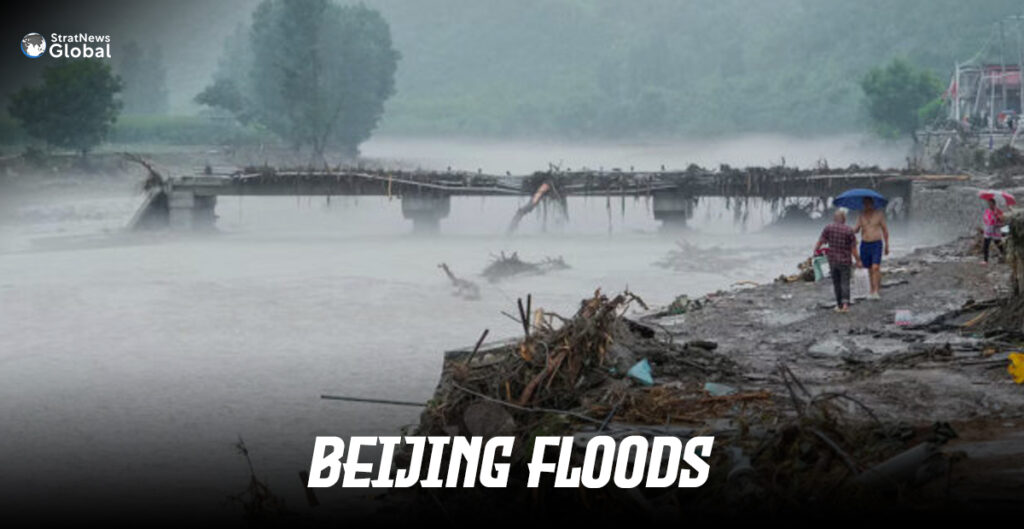
As nearly a year’s worth of rain battered Beijing in just a few days, thirty people were reported dead by midnight on Monday, according to China’s official news agency Xinhua.
The deaths were reported in Beijing’s mountainous northern districts, with 28 in Miyun and two in Yanqing. State media did not specify when or how the deaths occurred.
Heavy rain started last Wednesday and intensified around Beijing and surrounding provinces on Monday, with the capital getting rainfall of up to 543.4 mm (21.4 inches) in its northern districts, Xinhua said. The average annual rainfall in Beijing is around 600 mm.
Thousands Relocated
Authorities relocated more than 80,000 residents of Beijing as the rain hit, Xinhua reported. Roads and communication infrastructure were damaged, and power to 136 villages were cut off as of midnight Monday.
The most intense rain occurred on Saturday in Beijing’s hilly Huairou, which saw 95.3 mm of rain in one hour.
‘All-Out’ Search And Rescue Efforts
Late on Monday, Chinese President Xi Jinping said there had been “heavy casualties and property losses” in Beijing and the provinces of Hebei, Jilin and Shandong, and ordered “all-out” search and rescue efforts.
Premier Li Qiang also said heavy rain and flooding in Beijing’s Miyun district had caused “significant casualties”, according to Xinhua.
Highest-Level Alert Issued
Beijing issued its highest-level rain and flood alerts on Monday, advising residents to not leave their homes.
More than 730 million cubic meters of water has flown into the Miyun reservoir – the largest in China’s north – as of Tuesday morning, and 120 million cubic meters has been discharged since Sunday afternoon.
Beijing has urged residents to keep clear of downstream rivers whose water levels are expected to remain high.
China’s National Development and Reform Commission said on Tuesday that it was urgently arranging 200 million yuan ($27.9 million) to support Beijing in its flood relief efforts.
The funds will mainly be used to repair damaged transportation, water, medical and other infrastructure and public service facilities in Miyun and Huairou, the NDRC said.
China’s finance ministry also allocated 350 million yuan on Tuesday to aid disaster relief efforts in Beijing and other provinces.
($1 = 7.1778 yuan)
(With inputs from Reuters)
Strategic Contradictions Undercut IMEC’s Promise: Report
The India-Middle East-Europe Economic Corridor (IMEC), announced with much fanfare at the G20 Summit in New Delhi in September 2023, promised a bold new model of transcontinental connectivity.
Less than two years on, that promise remains largely unfulfilled.
A recent conference organised by the Chintan Research Foundation, featuring diplomats, academics, and industry leaders, underscored just how far IMEC is from moving beyond its PowerPoint phase.
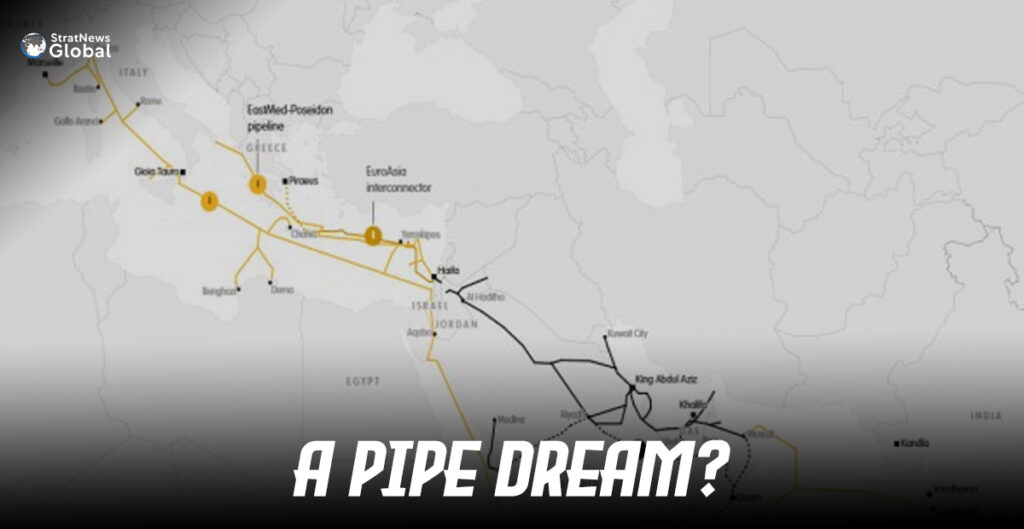
At its core, IMEC is envisioned as a multi-modal infrastructure network—combining sea routes, overland rail, undersea digital cables, energy pipelines, and renewable electricity transmission grids—linking India to Europe via the Arabian Peninsula.
Yet as detailed in the conference proceedings, nearly every element of the plan remains mired in delay, uncertainty, and geopolitical contradiction.
The Gaza conflict, which erupted just weeks after the project’s launch, has become a major stumbling block. Speakers repeatedly flagged the war as a stark reminder of the fragility of West Asian geopolitics. The report bluntly states that progress on IMEC remains “susceptible to geopolitical turbulence,” and that the corridor’s advancement is vulnerable to “episodic disruptions” until there is some resolution to the Israeli-Palestinian conflict.
In fact, a foundational meeting of IMEC partner countries—mandated within 60 days of the G20 MoU—has yet to take place. No feasibility studies have been released, no funding mechanisms defined, and no timelines agreed upon. Meanwhile, regional power shifts, unresolved rivalries, and diplomatic mistrust continue to undermine the coherence of the project.
The project’s North Corridor—traversing the UAE, Saudi Arabia, Jordan and Israel—faces particular scrutiny. The absence of formal customs and security agreements, particularly between Saudi Arabia and Israel, has left the corridor exposed to political stalemates. Even basic operational questions—who will control border security, what regulatory frameworks will apply, how cargo will be cleared—remain unanswered.
Even more awkward is the role of China. The Port of Haifa, a critical trans-shipment node in the IMEC plan, is currently operated by the Shanghai International Port Group—a Chinese firm. As one speaker noted, this creates a “strategic contradiction” at the heart of a Western-backed initiative meant to serve as a democratic, values-based alternative to China’s Belt and Road Initiative (BRI). The contradiction is especially pointed given India’s and the West’s growing unease with China’s expanding footprint in global infrastructure.
This tension is not theoretical. The Chintan report highlights the need for Israel to “take the lead” in resolving the Haifa port issue, acknowledging that Chinese control of a key node could compromise the strategic independence of the corridor.
On the logistics front, IMEC faces steep structural barriers. While it may shave roughly three days off the Mumbai-to-Europe shipping route compared to the Suez Canal, this minor time advantage is undercut by the complexity of trans-shipment across politically sensitive and poorly integrated regions.
A standard shipping route from Mumbai to Piraeus via Suez covers 7,637 km in about 12 days. IMEC’s proposed route shortens this to about 6,600 km, but adds layers of regulatory and logistical friction.
Critically, the report notes that rail freight costs 2.5 times more than ocean freight, and each trans-shipment adds cost and risk. The corridor’s hybrid model—60% sea, 40% overland—introduces operational inefficiencies that make its advertised cost and time benefits highly questionable. Without regulatory harmonisation and massive capacity upgrades, the corridor may end up slower and more expensive.
One glaring example: a single large container ship carries 20,000 TEUs, while a train can carry just 260. To match that, over 75 trains would be required. Current capacity on the UAE’s Etihad Rail network is just 1.1 million TEUs annually—IMEC would require a 35-fold increase.
Where IMEC does offer a distinctive edge is its integration of renewable energy and digital infrastructure. The inclusion of green hydrogen pipelines, high-speed data cables, and undersea electricity transmission links sets it apart from traditional connectivity models. India has committed $2.5 billion toward building a green hydrogen ecosystem, and companies like Adani and ReNew are positioned to play key roles.
The corridor aligns with India’s One Sun, One World, One Grid (OSOWOG) initiative, enabling real-time cross-border solar energy sharing. The planned 700-km undersea High-Voltage Direct Current (HVDC) link is technically feasible and could unlock energy trade between India and the Gulf. But again, the regulatory frameworks and multilateral coordination needed for such innovation remain absent.
Perhaps the most fundamental challenge is funding. While the report recommends creating an IMEC Funding Secretariat and engaging sovereign wealth funds and multilateral development banks, no such mechanisms currently exist. Private sector involvement is acknowledged as essential, but without clarity on risk-sharing or returns, investor appetite remains muted.
A proposed division of responsibilities—where each country develops its domestic ports and logistics infrastructure, while high-cost elements like undersea links are jointly financed—remains theoretical.
As the Chintan report makes clear, IMEC is not without merit. It reflects India’s rising global profile, its deepening ties with West Asia, and its ambition to be a hub for sustainable infrastructure.
But vision alone cannot move cargo—or geopolitics. Until there is hard commitment from partner countries, funding clarity, and institutional backing, IMEC remains more symbol than substance.
India Wants A US Trade Deal, But Not At Any Cost
As the United States steps up efforts to secure a trade agreement with India ahead of its self-imposed August 1 deadline, New Delhi is proceeding with caution, determined not to compromise national interests despite growing pressure.
Experts have warned that India must resist any unbalanced or excessive demands from Washington, especially in light of complications surrounding America’s recent trade deals with other nations.
Commerce and Industry Minister Piyush Goyal over the weekend confirmed that discussions with both the U.S. and Oman have progressed significantly. A high-level American delegation is expected next month to continue negotiations.
“India’s approach is guided by prudence and principle,” said Ajay Srivastava of the Global Trade Research Initiative (GTRI). “While a deal with the U.S.—India’s largest trading partner—would carry major economic and strategic weight, it’s critical that New Delhi does not yield to one-sided terms.”
Learning From Others
India’s measured stance stems in part from the fallout of recent U.S. trade arrangements. The U.S.-Japan agreement, for instance, has drawn criticism for its ambiguity and perceived imbalance. American officials claimed Japan had pledged $550 billion in investments, with 90% of returns flowing to U.S. taxpayers. However, Tokyo later clarified there was no binding agreement, and profit-sharing would be proportional to financial contributions—a clear disconnect in expectations.
Similarly, trade agreements with Indonesia and Vietnam, announced unilaterally by President Donald Trump, remain under negotiation or lack full ratification. In Vietnam’s case, uncertainty over high tariff impositions threatens to reduce exports to the U.S. by up to 33%, according to Bloomberg, with potential losses of $37 billion in revenue across key sectors such as electronics, garments, and machinery.
No Concessions Under Pressure
Despite the Trump administration’s August 1 cut-off for new deals before tariffs escalate, India has notably not been issued a tariff warning, unlike several other nations.
According to GTRI, a potential U.S.-India deal could mirror the template used with Japan, the EU, and others—introducing 10% to 20% tariffs on Indian exports in exchange for Indian tariff reductions, investment commitments, and greater regulatory access for American firms.
However, experts are urging India to scrutinize each clause, especially provisions related to market access for U.S. agricultural and tech products, and investment protections that could challenge India’s policy autonomy.
U.S.–EU Template
The most recent U.S.–EU trade pact finalized in Scotland on July 27 serves as a cautionary example. While it avoided an outright trade war, it came at the cost of sweeping concessions from Brussels.
The U.S. agreed to reduce a proposed 30% blanket tariff to 15% on most EU goods, while retaining high duties on steel and aluminium. In return, the EU committed to eliminating tariffs on many American exports and pledged massive investments and purchases—including $750 billion in U.S. energy and $600 billion in infrastructure.
Critics in Europe have questioned whether the deal undermines EU industries, especially given the deep cuts in regulatory protections and standards for U.S. products.
“The risk for India is entering into a similarly imbalanced framework that demands disproportionate sacrifices in return for uncertain benefits,” warned a Delhi-based trade analyst.
While both India and the U.S. see value in deepening economic ties, the current environment calls for restraint and strategic clarity. A deal remains possible, but Indian negotiators are expected to maintain a firm stance in safeguarding long-term interests.
“The next few weeks will be critical,” said Srivastava. “India must secure a deal that is equitable, enforceable, and respectful of its economic realities.”
Russia At The Doors: Inside Ukraine’s Gruelling Defence Of A Strategic City
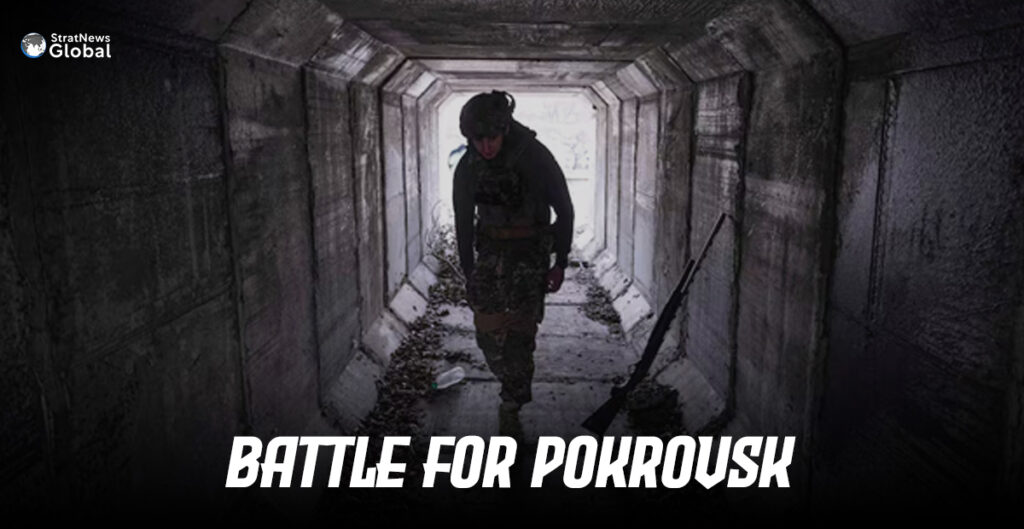
After months of holding off a larger Russian force around Pokrovsk with bomb-laden drones, Ukraine now faces advancing Russian troops who, amid a summer offensive exploiting defensive gaps, entered the city for the first time last week, according to geolocated footage from Ukrainian and Russian Telegram channels verified by Reuters.
Ukrainian soldiers’ success in stopping their enemy from taking Pokrovsk since last year has long thwarted one of Moscow’s central military goals, although the city itself is heavily damaged and all but a few hundred of the 60,000-strong population have fled.
Pokrovsk sits atop large coking coal reserves and, until Russian forces moved closer, was important to Ukraine’s military supply lines in the country’s east.
Reuters spoke to more than a dozen sources, including Ukrainian soldiers and relatives of Russian soldiers missing in action around the city, and made two trips to the area over four months to examine the shifting tactics in the key theatre of the eastern front.
The Pokrovsk front is the most active in the war, with 111,000 Russian soldiers amassed there for the summer offensive, Ukrainian top military commander Oleksandr Syrskyi has said.
Russia’s Prime Target
Russia’s forces initially aimed to seize Pokrovsk early last year, first with frontal assaults and later trying to encircle the city, which Russia calls by the Soviet-era name Krasnoarmeysk, or Red Army town.
Ukraine slowed the advance this spring by deploying experienced units, laying minefields and other defensive barriers, while harassing Russian forces with large numbers of drones, said Viktor Trehubov, spokesperson for the military administration that covers Pokrovsk.
“They didn’t stop trying to advance, but we were repelling them well,” said an artillery unit soldier who goes by call sign Vogak and serves on the Pokrovsk front.
Since then, Moscow’s forces have picked up the pace, adapting and expanding the use of drones in their own arsenal.
Russia has built on the lessons used in pushing Ukrainian forces out of its Kursk region, where it first scaled the use of fibre-optic cable drones that cannot be stopped by the electronic jammers both sides used to confuse regular radio-controlled drones, analyst Michael Kofman said.
The spools of hair-like cable give them enough range that Russia can threaten Ukraine’s forces and logistics 25 kilometres behind the front line. Russia has more of the fibre-optic drones than Ukraine, giving them an advantage, said Roman Pohorilyi, the founder of the Ukrainian open-source research group DeepState.
The advances accelerated after Russia took control of a highway in May that connects Pokrovsk to Kostiantynivka, another of Ukraine’s ‘fortress cities’ in the east, a map generated by DeepState shows.
One of the main roads to the city is covered by nets to protect vehicles from Russian drone strikes. Serhii Dobriak, the head of the local military administration, last week said it was increasingly hard to deliver food to the city and that grocery stores would have to close in the coming days.
While faster than before, Russia’s territorial gains remain minor, with only 5,000 square kilometres (1,930 square miles) of Ukraine taken since the start of last year, less than 1% of the country’s overall territory, according to a June report from the Centre for Strategic and International Studies, a Washington-based think tank.
In total, Russia has occupied around a fifth of Ukraine.
Ukrainian President Volodymyr Zelenskyy said the entry of small groups of Russian troops into Pokrovsk was insignificant and that they were “all destroyed” by Ukraine’s soldiers.
Russia’s Defence Ministry did not respond to detailed requests for comment for this story.
At What Cost?
Serhii Filimonov, commander of a Ukrainian military battalion called “Da Vinci Wolves,” which operates around Pokrovsk, saw firsthand how Russia’s glacial advance on the city over the past year cost it heavily in killed and injured soldiers in the first half of 2025.
Russian soldiers tried to advance by stealth but were hounded by Ukrainian soldiers flying small quadcopter drones mounted with cameras and explosives, he said.
“Every prisoner says drones are the thing they are most afraid of, the thing that constantly kills them, and the things they see when they sleep, the nightmares they have,” Filimonov told Reuters in an interview in April, citing debriefs of Russian soldiers captured by his men.
Filimonov said groups of attackers were given a phone with a location pinned on a map, and told to head towards it. If the first group was killed, another one was sent to replace them, he said, citing the debriefs. Reuters was unable to independently verify his account.
The Russians operated in raiding parties of around a half a dozen, often advancing on foot because large vehicles are an easy target for drone pilots, Filimonov and Trehubov said.
Some left their vehicles as far as nine miles (15 km) from the front line and walked the rest of the way to be less visible to drone operators, Filimonov said. Others have taken to motorbikes to outpace the aircraft, piloted by Ukrainian soldiers often wearing virtual reality-style goggles attached to a drone’s camera, offering a first-person view of the route and target, Trehubov said.
The Ukrainian resistance in and around Pokrovsk has blocked Russia’s ambition of taking the remaining parts of Ukraine’s Donetsk region, one of President Vladimir Putin’s principal war aims.
Although its significance to Ukraine as a military supply centre has already faded, Kyiv-based military analyst Serhii Kuzan said Pokrovsk’s fall could free up Russian troops and open the door to more Russian advances in the region.
More than a million Russian soldiers have been killed or wounded since the invasion of Ukraine in February 2022, almost a quarter of those since the start of this year, according to British military intelligence estimates.
Reuters could not verify these numbers.
Neither Ukraine nor Russia gives official data on their own personnel losses.
($1 = 79.4000 roubles)
(With inputs from Reuters)
Germany To Launch Gaza Aid Airlift, Mulls Pressure On Israel
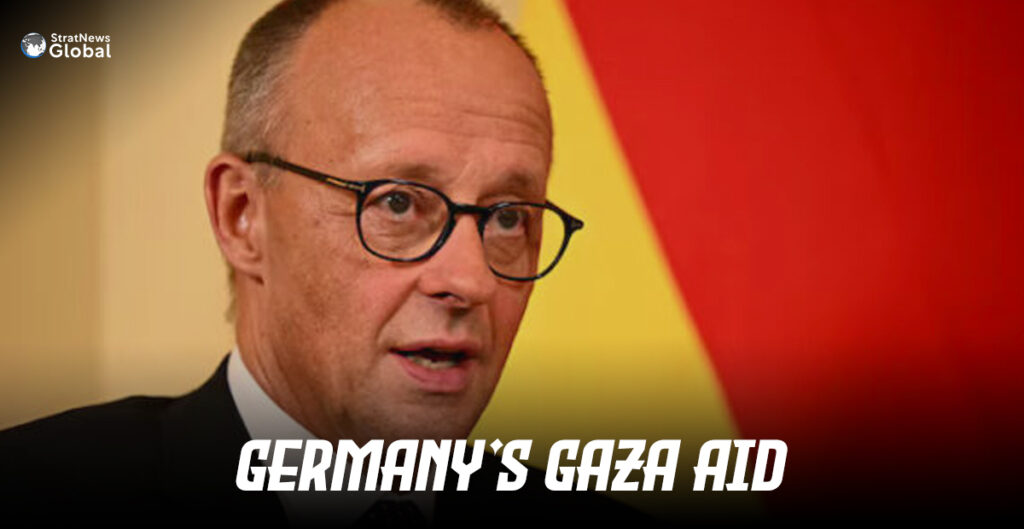
Germany is set to launch an immediate airlift to deliver humanitarian aid to Gaza, as Chancellor Friedrich Merz on Monday said Berlin is also considering increasing pressure on Israel over the “catastrophic” situation in the region.
As the death toll from almost two years of war in Gaza nears 60,000, a growing number of people are dying from starvation and malnutrition, Gaza health authorities say, with images of starving children shocking the world and fuelling international criticism of Israel over sharply worsening conditions.
Staunch Ally
Germany, together with the United States, has long remained one of Israel’s staunchest allies and largest arms suppliers. US President Donald Trump said on Monday many people were starving in the enclave, contradicting Israeli Prime Minister Benjamin Netanyahu who denied there was starvation there.
The German security cabinet convened for more than two hours on Monday to discuss the situation, Merz told a news conference in Berlin. While it welcomed Israel’s announcement of a halt in military operations for 10 hours a day in parts of Gaza as an “important first step”, it agreed more must follow.
Asked if the council discussed sanctions like suspending the EU pact governing relations with Israel, a move Germany has in the past rejected, Merz said the council had discussed what options were available.
“We are keeping such steps on the table,” he said.
Before making any decisions, however, he would try to speak with Netanyahu later on Monday and Foreign Minister Johann Wadephul would travel to the region on Thursday, possibly together with his British and French counterparts. The German government would then reassess the situation over the weekend.
In the meantime, Berlin would do what it could to help alleviate the humanitarian situation, launching an airlift in cooperation with Jordan to deliver aid into Gaza.
“Defence Minister Boris Pistorius will closely coordinate with France and the UK, who are also willing to provide such an airlift for food and medical supplies,” he said.
“We know that this can only provide very limited help for the people in Gaza, but it is nonetheless a contribution we are eager to make.”
Germany would also prepare for a Gaza reconstruction conference in coordination with regional partners, Britain and France, he said. “No further expulsions from the Gaza Strip must occur.”
Staatsraison
German officials say their approach to Israel is governed by a special responsibility, known as the Staatsraison, arising from the legacy of the Nazi Holocaust.
They have long believed they can achieve more through diplomatic back channels than public statements.
But Merz has come under growing pressure in recent weeks, including from within his own coalition, to take a firmer stance on Israel, and faced broad criticism for failing to join a statement last week by dozens of Western nations condemning the “inhumane killing” of Palestinians.
(With inputs from Reuters)
Trump Says Gaza Faces Acute Starvation, Promises To Establish Food Centres
U.S. President Donald Trump stated on Monday that many in Gaza are facing starvation and hinted that Israel should increase humanitarian access, as Palestinians awaited aid following an Israeli military announcement on efforts to boost supply deliveries.
As the death toll from two years of war in Gaza nears 60,000, a growing number of people are dying from starvation and malnutrition, Gaza health authorities say, with images of starving children shocking the world and fuelling international criticism of Israel over sharply worsening conditions.
Describing starvation in Gaza as real, Trump’s assessment put him at odds with Israeli Prime Minister Benjamin Netanyahu, who said on Monday “there is no starvation in Gaza” and vowed to fight on against the Palestinian terrorist group Hamas.
Food Centres
Trump, speaking during a visit to Scotland, said Israel has a lot of responsibility for aid flows, and that a lot of people could be saved. “You have a lot of starving people,” he said.
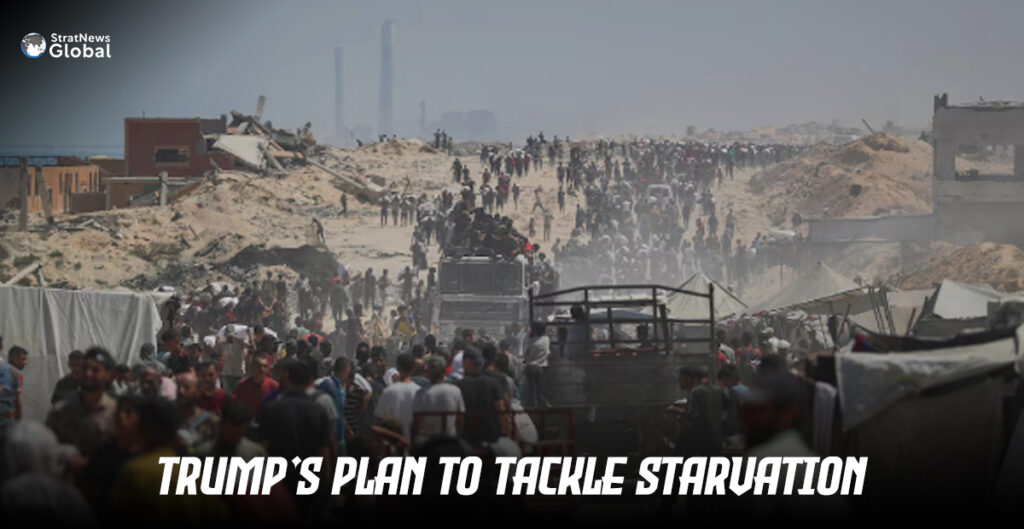
“We’re going to set up food centres,” with no fences or boundaries to ease access, Trump said. The U.S. would work with other countries to provide more humanitarian assistance to the people of Gaza, including food and sanitation, he said.
On Monday, the Gaza health ministry said at least 14 people had died in the past 24 hours of starvation and malnutrition, bringing the war’s death toll from hunger to 147, including 88 children, most in just the last few weeks.
Israel announced several measures over the weekend, including daily humanitarian pauses in three areas of Gaza, new safe corridors for aid convoys, and airdrops. The decision followed the collapse of ceasefire talks on Friday.
Long-Term Aid Supply Needed
U.N. agencies said a long-term, steady supply of aid was needed. The World Food Programme said 60 trucks of aid had been dispatched – short of target. Almost 470,000 people in Gaza are enduring famine-like conditions, with 90,000 women and children in need of specialist nutrition treatments, it said.
“Our target at the moment, every day, is to get 100 trucks into Gaza,” WFP Regional Director for the Middle East, North Africa, and Eastern Europe, Samer AbdelJaber, said.
Jan Egeland, head of the Norwegian Refugee Council, said the situation is catastrophic.
“At this time, children are dying every single day from starvation, from preventable disease. So time has run out,” he said. “The catastrophe is here,” he said. “Children are dying from starvation, and it’s manmade by Israel from A to Z.”
Netanyahu denied any policy of starvation towards Gaza, saying aid supplies would be kept up whether Israel was negotiating a ceasefire or fighting, he said.
Hamas ‘Shall Be There No More’
“We will continue to fight till we achieve the release of our hostages and the destruction of Hamas’ military and governing capabilities. They shall be there no more,” Netanyahu said.
Trump said Hamas had become difficult to deal with in recent days, but he was talking with Netanyahu about “various plans” to free hostages still held in the enclave.
The war began on October 7, 2023, when Hamas terrorists attacked communities in southern Israel, killing some 1,200 people and taking another 251 hostage, according to Israeli tallies.
The Gaza health ministry said that 98 Palestinians have been killed by Israeli fire in the past 24 hours.
In Gaza, Palestinians described the challenge of securing aid for their families living in tent encampments, a chaotic and often dangerous process.
Chaos In Aid Distribution
“Currently, aid comes for the strong who can race ahead, who can push others and grab a box or a sack of flour. That chaos must be stopped and protection for those trucks must be allowed,” said Emad, 58, who used to own a factory in Gaza City.
While some manage to get aid, others are deprived, said Wessal Nabil, from Beit Lahiya.
She said her husband was unable to bring aid because of an injured leg. She had tried herself several times but without success. “So who will feed us? Who will give us to drink?” she said.
The WFP said it has 170,000 metric tons of food in the region, outside Gaza, which would be enough to feed the whole population for the next three months if it gets the clearance to bring it into the enclave.
COGAT, the Israeli military aid coordination agency, said that over 120 trucks were distributed in Gaza on Sunday by the U.N. and international organisations.
Some of the trucks that made it into Gaza were seized by desperate Palestinians, and some by armed looters, witnesses said.
More aid was expected on Monday. Qatar said it had sent 49 trucks that arrived in Egypt en route to Gaza. Jordan and the United Arab Emirates airdropped supplies.
Israel cut off aid to Gaza from the start of March in what it said was a means to pressure Hamas into giving up dozens of hostages it still holds, and reopened aid with new restrictions in May. Hamas accuses Israel of using hunger as a weapon.
Israel says it abides by international law but must prevent aid from being diverted by terrorists, and blames Hamas for the suffering of Gaza’s people.
(With inputs from Reuters)