

Support us by contributing to StratNewsGlobal on the following UPI ID
ultramodern@hdfcbank

Strategic affairs is our game, South Asia and beyond our playground. Put together by an experienced team led by Nitin A. Gokhale. Our focus is on strategic affairs, foreign policy and international relations, with higher quality reportage, analysis and commentary with new tie-ups across the South Asian region.
You can support our endeavours. Visit us at www.stratnewsglobal.com and follow us on YouTube, Twitter, Facebook and Instagram.
र 500 per month
र 1000 per month
र 5000 per year
र 10000 per year
Donate an amount of your choice
र 500 per month
Donate र 500 per month

र 1000 per month
Donate र 1000 per month
र 5000 per year
Donate र 5,000 per year
र 10000 per year
Donate र 10,000 per year
Donate an amount of your choice
Donate an amount of your choice



New York Shooter Left Note Accusing NFL For Brain Injury, Says Mayor
The gunman who fatally shot four people during a rampage in a Midtown Manhattan office tower was found with a note blaming the National Football League for his degenerative brain condition, according to New York Mayor Eric Adams.
Police have identified the shooter as Shane Tamura, a 27-year-old Las Vegas resident with a history of mental illness struggles, who ended the Monday evening massacre by shooting himself in the chest on the 33rd floor of a Park Avenue office tower.
The NFL has its headquarters in the skyscraper, but Tamura apparently entered the wrong elevator bank and ended up in the offices of Rudin Management, a real estate company, where he shot employees, the mayor said.
“The note alluded to that he felt he had CTE, a known brain injury for those who participate in contact sports,” Adams told CBS News. “He appeared to have blamed the NFL for his injury.”
Chronic traumatic encephalopathy is a serious brain disease with no known treatment that can be caused by repeated bangs to the head from contact sports. It has been linked to aggression and dementia, and the NFL has paid an estimated $1 billion to settle concussion-related lawsuits with thousands of retired players after the deaths of several high-profile players.
Career Cut Short
Tamura was never an NFL player, but online records show he played in high school. The note found in his wallet said his football career was cut short by his brain injury, Bloomberg News reported.
Blackstone also has its headquarters in the tower, and one of the private equity firm’s executives was among those Tamura killed, while others were injured and taken to hospital.
Tamura also killed a New York Police Department officer, Didarul Islam, 36, who came from Bangladesh and had been on the force three years, the mayor said.
An NFL employee was also injured in the shooting and was in stable condition at a hospital, the Journal reported, citing a memo sent by NFL commissioner Roger Goodell to league staff.
Goodell wrote there would be “increased security presence” at the league’s offices “in the days and weeks to come,” ESPN reported.
Authorities offered few details about the three other victims besides the police officer – two men and a woman. A third man was gravely wounded by the gunfire and was “fighting for his life” in a nearby hospital, the mayor said.
History Of Mental Illness
Tamura appeared to have driven to New York City from Las Vegas over three days and to have acted alone, New York Police Commissioner Jessica Tisch told reporters on Monday night.
He entered the skyscraper’s lobby, turned to his right and immediately shot the NYPD officer, who was assigned to the building’s security detail, Tisch said. She said Tamura used an M4 Carbine, a semi-automatic rifle popular with civilian U.S. gun enthusiasts modeled on a fully automatic rifle used in the U.S. military.
He then shot a woman and two men in the lobby but inexplicably allowed another woman to pass him unharmed before he took the elevator to the 33rd-floor offices of Rudin Management. There he fatally shot his final victim before taking his own life, Tisch said.
A widely circulated photo showed the permit issued to Tamura by the Las Vegas Metropolitan Police Department allowing him to legally carry a concealed firearm.
A loaded revolver was later recovered from the black BMW vehicle Tamura had left double-parked outside the office tower, along with a backpack and prescription medications, Tisch said.
(With inputs from Reuters)
Trump To Decide On Trade Deals By Aug 1 As Talks With EU, China Continue, Says Commerce Chief
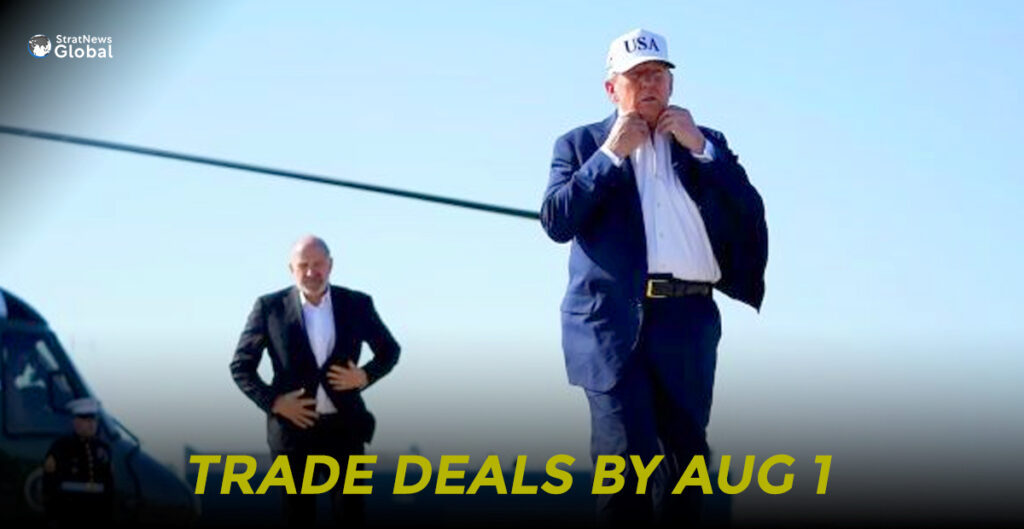
U.S. President Donald Trump will finalize his trade decisions this week, while parallel negotiations with China and the European Union are still underway, Commerce Secretary Howard Lutnick said on Tuesday, referring to Trump’s August 1 deadline.
U.S. and EU officials were still discussing steel and aluminum tariffs as well as digital services regulations following their framework announced on Sunday, Lutnick told CNBC in an interview, adding that talks with China were also “their own thing”.
“But for the rest of the world, we’re going to have things done by Friday,” he said in the interview.
Asked about remaining uncertainties surrounding the U.S.-EU agreement, Lutnick said Trump was working “to get things done now.”
He said pharmaceuticals were a key part of the EU deal so that medicines made in European countries—home to several major drugmakers—would see their products included in the 15% tariff.
“It was important for them to have pharmaceuticals be part of the deal at 15% because President Trump is going to come out in the next two weeks with his pharmaceutical policy, and it is going to be higher,” he said.
U.S. – China Negotiations
Meanwhile, U.S. and Chinese officials began a second day of talks in Stockholm on Tuesday to resolve longstanding economic disputes and step back from an escalating trade war between the world’s two biggest economies.
The meetings may not yield immediate large breakthroughs but the two sides could agree to another 90-day extension of a tariff truce struck in mid-May. It may also pave the way for a potential meeting between Trump and Chinese President Xi Jinping later in the year, though Trump on Tuesday denied going out of his way to seek one.
China is facing an August 12 deadline to reach a durable trade agreement with Trump’s administration, after reaching preliminary deals in May and June to end weeks of escalating tit-for-tat tariffs and a cut-off of rare earth minerals.
(With inputs from Reuters)
Gaza Crisis Could Be Declared Famine, Global Hunger Monitor Warns
A worst-case famine scenario is rapidly developing in Gaza, a global hunger monitor warned on Tuesday, urging immediate action to halt the conflict and ensure unrestricted humanitarian access, warning that inaction could lead to mass casualties.
Its alert coincided with a statement from Gaza health authorities saying Israel‘s military campaign had now killed more than 60,000 Palestinians.
The Integrated Food Security Phase Classification (IPC) raised the prospect that the manmade starvation crisis could be formally classified as a famine, in the hope that this might raise the pressure on Israel to let far more food deliveries in.
“Mounting evidence shows that widespread starvation, malnutrition, and disease are driving a rise in hunger-related deaths,” the IPC said.
It added that it would quickly carry out the formal analysis that could allow it to classify Gaza as “in famine”.
But it is unclear whether any such announcement would help to remove the main obstacle to food reaching Gaza’s 2.1 million people: Israel’s refusal to allow more than a trickle of trucks in.
Inadequate Food Access
“We’re getting about approximately 50% of what we’re requesting into Gaza since these humanitarian pauses started on Sunday,” Ross Smith of the World Food Programme told reporters in Geneva by video.
The WFP says almost 470,000 people are enduring famine-like conditions, with 90,000 women and children in need of specialist nutrition. Gaza’s health ministry says at least 147 people have died of hunger, including 88 children, most in the last few weeks.
Images of emaciated children have shocked the world and fuelled international criticism of Israel, prompting it at the weekend to announce daily humanitarian pauses to fighting in three areas of Gaza and new safe corridors for aid convoys.
Yet the supply remains far short of what aid agencies say is the bare minimum required.
The IPC alert said this meant 62,000 metric tons of staple food a month, but that, according to the Israeli aid coordination agency COGAT, only 19,900 tons entered in May and 37,800 in June.
Smith said the WFP lacked the stocks or permissions to reopen the bakeries and community kitchens that had been a lifeline before a total Israeli blockade began in May.
Israeli Foreign Minister Gideon Saar said on Tuesday that the situation in Gaza was “tough” but that there were lies about starvation. He said 5,000 aid trucks had entered Gaza in the last two months, and that Israel would assist those wanting to conduct airdrops – a delivery method that aid groups say is ineffective and tokenistic.
Israel has consistently said its actions are justified as self-defence. It says the Palestinian militant group Hamas, which ruled Gaza, is to blame for refusing to release hostages and surrender, and for operating in civilian areas, which Hamas denies.
Catastrophic Suffering
The IPC alert said that “immediate action must be taken to end the hostilities and allow unimpeded, large-scale, life-saving humanitarian response.
“This is the only path to stopping further deaths and catastrophic human suffering.”
The IPC partners with governments, international aid groups and U.N. agencies and assesses the extent of hunger suffered by a population.
Its famine classification requires at least 20% of people to be suffering extreme food shortages, with one in three children acutely malnourished and two people out of every 10,000 dying every day from starvation or malnutrition and disease.
The IPC’s latest data indicated that formal famine thresholds have already been reached for food consumption in most of Gaza, and for acute malnutrition in Gaza City.
But David Miliband, head of the International Rescue Committee aid group, said that “formal famine declarations always lag reality”.
“By the time that famine was declared in Somalia in 2011, 250,000 people – half of them children under 5 – had already died of hunger,” he said in a statement. “By the time famine is declared, it will already be too late.”
War has raged in Gaza between Israel and Hamas militants for 22 months.
After an 11-week Israeli blockade, limited U.N.-led aid operations resumed on May 19 and a week later, the obscure new U.S.-based Gaza Humanitarian Foundation – backed by Israel and the United States – began distributing food aid.
GHF’s Aid Model Criticised
The rival aid efforts have sparked a war of words – pitting Israel, the U.S. and the GHF against the U.N., international aid groups and dozens of governments from around the world.
Israel and the U.S. accuse Hamas of stealing aid – which the militants deny – and the U.N. of failing to prevent it. The U.N. says it has not seen evidence of Hamas diverting much aid.
The IPC said 88% of Gaza was now under evacuation orders or within militarised areas, and was critical of GHF efforts.
It said most of the GHF food items “require water and fuel to cook, which are largely unavailable”.
The IPC’s Famine Review Committee said: “Our analysis of the food packages supplied by the GHF shows that their distribution plan would lead to mass starvation.”
The GHF was not immediately available for comment. It has previously said it has so far distributed more than 96 million meals.
Jolien Veldwijk, CARE Palestine Country Director, said that Palestinians were suffering a “manmade famine, caused by Israel’s siege and the deliberate obstruction of aid, fuelled by the inaction of world leaders”.
“The haunting images of emaciated children are evidence of a failure of humanity to act.”
The war in Gaza began on October 7, 2023, when Hamas killed 1,200 people in southern Israel and took some 250 hostages, according to Israeli tallies.
(With inputs from Reuters)
NYC Police Probe Motive Behind Deadly Manhattan Office Tower Shooting
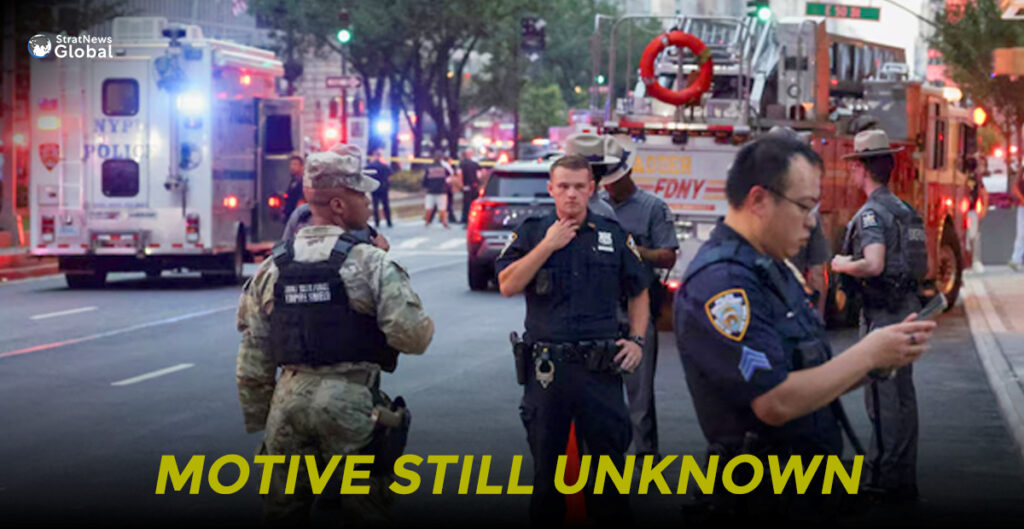
New York City homicide detectives on Tuesday searched for answers into what drove a man from Las Vegas to travel cross-country and unleash gunfire with a military-style rifle inside a Midtown Manhattan office tower, killing four people, including a police officer.
Gunman Shane Tamura, 27, brought the carnage to an end not long after it began on Monday evening by fatally shooting himself in the chest on the 33rd floor of the Park Avenue skyscraper, which houses the NFL headquarters and offices of several major financial companies.
Motive Remains A Mystery
New York Police Commissioner Jessica Tisch told reporters Monday night that the gunman appeared to have acted alone, though his motives remained a mystery.
Tisch said Tamura had a documented history of mental illness and appeared to have driven to New York from Las Vegas over a period of three days.
Tamura carried out his rampage, according to Tisch, armed with an M4 carbine, an assault-style rifle used extensively in the U.S. military.
A loaded revolver was later recovered from the black BMW vehicle Tamura had left double-parked outside the office tower, along with a backpack and prescription medications, she said.
Authorities offered no explanation for why Tamura might have singled out the building at 345 Park Avenue, whose tenants include the National Football League, private equity giant Blackstone, the accounting firm KPMG and real estate company Rudin Management.
Among the four victims slain was Didarul Islam, 36, a New York Police Department officer who immigrated to the U.S. from Bangladesh. Mayor Eric Adams described the officer, who had been on the force for about 3 1/2 years, as a “true blue” hero.
Authorities offered few details about the three other victims – two men and a woman. A third man was gravely wounded by the gunfire and was “fighting for his life” in a nearby hospital, the mayor said.
Shooter Opened Fire
According to a recap of the shooting spree outlined by Tisch at a late-night news conference, Tamura entered the skyscraper’s lobby, turned to his right and immediately opened fire on the NYPD officer, who was assigned to the building’s security detail.
The suspect then proceeded to shoot a woman and two men as he sprayed the lobby area with gunfire, but inexplicably allowed another woman to pass him unharmed before he took the elevator to the 33rd-floor offices of Rudin Management. There, he fatally shot his final victim before taking his own life, Tisch said.
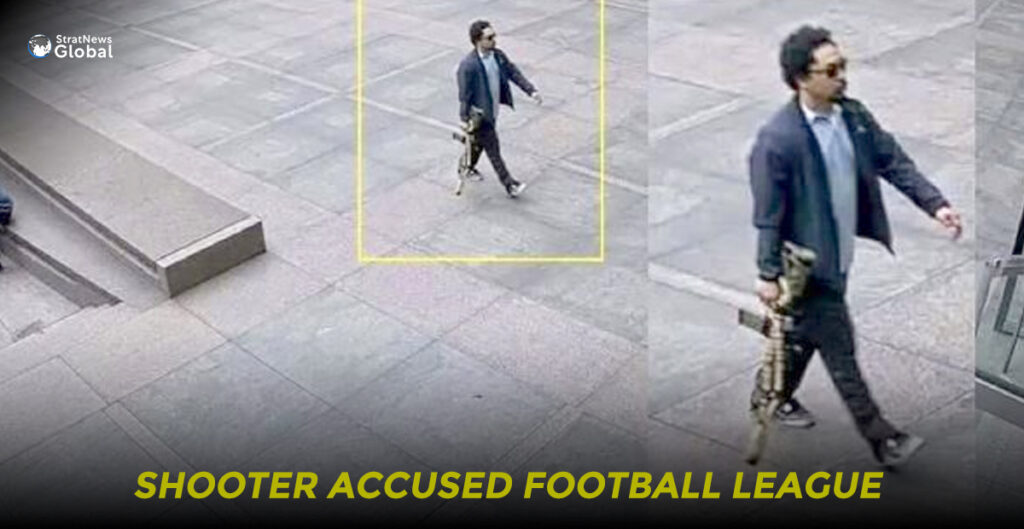
A widely published photo of the shooter, which CNN said was shared by police, showed him walking into the building carrying his rifle. Preliminary checks of the suspect’s background did not show a significant criminal history, CNN reported, citing officials.
Another widely circulated photo showed the permit issued to Tamura by the Las Vegas Metropolitan Police Department allowing him to legally carry a concealed firearm.
(With inputs from Reuters)
US, China Enter Second Day Of Stockholm Talks To Ease Tariff Hostilities
U.S. and Chinese officials entered a second day of talks in Stockholm on Tuesday aimed at resolving longstanding economic disputes and de-escalating the intensifying trade tensions between the world’s two largest economies.
The meetings may not yield immediate large breakthroughs, but the two sides could agree to another 90-day extension of a tariff truce struck in mid-May. It may also pave the way for a potential meeting between U.S. President Donald Trump and Chinese President Xi Jinping later in the year, though Trump on Tuesday denied going out of his way to seek one.
The delegations met for more than five hours on Monday at Rosenbad, the Swedish prime minister’s office in central Stockholm. Neither side made statements after the first day of talks.
U.S. Treasury Secretary Scott Bessent was seen arriving at Rosenbad on Tuesday morning after a separate meeting with Swedish Prime Minister Ulf Kristersson. China’s Vice Premier He Lifeng also arrived at the venue.
August 12 Deadline
China is facing an August 12 deadline to reach a durable tariff agreement with Trump’s administration, after reaching preliminary deals in May and June to end weeks of escalating tit-for-tat tariffs and a cut-off of rare earth minerals.
Without an agreement, global supply chains could face renewed turmoil from U.S. duties snapping back to triple-digit levels that would amount to a bilateral trade embargo.
The Stockholm talks follow Trump’s biggest trade deal yet with the European Union on Sunday for a 15% tariff on most EU goods exports to the United States, and a deal with Japan.
That agreement has brought a measure of relief to the EU but also frustration and anger, with France denouncing the deal as a “submission” and Germany, Europe’s largest economy, also warning of “significant” damage.
China can exercise a degree of leverage with its grip on the global market for rare earths and magnets, used in everything from military hardware to car windshield wiper motors, analysts say.
Unlike the EU, it also does not rely on the United States for security ties and can let trade talks play out for several more months, Cyrus de la Rubia, chief economist at Hamburg Commercial Bank, told Reuters.
“China is well aware of its strong negotiating position, as could clearly be seen in the temporary escalation observed in April,” he said.
“But over Europe always hangs the Damocles sword of the U.S. withdrawing its security guarantee, and that is why the EU did not escalate the situation like China did.”
Trump On Xi Meeting
The Financial Times reported on Monday that the United States had paused curbs on tech exports to China to avoid disrupting trade talks with Beijing and support Trump’s efforts to secure a meeting with Xi this year.
Trump pushed back against suggestions he was seeking a meeting with Xi. “This is not correct, I am not SEEKING anything! I may go to China, but it would only be at the invitation of President Xi, which has been extended. Otherwise, no interest!” he wrote on Truth Social on Tuesday.
Previous U.S.-China trade talks in Geneva and London in May and June focused on bringing U.S. and Chinese retaliatory tariffs down from triple-digit levels and restoring the flow of rare earth minerals halted by China and Nvidia’s H20 AI chips, and other goods halted by the United States.
Among broader economic issues, Washington complains that China’s state-led, export-driven model is flooding world markets with cheap goods, while Beijing says U.S. national security export controls on tech goods seek to stunt Chinese growth.
Bessent has already flagged a deadline extension and has said he wants China to rebalance its economy away from exports to more domestic consumption — a decades-long goal for U.S. policymakers.
(With inputs from Reuters)
Russian Bomb Strike On Ukrainian Penal Colony Kills 17
A Russian bombing targeting a penal colony in southeastern Ukraine killed 17 people overnight, officials reported, just hours after U.S. President Donald Trump announced plans to shorten the deadline for Vladimir Putin to reach a peace agreement.
Dozens more were wounded in the attack on the front-line Zaporizhzhia region, according to President Volodymyr Zelenskyy, who described the bombing as “deliberate”.
“The Russians could not have been unaware that they were targeting civilians in that facility,” he wrote on X.
“And this was done after a completely clear position was voiced by the United States.”
Zelenskyy added that a total of 22 people were killed in overnight strikes by Russia, including a 23-year-old pregnant woman who died in a missile strike on a hospital in another southeastern region.
Russia has stepped up airstrikes far behind the front line of its full-scale invasion, now in its fourth year, as it presses ahead on the battlefield with grinding gains.
Trump’s Deadline
Trump, underscoring his frustration with Putin, said on Monday he would give 10 or 12 days for Russia to make progress towards ending the war.
The U.S. President has threatened both sanctions on Russia and buyers of its exports unless progress is made. The fresh deadline suggests the U.S. president is prepared to move forward on those threats after previous hesitation to do so.
Speaking in Scotland, where he is holding meetings with European leaders and playing golf, Trump said he was disappointed in Putin and shortening a 50-day deadline he had set on the issue earlier this month.
“I’m going to make a new deadline of about … 10 or 12 days from today,” Trump told reporters during a meeting with British Prime Minister Keir Starmer. “There’s no reason in waiting… We just don’t see any progress being made.”
There was no immediate comment from the Kremlin.
High-Explosive Aerial Bombs
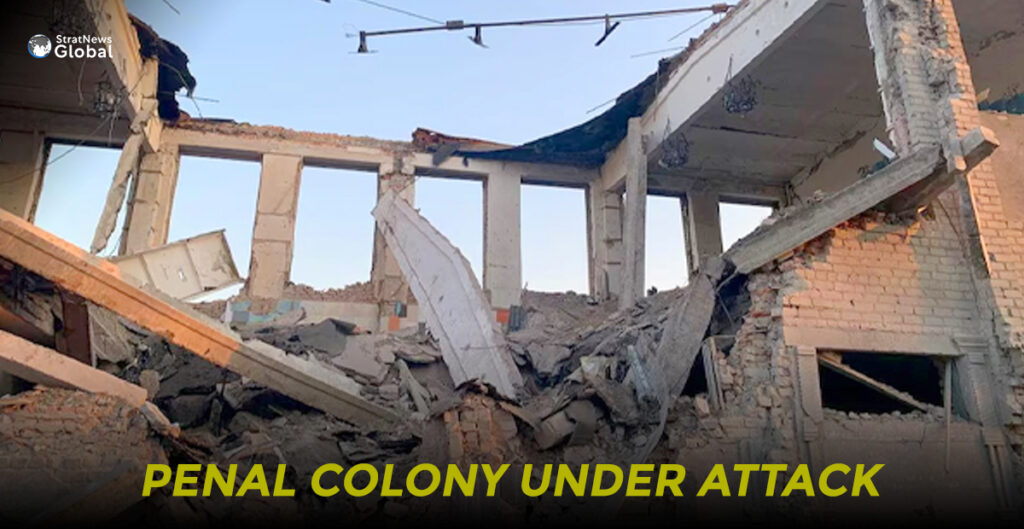
Meanwhile, in a statement, Ukraine’s justice ministry said the prison’s dining hall had been destroyed and other parts damaged in a strike that involved four high-explosive aerial bombs and wounded 42 people.
Reuters could not independently verify the report, and there was no immediate comment from Russia.
Both sides deny targeting civilians in their strikes, but thousands of civilians have been killed in the conflict, the vast majority of them Ukrainian.
(With inputs from Reuters)
Who Won Operation Sindoor And Who Lost? The Post-Mortem
Operation Sindoor is still on. And hence from a correctness perspective, there is no “mortem” for doing a post-mortem. However, it is worth analysing who achieved what objectives and therefore who won in the kinetic conflict under Operation Sindoor.
Operation Sindoor was launched on May 7, after the dastardly attack in Pahalgam on Hindu male tourists from India and Nepal on April 22. This attack was perpetrated by Pakistan state’s non-state actors, a euphemism for terrorists. Also, this may sound like an oxymoron: how can non-state actors belong to a state? And this is precisely the ridiculous claim by Pakistan that was called out by the Indian government. The outcome of such a call-out by the Indian government was an unequivocal shift towards viewing an attack by the so called “non-state” actors of Pakistan as an attack from Pakistan itself, which was the unassailable truth.
In response, the Indian government decided to take a measured step of only destroying nine terrorist camps within Pakistan. This military operation took less than 25 minutes to complete on May 7, thereby achieving the military objective of India, which was to communicate that from now on, Pakistan’s state-sponsored violence against India, no matter if the vector used is non-military personnel such as terrorists or any other mechanism, will not be differentiated from violence by Pakistan as a state, and hence the response from India will be a military one.
This is the same paradigm that Israel used as response to Hamas’ terrorist attack on Israeli soil.
So who won the conflict? The question becomes more acute, given the massive propaganda war that was unleashed by Pakistan, which was curiously lapped up by the Western press and governments, as is reflected in the utterances of some heads of state. The answer to the question of who won would be based on who achieved their objectives from the conflict.
Based on the above parameter, India undisputedly achieved its single-minded objective of establishing that it will not differentiate between non-state actors and their handlers. The two will be treated as same and India will not shy away from military escalation as a response to such cross-border terrorism. The message is clear not only to Pakistan but also to the rest of the world.
The conflict also showed that the Indian military is in the right trajectory in terms of its transformation. And though many more years of investment are needed, what has already been achieved has made the Indian defence an even more formidable force.
The conflict also achieved an outcome which was not a stated objective—it put India’s military capabilities at the forefront and established the Indian military as a force to reckon with in the global pecking order. The Indian military is now an even more feared and respected machinery and its technological capabilities well acknowledged. This development has had an unexpected benefit in terms of making Indian-made weapons much sought after globally, propelling their exports.
What is the flip side? The world has woken up to India’s capabilities. The conflict demonstrated that Western- and Chinese-made weapons are ineffective against India’s defensive and offensive capabilities. The initial restrained response from India was viewed as a deficiency of the Indian military, which quickly switched to a full-blown display of military capabilities, decimating Pakistan’s China-supplied air defences, blowing up much of their military assets including those supplied and maintained by the west. Therefore, there is a scramble to now equip Pakistan with deadlier weapons and capabilities. It will also force China and other powers that were involved, such as Turkey, to upgrade their own military capabilities. This further reduces any luxury of time that India had in its journey towards rapid transformation of its military capabilities.
A vector once used cannot be used again in another conflict, as the NSA had once remarked to me. India would now need to institutionalise continuous building of new weapon platforms, weapon systems and weapon paradigms and further accelerate its transformation. The conflict has clearly helped in pushing India’s mighty military-industrial complex to not just modernise but also move towards creating new benchmarks and weapons systems that the world has not yet seen.
However, was India’s response unexpected? Clearly not. The message that India will give a military response to Pakistan-orchestrated terrorist attack was delivered as part of India’s 2019 military action in the aftermath of Pakistan’s terrorist attack in Pulwama. The Balakot air strikes by India wiped out the terrorist camps located there.
Hence, it was not a surprise that Operation Sindoor was launched by India in response to Pakistan’s Pahalgam terrorist attack. In fact, India’s military response was expected. Pakistan’s military was ready for it. It is a different matter that their military capability did not match their bluster and was decimated.
So if it was obvious that India will respond militarily to Pakistan’s terrorist attack on India, why did the Pakistani top brass initiate such a misadventure? What did they target to achieve through such a cowardly attack?
It is worth mentioning at this stage that cowardice has become the hallmark of Pakistan’s military planners. During Operation Sindoor, the Pakistani military adopted the same strategies that their terrorists adopt—hide behind civilians to attack Indians. Terrorists hide behind women and children to throw stones or grenades. The Pakistani military hid behind civilian aircraft that were flying at that time, to fire missiles at India, knowing fully well that as a responsible professional force, the Indian military will not take any action that will endanger civilians. In fact, it is a matter that needs to be taken up in international courts as a war crime and a terrorist act committed directly by the Pakistani military. But wait, the Army Chief of Pakistan was in fact rewarded with a promotion for such cowardice, thereby institutionalising cowardice as an accepted behaviour of the Pakistani military.
So coming back to deciphering the possible objectives of the Pakistani military for initiating this misadventure that claimed the lives of their military personnel, their terrorists and civilians on both sides. Let us delve deeper into the context and sequence of events from the Pakistani military side, which led it to initiate such a conflict and drag into it the country that it owns.
On April 16, then General (now Field Marshal) of Pakistani Army, Asim Munir suddenly crafted an insidious argument in public, wrapped in his infamous utterances that attempted to point out differences between Hindus and Muslims. There was no immediate provocation that was relatable to the context of his outburst. So clearly his paroxysm appeared to be premeditated for a larger scheme. What was this scheme?
The Pakistani military was losing grip on the country it owned. The public had become significantly disillusioned under the continuous assault of brazen corruption, price rise, government apathy, increased crime and gradual but definite collapse of administration. On the face of abject poverty that millions of Pakistanis were being forced into, the splendour in which the military personnel lived was a rude and perverse demonstration of how the people were being looted to serve their rulers. If there was democracy, the democratic process would have churned out some solution. Instead, with the US endorsed, in-your-face sham elections that stole the votes to install a military-controlled puppet government, snubbed out any near-term possibility of relief for the people. More crippling taxes were imposed on the people, while neither the government nor the military made any tangible compromises to their budgets. In fact, the military budget went up in the face of increased financial hardship of the people of Pakistan and compensation to legislators were increased to address the “hardship” faced by the legislators.
In addition, powerful secessionist movements were coming to a boil in Balochistan and Khyber Pakhtunkhwa. There was also a brief conflict with Iran. And it appeared that the new US administration was ready to call out the decades-old bluffs and lies of the Pakistani military. Money was running out and their iron friend, China, was playing hardball. What was the way out?
The Pakistani military urgently needed a conflict. And who better than India to have such a conflict. But how can the Pakistani military initiate such a conflict in today’s world, where everything is monitored and every place is watched? Could Pakistan army provoke India by starting with a local gunfire and escalating it, blaming India for it? They would have been quickly caught if they did such a misstep. So the obvious way out was to follow their age-old doctrine of initiating terror attack on India with such military precision and barbarity that India would respond to it militarily.
Hence the objectives of Pakistan were simple. To be able to re-create an enemy to display to its people in order to reclaim its control over the country it has. But there were other objectives. (a) to re-hyphenate Pakistan with India, (b) to bring Kashmir back into international radar, (c) to destroy the peace in Kashmir, (d) to degrade the economic benefits of peace that the ordinary people of Kashmir were enjoying and (e) perhaps provide validation of its new Chinese-supplied military systems.
So the playbook was simple. Carry out a terrorist attack on India. Wait for India to retaliate. Unleash the propaganda war (a) within Pakistan and (b) globally, in order to achieve its objectives. And somehow they also believed that they have superior military capability, given the new arms from China and Turkey and also weapons supplied by multiple Western nations. Somehow Asim Munir dreamt of being able to capture land from India, a dream that many Pakistani military heads have dreamt of, and each time the dreams have become nightmares for them, which they would then address through outright lies delivered through crass propaganda.
So if these were the objectives and this was the playbook, did the Pakistani army succeed in meetings its objectives? Unfortunately, it seems they did. They were able to rally Pakistanis behind the army. The memes lampooning the Pakistani military establishment have reduced significantly on social media. The Pakistanis are back to having a perverse feeling of nationalism for being beaten up by their giant neighbour. Obviously, Pakistani domestic propaganda has worked well. As their propaganda engine was well oiled and ready to be unleashed even before the conflict happened, they were able to influence the global press and therefore the narrative. They have been successful in bringing back the re-hyphenation of Pakistan with India, much to the irritation of India. Kashmir has been brought back into global discussions. Tourism and allied industries have been decimated in Kashmir, at least for the time being. And they and their allies, China and Turkey, as well as western nations who sold and maintained military hardware for Pakistan, were able to test the adequacy or inadequacy of their weapon systems in a real war scenario, and therefore be able to upgrade them. It also let China test India’s defences, preparing them for a potential future Sino-Indian military conflict.
So even the Pakistani military met all its objectives from Operation Sindoor.
Then who lost? Clearly, Pakistan as a state and the Pakistanis lost. They lost their people, their soldiers who were treated as sacrificial lambs and credibility as a safe investment destination. With military equipment worth billions of dollars destroyed, and an even bigger amount of military equipment and infrastructure rendered obsolete as an aftermath of Operation Sindoor, the ordinary people of Pakistan will have to shoulder higher tax burdens and many civilians will die because of poor nutrition, lack of access to medical care and general degeneration of civic infrastructure. Perhaps this is what Asim Munir meant when he said Pakistani Muslims are different from Indians. Pakistani Muslims appear to have been condemned by their military rulers to live without hope or happiness. The only two things they have free access to are hype and heaven.
This analysis would also lead to a question: should India not have responded to the venomous provocation of the Pakistani military? Should India have ignored the Pahalgam terrorist attack? Absolutely not. India should have and did respond militarily to Pakistan’s provocation. The continuation of that response may be non-kinetic and that response continues as of date.
(The author is President, Centre for Domestic Economy Policy Research. Views expressed here are personal)
Op Sindoor: Jaishankar Blasts Congress Track Record On Terror, China
Monday’s debate in the Lok Sabha on Operation Sindoor may have been an uncomfortable walk down memory lane for the Opposition, especially for the Congress Party members.
External Affairs Minister Jaishankar referred to questions from the Opposition as to why Op. Sindoor was stopped, and recalled the then Congress government’s inaction in the wake of the 26/11 attack by Pakistani terrorists on Mumbai.
He quoted from then National Security Adviser Shivshankar Menon’s book Choices, where he had written: “On sober reflection and in hindsight, I believe that decision not to retaliate militarily but to concentrate on diplomatic, covert and other means was the right one for that time and place.”
In Jaishankar’s view, the same government then went on to compound that “inaction” by agreeing with the then Pakistani prime minister at Sharm el-Sheikh in Egypt that “terrorism is a main threat to both countries,” and then adding that terrorism should not be linked to the composite dialogue and then accepting a reference to Balochistan.
“Here is a country reeling after 26/11 and you are equating Balochistan and what happened in Mumbai and you are saying that both the perpetrator and the victim have a problem and now you are asking me, why didn’t you go further,” Jaishankar said.
He faulted the 2006 UPA government-Pakistan statement made in Havana, three months after the Mumbai train bombings in which more than 200 people were killed, where both condemned terrorism and that “it is a scourge that we need to effectively deal with together.”
“The people who did nothing are asking the government that did so much, why didn’t you do more. I think it’s extraordinary.”
The Leader of the Opposition Rahul Gandhi, Jaishankar said, has been warning about a two-front scenario, meaning China and Pakistan together against India. But this collaboration has been going on for 60 years, he said, and ticked off dates:
In 1963 the Shaksgam Valley was ceded to China by Pakistan, in 1966 they agreed to build the Karakoram Highway, Chinese military supplies to Pak began in 1966, nuclear collaboration in 1976.
Add to that, 2005 Pak-China Treaty of Friendship, 2006 Pak-China FTA, 2013 Gwadar Port handed over to China and in May 2013, the Pak-China Economic Corridor agreement was sealed.
He agreed that Pakistan got a loan of $7 billion this year but pointed to the $15 billion it got in 2008 ($9.70 billion) and in 2013 ($5.9 billion), both UPA years.
Pakistan has been on the FATF grey list for the longest period under the Modi government, he said, 1576 days, and that country remains under the Enhanced Follow-up Category because of only partial compliance.
He faulted the Congress for declaring China a strategic partner of India in 2005, and the concept of “Chindia”, that India and China have common interests, is something that was claimed by the spokesman of that party, and underscored that the Leader of the Opposition was briefed by the Chinese ambassador during the Doklam crisis.
He recalled the Congress move for a regional trading arrangement with China, that fortunately did not fructify, and pointed out that Chinese 3G and 4G was allowed into India by the Congress.
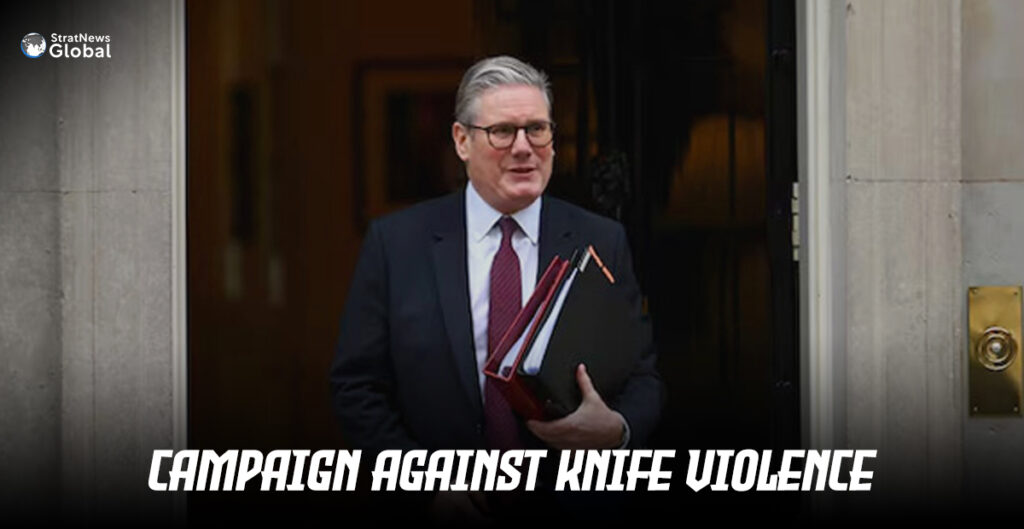
Britain Launches Knife Amnesty Campaign Targeting Youth Violence
One year after one of Britain’s most shocking knife attacks, the government has launched a month-long campaign urging the youth to surrender bladed weapons at designated “amnesty” bins or mobile collection vans—part of a broader effort to curb knife-related violence, especially among youth.
On July 29, 2024, teenager Axel Rudakubana, who was obsessed with violence and genocide, attacked a Taylor Swift-themed children’s dance event in the northern English town of Southport, killing three girls and stabbing 10 other people.
Since then, Prime Minister Keir Starmer’s Labour government has pledged tougher age checks for knife buyers, warned social media firms they could face fines for failing to curb sales and promotion of weapons, and banned zombie-style knives and ninja swords.
Starmer launched a coalition in September last year aimed at tackling youth knife crime. Actor and anti-knife campaigner Idris Elba joined the conversation at a meeting this month, alongside King Charles.
Charities and experts interviewed by Reuters call the government’s efforts a step forward but say they largely fail to address the root causes. Some charities involved in classes and workshops aimed at young people are urging the government to make such education part of the national curriculum.
Overall, knife crime in England and Wales has risen 87% over the past decade, with 54,587 offences last year alone, a 2% rise from 2023 and among the highest rates in Europe, figures from Britain’s interior ministry show.
It did not provide a breakdown of knife crime offences by age group. But data from the justice ministry showed that in the year to March 2024, there were just over 3,200 knife or offensive weapon offences committed by children (aged 10-17) resulting in a caution or sentence.
Of the 262 people killed with a knife or sharp object in the 12 months to March 2024, 57 were under 25. Kitchen knives were the most commonly used weapons.
A public inquiry into the Southport murders that opened this month will begin by looking into the specifics of Rudakubana’s case before a second phase examines the wider issue of children being drawn into violence, an increasing concern for British authorities.
Amanda Marlow, from the youth charity Safety Centre, which runs knife crime awareness workshops in schools, says young people carry knives for a range of reasons. These include seeing it as a “quick fix” to make money when growing up in poverty, trying to gain status among peers, or being drawn into the wrong crowd, such as gangs, where they are often exploited.
Some police forces have launched dedicated knife crime units. In the West Midlands, one of the country’s worst-hit areas, the Guardian Taskforce focuses on reducing knife crime among under-25s.
In June alone, officers patrolled for over 3,000 hours, carried out 366 stop-and-searches, and seized 57 knives or offensive weapons. “Every knife seized is a life saved,” Inspector Kate Jeffries of the task force said in a statement.
After surviving the Southport stabbings, Leanne Lucas launched the “Let’s Be Blunt” campaign, calling for safer, rounded-tip kitchen knives instead of pointed ones.
Poverty And Mental Health
Jade Levell, a researcher at the University of Bristol who studies masculinity, vulnerability and violence, said anti-knife crime efforts should focus on early intervention, such as mental health care, rather than short-term fixes like amnesty bins.
“Some boys see their only option is to be afraid or to make others afraid of them,” Levell said, referring to those growing up with violence, poverty or discrimination.
Some 4.5 million children are growing up in poverty in the UK, according to charities. In 2023, about 1 in 5 children and young people aged 8 to 25 years had a probable mental disorder, according to the National Health Service.
The government announced funding this month for hubs offering mental health and career support for young people at risk of gang involvement, violence or knife crime. The scheme, focused on high-risk areas, is starting with eight such centres and aims to have 50 open in the next four years.
Educating Young People
The violent death of his son two years ago prompted Martin Cosser to found a charity dedicated to educating young people about knife crime, one of several such initiatives around the country.
Charlie’s Promise, named after 17-year-old Charlie who was stabbed multiple times in the chest by another teenager at a packed end-of-term party, has spoken to 41,000 young people in schools and elsewhere.
“Nothing brings my little boy home,” said Cosser, adding that far more must be done to stop the knife crime crisis spiralling out of control. “We need to understand the emotional drivers behind why people pick up knives.”
Charity Safety Centre delivers workshops in schools, specifically designed for children aged 9 to 12. At a recent session in a school in the southern English town of Milton Keynes, staff from the charity explained what knife crime is and the dangers it poses, encouraging active participation through questions and games.
Safety Centre and Charlie’s Promise are among several groups calling for such education to become a mandatory part of the national school curriculum.
Amani Simpson, who survived being stabbed in 2011 and now shares his story as a youth coach, believes societal pressures and some forms of entertainment, such as violent video games, also play a role in spawning knife crime.
“Young people feel displaced and disengaged … those things need to be uprooted,” Simpson said after a talk at TCES North West London, a special education school, emphasising the importance of helping them believe in their own potential so they make better choices.
“Hope for me is the missing piece,” he said.
(With inputs from Reuters)
New Zealand Unveils Law Restricting Same-Day Voter Registration, Prisoner Voting Rights
The New Zealand government on Tuesday unveiled legislation that will prohibit same-day voter registration and prevent prisoners from voting while incarcerated—measures critics warn could suppress voter turnout.
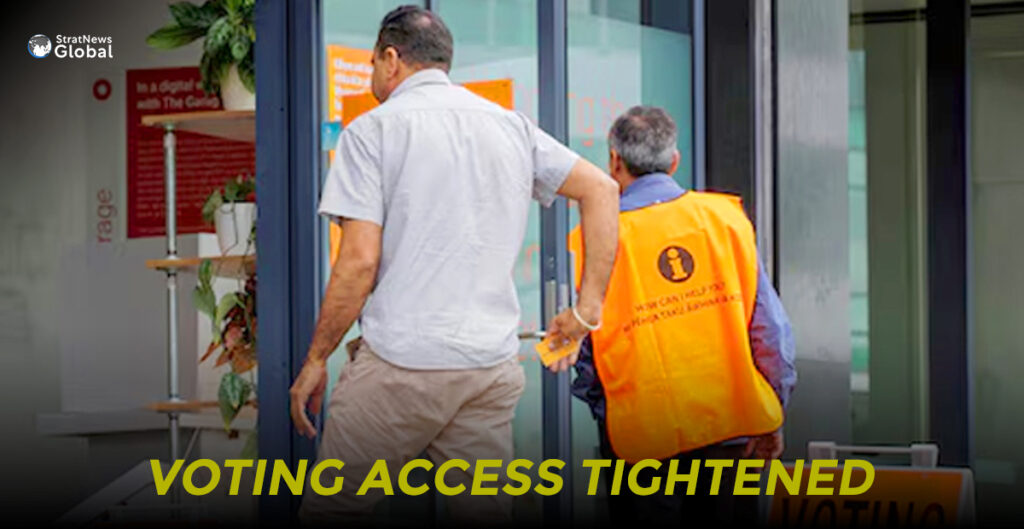
The proposed law, which passed its first of three readings in parliament on Tuesday, will allow people to enrol to vote only up to 13 days before an election. Currently, potential voters can enrol up to and on election day.
The law will also ban all prisoners from voting and require voting to open 12 days ahead of the official election day.
“This bill overhauls a number of outdated and unsustainable electoral laws. The package of amendments will strengthen the system, helping to deliver timely election results, manage the costs, clarify rules and provide more efficient services to voters,” said Minister of Justice Paul Goldsmith, who proposed the bill.
Rights Concerns Raise Alarms
However, a report by Attorney General Judith Collins concluded that the bill “appears to be inconsistent” with the country’s Bill of Rights, including the right to freedom of expression and the right to vote.
The changes are, in part, prompted by delays in results at the 2023 election, when it took nearly three weeks before an official result was released due to the high number of special votes.
Special votes are cast by New Zealanders living or travelling overseas, voting outside their constituency or newly enrolled.
The Attorney General’s report, which was released publicly on Friday, said that in the last election, special votes included over 97,000 people who registered for the first time during the voting period, and nearly 134,000 people who changed electoral districts during the voting period.
“This gives some indication of the number of people who may be affected,” said Collins, who is a member of the ruling party.
Duncan Webb, a lawmaker from the opposition Labour Party opposing the bill, on Tuesday called it “a dark day for democracy”.
“Politicians should be making it easier for people to vote, not harder. It’s how we make sure that everybody’s voice is heard, that everyone gets a say,” he said.
(With inputs from Reuters)