

Support us by contributing to StratNewsGlobal on the following UPI ID
ultramodern@hdfcbank

Strategic affairs is our game, South Asia and beyond our playground. Put together by an experienced team led by Nitin A. Gokhale. Our focus is on strategic affairs, foreign policy and international relations, with higher quality reportage, analysis and commentary with new tie-ups across the South Asian region.
You can support our endeavours. Visit us at www.stratnewsglobal.com and follow us on YouTube, Twitter, Facebook and Instagram.
र 500 per month
र 1000 per month
र 5000 per year
र 10000 per year
Donate an amount of your choice
र 500 per month
Donate र 500 per month

र 1000 per month
Donate र 1000 per month
र 5000 per year
Donate र 5,000 per year
र 10000 per year
Donate र 10,000 per year
Donate an amount of your choice
Donate an amount of your choice
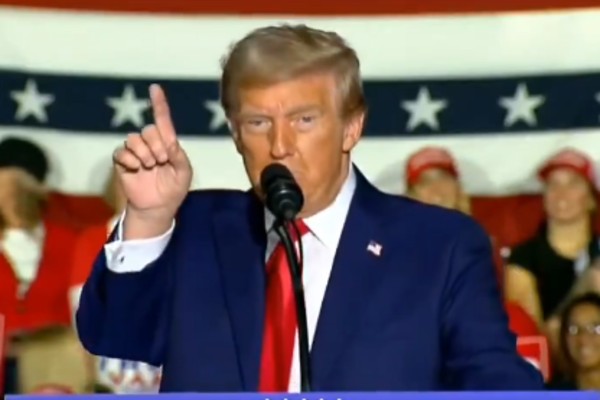

Trump Throws a Tantrum, New Delhi Keeps Its Cool
It began, as so many Trumpian fiascos do, with a screaming capital-letter announcement about tariffs.
On July 30, U.S. President Donald J. Trump took to his social media platform to declare that India would be hit with a 25% tariff, plus an unspecified “penalty,” starting August 1. The reason? India’s “very high tariffs,” “obnoxious trade barriers,” and its enduring defence and energy ties with Russia.
Never mind that India is the world’s fifth-largest economy. Or that bilateral trade between the U.S. and India hit a record $200 billion in 2023. In Trump’s zero-sum worldview, complex geopolitics must bow to chest-thumping sloganeering.
As if the first post wasn’t unhinged enough, Trump followed it with an even more bizarre outburst, essentially throwing India, Russia, and former Russian President Dmitry Medvedev under the rhetorical bus. “I don’t care what India does with Russia,” he fumed, accusing both nations of having “dead economies.” He then claimed the U.S. does “very little business” with India—again, false—and declared that Russia and America should “keep it that way.”
He finished with a mafia-flavoured threat: Medvedev, he warned, should “watch his words,” because he’s “entering very dangerous territory!”
And yet, while Trump performed his usual carnival act of grievance and bravado, India’s response was classic New Delhi: measured, deliberate, and firmly rooted in national interest.
The Commerce Ministry acknowledged the tariff announcement, stating that it was “studying the implications” of the move and that India remained committed to a “fair, balanced, and mutually beneficial trade agreement” with the United States. No drama. No panic. No tweetstorms. Officials emphasized that India has consistently engaged the U.S. in trade negotiations—but not at the cost of core interests, particularly in agriculture, dairy, MSMEs, and strategic autonomy. As one official said, “We want a deal, not a diktat.”
Indeed, despite Trump’s absurd claim that the U.S. has “done very little business with India,” reality tells another story: India is a major defence partner, a critical player in global supply chains, and one of the top buyers of U.S. technology and machinery. The two nations share strategic convergences on China, the Indo-Pacific, and counterterrorism.
What they don’t share is Trump’s tendency to confuse diplomacy with delinquency.
India’s political opposition, sensing an opportunity, pounced. Congress leaders called the tariff a betrayal, arguing that Prime Minister Modi’s red-carpet diplomacy—from “Howdy Modi” in Houston to “Namaste Trump” in Ahmedabad—had yielded little more than tariffs and threats. One MP declared, “This is what happens when you mistake photo-ops for foreign policy.”
Economists were more tempered. They warned that sectors like pharmaceuticals, gems and jewellery, textiles, and auto components could be hit hard. A 25% tariff would dampen export competitiveness and potentially affect GDP in the short term. Still, many saw Trump’s move as a pressure tactic rather than a coherent strategy—especially given that the U.S. is also courting India to counter China’s dominance in Asia.
A recent SBI Research report suggested that India could absorb the shock by boosting exports to other markets like ASEAN, the EU, and the UK, and by riding the tailwinds of the “China-plus-one” manufacturing shift. In other words, India has options—something Trump seems unaware of.
Tariffs are a blunt instrument. When used thoughtfully, they can protect domestic industry or serve as leverage in high-stakes negotiations. But when deployed via social media tantrum—without consultation, context, or clarity—they’re nothing more than economic vandalism.
Trump’s criticism of India’s ties with Russia is especially rich, considering his own ambiguous flirtations with Moscow. India’s long-standing defence relationship with Russia predates his presidency by decades. It’s built on necessity, geography, and strategic balance—not ideology. To demand that India sever those ties on Washington’s timetable, and then punish it when it doesn’t, is not how allies are treated.
Ultimately, this episode is less about trade policy and more about tone.
Trump, true to form, chooses bluster over substance, bullying over strategy, and narcissism over nuance. His statements aren’t just factually incorrect, they’re diplomatically corrosive.
India, in contrast, demonstrates the maturity of a nation that doesn’t mistake performative outrage for real power. It has signalled that it will continue engaging with the United States, but on terms that reflect its sovereignty, not Trump’s social media mood swings.
So what’s next? India will likely ride out this storm, just as it did in 2019 when Trump revoked its trade benefits under the Generalized System of Preferences.
And if history is any guide, this latest outburst may soon be forgotten, replaced by whatever shiny object catches Trump’s attention next.
But one thing is clear: India is no one’s punching bag. And while Trump rants into the digital void, India’s message is simple: We’re open for business—not for bullying.
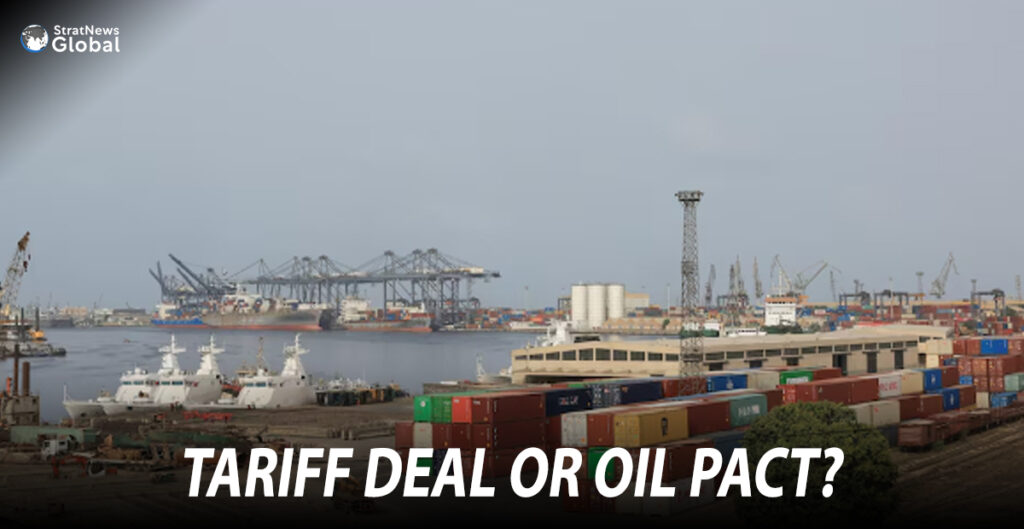
Pakistan Says It Seals US Tariff Deal As Trump Highlights Oil Reserves Pact
The United States and Pakistan announced a new deal that Islamabad said would reduce tariffs on its exports, while President Donald Trump emphasised a separate pact aimed at developing Pakistan’s oil reserves.
Neither mentioned the tariff rate agreed.
Pakistan, which Washington has designated a “major non-NATO ally” in its effort to counter rival China’s influence in the region, faced a potential tariff of 29% declared in April that was later suspended for 90 days to allow trade talks.
“We have just concluded a Deal with the Country of Pakistan, whereby Pakistan and the United States will work together on developing their massive Oil Reserves,” Trump wrote on social media.
“We are in the process of choosing the Oil Company that will lead this Partnership.”
He gave no further details.
‘Deal Concluded’
Pakistani Foreign Minister Ishaq Dar also confirmed the deal. “Deal concluded,” he told Reuters, without elaborating.
Although Trump did not mention a tariff deal, Pakistan’s finance ministry said on Thursday it would lead to “reduction of reciprocal tariffs, especially on Pakistani exports to the United States”, but stopped short of revealing the figure.
“This deal marks the beginning of a new era of economic collaboration, especially in energy, mines and minerals, IT, cryptocurrency and other sectors,” it said.
The deal was a win-win situation for both nations, Finance Minister Muhammad Aurangzeb, who led the final round of talks in Washington, said in video remarks.
“From our perspective, it was always going beyond the immediate trade imperative, and its whole purpose was, and is, that trade and investment have to go hand in hand,” he added in the statement from his office.
Last week, Dar said both nations were “very close” to a trade deal that could come within days, after he met Secretary of State Marco Rubio on Friday.
They discussed expanding trade and ties in critical minerals and mining, the two sides said afterwards. Other Pakistani officials have also visited for talks in recent weeks.
Under Trump, Washington has sought to renegotiate trade deals with many countries, which he threatened with tariffs for trade relations he calls unfair, a characterisation many economists dispute.
U.S. total goods trade with Pakistan was an estimated $7.3 billion in 2024, the Office of the U.S. Trade Representative says on its website, up from about $6.9 billion in 2023.
In 2024, its goods trade deficit with Pakistan was $3 billion, up 5.2% from 2023.
25% Tariff On Indian Exports
Trump also said Washington was still negotiating with India on trade after he declared a tariff of 25% on goods imported from Pakistan’s arch foe would start from Friday.
Pakistan recently said it “appreciated the pivotal role” of Trump and Rubio “in de-escalating tensions between Pakistan and India by facilitating a ceasefire.”
Trump has repeatedly taken credit for the India-Pakistan ceasefire he announced on social media on May 10 after Washington’s talks with both sides.
India disputes Trump’s claims that the ceasefire resulted from his intervention and trade threats.
India’s position is that New Delhi and Islamabad must resolve problems directly with no outside involvement.
The latest escalation in the decades-old India-Pakistan rivalry was triggered by a deadly April 22 attack by Pakistani terrorists in Jammu and Kashmir’s Pahalgam.
Islamabad, however, denied responsibility.
India struck terrorist infrastructure in Pakistan and Pakistan-occupied Kashmir (PoK) on May 7, and they exchanged deadly hostilities until the ceasefire.
(With inputs from Reuters)
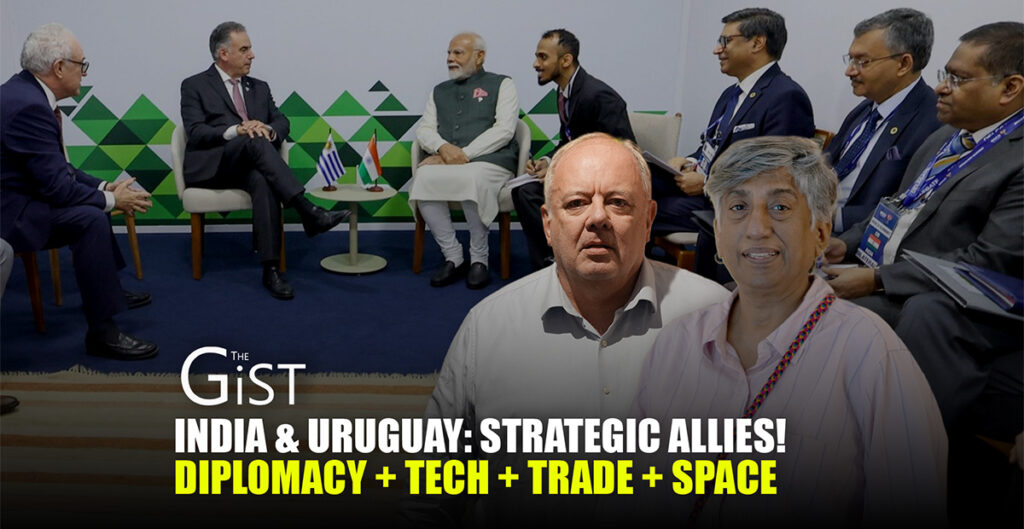
India and Uruguay Deepen Ties Across Security, Space, Trade, and Technology
South American nation Uruguay has reaffirmed its strong support for India on multiple global and regional fronts, including the fight against terrorism, expansion of trade ties, collaboration in defence and space technology, and joint efforts in Antarctic research.
As the two democracies seek to upgrade their long-standing relationship, fresh momentum is building around areas such as railway modernization, artificial intelligence, clean energy, and audiovisual co-productions, with both sides committed to turning shared values into strategic action.
Speaking in an exclusive interview, Uruguay’s Ambassador to India, Alberto Guañi, outlined a broad and ambitious agenda to strengthen bilateral cooperation. Guañi emphasized that Uruguay views India as a natural partner in the Global South, and is eager to deepen ties in both traditional and emerging sectors.
Shared Democratic Values and Global Solidarity
Despite being geographically distant, India and Uruguay continue to find common ground in global governance, multilateralism, and democratic principles. Uruguay has reiterated its support for India’s long-standing bid for a permanent seat on the United Nations Security Council and condemned terrorism in all forms — especially incidents targeting Indian civilians.
“There is deep sorrow whenever India is affected by terrorism — and we stand firmly against such acts,” Ambassador Guañi said, noting that President Yamandú Orsi personally conveyed Uruguay’s condolences to Prime Minister Modi.
He also praised the two countries’ commitment to democratic governance, calling India “the world’s largest democracy” and Uruguay “one of the oldest in the region” — united by shared values despite the 15,000 km between them.
Diplomatic Momentum and Institutional Presence
Recent high-level meetings between Indian and Uruguayan leadership have injected new energy into the relationship. According to him these are the most significant exchanges since former Prime Minister Indira Gandhi’s visit to Montevideo in 1968. A major outcome: India’s decision to open a full-fledged embassy in Uruguay, which the ambassador called a “crucial step” in building institutional capacity and driving future initiatives.
Trade, Technology, and Uruguay as India’s Gateway to South America
Uruguay aims to become a regional hub for Indian business, using its advanced infrastructure and pro-investment policies to support entry into broader Latin American markets. The Ambassador highlighted existing Indian investments — notably Tata Consultancy Services (TCS), which employs over 3,000 people in Uruguay — as examples of successful bilateral engagement.
He also pointed to promising opportunities in agritech, pharmaceuticals, and manufacturing, and reiterated Uruguay’s push to expand the India–MERCOSUR Preferential Trade Agreement, which has faced procedural delays. “India’s strong links with Brazil, Argentina, and now Uruguay place it in a unique position to push this forward,” he noted.
Railways and Infrastructure Cooperation
He revealed that Uruguay is actively exploring options to revitalize its railway system, particularly for passenger transport. Indian technology and rolling stock are being evaluated as cost-effective and high-quality solutions. “We are keen to source rail infrastructure from India — from wagons to potentially even fast trains,” he said, adding that Uruguay is also reviewing Indian proposals for infrastructure and construction projects.
Partnership in Defence, AI, and Space
Uruguay is emerging as a niche player in technology and defence, and sees India as a strategic partner in areas like drones, satellite manufacturing, and artificial intelligence.
“Uruguay already produces drones and satellites — we want to jointly develop new applications, especially for civilian and agricultural use,” Guañi said. He also suggested that India could use Uruguay as a southern hemisphere launch base, opening up new strategic possibilities for ISRO.
On AI, Uruguay is focused on human-centered innovation, and wants to collaborate with Indian firms and institutions to create ethical and socially beneficial AI systems. “This is a global technology that requires global responsibility,” the ambassador stressed.
Antarctica and Scientific Exploration
Ambassador Guañi proposed collaborative research in Antarctica, where Uruguay maintains two research bases. He said Indian scientists would be welcome to participate in joint expeditions, especially in areas like marine biology, climate science, and sustainable exploration.
One key area of shared interest is krill research, which has medical implications for brain health and aging. “We’ve made some fascinating discoveries that we’re eager to explore further with Indian researchers,” Guañi noted.
Cultural and Creative Exchanges
Uruguay is inviting Indian filmmakers to explore its diverse landscapes and tax incentives for film production. “It’s much cheaper to film in Uruguay than in many parts of the world — and we have European-style settings, skilled extras, and a bilingual workforce,” said the ambassador.
Talks are underway to sign an MoU on audiovisual co-productions, which could make Uruguay a Latin American hub for Bollywood productions targeting global audiences.
Education, Language, and People-to-People Ties
Uruguay, known for its successful “one laptop per child” digital education model, is interested in partnering with India on software, ed-tech, and language training. Ambassador Guañi proposed mutual programs in which Uruguay could help teach Spanish in Indian schools, while learning from India’s expertise in English and STEM education.
“This kind of cooperation is essential to building the future workforce of both nations,” he said.
Connectivity and Visa Reform
A recurring challenge is the lack of direct air connectivity and the complex visa regime between South America and India. Guañi advocated for a Schengen-style visa for MERCOSUR nations to simplify travel and boost tourism and business exchanges.
“We must remove barriers to people-to-people contact. A direct flight via Madrid, and streamlined visas, could transform our relationship,” he said, while also calling for strong safeguards against human trafficking.
A Modern South–South Alliance
As global dynamics shift, Uruguay sees India not just as an economic giant, but as a moral and strategic leader in the Global South. From space to sustainable energy, and from trade to culture, Ambassador Guañi believes there is enormous untapped potential.
“We are far apart geographically, but aligned in values, ambitions, and vision,” he said. “Now is the time to act on this partnership.”
Ukraine’s Parliament To Debate Reinstating Independence Of Anti-Corruption Agencies
Ukrainian lawmakers are set to review a bill on Thursday that would restore the autonomy of the nation’s two key anti-graft agencies, in an effort to ease a political crisis undermining confidence in President Volodymyr Zelenskyy’s leadership during the war.
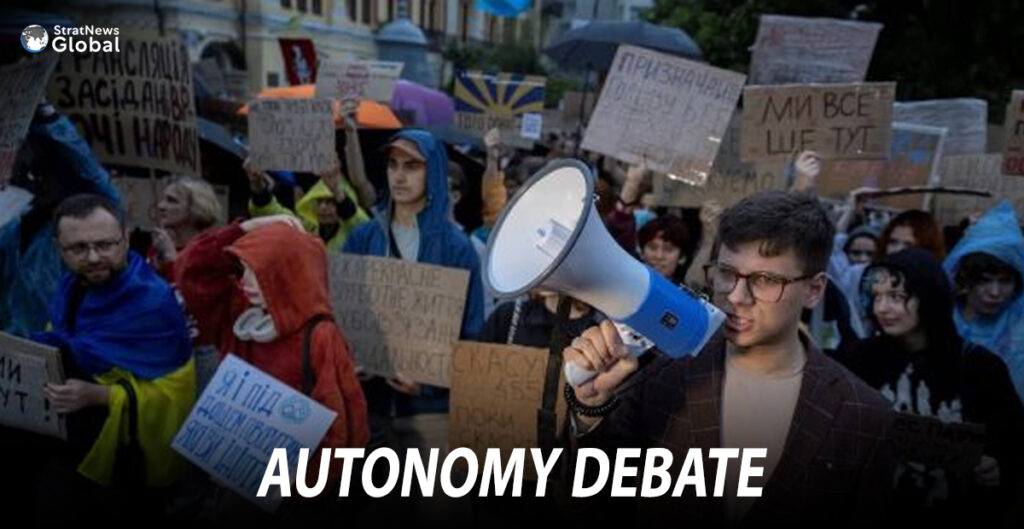
Thousands of protesters rallied in Kyiv and other cities in recent days in a rare show of discontent after lawmakers led by Zelenskyy’s ruling party rushed through amendments last week defanging the respected agencies.
Zelenskyy reversed course after the outcry and under pressure from top European officials, who warned Ukraine was jeopardising its bid for EU membership by curbing the powers of its anti-graft authorities.
Protests Continue
Demonstrations had continued even after he submitted the new bill restoring their independence, with hundreds rallying near the presidential administration in Kyiv late on Wednesday to chants of “Shame!” and “The people are the power!”.
“I really want parliament to vote (for the new measure) just as quickly as it did last time,” said protester Kateryna Kononenko, 36, referring to last week’s fast-tracked approval of the controversial amendments.
Activists also called for demonstrations near parliament ahead of Thursday’s vote in an attempt to pressure lawmakers to approve the new bill.
Eradicating graft and shoring up the rule of law are key requirements for Kyiv to join the EU, which Ukrainians see as critical to their future as they fend off a Russian invasion.
Last week’s amendments had given Zelenskiy’s hand-picked general prosecutor the power to transfer cases away from the anti-graft agencies and reassign prosecutors – a step critics had said was designed to protect allies from prosecution.
While much smaller, the rallies of the past week have sparked comparisons to Ukraine’s 2014 Maidan revolution, when protesters toppled a president they accused of corruption and heavy-handed rule.
More than two-thirds of Ukrainians support the recent protests, according to a recent survey by Ukrainian pollster Gradus Research.
Corruption Fighters
The National Anti-Corruption Bureau of Ukraine (NABU) and the Specialised Anti-Corruption Prosecutor’s Office (SAPO) have stepped up a closely watched campaign against graft since Russia’s February 2022 invasion.
They have produced charges against lawmakers and senior government officials, including a then-deputy prime minister who was accused last month of taking a $345,000 kickback.
After Zelenskyy’s reversal, NABU chief Semen Kryvonos said he expected pressure against his agency to continue, fuelled by what he described as corrupt forces uninterested in cleaning up Ukraine.
He added that he and other anti-corruption officials felt a greater sense of responsibility following the protests, but also called on the country’s leadership to help their effort.
“This responsibility must be shared with the government, which needs to react and say, ‘Okay, there’s corruption here – let’s destroy it.'”
(With inputs from Reuters)
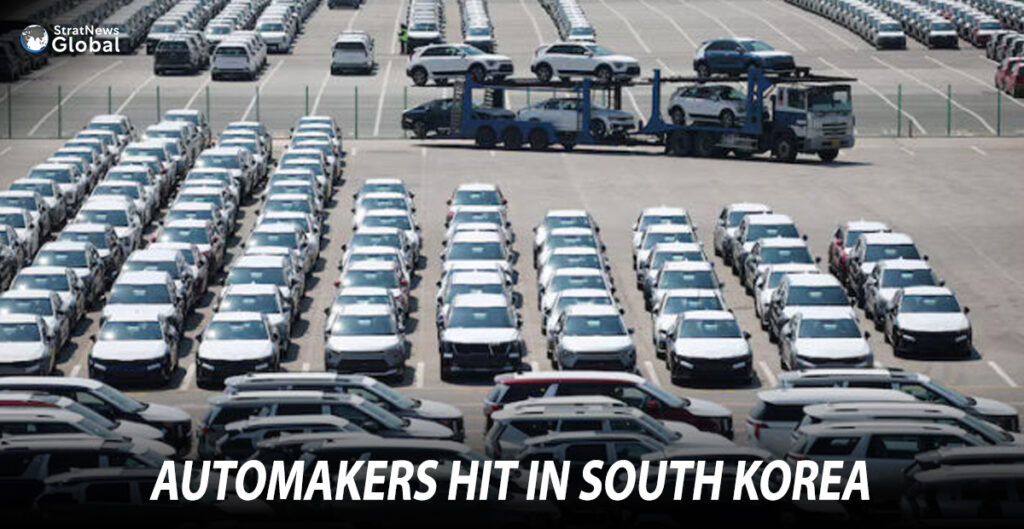
US-South Korea Deal Dents Automakers Hyundai, Kia
In a setback for South Korean carmakers, shares of Hyundai Motor and Kia Corp fell on Thursday after US President Donald Trump announced a 15% import tariff on South Korean goods, including automobiles, as part of a new trade agreement.
While the agreement reduces auto tariffs from 25%, it removes the 2.5% advantage in tariffs that South Korean automakers had enjoyed over Japanese rivals under the Korea-US free trade deal.
Some analysts said the share falls may have been driven by profit-taking as news of the tariffs was already factored in after South Korean automaker shares surged last week following news that Trump agreed to reduce Japanese auto imports to 15%, a move that stoked optimism about a similar deal for Seoul.
Tariff Cuts ‘Fortunate’
South Korea’s auto association said the tariff cuts are “fortunate” and said it removes uncertainty and creates a level playing ground with Japanese and European rivals.
Hyundai Motor said the deal “validates our unwavering confidence in the US market and our commitment to American manufacturing”.
Hyundai Motor Group in March announced a $21 billion investment in the United States with Trump at the White House, including a $5.8 billion steel factory and an expansion of Hyundai Motor’s new car factory in Georgia.
Before Washington imposed 25% auto tariffs in April, there were zero tariffs on most South Korean auto imports under a bilateral trade deal, while there was a 2.5% tariff on Japanese auto imports.
South Korean negotiators demanded 12.5% auto tariffs, but Trump wanted the rate to be 15%, the presidential office said.
Hyundai Motor shares fell 4.5% and Kia Corp stock lost 6.6%.
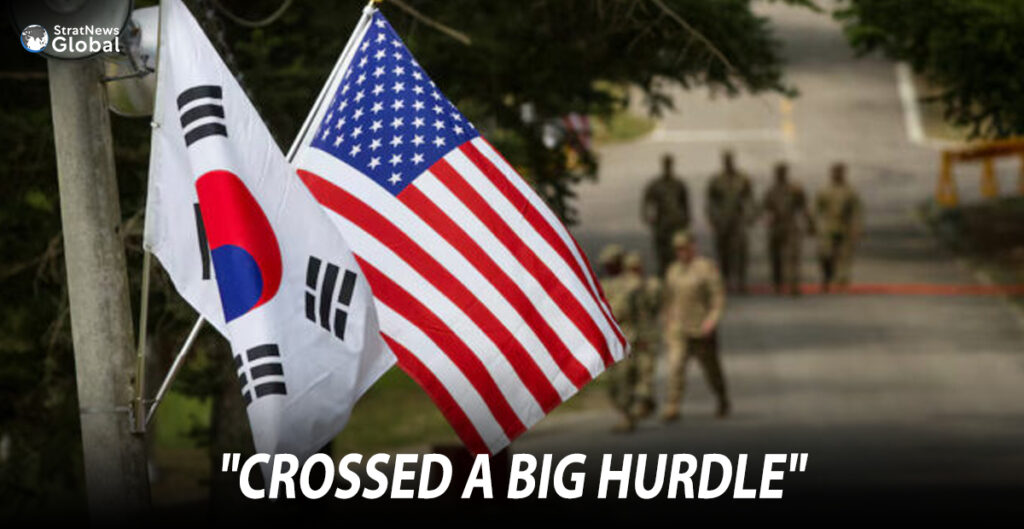
‘Crossed A Big Hurdle’
Announcing the tariffs, Trump wrote on Truth Social: “I am pleased to announce that the United States of America has agreed to a Full and Complete Trade Deal with the Republic of Korea.”
The negotiations were an early test for South Korean President Lee Jae Myung, who took office in June after a snap election. He said the deal had eliminated uncertainty in the export environment and set US tariffs lower than or at the same level as major competitors.
“We have crossed a big hurdle,” Lee said in a post on Facebook. Trump said Lee would visit the White House “within the next two weeks” for his first meeting with the US president.
(With inputs from Reuters)
Trump Unleashes Series Of Tariff Measures On Copper, Brazil, South Korea, And Small Imports
U.S. President Donald Trump on Wednesday announced a flurry of tariff actions, including adjustments to proposed duties on copper imports, products from Brazil and South Korea, and the removal of a tariff exemption for low-value foreign shipments.
The wave of announcements came as the clock ticked down toward an August 1 deadline for higher U.S. tariff rates, as Trump presses on with his bid to reshape global trade.
Capping a day that began with Trump announcing a 25% tariff rate on goods from India, after months of negotiations between Washington and New Delhi failed to produce a trade deal, Trump said a 50% tariff on copper pipes and wiring would kick in on Friday.
Trump plans to sign new executive orders on Thursday imposing higher tariff rates on several countries that have been unable to reach negotiated trade deals with the United States, Politico reported, citing a White House official.
Details of the copper levy fell short of the sweeping restrictions expected and left out copper input materials such as ores, concentrates and cathodes.
The surprise move dragged down U.S. copper prices more than 17% on the Comex exchange and unwound a premium over the London global benchmark that had grown in recent weeks, with shipments diverted there in anticipation of higher domestic prices.
“Markets are now busily repricing refined copper much lower after Trump’s epic backflip on his own import tariff policy,” said Tom Price, an analyst at the London brokerage Panmure Liberum. “Someone must have finally got through to (Trump) that the U.S. economy simply can’t afford this new trade-hit.”
Trump first teased the copper tariff in early July, implying that it would apply to all types of the red metal, ranging from cathodes produced by mines and smelters to wiring and other finished products.
Yet the proclamation released by the White House said the tariff will apply only to pipes, tubes and other semi-finished copper products, as well as products that copper is heavily used to manufacture, including cable and electrical components.
The move aids manufacturers, but does little to boost the constrained U.S. copper mining industry, which for years has asked Washington for permitting reform or other steps that could fuel growth. The move is essentially a boost for Chile and Peru, two of the world’s largest copper miners and major suppliers to the United States.
Brazil ‘Not Worst-Case Scenario’
Trump on Wednesday slapped a 50% tariff on most Brazilian goods to fight what he has called a “witch hunt” against former President Jair Bolsonaro, but softened the blow by excluding sectors such as aircraft, energy and orange juice from the heavier levies.
That came as a relief for many in Brasilia, who since Trump announced the tariffs had been urging protections for major exporters caught in the crossfire. Shares of planemaker Embraer and pulpmaker Suzano rose.
“We’re not facing the worst-case scenario,” Brazilian Treasury Secretary Rogerio Ceron told reporters. “It’s a more benign outcome than it could have been.”
The new tariffs will go into effect on August 6, not August 1 as Trump announced originally.
South Korea ‘Shipbuilding Deal’
Trump also announced the U.S. will charge a 15% tariff on imports from South Korea as part of a deal that eases, for now, tension with a top-10 trading partner and key Asian ally.
Imports from South Korea, a powerhouse exporter of computer chips, cars and steel, had faced a 25% rate.
“I am pleased to announce that the United States of America has agreed to a Full and Complete Trade Deal with the Republic of Korea,” Trump wrote on Truth Social, shortly after he met with South Korean officials at the White House.
Trump said Seoul had agreed to invest $350 billion in the United States in projects selected by him and to purchase $100 billion of liquefied natural gas and other energy products.
South Korean Finance Minister Koo Yoon-cheol said on Thursday that a shipbuilding partnership package dubbed “Make America Shipbuilding Great Again” was key to the tariffs agreement.
The shipbuilding partnership worth about $150 billion will be led by South Korean shipbuilders to rebuild the U.S. shipbuilding industry, Koo said.
The other $200 billion would include funds for chips, nuclear power, batteries, and biologics, Kim Yong-beom, policy chief from the South Korean presidential office, told a briefing.
U.S. Commerce Secretary Howard Lutnick said on X that the South Korean energy purchases would take place “over the next 3.5 years.”
‘De Minimis’
The White House also said the United States is suspending a “de minimis” exemption that allowed low-value commercial shipments to be shipped to the United States without tariffs.
Under Trump’s order, packages valued at or under $800 sent to the U.S. outside of the international postal network will now face “all applicable duties” starting on August 29, the White House said.
Trump earlier targeted packages from China and Hong Kong. The tax-and-spending bill recently signed by Trump repealed the legal basis for the de minimis exemption worldwide starting on July 1, 2027.
Goods shipped through the postal system will face one of two tariffs: either an “ad valorem duty” equal to the effective tariff rate of the package’s country of origin or, for six months, a specific tariff of $80 to $200 depending on the country of origin’s tariff rate.
(With inputs from Reuters)
US Senate Votes Down Efforts To Halt Arms Sales To Israel Over Gaza
The U.S. Senate on Wednesday rejected two resolutions aimed at stopping arms sales to Israel over civilian deaths in Gaza, though the proposals gained more backing than previous attempts earlier this year.
The two resolutions were introduced by Senator Bernie Sanders, a Vermont independent aligned with Democrats. They failed by 73 to 24 and 70 to 27 in the 100-member chamber in voting late on Wednesday night.
Similar measures, also introduced by Sanders, failed by 82-15 and 83-15 in April.
A decades-long tradition of strong bipartisan support for Israel in the U.S. Congress means resolutions to stop weapons sales are unlikely to pass, but backers hope raising the issue will encourage Israel’s government and the U.S. administration to do more to protect civilians.
Clash Between Democrats And Republicans
All of the votes for the resolutions came from Democrats, with all of President Donald Trump’s fellow Republicans opposed. Sanders said in a statement he was pleased that a majority of the Democratic caucus had backed the effort.
“The tide is turning. The American people do not want to spend billions to starve children in Gaza,” Sanders said. “The Democrats are moving forward on this issue, and I look forward to Republican support in the near future.”
Senator Jeanne Shaheen of New Hampshire, the top Democrat on the Senate Foreign Relations Committee, was one of the Democrats who opposed the Sanders-backed resolutions in April but voted for them this time.
Shaheen said in a statement that Israel has a right to defend its citizens, but added: “it is clear that the Government of Israel has not conducted its military operations in Gaza with the necessary care required by international humanitarian law. It is also clear that the Government of Israel has failed to allow adequate humanitarian assistance into Gaza, resulting in unbelievable suffering.”
The resolutions would have blocked the sale of $675 million in bombs and shipments of 20,000 assault rifles.
Senator Jim Risch of Idaho, the Republican chairman of the Senate Foreign Relations Committee, said in a speech opposing the resolutions that the terrorist group Hamas was to blame for the situation in Gaza. “It is in the interest of America and the world to see this terrorist group destroyed,” he said.
Israel has consistently said its actions in Gaza are justified as self-defence and accuses Hamas of using civilians as human shields, a charge Hamas denies.
International Outrage
The U.S. Senate vote came as France and Canada have indicated they plan to recognize a Palestinian state amid growing international outrage over the dire humanitarian crisis in Gaza. Britain has also said it would recognize the state at September’s U.N. General Assembly meeting if the fighting in Gaza had not stopped by then.
Israel’s military campaign in Gaza has killed more than 60,000 Palestinians, destroyed much of the enclave and led to widespread hunger. A global hunger monitor has warned that a worst-case scenario of famine is unfolding in the enclave.
The war began after Gaza’s dominant Palestinian terrorist group Hamas carried out a cross-border attack on southern Israel, killing around 1,200 people and taking more than 250 hostages, according to Israeli authorities.
Israel’s subsequent air and ground campaign has leveled entire neighbourhoods in Gaza and displaced most of the population of 2.3 million.
Israel says its operations are aimed at dismantling Hamas’ military capabilities and securing the release of hostages.
(With inputs from Reuters)
Australia Cuts Education Loans By $10 Billion
In a major relief for students, Australia’s parliament on Thursday passed a law to slash education loans by 20%, wiping out over A$16 billion ($10.31 billion) in debt for 3 million people, while fulfilling a key election promise to ease the rising cost of living.
The law is the first passed by Prime Minister Anthony Albanese’s centre-left Labor Party since being re-elected in May with one of the country’s largest-ever majorities.
Delivering On Promises
“We promised cutting student debt would be the first thing we did back in parliament – and that’s exactly what we’ve done,” Albanese said in a statement.
“Getting an education shouldn’t mean a lifetime of debt.”
Education Minister Jason Clare said the measure would help “take a weight” off the backs of young people.
“Young Australians don’t always see something for them on the ballot paper, but they did this year and they voted for it in their millions,” he said at a press conference.
“And we’re repaying now the trust that these young Australians have placed in us.”
Young Voters
Millennials and Generation Z made up 43% of the 18 million people enrolled to vote in Australia’s May general election, outnumbering Baby Boomers.
Seizing on the generational shift, Labor made cutting student debt a key election promise, framing it as a measure to ease living costs and tackle intergenerational inequality.
The government said reducing student loans by one-fifth was equivalent to more than A$16 billion in debt relief for three million Australians.
It would mean a university graduate with an average loan of A$27,600 would have A$5,520 wiped, the government said, adding the changes would be backdated from June 1, 2025, before the loans were indexed 3.2% for inflation.
The law would also raise the minimum repayment threshold from an income of A$54,435 to A$67,000, reducing the amount low-income earners would have to pay.
($1 = 1.5516 Australian dollars)
(With inputs from Reuters)
Trump Sets 15% Tariff On South Korean Imports
President Donald Trump on Wednesday announced a 15% tariff on imports from South Korea, as part of a deal aimed at temporarily easing tensions with one of America’s top trading partners and key Asian allies.
The arrangement, announced shortly after Trump met with Korean officials at the White House, came during a blizzard of trade policy announcements ahead of a self-imposed August 1 deadline.
That is when Trump has promised higher tariffs will kick in on US imports from a range of countries. Imports from South Korea, a powerhouse exporter of computer chips, cars and steel, faced a 25% rate.
‘Crossed A Big Hurdle’
“I am pleased to announce that the United States of America has agreed to a Full and Complete Trade Deal with the Republic of Korea,” Trump wrote on Truth Social.
The negotiations were an early test for South Korean President Lee Jae Myung, who took office in June after a snap election. He said the deal had eliminated uncertainty in the export environment and set US tariffs lower than or at the same level as major competitors.
“We have crossed a big hurdle,” Lee said in a post on Facebook. Trump said Lee would visit the White House “within the next two weeks” for his first meeting with the US president.
Seoul’s Hefty Investment
Trump said South Korea had agreed to invest $350 billion in the United States in projects selected by Trump and to purchase $100 billion of liquefied natural gas and other energy products, the US president said. Both steps have been major priorities for Trump, a Republican, in other trade deals.
Of the $350 billion investment fund, $150 billion was aimed at a shipbuilding partnership while $200 billion would include funds for chips, nuclear power, batteries, and biologics, Kim Yong-beom, policy chief from the South Korean presidential office, told a briefing.
Kim said some existing investment plans by South Korean companies would be part of the fund, and that they had ensured there would be safeguards over how the funds were used.
Reuters has not seen the text of the deal or analyzed its terms.
It was not immediately clear how the investment deals would be structured, where the financing would come from, over what time frame they would be implemented and to what extent their terms would be binding on the parties involved. Trump said additional South Korean investments would be announced later.
Trump also said South Korea would accept American products, including cars, trucks and agriculture into its markets and impose no import duties on them.
US Commerce Secretary Howard Lutnick said on X that the South Korean energy purchases would take place “over the next 3.5 years”.
No Access To Rice, Beef Markets
The US tariff rate on South Korean autos would be set at 15% and their semiconductor and pharmaceutical exports would not be treated more harshly than those from other countries, he added. Steel, aluminum, and copper were not covered by the new deal and US tariff rates on those goods would remain unchanged.
Despite claims by Trump and US officials that non-tariff barriers on agriculture would be eliminated, Kim said that South Korea’s rice and beef markets would not be open.
South Korean Finance Minister Koo Yun-cheol, Industry Minister Kim Jung-kwan and Minister for Trade Yeo Han-koo had been in Washington for talks with senior US officials and were believed to have met with Trump shortly before the deal announcement.
Pressure had been mounting on South Korea since Japan clinched a deal to cut Trump’s threatened tariffs to 15% earlier this month.
Amid the last-minute push by government officials to reach a tariff deal, South Korea’s Samsung Electronics inked a $16.5 billion chip deal with Tesla.
South Korean battery maker LG Energy Solution also signed a $4.3 billion deal to supply Tesla with energy storage system batteries, a person familiar with the matter told Reuters.
(With inputs from Reuters)
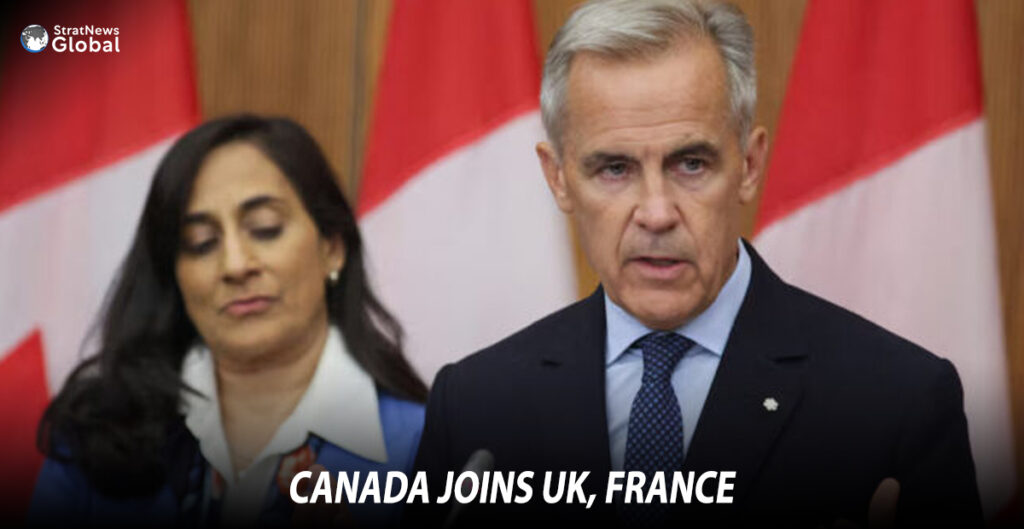
Canada Backs Palestinian Statehood As Gaza Crisis Worsens
Canadian Prime Minister Mark Carney on Wednesday announced that Canada will recognise the State of Palestine at a United Nations meeting in September, increasing pressure on Israel as the humanitarian crisis deepens in Gaza.
The announcement came after France said last week it would recognize a Palestinian state and a day after Britain said it would recognize the state at September’s UN General Assembly meeting if the fighting in Gaza, part of the Palestinian territories occupied by Israel, had not stopped by then.
Carney told reporters that the reality on the ground, including starvation of people in Gaza, meant “the prospect of a Palestinian state is literally receding before our eyes”.
“Canada condemns the fact that the Israeli government has allowed a catastrophe to unfold in Gaza,” he said.
Carney said the planned recognition was based in part on repeated assurances from the Palestinian Authority, which represents the State of Palestine at the UN, that it was reforming its governance and is willing to hold general elections in 2026 in which Hamas “can play no part”.
Growing Outrage
The announcements by some of Israel’s closest allies reflect growing international outrage over Israel’s restrictions on food and other aid to Gaza in its war against Hamas militants, and the dire humanitarian crisis there. A global hunger monitor has warned that a worst-case scenario of famine is unfolding in the enclave.
The Gaza health ministry reported seven more hunger-related deaths on Wednesday, including a two-year-old girl with an existing health condition. The Hamas-run government media office in Gaza said the Israeli military killed at least 50 people within three hours on Wednesday as they tried to get food from UN aid trucks coming into the northern Gaza Strip.
‘Reward For Hamas’
Israel and its closest ally, the US, both rejected Carney’s statements.
“The change in the position of the Canadian government at this time is a reward for Hamas and harms the efforts to achieve a ceasefire in Gaza and a framework for the release of the hostages,” the Israeli foreign ministry said in a statement. Israeli Prime Minister Benjamin Netanyahu made similar comments after the French and British announcements.
A White House official, speaking on condition of anonymity, said President Donald Trump also sees recognition of the State of Palestine as wrongly “rewarding Hamas”.
US special envoy Steve Witkoff is due to travel to Israel on Thursday to discuss Gaza. Trump said this week he expected centers to be set up to feed more people in the enclave.
The State of Palestine has been a non-member observer state of the UN General Assembly since 2012, recognized by more than three-quarters of the assembly’s 193 member states.
Jonathan Panikoff, former deputy US national intelligence officer on the Middle East, said recognition of Palestine is intended “to increase pressure on Israel to compel it to return to a two-state paradigm”. But he said Canada’s announcement is “unlikely to be anything more than symbolic and risks undermining their relationship with a longtime ally in Israel”.
French President Emmanuel Macron, who spoke with Carney before Canada’s announcement, said the recognition of Palestine will “revive a prospect of peace in the region”.
Possible Ultimatum To Hamas
Israeli security cabinet member Zeev Elkin said on Wednesday that Israel could threaten to annex parts of Gaza to increase pressure on Hamas, eroding Palestinian hopes of statehood on land Israel now occupies.
Mediation efforts to secure a 60-day ceasefire and the release of remaining hostages held by Hamas ground to a halt last week.
In Gaza, resident Saed al-Akhras said the recognition of Palestine by major powers marked a “real shift in how Western countries view the Palestinian cause.”
“Enough!” he said. “Palestinians have lived for more than 70 years under killing, destruction and occupation, while the world watches in silence.”
‘Violation Of International Law’
Families of Israeli hostages still held in Gaza appealed for no recognition of a Palestinian state to come before their loved ones were returned.
“Such recognition is not a step toward peace but rather a clear violation of international law and a dangerous moral and political failure that legitimizes horrific war crimes,” the Hostages Family Forum said.
Netanyahu said this month he wanted peace with Palestinians but described any future independent state as a potential platform to destroy Israel, so control of security must remain with Israel.
His cabinet includes far-right members who openly demand the annexation of all Palestinian land. Finance Minister Bezalel Smotrich said on Tuesday that reestablishing Jewish settlements in Gaza was “closer than ever,” calling Gaza “an inseparable part of the Land of Israel.”
Aid Going In, But Not Enough
A 2-year-old girl being treated for a build-up of brain fluid died overnight of hunger, her father told Reuters on Wednesday.
“Doctors said the baby has to be fed a certain type of milk,” Salah al-Gharably said by phone from Deir Al-Balah. “But there is no milk. She starved. We stood helpless.”
The deaths from starvation and malnutrition overnight raised the toll from such causes to 154, according to the Gaza health ministry, including at least 89 children, since the war’s start, most of them in recent weeks.
Israel said on Sunday it would halt military operations for 10 hours a day in parts of Gaza and designate secure routes for convoys delivering food and medicine.
The UN Office for the Coordination of Humanitarian Affairs said the United Nations and its partners had been able to bring more food into Gaza in the first two days of pauses, but the volume was “still far from enough.”
The war began on October 7, 2023, when Hamas led attacks on communities and military bases in southern Israel in which some 1,200 people were killed, including more than 700 civilians, and another 251 taken as hostages to Gaza, according to Israeli tallies.
Since then, Israel’s offensive in the Gaza Strip has killed more than 60,000 people and laid waste to much of the territory, the Gaza health ministry says.
(With inputs from Reuters)