

Support us by contributing to StratNewsGlobal on the following UPI ID
ultramodern@hdfcbank

Strategic affairs is our game, South Asia and beyond our playground. Put together by an experienced team led by Nitin A. Gokhale. Our focus is on strategic affairs, foreign policy and international relations, with higher quality reportage, analysis and commentary with new tie-ups across the South Asian region.
You can support our endeavours. Visit us at www.stratnewsglobal.com and follow us on YouTube, Twitter, Facebook and Instagram.
र 500 per month
र 1000 per month
र 5000 per year
र 10000 per year
Donate an amount of your choice
र 500 per month
Donate र 500 per month

र 1000 per month
Donate र 1000 per month
र 5000 per year
Donate र 5,000 per year
र 10000 per year
Donate र 10,000 per year
Donate an amount of your choice
Donate an amount of your choice
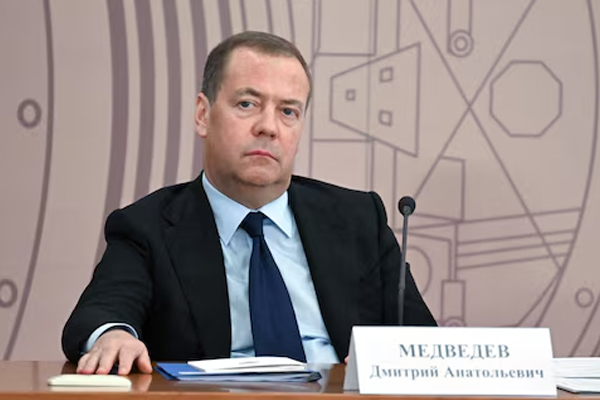
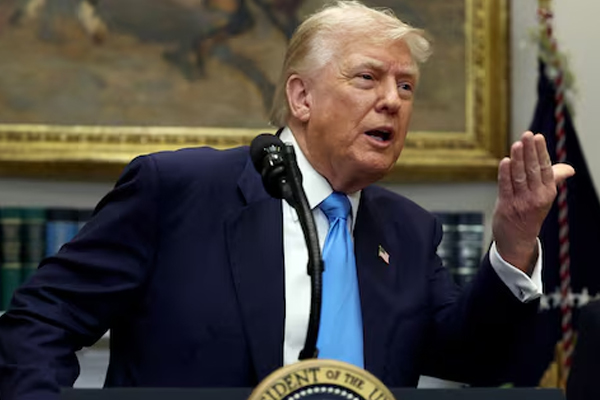

Medvedev Warns Trump Of Russia’s Doomsday Nukes Amid Escalating War Of Words
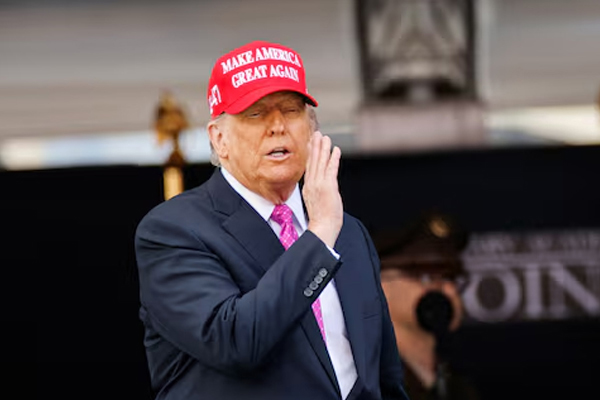
Former Russian President Dmitry Medvedev on Thursday warned United States President Donald Trump to remember Russia’s Soviet-era last-resort nuclear strike capabilities after Trump told him to “watch his words.”
Trump, in a post on his Truth social network in the early hours of Thursday, singled out Medvedev, who is deputy chairman of Russia’s Security Council, for sharp criticism after Medvedev said that Trump’s threat of hitting Russia and buyers of its oil with punitive tariffs was “a game of ultimatums” and a step closer towards a war between Russia and the United States.
“Tell Medvedev, the failed former President of Russia, who thinks he’s still President, to watch his words. He’s entering very dangerous territory!,” Trump wrote, in his second warning to the close ally of President Vladimir Putin in recent weeks.
Trump on July 29 said Russia had “10 days from today” to agree to a ceasefire in Ukraine or be hit, along with its oil buyers, with tariffs.
Moscow, which has set out its own terms for peace, which Kyiv says amount to demanding its capitulation, has not so far indicated it will comply with Trump’s deadline.
Trump, in his post on Thursday, said he didn’t care what India – one of Russia’s biggest oil buyers along with China – did with Russia.
“They can take their dead economies down together, for all I care. We have done very little business with India; their Tariffs are too high, among the highest in the World. Likewise, Russia and the USA do almost no business together. Let’s keep it that way,” he said.
‘The Fabled Dead Hand’
Medvedev said that Trump’s statement showed that Russia should continue on its current policy course.
“If some words from the former president of Russia trigger such a nervous reaction from the high-and-mighty president of the United States, then Russia is doing everything right and will continue to proceed along its own path,” Medvedev said in a post on Telegram.
Trump should remember, he said, “how dangerous the fabled ‘Dead Hand’ can be,” a reference to a secretive semi-automated Russian command system designed to launch Moscow’s nuclear missiles if its leadership had been taken out in a decapitating strike by a foe.
Medvedev has emerged as one of the Kremlin’s most outspoken anti-Western hawks since Russia sent tens of thousands of troops into Ukraine in 2022. Kremlin critics deride him as an irresponsible loose cannon, though some Western diplomats say his statements give a flavour of thinking in senior Kremlin policy-making circles.
Trump also rebuked Medvedev in July, accusing him of throwing around the “N (nuclear) word” after the Russian official criticised U.S. strikes on Iran and said “a number of countries” were ready to supply Iran with nuclear warheads.
“I guess that’s why Putin’s ‘THE BOSS'”, Trump said at the time.
(With inputs from Reuters)
Trump’s Tariffs To Face Crucial Test In US Appeals Court
A U.S. appeals court on Thursday will examine President Donald Trump’s authority to impose tariffs, following a lower court ruling that he overstepped with broad levies on imports.
The U.S. Court of Appeals for the Federal Circuit in Washington, D.C., will consider the legality of “reciprocal” tariffs that Trump imposed on a broad range of U.S. trading partners in April, as well as tariffs imposed in February against China, Canada and Mexico.
A panel of all of the court’s active judges, eight appointed by Democratic presidents and three appointed by former Republican presidents, will hear arguments scheduled to begin at 10 a.m. ET in two cases brought by five small U.S. businesses and 12 Democratic-led U.S. states.
The arguments – one day before Trump plans to increase tariff rates on imported goods from nearly all U.S. trading partners – mark the first test before a U.S. appeals court of the scope of his tariff authority. The president has made tariffs a central instrument of his foreign policy, wielding them aggressively in his second term as leverage in trade negotiations and to push back against what he has called unfair practices.
Tariff Authority Challenged
The states and businesses challenging the tariffs argued that they are not permissible under emergency presidential powers that Trump cited to justify them. They say the U.S. Constitution grants Congress, and not the president, authority over tariffs and other taxes.
Trump claimed broad authority to set tariffs under the International Emergency Economic Powers Act (IEEPA), a 1977 law historically used for sanctioning enemies or freezing their assets. Trump is the first president to use it to impose tariffs.
Trump has said the April tariffs were a response to persistent U.S. trade imbalances and declining U.S. manufacturing power.
He said the tariffs against China, Canada and Mexico were appropriate because those countries were not doing enough to stop illegal fentanyl from crossing U.S. borders. The countries have denied that claim.
On May 28, a three-judge panel of the U.S. Court of International Trade sided with the Democratic states and small businesses that challenged Trump. It said that the IEEPA, a law intended to address “unusual and extraordinary” threats during national emergencies, did not authorise tariffs related to longstanding trade deficits.
The Federal Circuit has allowed the tariffs to remain in place while it considers the administration’s appeal. The timing of the court’s decision is uncertain, and the losing side will likely appeal quickly to the U.S. Supreme Court.
The case will have no impact on tariffs levied under more traditional legal authority, such as duties on steel and aluminium imports.
Trump’s Tariff Threats
Trump’s on-again, off-again tariff threats have roiled financial markets and disrupted U.S. companies’ ability to manage supply chains, production, staffing and prices.
The president recently announced trade deals that set tariff rates on goods from the European Union and Japan, following smaller trade agreements with Britain, Indonesia and Vietnam.
Trump’s Department of Justice has argued that limiting the president’s tariff authority could undermine ongoing trade negotiations, while other Trump officials have said that negotiations have continued with little change after the initial setback in court.
Trump has set an August 1 date for higher tariffs on countries that don’t negotiate new trade deals.
There are at least seven other lawsuits challenging Trump’s invocation of IEEPA, including cases brought by other small businesses and California.
A federal judge in Washington, D.C., ruled against Trump in one of those cases, and no judge has yet backed Trump’s claim of unlimited emergency tariff authority.
(With inputs from Reuters)
Where Does India Trade In A Fragmenting World?
Last week India and the United Kingdom inked a Comprehensive Economic Trade Agreement (FTA). It is not India’s first such trade agreement and neither will it be the last.
At a time when the world economy is fragmenting due to geopolitics, the business, composition and direction of trade is being reinvented. The earlier mantra of identifying the cheapest product and locating the fastest route is no longer tenable.
What will be this new geometry of trade? How will India traverse this new world trade order?
To answer all this and more, StratNewsGlobal.Tech spoke to Harsh Pant, Professor of International Relations, King’s College, London on Capital Calculus.
Trump Envoy Witkoff Heads To Israel To Revive Gaza Truce Talks
U.S. special envoy Steve Witkoff was set to arrive in Israel on Thursday to revive stalled Gaza ceasefire talks and address a worsening humanitarian crisis, as a global hunger monitor warned of an unfolding famine in the Palestinian enclave.
Indirect ceasefire talks between Israel and Palestinian militant group Hamas in Doha ended in deadlock last week, with the sides trading blame for the impasse and gaps remaining over issues including the extent of Israeli forces’ withdrawal.
Witkoff, who will meet Israeli Prime Minister Benjamin Netanyahu, arrives as Israel faces mounting international pressure over Gaza, with Canada the latest Western power to say it will recognise a Palestinian state.
Israel on Wednesday sent a response to Hamas’ latest amendments to a U.S. proposal that would see a 60-day truce and the release of hostages in exchange for Palestinian prisoners, a source familiar with the details said.
There was no immediate comment from Hamas.
Gaza medical officials said at least 23 people were reported killed by Israeli fire across the enclave, including 12 people among crowds who had gathered to receive aid around the Netzarim corridor, an area held by Israeli troops in central Gaza.
The Israeli military said it was looking into the report.
Since the war began, the Gaza health ministry has recorded 154 deaths from starvation and malnutrition, most of them in recent weeks, including at least 89 children.
Facing mounting international outrage over images of starving children, Israel said on Sunday it would halt military operations for 10 hours a day in parts of Gaza and designate secure routes for convoys delivering food and medicine.
Calls On Hamas To Disarm
The U.N. Office for the Coordination of Humanitarian Affairs said on Wednesday that the United Nations and its partners had been able to bring more food into Gaza in the first two days of pauses, but the volume was “still far from enough.”
Even with more aid running through Gaza, residents face peril from Israeli forces and Palestinian looters when trying to reach the supplies.
“I have tried several times to grab a sack of flour. The only time I managed to do so, someone with a knife froze me in the street and took it away, threatening to stab me,” one man from Deir Al-Balah told Reuters, asking not to be identified.
With the number of Palestinians killed in almost two years of war passing 60,000 this week, pressure has been mounting in Gaza on Hamas to reach a ceasefire deal with Israel.
“We can save thousands of lives and maybe the war wouldn’t resume,” Rami from Gaza City told Reuters via a chat app.
In Israel, protests were expected in Tel Aviv and Jerusalem, calling on the government to end the war.
Netanyahu, whose ruling coalition includes two parties that want to conquer Gaza and reestablish Jewish settlements there, has said he will not end the war until Hamas no longer rules the enclave and lays down its arms. Hamas has rejected calls to disarm.
Qatar and Egypt, who are mediating the ceasefire efforts, backed a declaration on Tuesday by France and Saudi Arabia, which outlined steps for a two-state solution to the Israeli-Palestinian conflict.
The declaration says Hamas “must end its rule in Gaza and hand over its weapons to the Palestinian Authority”, which is led by its rivals and based in the Israeli-occupied West Bank. Israel has rejected the Palestinian Authority gaining control of Gaza.
Israel has denounced declarations by France, Britain and Canada since last week that they may recognise a Palestinian state, which Israel says amounts to rewarding Hamas for its October 7, 2023, attack on Israeli territory. That attack, when fighters killed 1,200 people and took 251 hostages back to Gaza, precipitated the war.
(With inputs from Reuters)
Myanmar Forms Interim Govt Before December Polls, But Top General Retains Control
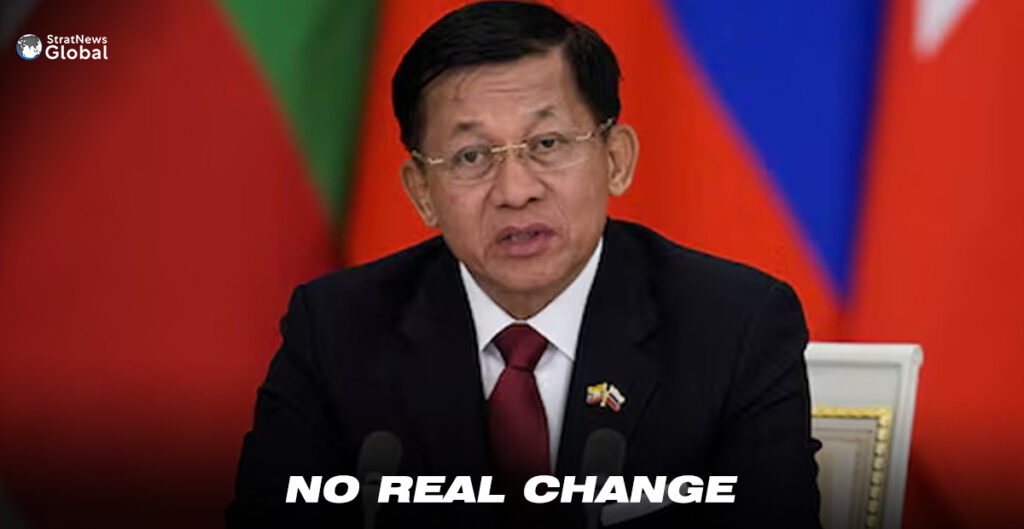
Myanmar military on Thursday nominally handed power to a civilian-led interim government ahead of December’s planned election, while the junta chief retained control as acting president.
An announcement in state media said a decree that granted power to the military after its 2021 coup had been cancelled and a caretaker administration had been formed alongside a special commission to oversee the election.
No Change In Status Quo
The move signals no change to the status quo in Myanmar, with coup leader Min Aung Hlaing holding on to all major levers of power as acting president while retaining his position as chief of the armed forces.
A state of emergency in place since the coup, which was due to expire on Thursday after seven extensions, has now been lifted, said Zaw Min Tun, a government spokesperson.
“The interim president and commander in chief said the upcoming six months are the time to prepare and host the election,” he told state media.
Myanmar has been in chaos since the coup against Aung San Suu Kyi’s elected civilian government plunged the Southeast Asian nation into civil war, with the military fighting to contain a rebellion and accused of widespread atrocities, which it denies.
The election has been dismissed by Western governments as a sham to entrench the generals’ power and is expected to be dominated by proxies of the military, with opposition groups either barred from running or refusing to take part.
David Mathieson, an independent Myanmar-focused analyst, said the change in power was cosmetic and those in charge would continue to be abusive and repressive.
“They are just rearranging the same pieces and calling the regime a new name,” he said. “Nothing will change in the near term, but this is part of preparations for an election which we don’t know much about.”
War Raging
The extent of the civil war’s impact on the planned election remains unclear. In an effort to create voter rolls, the junta held a nationwide census last year but was only about to conduct it in 145 out of Myanmar’s 330 townships – reflecting its lack of control over swathes of the country.
Established ethnic minority armies and new armed groups have mounted an unprecedented resistance against the military, gaining control of significant territory, including much of the country’s borderlands.
China’s foreign ministry said on Thursday it supported Myanmar’s efforts to achieve peace and reconciliation.
“China supports Myanmar’s development path in line with its national conditions and Myanmar’s steady advancement of its domestic political agenda,” spokesperson Guo Jiakun said.
The military has killed more than 6,000 people and arbitrarily detained over 20,000 since the coup, according to Amnesty International. Myanmar has also seen a return to judicial executions, and more than 3.5 million people are internally displaced, an Amnesty report said in January.
Myanmar’s military has dismissed allegations of abuses as Western disinformation.
It justified its 2021 coup as a necessary intervention following what it said was widespread fraud in an election three months earlier that was won decisively by Suu Kyi’s now defunct ruling party.
Election monitoring organisations found no evidence of fraud that would have changed the outcome.
(With inputs from Reuters)
Trump’s Fantasies Extend To India Buying Pakistani Oil
Was it pique with India that prompted Donald Trump to announce a trade deal with Pakistan? The latter announcement came hours after the US president announced 25% tariffs on goods imported from India.
For good measure, he had also added, “Pakistan and the US will work together on developing their massive oil reserves”, and raised the possibility of India buying oil from Islamabad sometime in the future.
Let’s look at the trade deal first: no details are available in the public domain. The word is it will be made public after similar negotiations with other countries are concluded. The negotiations seemed to have lasted all of four days and Prime Minister Shehbaz Sharif described it as “historic”. Reports suggest Pakistan has got relief from the 29% tariff threatened on its exports to the US. Total bilateral trade is a little over $7 billion in favour of Islamabad.
The oil deal has evoked interest. Contrary to Trump’s claim of
“massive oil reserves”, Pakistan’s reserves estimated in a 2016 study by the US Energy Information Administration, placed it at 353.3 million proven barrels. Current daily oil production in Pakistan is around 88,000 barrels which is below national consumption forcing the country to import.
A three-year survey conducted in Pakistan reportedly identified “large underwater structures with oil and gas signature”, but these claims are yet to be substantiated. In fact, Muhamad Arif a technical expert who had served with Pakistan’s Oil and Gas Regultory Authority, has said that these cannot yet be classified as “reserves.” This is because they are not discovered, commercially viable, and supported by a full development plan.
A 2022 report by the Express Tribune claimed Balochistan had recoverable oil reserves of 1.84 million barrels, 0.24 million of which had been used, and Khyber-Pathkunkhwa had 264.83 million of which 170.59 million were consumed. So far, Pakistan’s attempted explorations in these regions have been limited, largely due to security challenges.
As for exporting oil or gas to India, that maybe premature since there is no clarity on whether Pakistan has enough to export. Then again, given the strains in their relationship, it is unlikely India will want to get into a position of energy dependence on Pakistan.
(This article was written by Tisya Sharma, an Intern at StratNews Global)
UN Says M23 Rebel Attack Killed 169 Civilians In Eastern Congo
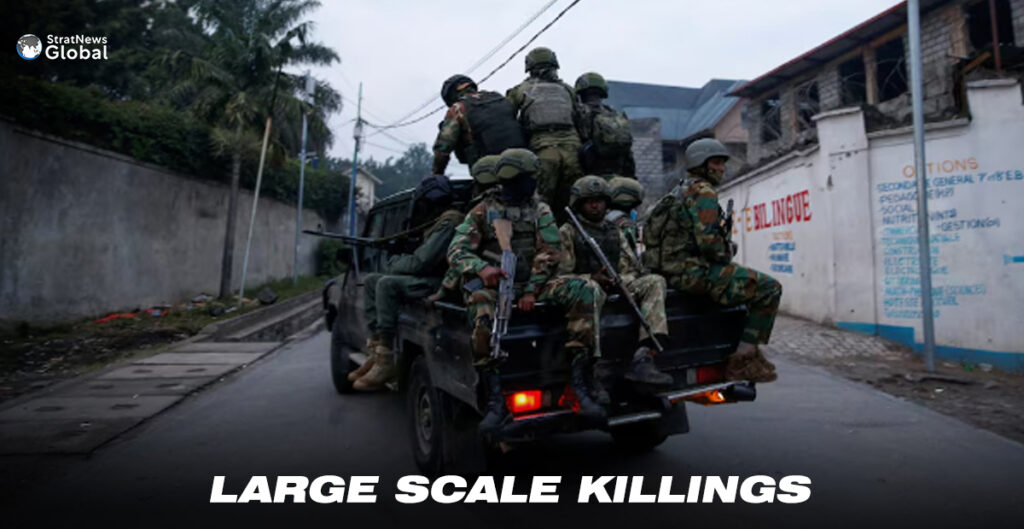
An M23 rebel assault on farmers and other civilians in eastern Democratic Republic of Congo killed 169 people earlier this month, a UN body said, marking one of the deadliest incidents since the Rwanda-backed group’s resurgence.
M23 leader Bertrand Bisimwa told Reuters it would investigate, but the report could be a “smear campaign”.
The UN rights body’s account has not been previously reported and emerged as U.S. President Donald Trump’s administration pushes for peace between Congo and Rwanda, which it hopes will unlock billions in mineral investments.
Reuters has not been able to independently confirm the killings, but a local activist cited witnesses as describing M23 combatants using guns and machetes to kill scores of civilians.
The M23 and Congolese government have pledged to work towards peace by August 18 after the rebels this year seized more territory than ever before in fighting that has killed thousands and displaced hundreds of thousands more.
Killings Started On July 9
According to findings by the U.N. Joint Human Rights Office (UNJHRO), which monitors Congo, the M23 operation that led to the farmers’ killings began on July 9 in the Rutshuru territory of North Kivu province.
It targeted suspected members of the Democratic Forces for the Liberation of Rwanda (FDLR), a Congo-based group that includes remnants of Rwanda’s former army and militias that carried out the 1994 Rwandan genocide, UNJHRO said.
“Civilians, mainly farmers temporarily camping in their fields for the ploughing season, have been attacked. The human toll has been particularly high: at least 169 people have been killed,” UNJHRO said in findings shared by Reuters.
The victims were “far from any immediate support or protection,” UNJHRO said, citing credible information from several independent sources.
In response, M23’s Bisimwa said the group had been notified about UNJHRO’s findings in a letter and would form a commission to investigate the unconfirmed accusations.
“We believe that before imposing sanctions, the facts must first be established by verifying their actual existence through an investigation,” he said.
“This rush to publish unverified information is propaganda whose purpose is known only to the United Nations Joint Human Rights Office,” he said, adding that the allegations could be part of a “smear campaign” by Congolese employees of UNJHRO.
UNJHRO is made up of the human rights division of Congo’s U.N. peacekeeping mission and the former office of the UN High Commissioner for Human Rights in Congo.
It has both Congolese and foreign staff members.
Hutu Farmers Targeted
The activist in Rutshuru, who did not want to be named for safety reasons, told Reuters the M23 combatants killed more than 100 civilians, mostly Congolese Hutu farmers.
The victims had initially fled when M23 advanced on the territory, but they returned after M23 promised them safety, the activist said.
U.N. human rights chief Volker Turk said last month that M23, Congo’s army and allied militias had all committed abuses in eastern Congo, many of which may amount to war crimes.
Rwanda has long denied helping M23 and says its forces act in self-defence against Congo’s army and ethnic Hutu militiamen linked to the 1994 Rwandan genocide, including the FDLR.
A report by a group of United Nations experts published this month said Rwanda exercised command and control over M23 and was backing the group in order to conquer territory in eastern Congo.
A government spokesperson said at the time that the report misrepresented Rwanda’s security worries related to the FDLR and affiliated groups. The spokesperson, Yolande Makolo, did not respond to a request for comment about UNJHRO’s findings.
Persistent violence in eastern Congo threatens Trump’s vision for the region, which has been plagued by war for decades and is rich in minerals including gold, cobalt, coltan, tungsten and tin.
Peace Deal
A peace agreement signed on June 27 in Washington by the Congolese and Rwandan foreign ministers requires Congo to “neutralise” the FDLR as Rwanda withdraws from Congolese territory.
Both the Congolese operations against the FDLR and the Rwandan withdrawal were supposed to have started on Sunday, though it is unclear what progress has been made.
They have three months to conclude.
Congolese government spokesperson Patrick Muyaya told Reuters the killings in Rutshuru demonstrate that M23 is a destabilising force incapable of bringing security.
Kinshasa wants a peace deal that will allow for the restoration of its authority in the region, Muyaya said.
(With inputs from Reuters)
Death Toll Climbs In Northern China After Torrential Rains, State Media Reports
Severe weather has killed at least eight people in Chengde, near Beijing, the Chinese capital, with 18 still missing after a week of heavy rainfall in the hilly region.
The deaths occurred in villages within the Xinglong area of Chengde in Hebei province, state-run Xinhua reported late on Wednesday, citing local authorities, without specifying when or how the people died.
Work is still underway to locate those missing, Xinhua said.
Set against mountainous terrain, Chengde was known as a resort town for Qing dynasty emperors to escape Beijing’s heat in the summer centuries ago.
Extreme rains that began last Wednesday have lashed Beijing and surrounding regions, pouring a year’s worth of rain in less than a week in some areas and killing at least 30 on the outskirts of the capital. Twenty-eight of those deaths occurred in the hilly Miyun district.
The deaths in Chengde occurred in villages which border Miyun and sit about 25 km (16 miles) away from the Miyun reservoir, the largest in China’s north.
Record Rainfall Impact
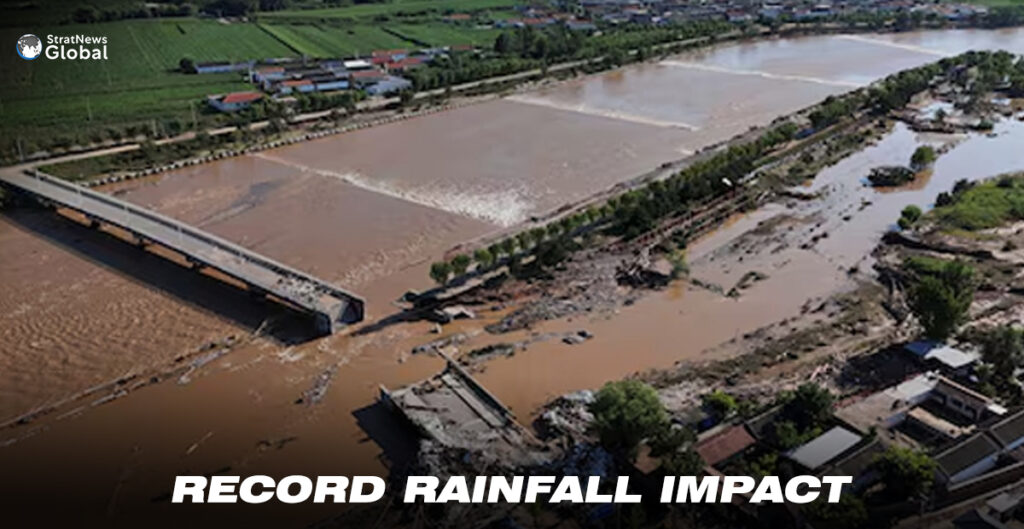
The reservoir saw record-breaking inflow and outflow of water, and overall water level and capacity during this round of rainfall, which devastated nearby towns.
At its peak on Sunday, up to 6,550 cubic metres of water – about 2.5 Olympic-sized pools – flooded into the reservoir every second, pushing its capacity to a record high of 3.63 billion cubic metres since it was built in 1960.
The villages where eight have died sit on higher elevations in a valley, upstream of the Miyun reservoir.
In another village to the north of the reservoir, a landslide on Monday killed eight people while four remained missing.
Extreme rainfall and severe flooding, which meteorologists link to climate change, increasingly pose major challenges for Chinese policymakers, with officials partially attributing a slowdown in factory activities to heavy rains and flooding.
(With inputs from Reuters)
Russian Missile And Drone Strikes On Kyiv Kill Six, Ukrainian Officials Say
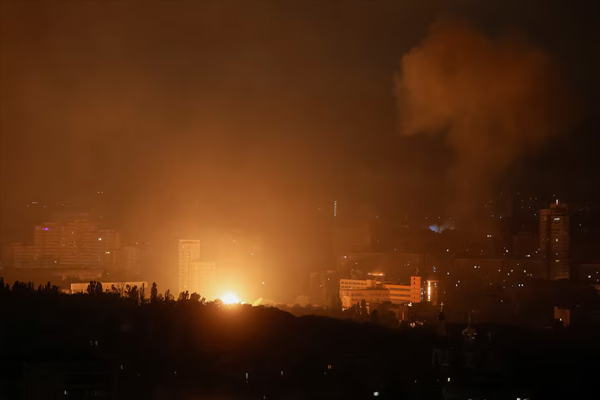
Russian missile and drone strikes on Kyiv killed at least six people—including a six-year-old boy and his mother—and left 82 others injured early on Thursday, according to Ukrainian officials.
President Volodymyr Zelenskyy said Russia launched more than 300 drones and eight missiles and hit residential buildings in the capital.
“Today, the world has once again seen Russia’s response to our desire for peace with America and Europe. Therefore, peace without strength is impossible,” Zelenskyy said on the Telegram app.
Kyiv Mayor Vitali Klitschko said nine children were wounded, the largest number hurt in a single night in the city since Russia started its full-scale invasion almost three and a half years ago.
Yurii Kravchuk, 62, stood wrapped in a blanket next to a damaged building, with a bandage around his head. He heard the missile alert but did not get to a shelter in time, he told Reuters.
“I started waking up my wife, and then there was an explosion … My daughter ended up in the hospital.”
Emergency crews were putting out fires and cutting through concrete blocks in search of survivors across the city.
Explosions rocked Kyiv for hours and blazes lit up the night sky. Schools and hospitals were among the buildings that took hits across 27 locations in the city, officials said.
The air force reported five direct missile hits and 21 drone hits in 12 locations.
Russia, which denies targeting civilians, has stepped up air strikes on Ukrainian towns and cities far from the front line of the war in recent months.
U.S. President Donald Trump said on Tuesday that the United States would start imposing tariffs and other measures on Russia “10 days from today” if Moscow showed no progress toward ending the conflict.
“This is Putin’s response to Trump’s deadlines,” Prime Minister Yulia Svyrydenko said. “The world must respond with a tribunal and maximum pressure.”
Zelenskyy posted a video of burning ruins, saying people were still trapped under the rubble of one partially-ruined residential building.
Ukrainian air defence units downed 288 attack drones and three cruise missiles, the air force said.
(With inputs from Reuters)
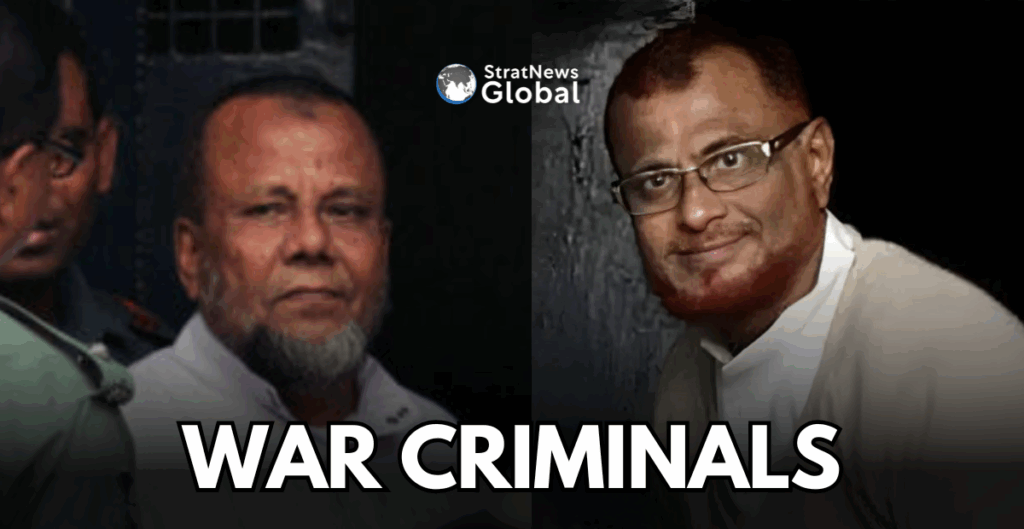
Bangladesh: Acquittal Of 1971 War Criminals Raises Serious Questions
Some say it’s a sign of the times; Two persons convicted and sentenced to death for crimes against humanity during the Bangladesh liberation war of 1971 are now free men. While one of them, Mobarak Hossain, was acquitted by the Supreme Court on Wednesday, the other Jamaat leader, Azharul Islam, was acquitted four months ago, and critics say the interim government of Mohammad Yunus is soft on such extremists.
Important to note that Hossain had been sentenced to death by the International Crimes Tribunal Bangladesh, which noted that “It is well-proved that the accused was a member of Razakar Bahini at his locality during the Liberation War in 1971 and he actively and directly participated in different atrocious activities committed by local Razakar Bahini in association with the Pakistani occupation force.”
The Tribunal, while acquitting him of three charges, sentenced him to death for “Abduction, torture and killing of 33 unarmed civilians on the bank of Ganga Sagar Dighi of village Tanmandayl under Akhaura Police Station, District- Brahmanbaria.” Hossain, of course, had appealed against the ruling 11 years ago and is now free.
As for Jamaat-e-Islami leader Azharul Islam, the charges against him included rape, abduction, and charges of murder during the 1971 war. The Jamaat had opposed the war of liberation that saw East Pakistan break away and emerge as Bangladesh, siding with the Pakistani army. In this context, the acquittal of Azharul Islam sparked protests among left-leaning students in Dhaka University and Rajshahi University.
Shimul Kumbhakar of the Bangladesh Students Union warned that if the “Interim government continues releasing Razakar and Al Badr (Pak army collaborators) members and fully absolving them of their crimes, it will face the same downfall as the fascist Hasina regime.”
It remains to be seen how many more such acquittals take place under Mohammad Yunus’ watch. Recall that under Sheikh Hasina, no less than five prominent leaders who had opposed the liberation war and supported the Pakistan Army’s genocide were hanged. Clearly, times have changed.
(This article was written by Tisya Sharma. She is an intern at StratNews Global.)