

Support us by contributing to StratNewsGlobal on the following UPI ID
ultramodern@hdfcbank

Strategic affairs is our game, South Asia and beyond our playground. Put together by an experienced team led by Nitin A. Gokhale. Our focus is on strategic affairs, foreign policy and international relations, with higher quality reportage, analysis and commentary with new tie-ups across the South Asian region.
You can support our endeavours. Visit us at www.stratnewsglobal.com and follow us on YouTube, Twitter, Facebook and Instagram.
र 500 per month
र 1000 per month
र 5000 per year
र 10000 per year
Donate an amount of your choice
र 500 per month
Donate र 500 per month

र 1000 per month
Donate र 1000 per month
र 5000 per year
Donate र 5,000 per year
र 10000 per year
Donate र 10,000 per year
Donate an amount of your choice
Donate an amount of your choice
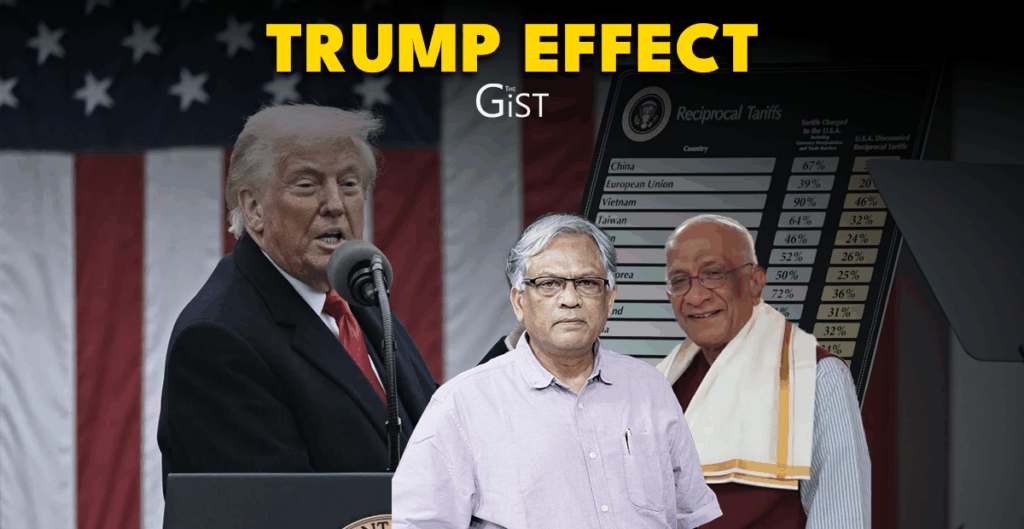


‘Trump’s Involvement In Trade Talks Complicates Issues For India’
“It is not normal, to see a head of state inserting himself or herself into the negotiations at this level. And normally trade negotiations are, you know, complex.”
That was former diplomat and trade expert V S Seshadri, talking to The Gist on the India-US bilateral trade negotiations and President Trump’s rather insulting remarks about this country.
India has not reacted to his insults, preferring to stick to the book, focusing on the negotiations and expressing its hopes for an agreement fair to both countries. But the Trump factor cannot be ignored.
“Trump is trying to achieve three or four things,” says Seshadri, “he’s trying to see if we can reduce the significant levels of trade deficit. He’s trying to see if he can increase domestic US manufacturing, which he feels, has got neglected.”
Trump also wants to reduce US dependence on strategic materials such as steel and aluminium, copper, pharmaceuticals, semiconductors and so on. He’s also trying to see if he can revenues by using tariffs as leverage and by using market access to the US as leverage.
Seshadri believes Trump does not have a uniform template applied in negotiations with every country. Of the six or seven countries he has struck deals with so far, in the case of the EU, Japan, Korea, all developed countries with some surplus capital to invest, he has got them to make commitments to invest in the US.
“He’s quite flexible in that sense, he’s ready to take whatever’s coming, does it meet his expectations and then of course he has to read it to his MAGA crowd, his domestic constituency.”
Trump’s personal involvement in the negotiations complicates issues for countries like India that approach things systematically, step-by-step and want everything documented. Trump’s desire for big announcements that are made followed by negotiations on the details undermines the Indian approach.
Tune in for more in this conversation with Ambassador V S Seshadri, former diplomat and trade expert.
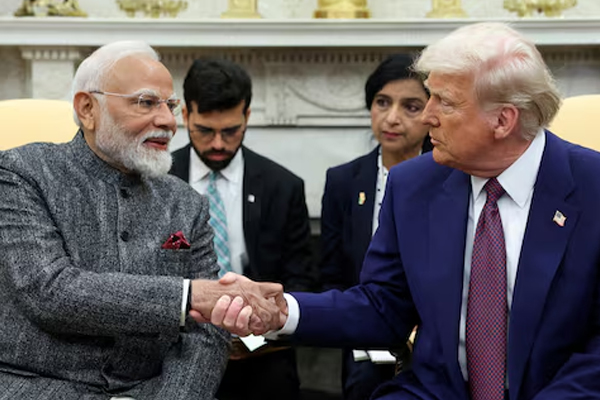
India Engaged In Trade Talks With US After Trump Imposes 25% Tariff On Exports
India is currently engaged in trade talks with the United States, a government source said on Friday, one day after President Donald Trump imposed a 25% tariff on Indian exports.
Trump set steep import duties on dozens of trading partners, including a 35% tariff on many goods from Canada, 50% for Brazil, 20% for Taiwan and 39% for Switzerland, according to a presidential executive order.
A U.S. delegation is expected to visit New Delhi later this month, the government source said.
“We remain focused on the substantive agenda that our two countries have committed to and are confident that the relationship will continue to move forward,” India’s foreign ministry said in a statement on Friday.
Agriculture Access Stalls Progress
Trade talks between Washington and New Delhi have been bogged down by issues including access to India’s highly protected agriculture and dairy sector.
Nearly $40 billion worth of exports from the South Asian nation – the world’s fifth-largest economy – could be impacted by Trump’s tariff salvo, according to the source.
Without a deal, the rate singles out India for harsher trade conditions than its major peers, potentially damaging the economy of a strategic U.S. partner in Asia that is seen as a counterbalance to Chinese influence.
The source said there is no question of compromising on India’s agriculture and dairy sectors, especially not allowing the import of dairy products due to religiously based opposition to animal feed in these products.
On Wednesday, Trump also threatened additional penalties on India for its commercial dealings with Russia and membership in the BRICS group of major emerging and developing economies. There is no clarity yet on the penalty. Trump accuses BRICS of pursuing “anti-American policies”.
Differences between the U.S. and India cannot be resolved overnight to arrive at a trade deal, a senior U.S. official said on Thursday.
The U.S. has a trade deficit of $46 billion with India.
(With inputs from Reuters)
US, Australia Conduct First-Ever Joint Military Drills In Papua New Guinea
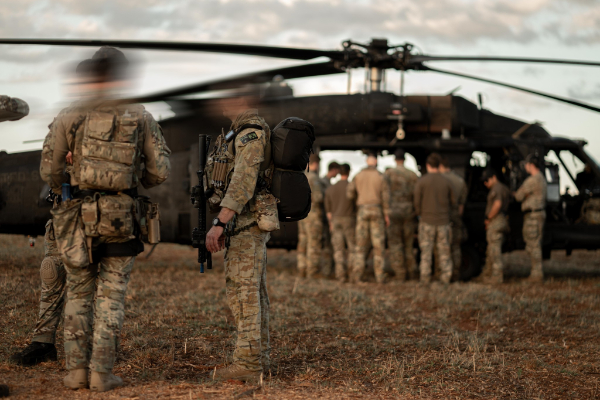
The joint U.S.-Australian military exercise Talisman Sabre stretched across 500 km of Papua New Guinea’s (PNG) remote northern coast this week, marking the first time the war games have been conducted outside Australia, according to officials.
Talisman Sabre exercises in Australia last month involved 40,000 troops from 19 countries.
For the Papua New Guinea component, U.S., Australian and PNG forces are conducting disaster recovery and survival exercises through seven regions of PNG, moving through terrain from Wewak to Lae that saw fierce fighting between Japan and the U.S. in World War Two.
The PNG activities test “combined capabilities across sea, land, air, cyber, and space operations”, a U.S. Embassy spokesperson said in a statement.
The Talisman Sabre closing ceremony will be held on Monday in the PNG city of Lae.
Strategic Access
The U.S. military gained access to Lae’s major seaport under a 2023 defence deal with PNG, signed after China struck a security pact with neighbouring Solomon Islands.
The PNG defence agreement will “enhance security and prosperity for both nations”, the U.S. embassy spokesperson added.
Papua New Guinea’s Prime Minister James Marape met the U.S. under secretary for defence policy, Elbridge Colby, in Washington last month to discuss regional security challenges, with Marape raising “the importance of defending Papua New Guinea’s sovereignty”, said the embassy spokesperson.
Colby has reportedly pressed U.S. allies Australia and Japan to clarify what role they would play if the U.S. and China went to war over Taiwan.
China has been a major infrastructure lender to PNG, and Marape’s office did not respond to a Reuters request for comment.
Another key PNG site listed in the U.S. defence agreement is the Lombrum Naval Base, which PNG’s Defence Minister Billy Joseph recently said will be officially handed over by Australia in a ceremony later this month, after a multi-million dollar renovation.
Australia outbid China to upgrade the strategically located navy base in 2018.
China’s embassy in PNG last week posted social media images of Joseph at a local event celebrating the founding of the People’s Liberation Army, and said China was willing to deepen military cooperation with PNG.
(With inputs from Reuters)
China’s Mega Dam And India’s Asymmetric Challenge
Part I: Promises Vs. Power: China’s Mega Dam Contradiction
India’s response to China’s mega dam project on the Yarlung Tsangbo (as the Brahmaputra is known in Tibet) near the Great Bend, where the river curves sharply before entering India, remains mired in internal contradictions.
Officials have proposed two key storage dams in Arunachal Pradesh — at Yinkiong and downstream toward Upper Siang — with a combined storage capacity of 9.2 billion cubic metres. These would help store excess monsoon flow and act as shock absorbers for sudden upstream discharges.
But these plans, as noted by a senior Indian specialist on water resources, remain mostly on paper. The upstream Chinese dam is already under construction.
Ironically, the very risks India worries about from China’s dam are mirrored in opposition to its own: fragile terrain, seismic vulnerability, and local livelihoods. The 510-metre FRL planned for the Indian dam would submerge significant portions of Yinkiong and impact defence infrastructure, requiring major relocations.
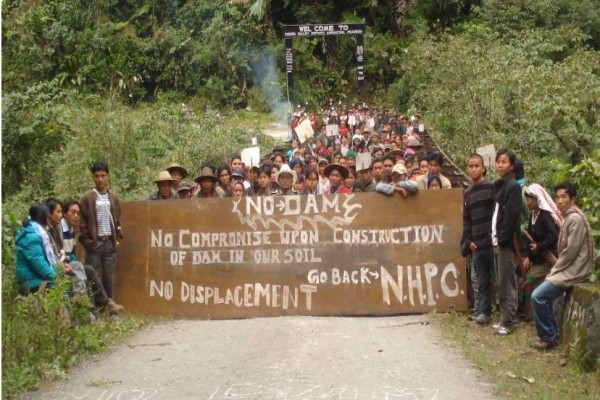
Local communities have strongly opposed these projects, citing ecological risks and displacement. Past efforts, such as the Upper Siang multipurpose project, have been shelved for similar reasons.
The state’s location in a seismic hotspot further complicates matters. Memories of past disasters, including the 1950 Rima earthquake and the 2017–2018 landslides upstream in Tibet, have made the population more wary of massive infrastructure projects. While China pushes ahead with its mega project in the same vulnerable terrain, India must contend with a different reality — one shaped by democratic norms, legal checks, and people’s voices.
Events in 2017 and 2018 have only heightened these concerns. The landslides and earthquakes upstream turned the Siang black and blocked flows, revealing the fragility of both the river system and India’s monitoring capabilities.
Even as China builds aggressively in this high-risk terrain, India must weigh its response more cautiously. The memory of past disasters — the 1950 quake, the 2017 landslides, and the 2018 river blockages — makes local resistance both grounded and legitimate.
India has established an extensive network of automated river sensors at Tuting, Yinkiong, Pasighat, and other sites. These stations allow for near-real-time tracking of water levels, turbidity, and flow. But they are early warning systems, not preventive mechanisms. With the termination of the data-sharing agreement by China in 2023, India now flies blind to upstream developments unless they become immediately visible — or catastrophic.
India’s actionable paths are limited but not absent. Several strategic, diplomatic, and technical options could bolster India’s position:
- Expedite Domestic Infrastructure: Responsibly fast-tracking the Yinkiong and Upper Siang projects is essential, but it must be done in consultation with local communities, using environmentally sensitive designs, seismic risk modelling, and compensation mechanisms.
- Enhance Bilateral and Trilateral Mechanisms: India could push for the revival of hydrological data-sharing mechanisms with China — or propose a new framework involving Bangladesh. The absence of a basin-level institution like the Mekong River Commission makes the Brahmaputra basin vulnerable to unilateral actions.
- Regional Coordination with Bangladesh: India and Bangladesh share strong ties, but Brahmaputra water flows remain a delicate subject. India can initiate joint assessments with Dhaka to determine potential downstream impacts and present a united front in discussions with Beijing.
- International Advocacy on Ecological Risk: India can raise awareness in UN forums, the World Bank, and climate conferences, emphasising the ecological and geological threats posed by mega infrastructure in the Himalayas. Xi Jinping’s pledges at the 7th Tibet Work Forum offer diplomatic leverage to highlight the contradiction between words and actions.
- Invest in Resilience and Forecasting Systems: India must upgrade its flood forecasting systems and invest in resilient infrastructure downstream in Assam and West Bengal. This includes strengthening embankments, improving reservoir management, and modernising irrigation systems.
- Use Satellite Monitoring for Transparency: With bilateral data unavailable, India should expand use of remote sensing and AI-driven modelling to monitor upstream activity in Tibet. Partnering with space-faring nations and agencies (like ISRO, NASA) can help maintain a credible, independent information flow.
- Public Diplomacy and Strategic Messaging: India can also shape global narratives through research institutes, media, and strategic forums — highlighting how the Great Bend project could destabilise fragile ecosystems and jeopardise millions of lives downstream.
India’s challenge lies in asymmetry. While China moves swiftly, India is held back by constitutional safeguards, environmental laws, and democratic resistance. That these are strengths, not weaknesses, should be India’s narrative — but they also demand better governance and faster action.
It is also a reminder that water, once seen as a benign natural resource, is fast becoming a strategic asset. Hydrological dominance in the Himalayas could offer political leverage, economic security, or a trigger for conflict.
India cannot match China dam for dam — nor should it attempt to. But it must prepare to safeguard its interests through a mix of infrastructure, diplomacy, resilience, and regional alliances. The disasters of the past — and the dam being built today — offer ample reason to act before the next crisis arrives.
Whether or not China acts responsibly, India must. And that means moving from reaction to readiness — before the next flood, quake, or landslide turns warning into catastrophe.
Part III: Strategic Waters: India’s Dam Dilemma in Arunachal Pradesh
Pacific Island Nation Of Tuvalu May Go Under The Waves In 25 Years
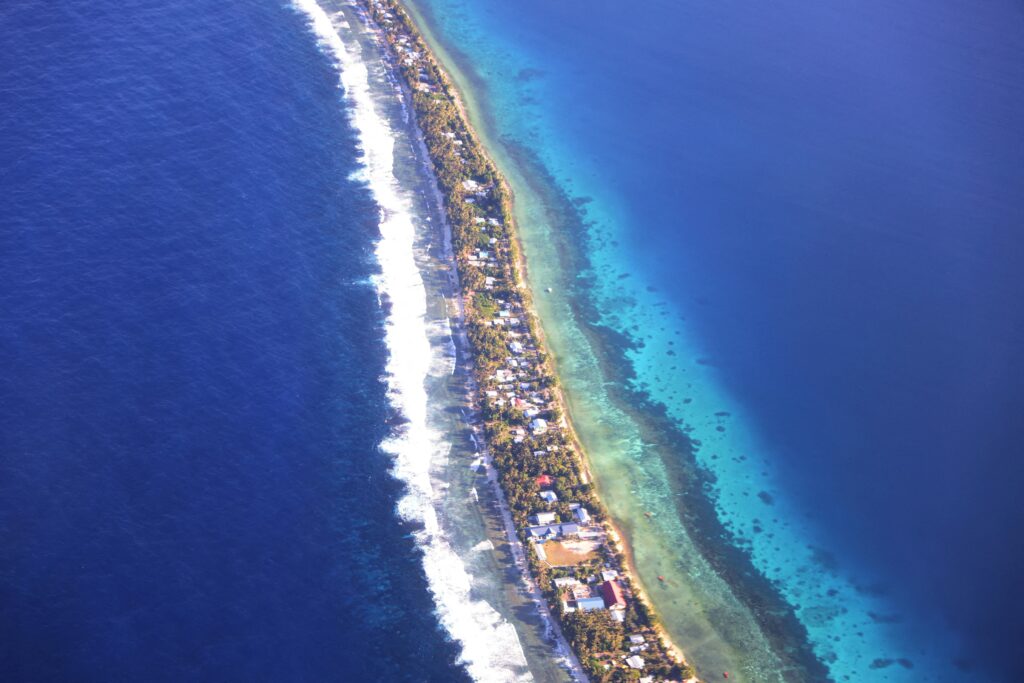
In about 25 years from now, the Pacific island nation of Tuvalu may completely disappear due to rising sea levels and climate change, says a report in Wired magazine. The report quotes from a study by NASA’s Sea Level Change Team, that in 2023 Tuvalu’s nine coral islands and atolls lay just two metres above sea level, “making them extremely vulnerable to rising ocean, flooding and storm surges all exacerbated by the climate crisis.”
In fact, Tuvalu could be the first country to see its entire population of about 11,000 move to greener pastures, notably Australia which has pioneered a “climate visa” programme to victims of such tragedies.
The Tuvalu government had announced plans three years back to become the world’s first digital nation, even rewriting the constitution to define itself as a virtual state. Government functions are being digitised and Tuvalu’s history and culture will be preserved online even when the country no longer exists physically.
Tuvalu, however, is not the only island vulnerable to this. Maldives, the lowest lying country in the world, also faces this threat, with its 1200 islands just 1.5 meters above sea level. According to data from earth.org, 77% of its land area is predicted to be underwater by 2100, with a 2021 report by NASA concluding low-lying islands could become uninhabitable by 2050.
The escalating impacts of rising sea levels also seem to be reshaping India’s coastline, impacting socio-economic conditions especially in southern India. A report last year by the Tamil Nadu government titled Climate Risk Assessment and Adaptation plan, warned that by 2050, 6,000 hectares of land across the three eastern districts of Tiruvarur, Nagapattinam, and Thanjavur could go under water.
Worse still, coastal communities which have been historically dependent on fishing and agriculture, are now being displaced and forced to migrate due to these rising sea levels, and saltwater intrusion.
An Advisory Opinion delivered by the International Court of Justice on 23rd July, titled “Obligations of State in Respect of Climate Change” , underscored that under Laws of the Seas, states are obliged to work together in the context of sea level rise. This is important for rights of states and communities affected by climate change. But the court has no power over sovereign governments.
Rise in sea levels is driven by carbon emissions, and industrialised nations bear a large share of the blame for the manner in which they have degraded the environment in the pursuit of economic growth and wealt accumulation. This issue requires major policy changes and contributions especially by emitters like the U.S., to international climate commitments. But under President Trump, “drill baby drill” is the catchword and US oil and gas exploration is expected to see a significant boost.
(This article was written by Tisya Sharma, an Intern at StratNewsGlobal)
Europe Ramps Up Climate Monitoring, Seeks Independence From US Data
Countries in Europe are moving to reduce their reliance on critical scientific data long provided freely by the United States, instead accelerating the development of their own climate and weather monitoring systems, according to Reuters interviews.
The effort – which has not been previously reported – marks the most concrete response from the European Union and other European governments so far to the U.S. government’s retreat from scientific research under President Donald Trump’s administration.
Since his return to the White House, Trump has initiated sweeping budget cuts to the National Oceanic and Atmospheric Administration, the National Institutes of Health, the Environmental Protection Agency, the Centres for Disease Control and other agencies, dismantling programs conducting climate, weather, geospatial and health research, and taking some public databases offline.
As those cuts take effect, European officials have expressed increasing alarm that – without continued access to U.S.-supported weather and climate data – governments and businesses will face challenges in planning for extreme weather events and long-term infrastructure investment, according to Reuters interviews. In March, more than a dozen European countries urged the EU Commission to move fast to recruit American scientists who lost their jobs to those cuts.
Asked for comment on NOAA cuts and the EU’s moves to expand its own collection of scientific data, the White House Office of Management and Budget said Trump’s proposed cuts to the agency’s 2026 budget were aimed at programs that spread “fake Green New Scam ‘science,'” a reference to climate change research and policy.
“Under President Trump’s leadership, the U.S. is funding real science again,” Rachel Cauley, an OMB spokesperson, said via email.
European officials told Reuters that – beyond the risk of losing access to data that is bedrock to the world’s understanding of climate change and marine systems – they were concerned by the general U.S. pullback from research.
“The current situation is much worse than we could have expected,” Sweden’s State Secretary for Education and Research, Maria Nilsson, told Reuters. “My reaction is, quite frankly, shock.”
The Danish Meteorological Institute described the U.S. government data as “absolutely vital” – and said it relied on several data sets to measure, including sea ice in the Arctic and sea surface temperatures.
“This isn’t just a technical issue; reliable data underpins extreme weather warnings, climate projections, protecting communities and ultimately saves lives,” said Adrian Lema, director of the DMI’s National Centre for Climate Research.
Reuters interviewed officials from eight European countries who said their governments were undertaking reviews of their reliance on U.S. marine, climate and weather data. Officials from seven countries – Denmark, Finland, Germany, Netherlands, Norway, Spain and Sweden – described joint efforts now in the early stages to safeguard key health and climate data and research programs.
Leaning On The US
As a priority, the EU is expanding its access to ocean observation data, a senior European Commission official told Reuters. Those data sets are seen as critical to the shipping and energy industries as well as early storm warning systems.
Over the next two years, the senior official said, the EU plans to expand its own European Marine Observation and Data Network, which collects and hosts data on shipping routes, seabed habitats, marine litter and other concerns.
The initiative was aimed at “mirroring and possibly replacing US-based services,” the senior European Commission official told Reuters.
Europe is particularly concerned about its vulnerability to U.S. funding cuts to NOAA’s research arm that would affect the Global Ocean Observing System, a network of ocean observation programs that support navigation services, shipping routes and storm forecasting, a second EU official told Reuters.
The insurance industry relies on the Global Ocean Observing System’s disaster records for risk modelling. Coastal planners use shoreline, sea-level, and hazard data to guide infrastructure investments. The energy industry uses oceanic and seismic datasets to assess offshore drilling or wind farm viability.
In addition, the senior EU Commission official said, the EU is considering increasing its funding of the Argo program, a part of the Global Ocean Observing System which operates a global system of floats to monitor the world’s oceans and track global warming, extreme weather events and sea-level rise.
NOAA last year described the program, in operation for over 25 years, as the “crown jewel” of ocean science. It makes its data freely available to the oil and gas industry, marine tourism and other industries.
The United States funds 57% of Argo’s $40 million annual operating expenses, while the EU funds 23%. The White House and NOAA did not respond to questions about future support for that program.
The European moves to establish independent data collection and play a bigger role in Argo represent a historic break with decades of U.S. leadership in ocean science, said Craig McLean, who retired in 2022 after four decades at the agency. He said U.S. leadership of weather, climate and marine data collection was unmatched, and that through NOAA, the U.S. has paid for more than half of the world’s ocean measurements.
European scientists acknowledge the outsized role the U.S. government has played in global scientific research and data collection – and that European countries have grown overly dependent on that work.
“It’s a bit like defence: we rely heavily on the U.S. in that area, too. They’re trailblazers and role models—but that also makes us dependent on them,” Katrin Boehning-Gaese, scientific director of Germany’s Helmholtz Centre for Environmental Research, told Reuters.
(With inputs from Reuters)
Indonesia’s President Prabowo Pardons Two Jailed Political Rivals
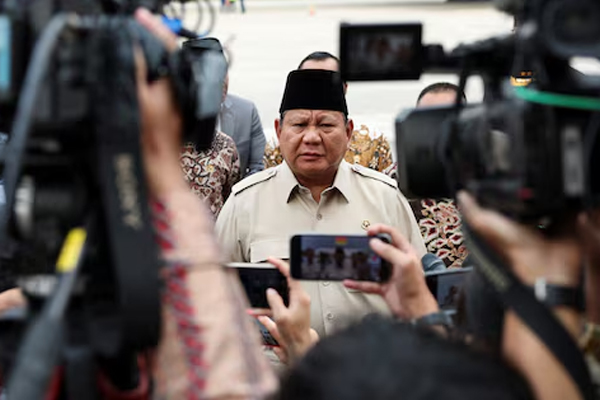
Indonesian President Prabowo Subianto has pardoned two political rivals—a former trade minister and a senior opposition politician—just weeks after both received jail sentences, officials said.
Prabowo granted amnesty to Hasto Kristiyanto, the secretary general of parliament’s largest party, the Indonesian Democratic Party of Struggle (PDIP), Law Minister Supratman Andi Agtas said late on Thursday in a news conference broadcast by local media, after meeting the House’s deputy speaker.
Hasto was sentenced to 3-1/2 years in prison last week for bribing an election official, but the amnesty revokes his sentence, though his conviction will still stand.
The president also granted an abolition for Thomas Trikasih Lembong, a trade minister under President Joko Widodo, who was sentenced to 3-1/2 years in prison for improperly granting sugar import permits, Supratman said in the news conference.
The abolition means Lembong, who was the campaign manager of Prabowo’s rival candidate in last year’s presidential election, is acquitted of the charges and his sentence.
Clemencies Mark Unity Effort
Prabowo granted the clemencies as the government sees the need to unite all political elements and as part of Indonesia’s independence celebrations in August, said Supratman.
“We need to build this nation together, with all the political elements … And both have contributed to the republic,” Supratman said.
It is common for the Indonesian president to give pardons ahead of the national independence day on August 17. The amnesty for Hasto was among the pardons given to more than 1,100 other people, Supratman added.
Lawyers for Hasto and Lembong did not immediately respond to Reuters’ request for comments.
Under Indonesian law, the president has the authority to give amnesty and abolition, but it requires approval from the parliament, said Bivitri Susanti from Indonesia’s Jentera School of Law.
Still, she said the amnesty given to Hasto was rather “political” to gain support from the largest opposition party in the parliament, while for Lembong, the government is responding to growing protests from the public over his sentence.
Other observers were concerned that the pardons undercut efforts by the judiciary to deal with corruption in a country where concerns about graft and government misconduct are high.
“It shows that the government could intervene in law enforcement, make it a political bargain,” said Muhammad Isnur from the rights group Indonesian Legal Aid Foundation.
(With inputs from Reuters)
Israel Agreed To Match $30M US Aid To GHF, Trump Officials Told Congress
Senior Trump administration officials informed Congress this month that Israel had agreed to match a $30 million U.S. grant to the Gaza Humanitarian Foundation (GHF), according to two sources familiar with the matter, marking a previously undisclosed contribution to the controversial armed private aid initiative.
Aside from the U.S. contribution, which the U.S. State Department announced in June, the sources of the foundation’s funding have been opaque – GHF does not disclose its donors.
Global Pressure
Israel faces intensifying international pressure over the humanitarian crisis in Gaza and its promotion of GHF’s aid operation, which has distribution sites only in southern Gaza and has been called dangerous and ineffective by aid groups and the United Nations – claims the group denies.
Aryeh Lightstone and Charles Leith, aides to Trump’s Middle East envoy Steve Witkoff, briefed U.S. Senate and House of Representatives committees on July 8 and 9 about the GHF operation, according to the two sources.
They told the congressional committees that Israel had agreed to match the $30 million that the U.S. awarded to GHF in June, enough to fund the organisation through the end of July, according to the sources, who spoke on condition of anonymity.
Lightstone and Leith did not respond to a request for an interview, and the White House referred questions to the State Department.
Donors Pledge Millions
Donors “have pledged or disbursed tens of millions of dollars to GHF,” a State Department spokesperson said, without identifying those donors.
“The United States has pledged tens of millions of dollars,” the spokesperson continued, adding that the U.S. aid “does not come close to encompassing the total amount of help the administration has given the people of Gaza since January 2025.”
The Israeli government did not respond to requests for comment.
$60M For Gaza Aid
President Donald Trump said on Monday that the U.S. had dispensed $60 million for Gaza humanitarian aid. The State Department, however, has made no other announcements beyond the $30 million approved for the GHF in June.
A third source familiar with the matter said some U.S. officials believe Trump likely was conflating the U.S. and Israeli funds.
Lightstone and Leith told Congress that the hope was that by August, other donors would see GHF’s success and contribute to its operation, allowing the foundation to double its distribution sites from four to eight, according to the sources.
Reuters could not verify whether Israel had disbursed the $30 million to GHF, which uses private for-profit U.S. military and logistics firms to transport aid into the Palestinian enclave for distribution to its sites.
More Funds Needed
Speaking on Wednesday to the Hudson Institute think tank, GHF Executive Chairman Rev. Dr. Johnnie Moore, a former evangelical adviser to the White House during Trump’s first term, said that as a private U.S. charity, the foundation did not have to disclose its donors.
He indicated that GHF required more money. “The biggest problem is just we need more of it, and $30 million is not going to get it done,” he said, in an apparent reference to the U.S. contribution.
GHF said in an email to Reuters that it was focused on distributing as much food as was safely possible and was continuing to press the Israeli government to allow it to open additional distribution sites, including in northern Gaza. It declined to comment on its donors or funding.
Starvation In Gaza
GHF has been criticised by the United Nations, aid groups and others over what they say is an unsafe aid distribution model and a breach of humanitarian impartiality standards, allegations that GHF denies.
Israel alleges that the U.N.-led aid system that has traditionally served the residents of Gaza has let Hamas-led militants loot aid shipments intended for civilians.
Hamas denies the accusation.
A recent U.S. government internal analysis found no evidence of systematic theft of U.S.-funded aid by Hamas.
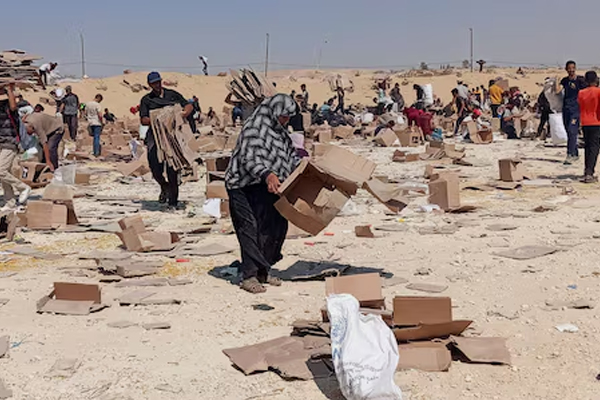
Starvation has been spreading in Gaza, and a hunger monitor on Tuesday said a worst-case scenario of famine is unfolding and immediate action is needed to avoid widespread death.
In his Wednesday remarks, Moore denied that famine is developing. “That’s made up. There’s not a famine. There’s acute hunger. There’s not enough food in the Gaza Strip,” he said.
Deadly Hunger
Gaza health authorities have been reporting increasing deaths from hunger-related causes, and images of emaciated Palestinian children have drawn international condemnation.
Trump this week declared that many people were starving, contradicting Israeli Prime Minister Benjamin Netanyahu, who has said there was no starvation in the densely populated coastal enclave, largely destroyed by Israel’s military offensive that has killed over 60,000 people according to Gaza health officials.
Trump promised to set up new food centres and said the top priority in Gaza was feeding people.
Stocks Running Out
Gaza’s food stocks have been running out since Israel, at war with Palestinian militant group Hamas since its fighters killed 1,200 people and took 251 hostages back to Gaza in October 2023, according to Israeli tallies, cut off all supplies to the territory in March.
That blockade was lifted in May, but with restrictions that Israel says are needed to prevent aid from being diverted to militant groups.
Israel says it has no aim to starve Gaza. This week, it announced steps to allow more aid in, including pausing fighting in some locations, air-dropping food and offering more secure routes.
(With inputs from Reuters)
Rwanda, Congo Hold First Joint Oversight Meeting Under Peace Accord
Rwanda and the Democratic Republic of Congo held their first joint oversight committee meeting on Thursday, marking initial progress toward implementing last month’s Washington-brokered peace deal, despite several outstanding commitments.
The African Union, Qatar and the United States joined the meeting of the committee in Washington, which was established as a forum to deal with the implementation and dispute resolution of the peace agreement.
The deal in June between Rwanda and Congo marked a breakthrough in talks held by U.S. President Donald Trump’s administration, which aims to bring an end to fighting that has killed thousands and attracted billions of dollars of Western investment to a region rich in tantalum, gold, cobalt, copper, lithium and other minerals.
In the Washington agreement, the two African countries pledged to implement a 2024 deal that would see Rwandan troops withdraw from eastern Congo within 90 days.
It also said Congo and Rwanda would form a joint security coordination mechanism within 30 days and implement a plan agreed last year to monitor and verify the withdrawal of Rwandan soldiers within three months.
Delays Cloud Security Commitments
Congolese military operations targeting the Democratic Forces for the Liberation of Rwanda (FDLR), a Congo-based armed group that includes remnants of Rwanda’s former army and militias that carried out a 1994 genocide, are meant to conclude over the same timeframe.
But 30 days from the signing have passed without a meeting of the joint security coordination mechanism, and operations targeting the FDLR and the withdrawal of Rwandan soldiers have yet to begin.
The joint oversight committee meeting, due to meet within 45 days of the signing, was on schedule.
Trump’s senior Africa adviser, Massad Boulos, told reporters on Wednesday that the deal was not off track, adding that a meeting of the security mechanism was due to be announced in the coming days.
Asked about lack of progress on operations against the FDLR and withdrawal of Rwandan soldiers, Boulos said: “There was no timeline for that… if you look at the chronology of what we’ve been able to do since April, it’s been extensive, and it’s been very much on point and very much in line with our aspirations. So it’s not off track in any way.”
But sources with knowledge of the negotiations recognised delays in the implementation of the deal, but added it was not yet threatening the deal as a whole.
Military and diplomatic sources told Reuters that the parties in conflict, including armed groups as M23 and militia fighters known as Wazalendo, have strengthened their military presence on the front lines.
(With inputs from Reuters)
U.S. Slaps 25% Blanket Tariff On Indian Goods Effective August 7
The United States has announced that 25% tariff on all Indian-origin goods will come into force on August 7. A move seen as one of the most severe trade actions the U.S. has taken against a strategic partner in recent years.
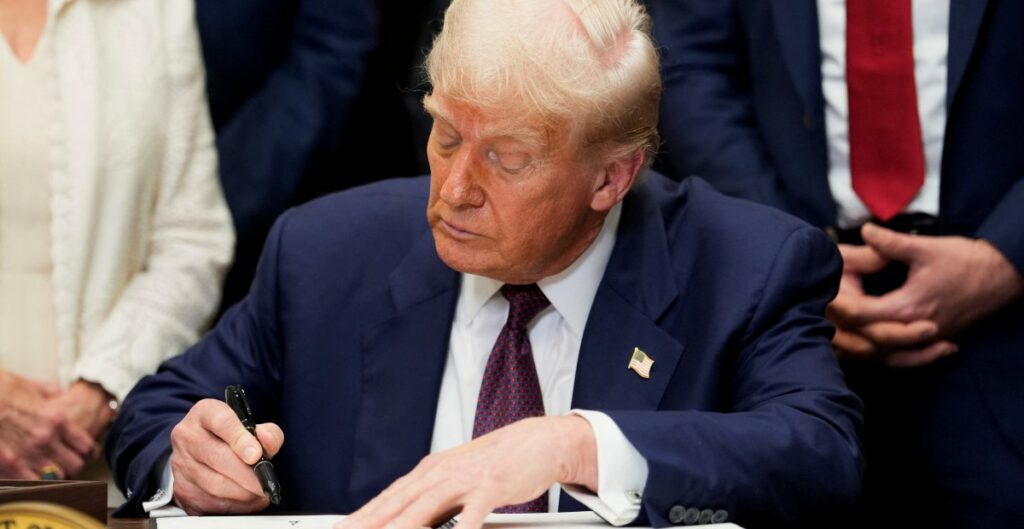
President Trump signed the executive order on Thursday. It includes no product- or sector-specific exemptions for India, unlike concessions granted to other trading nations. The flat tariff applies uniformly across categories, regardless of their criticality or existing trade volumes.
India Singled Out
Trade experts and industry observers say this measure represents more than just a tariff hike; it’s a strategic pressure tactic.
“This is not just a trade measure; it’s a geopolitical lever,” said Ajay Srivastava of the Global Trade Research Initiative (GTRI). “Unlike China and several U.S. allies who retained exemptions for sectors like pharmaceuticals and semiconductors, India has been denied all such relief, signalling a targeted push to compel India into trade concessions.”
India’s reluctance to open up sensitive sectors, particularly agriculture and energy, is believed to be a major sticking point in negotiations. The U.S. administration also cited India’s continued oil trade with Russia as a contributing factor.
No Exemptions, No Relief
While South Korea managed to reduce its exposure through negotiated settlements and China continues to enjoy carve-outs for key goods, India is being subjected to a blanket 25% duty.
Even sectors typically protected in other trade pacts, like finished pharmaceutical products, APIs, smartphones, semiconductors, and energy commodities, are included.
Furthermore, the executive order clarifies that the tariffs are in addition to standard MFN duties, significantly raising the cost of Indian exports entering the U.S. market.
Impact On Indian Exports
According to initial projections, India’s goods exports to the U.S. could drop by over 30% in FY2026—from $86.5 billion in FY2025 to around $60.6 billion.
Sectors with high import content and lower domestic value addition, such as petroleum products ($4.1 billion), smartphones ($10.9 billion), and pharmaceuticals ($9.8 billion), are expected to be hit the hardest.
Transition Period And Transit Relief
Goods already in transit will continue to be charged under the existing lower tariffs, typically around 10% on most items, until October 5, 2025. After this, all imports from India will uniformly face the 25% duty, barring any late-breaking trade agreement.
Signal To Others
Trade experts believe India is being made an example to pressure other nations into compliance.
“The U.S. is using its market access as leverage. This is not about fair trade, it’s about strategic alignment,” said Srivastava. “India is being used to send a broader message: Align with U.S. policy priorities or face consequences.”
Global Tariff Landscape
Tariff rates under the executive order range from 10% to 41%, depending on bilateral relationships and perceived national security risks:
- Brazil faces 50%, though sectors like energy and aircraft are exempted.
- South Korea agreed to a 15% rate in exchange for a $350 billion U.S. investment pledge.
- Switzerland has been hit with an unusually high 39% tariff.
- Syria faces the highest tariff at 41%.
In contrast, Canada and Mexico received selective relief under the USMCA, with Mexico granted a 90-day exemption on most tariffs, though tariffs on Mexican metals remain high.