

Support us by contributing to StratNewsGlobal on the following UPI ID
ultramodern@hdfcbank

Strategic affairs is our game, South Asia and beyond our playground. Put together by an experienced team led by Nitin A. Gokhale. Our focus is on strategic affairs, foreign policy and international relations, with higher quality reportage, analysis and commentary with new tie-ups across the South Asian region.
You can support our endeavours. Visit us at www.stratnewsglobal.com and follow us on YouTube, Twitter, Facebook and Instagram.
र 500 per month
र 1000 per month
र 5000 per year
र 10000 per year
Donate an amount of your choice
र 500 per month
Donate र 500 per month

र 1000 per month
Donate र 1000 per month
र 5000 per year
Donate र 5,000 per year
र 10000 per year
Donate र 10,000 per year
Donate an amount of your choice
Donate an amount of your choice





Indian Army’s IPKF Experience: ‘We Learnt How To Fight Guerrilla As Guerrilla’
The Indo-Sri Lanka Accord signed 38 years ago was a major diplomatic blunder, one India could have done without. The agreement signed by then PM Rajiv Gandhi and Sri Lankan President JR Jayawardene on July 29, 1987 led to the deployment of the Indian Peace Keeping Force (IPKF) to resolve the ethnic violence in the island nation.
That was by far the largest foreign deployment of Indian troops abroad. And it ultimately turned out to be one of the bloodiest episodes in India’s military history, with over 1100 troops laying down their lives in the line of duty.
The accord pleased neither the majority Sinhalese nor the minority Tamils. The former saw it as a sell-out to India. The Tamils, who initially saw some hope, later turned hostile towards the Indian forces.
One incident turned the Liberation Tigers of Tamil Eelam (LTTE) against the IPKF, says Col. Yash Saxena (Retd), who, as Second Lieutenant, was part of the IPKF.
About 13 Tamil insurgents who were captured by the Sri Lankan army killed themselves while in custody but the LTTE blamed the IPKF for not preventing the incident. That was when LTTE chief Prabhakaran said it was time to “fight our own war and not depend upon India”, recalls Col. Saxena (Retd). The assault was then directed at Indian troops.
How The LTTE Operated
The group practised unconventional warfare. They didn’t believe in copybook styles; rather moves and strategy were tailor-made for a particular operation, says Col. Saxena (Retd). “Guile and surprise were their biggest weapons.”
High Motivation
Fighting for a separate Tamil motherland was the trigger for a high level of motivation. The insurgents knew they were fewer in number and up against a regular army that had more firepower. And if a person has a cyanide capsule around his neck, that’s indicative enough of being prepared to lay down one’s life for the cause.
Optimal Use
For the insurgents, maximum usage of existing resources was a given. They used the weapons or whatever they had very well, recalls Col. Saxena (Retd), citing an example. “An AK-47 rifle has 30 rounds of ammunition but they made it 31 by putting one in the chamber. Also, the trick of using two magazines at one time by strapping one to the opposite side of the other. These are things we learnt from them.”
How LTTE Tracked Indian Troops
Quite familiar with the terrain, the LTTE cadre used innovative methods to track the movement of Indian troops. “We had a typical smell to our bodies, given that we ate a particular type of food and rubbed the same kind of oil, quite different from what Tamils use. That’s what we learnt after we caught a few insurgents,” said Col. Saxena (Retd).
Invaluable Lessons
In a reversal of tactics, the Indian troops then started rubbing fish oil, similar to what the insurgents did. They also didn’t wear jungle shoes to avoid detection due to the markings left by the footwear.
The tactics learnt there from 1987-1990 came in handy. Those years of deployment were sort of a ‘nursery’. “We learnt how to fight guerrilla as guerilla.”
Indian Firms Up Against The Harsh Realities Of US Sanctions
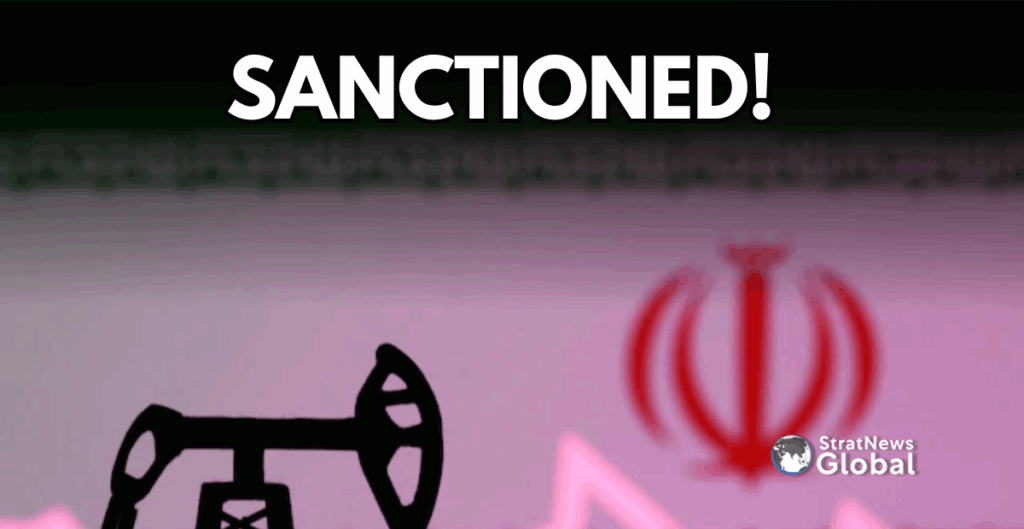
Six Indian firms have fallen victim to US sanctions even while doing no trade with the US. They are accused of buying US-sanctioned Iranian petrochemical products, and while some may have done so by buying directly from Iran, others bought the same from suppliers in the UAE.
All the cargoes went to India, nothing to the US. But in the world of international trade dominated by the US dollar, and linked to Western shipping insurers and banks that observe rules laid down by the Office of Foreign Assets Control, which is part of the US Treasury, these six Indian firms got hopelessly entangled.
None of these Indian firms under US sanctions are publicly listed or even widely known. But according to industry sources, these are key links in the supply chains that are critical to textiles, plastics and pharmaceuticals.
The firms are Kanchan Polymers, Alchemical Solutions, Ramniklal S Gosalia and Company, Jupiter Dye Chem, Global Industrial Chemicals, and Persistent Petrochem.
Kanchan Polymers, described as a “small player” in the industry, bought $1.3 million of Iranian polyethene from a supplier in the UAE. Persistent Petrochem did the same over a one-year period from January 2024 to January 2025 and, according to the US, bought $14 million of Iranian petrochemicals, also from a UAE supplier.
Global Industrial Chemicals reportedly imported $51 million of Iranian methanol and related products, which are critically required in the Indian plastics and coatings sector. It doesn’t sell anything directly to the US, but is now at risk of being isolated by Western banks and financial intermediaries.
The US “weaponizing” of even trade, which does not touch its shores, will add to the clamour in some quarters that “de-dollarisation” is the only way forward. This is a persistent demand within the BRICS, although India and some other members have publicly opposed to it.
An analysis in Modern Diplomacy by Ayesha Sikandar last month titled Indian Factor in BRICS De-Dollarization Dream, notes that “India’s long-term development goals – digital, infrastructure, clean energy transition projects, poverty alleviation and advanced manufacturing are tied mainly to the Western sphere.”
If all of the above is to materialise, India needs technology, investment and Western multilateral financial institutions, and that could be at risk if it pursues de-dollarisation.
In that sense, Sikandar writes, “India is among the most dollarized countries in the world and escaping dollarized systems would have an irrecoverable impact on its growing economy. India views the US as vital for its economic modernization and global political clout.”
All this, of course, is scant comfort to the Indian firms sanctioned by the US. India will have to work with the US in this regard, hoping to temper some of the harsher realities of global geopolitics.
Saint Lucia Court Strikes Down Anti-Gay Laws
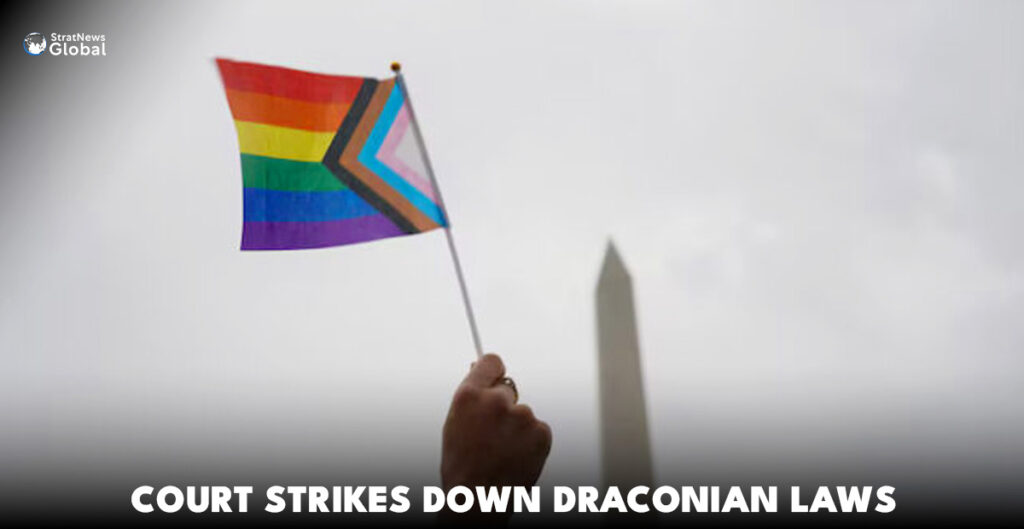
Caribbean LGBTQ+ activists this week celebrated a landmark court ruling in Saint Lucia that struck down colonial-era laws criminalising same-sex relations, which earlier carried prison terms of up to 10 years.
The Eastern Caribbean Supreme Court issued the decision on Tuesday in the case brought by LGBTQ rights alliance ECADE on behalf of a gay couple.
‘Incompatible With Human Dignity’
The court ruled that sections of the criminal code that outlawed “buggery” and “gross indecency” were unconstitutional.
“Our own courts are now recognizing that these colonial-era laws are incompatible with human dignity,” Dane Lewis, regional program manager at rights group CariFLAGS, said.
Many Caribbean countries still have laws forbidding intimacy between people of the same sex, a legacy of British colonial-era statutes. Though rarely enforced, activists say these cement widespread institutional biases and discrimination.
‘Momentous Legal Change’
Jessica St. Rose, founder of local rights group 758Pride, said the ruling marked a “momentous legal change.”
“It sends a clear message that love is not a crime,” she said, though Saint Lucia still needs reforms to protect LGBTQ people from discrimination and threats to their safety.
Saint Lucian politicians were mostly silent about the decision publicly, including Prime Minister Philip Pierre who made a national address ahead of Friday’s Emancipation Day.
In nearby Guyana, where “buggery” is a felony subject to a lifetime behind bars, rights group Guyana Together welcomed that another country in the CARICOM regional bloc had “dismantled these archaic laws.”
More than 60 countries worldwide criminalize gay sex, many former British colonies across Africa and the Caribbean.
There was some criticism on social media from Saint Lucia residents of the decision, some citing Christian scripture and calling the ruling a sin.
“We do expect the religious society to come out to speak out against the recent ruling,” St. Rose said.
Hope
Bradley Desir, a gay man from Saint Lucia who moved to Canada in 2016, said he was encouraged by signs of change and would feel safer visiting the island though he would still maintain his guard.
“I hope they carry on with the discussion and possibly call for the legalization of (gay) marriage,” he said, adding he did not expect this in his lifetime.
The growing visibility of LGBTQ people through global media was a positive sign, he added: “Kids today are growing up in a different world.”
(With inputs from Reuters)
Chile: Codelco Clears Tunnel Blockage, No Contact Yet With Trapped Miners
Chile’s copper giant Codelco announced on Saturday it has cleared just over 20% of the blocked tunnels at its El Teniente mine but has yet to establish contact with the trapped miners.
A collapse on Thursday evening due to a strong tremor killed one worker and left five others trapped in the new Andesita section of El Teniente.
Rescue teams have now used heavy machinery to clear 20 meters (65.62 feet) out of 90 meters of passages needed to reach the location where Codelco believes the workers to be, said El Teniente’s general manager, Andres Music.
Rescue teams are progressing at a rate of about 15 to 20 meters every 24 hours, Music said. He noted that it was difficult to predict when they would be able to fully clear the remaining 70 meters, where there is a truck turnaround wall.
“We believe that, possibly, if the workers tried to take shelter, they might be in that area,” he said.
Forty-four hours have passed since the accident at around 5:30 p.m. local time on Thursday, which was caused by one of the largest tremors ever recorded at El Teniente, with the impact of a 4.2 magnitude quake.
Codelco is investigating whether the cause was mining activity or natural tectonic shifts in the earthquake-prone country.
Mining Halted After Collapse
Chilean copper giant Codelco has halted mining at its flagship El Teniente mine and postponed its quarterly results announcement as it continued efforts on Friday to reach trapped workers following the deadly collapse.
Codelco said it would reschedule the release of its first-half financial results, planned for Friday morning, due to its attention on rescue efforts, which were complicated by aftershocks.
Codelco halted copper mining at El Teniente as part of its emergency protocol, while continuing its processing and smelting operations, said Amador Pantoja, an El Teniente union leader.
Codelco, the world’s biggest miner that has been struggling to boost output, has not addressed how El Teniente’s production could be affected.
However, Chairman Maximo Pacheco told a press conference that unaffected areas of the mine should be able to operate normally. In the Andesita sector, 300 linear meters were severely damaged, and another 400 linear meters were moderately damaged.
Chilean Mining Minister Aurora Williams said the government would formally order Codelco to suspend all underground operations at the mine, part of the protocol for major accidents.
(With inputs from Reuters)
US Court Revives Child Exploitation Case Against Musk’s X
A US federal appeals court on Friday revived part of a lawsuit alleging that Elon Musk’s platform X has become a hub for child exploitation, while also ruling that the platform remains largely protected from liability over harmful content.
While rejecting some claims, the 9th US Circuit Court of Appeals in San Francisco said X, formerly Twitter, must face a claim it was negligent by failing to promptly report a video containing explicit images of two underage boys to the National Center for Missing and Exploited Children (NCMEC).
The case predated Musk’s 2022 purchase of Twitter. A trial judge had dismissed the case in December 2023. X’s lawyers did not immediately respond to requests for comment. Musk was not a defendant.
Plaintiff Details Ordeal
One plaintiff, John Doe 1, said he was 13 when he and a friend, John Doe 2, were lured on SnapChat into providing nude photos of themselves to someone John Doe 1 thought was a 16-year-old girl at his school.
The SnapChat user was actually a child pornography trafficker who blackmailed the plaintiffs into providing additional explicit photos. Those images were later compiled into a video that was posted on Twitter.
According to court papers, Twitter took nine days after learning about the content to take it down and report it to NCMEC, following more than 167,000 views, court papers showed.
Circuit Judge Danielle Forrest said section 230 of the federal Communications Decency Act, which protects online platforms from liability over user content, didn’t shield X from the negligence claim once it learned about the pornography.
“The facts alleged here, coupled with the statutory ‘actual knowledge’ requirement, separates the duty to report child pornography to NCMEC from Twitter’s role as a publisher,” she wrote for a three-judge panel.
X must also face a claim its infrastructure made it too difficult to report child pornography.
‘Justice And Accountability’
It was found immune from claims it knowingly benefited from sex trafficking, and created search features that “amplify” child pornography posts.
Dani Pinter, a lawyer at the National Center on Sexual Exploitation, which represented the plaintiffs, said in a statement: “We look forward to discovery and ultimately trial against X to get justice and accountability.”
The case is Doe 1 et al v Twitter Inc et al, 9th US Circuit Court of Appeals, No. 24-177.
(With inputs from Reuters)
US Envoy Assures Israeli Hostage Families Of Plan To End Gaza War
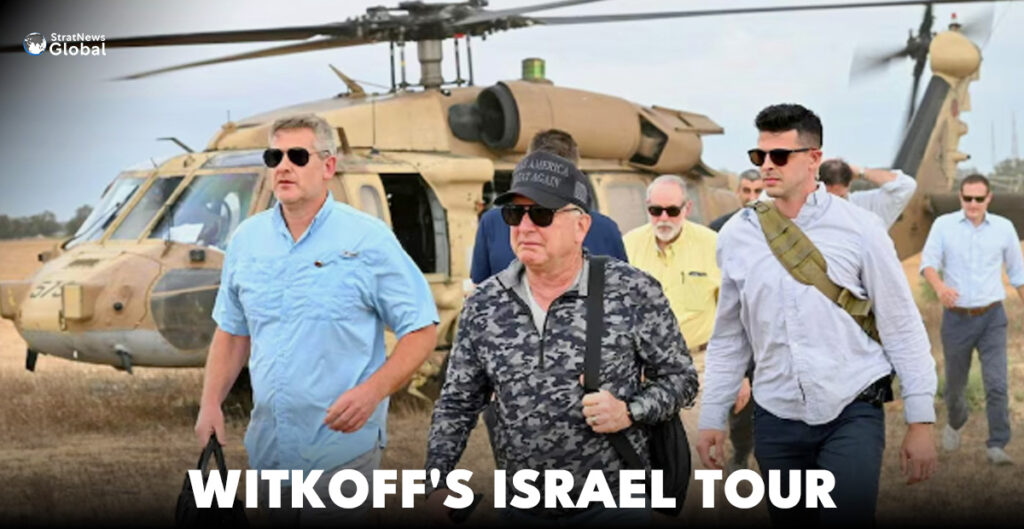
U.S. President Donald Trump’s Middle East envoy informed families of hostages held by Hamas on Saturday that he is collaborating with the Israeli government on a plan to effectively end the war in Gaza.
Trump has made ending the conflict a major priority of his administration, though negotiations have faltered. Steve Witkoff is visiting Israel as its government faces mounting pressure over the deteriorating humanitarian conditions in the enclave.
In a recording of the meeting, reviewed by Reuters, Witkoff is heard saying: “We have a very, very good plan that we’re working on collectively with the Israeli government, with Prime Minister Netanyahu … for the reconstruction of Gaza. That effectively means the end of the war.”
The White House did not immediately respond to a request for comment on his remarks.
Witkoff also said that Hamas was prepared to disarm in order to end the war, though the group has repeatedly said it will not lay down its weapons.
In response to the reported remarks, Hamas, which has dominated Gaza since 2007 but has been militarily battered by Israel in the war, said it would not relinquish “armed resistance” unless an “independent, fully sovereign Palestinian state with Jerusalem as its capital” is established.
Indirect negotiations between Hamas and Israel aimed at securing a 60-day ceasefire in the Gaza war and a deal for the release of half the hostages ended last week in deadlock.
On Saturday, Hamas released its second video in two days of Israeli hostage Evyatar David. In it, David, skeletally thin, is shown digging a hole, which, he says in the video, is for his own grave.
Witkoff met with Netanyahu on Thursday.
Afterwards, a senior Israeli official said an understanding between Israel and Washington was emerging that there was a need to move from a plan to release some of the hostages to a plan to release all the hostages, disarm Hamas and demilitarise the Gaza Strip, echoing Israel’s key demands for ending the war.
Gaza Starvation
On Tuesday, Qatar and Egypt, who are mediating ceasefire efforts, endorsed a declaration by France and Saudi Arabia outlining steps toward a two-state solution to the Israeli-Palestinian conflict. As part of it, they said Hamas must hand over its arms to the Western-backed Palestinian Authority.
Witkoff arrived in Israel with Netanyahu’s government facing a global outcry over devastation in Gaza and the starvation growing among its 2.2 million people.
The crisis has also prompted a string of Western powers to announce they may recognise a Palestinian state.
On Friday, Witkoff visited a U.S.-backed aid operation in southern Gaza, which the United Nations has partly blamed for deadly conditions in the enclave, saying he sought to get food and other aid to people there.
Dozens have died of malnutrition in recent weeks after Israel cut off all supplies to the enclave for nearly three months from March to May, according to Gaza’s health ministry. It said on Saturday that it had recorded seven more fatalities, including a child, since Friday.
Israel blames Hamas for the suffering in Gaza and says it is taking steps for more aid to reach its population, including pausing fighting for part of the day in some areas, air drops and announcing protected routes for aid convoys.
U.N. agencies have said that airdrops of food are insufficient and that Israel must let in far more aid by land and quickly ease access to it.
The Gaza war began when Hamas killed more than 1,200 people and took 251 hostage in an attack on southern Israel on October 7, 2023, according to Israeli figures. Israel’s offensive has since killed more than 60,000 Palestinians, according to Gaza health officials.
According to Israeli officials, 50 hostages now remain in Gaza, only 20 of whom are believed to be alive.
(With inputs from Reuters)
U.S. Said Deportations To Third Countries Were Necessary, But Sent Them Home Instead
The Trump administration argued that certain serious offenders had to be deported to third countries, claiming their own nations refused to take them back. However, a review of recent cases reveals that at least five such individuals were returned to their home countries within weeks.
President Donald Trump aims to deport millions of immigrants in the U.S. illegally and his administration has sought to ramp up removals to third countries, including sending convicted criminals to South Sudan and Eswatini, formerly known as Swaziland, two sub-Saharan African nations.
Immigrants convicted of crimes typically first serve their U.S. sentences before being deported. This appeared to be the case with the eight men deported to South Sudan and five to Eswatini, although some had been released years earlier.
Third-Country Deportations
The U.S. Department of Homeland Security said in June that third-country deportations allow them to deport people “so uniquely barbaric that their own countries won’t take them back.” Critics have countered that it’s not clear the U.S. tried to return the men deported to South Sudan and Eswatini to their home countries and that the deportations were unnecessarily cruel.
It was found that at least five men threatened with deportation to Libya in May were sent to their home countries weeks later, according to interviews with two of the men, a family member and attorneys.
After a U.S. judge blocked the Trump administration from sending them to Libya, two men from Vietnam, two men from Laos and a man from Mexico were all deported to their home nations. The deportations have not previously been reported.
DHS spokesperson Tricia McLaughlin contested that the home countries of criminals deported to third countries were willing to take them back, but did not provide details on any attempts to return the five men home before they were threatened with deportation to Libya.
“If you come to our country illegally and break our laws, you could end up in CECOT, Alligator Alcatraz, Guantanamo Bay, or South Sudan or another third country,” McLaughlin said in a statement, referencing El Salvador’s maximum-security prison and a detention center in the subtropical Florida Everglades.
Far From Home
DHS did not respond to a request for the number of third-country deportations since Trump took office on January 20, although there have been thousands to Mexico and hundreds to other countries.
The eight men sent to South Sudan were from Cuba, Laos, Mexico, Myanmar, South Sudan and Vietnam, according to DHS. The man DHS said was from South Sudan had a deportation order to Sudan, according to a court filing. The five men sent to Eswatini were from Cuba, Jamaica, Laos, Vietnam and Yemen, according to DHS.
White House spokeswoman Abigail Jackson said the men deported to South Sudan and Eswatini were “the worst of the worst” and included people convicted in the United States of child sex abuse and murder. “American communities are safer with these heinous illegal criminals gone,” Jackson said in a statement.
The Laos government did not respond to requests for comment regarding the men threatened with deportation to Libya and those deported to South Sudan and Eswatini. Vietnam’s foreign ministry spokesperson said on July 17 that the government was verifying information regarding the South Sudan deportation but did not provide additional comment.
The government of Mexico did not comment.
The Trump administration acknowledged in a May 22 court filing that the man from Myanmar had valid travel documents to return to his home country but he was deported to South Sudan anyway. DHS said the man had been convicted of sexual assault involving a victim mentally and physically incapable of resisting.
Eswatini’s government said on Tuesday that it was still holding the five migrants sent there in isolated prison units under the deal with the Trump administration.
‘A Very Random Outcome’
The Supreme Court in June allowed the Trump administration to deport migrants to third countries without giving them a chance to show they could be harmed. But the legality of the removals is still being contested in a federal lawsuit in Boston, a case that could potentially wind its way back to the conservative-leaning high court.
Critics say the removals aim to stoke fear among migrants and encourage them to “self deport” to their home countries rather than be sent to distant countries they have no connection with.
“This is a message that you may end up with a very random outcome that you’re going to like a lot less than if you elect to leave under your own steam,” said Michelle Mittelstadt, communications director for the non-partisan Migration Policy Institute.
No Assurance Of Safety
Internal U.S. immigration enforcement guidance issued in July said migrants could be deported to countries that had not provided diplomatic assurances of their safety in as little as six hours.
While the administration has highlighted the deportations of convicted criminals to African countries, it has also sent asylum-seeking Afghans, Russians and others to Panama and Costa Rica.
The Trump administration deported more than 200 Venezuelans accused of being gang members to El Salvador in March, where they were held in the country’s CECOT prison without access to attorneys until they were released in a prisoner swap last month.
More than 5,700 non-Mexican migrants have been deported to Mexico since Trump took office, according to Mexican government data, continuing a policy that began under former President Joe Biden.
Deportation Threats
The fact that one Mexican man was deported to South Sudan and another threatened with deportation to Libya suggests that the Trump administration did not try to send them to their home countries, according to Trina Realmuto, executive director at the pro-immigrant National Immigration Litigation Alliance.
“Mexico historically accepts back its own citizens,” said Realmuto, one of the attorneys representing migrants in the lawsuit contesting third-country deportations.
The eight men deported to South Sudan included Mexican national Jesus Munoz Gutierrez, who had served a sentence in the U.S. for second-degree murder and was directly taken into federal immigration custody afterward, according to Realmuto. Court records show Munoz stabbed and killed a roommate during a fight in 2004.
When the Trump administration first initiated the deportation in late May, Mexico’s President Claudia Sheinbaum said her government had not been informed.
“If he does want to be repatriated, then the United States would have to bring him to Mexico,” Sheinbaum said at the time.
His sister, Guadalupe Gutierrez, said in an interview that she didn’t understand why he was sent to South Sudan, where he is currently in custody. She said Mexico is trying to get her brother home.
“Mexico never rejected my brother,” Gutierrez said.
Immigration Offenders
Immigration hardliners see the third-country removals as a way to deal with immigration offenders who can’t easily be deported and could pose a threat to the U.S. public.
“The Trump administration is prioritizing the safety of American communities over the comfort of these deportees,” said Jessica Vaughan, policy director at the Center for Immigration Studies, which supports lower levels of immigration.
The Trump administration in July pressed other African nations to take migrants and has asked the Pacific Islands nation of Palau, among others.
Under U.S. law, federal immigration officials can deport someone to a country other than their place of citizenship when all other efforts are “impracticable, inadvisable or impossible.”
‘Using Us As A Pawn’
Immigration officials must first try to send an immigrant back to their home country, and if they fail, then to a country with which they have a connection, such as where they lived or were born.
For a Lao man who was almost deported to Libya in early May, hearing about the renewed third-country deportations took him back to his own close call. In an interview from Laos granted on condition of anonymity because of fears for his safety, he asked why the U.S. was “using us as a pawn?”
His attorney said the man had served a prison sentence for a felony.
He recalled officials telling him to sign his deportation order to Libya, which he refused, telling them he wanted to be sent to Laos instead. They told him he would be deported to Libya regardless of whether he signed or not, he said. DHS did not comment on the allegations.
The man, who came to the United States in the early 1980s as a refugee when he was four years old, said he was now trying to learn the Lao language and adapt to his new life, “taking it day by day.”
(With inputs from Reuters)
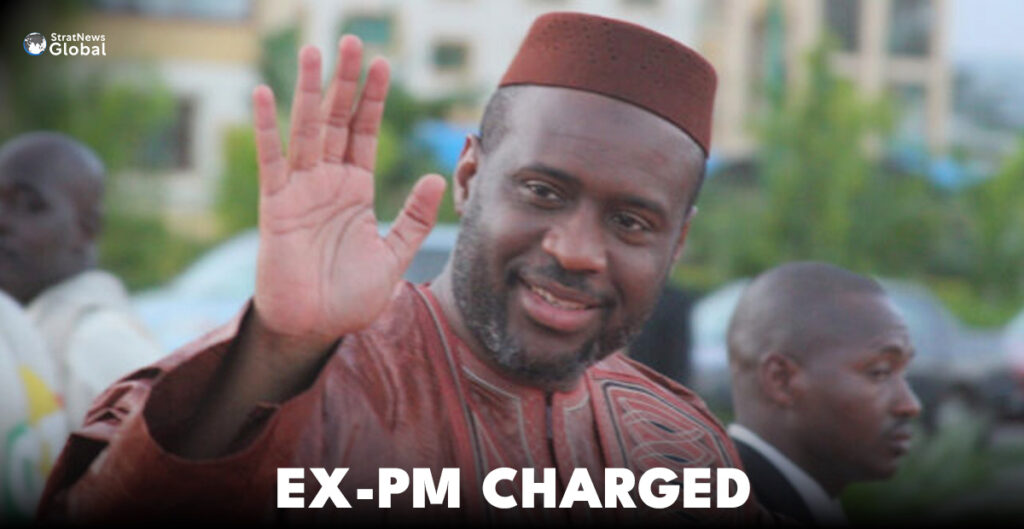
Mali Charges Ex-PM Mara For Criticising Erosion Of Democracy
A Malian court has detained and charged former Prime Minister Moussa Mara for a social media post criticising the erosion of democratic space under military rule, his lawyer said on Friday night.
Mara is one of few public figures in the country who has been willing to openly question moves taken this year to dissolve political parties and grant the military government, led by Assimi Goita, a five-year mandate without elections.
Last month, authorities formally approved Goita’s five-year term and said it could be renewed as many times as necessary as Mali struggles to respond to a long-running jihadist insurgency.
Goita assumed power after military coups in 2020 and 2021.
Several Summons
Mara had been summoned several times for questioning this month over a social media post dated July 4 expressing solidarity with government critics who have been jailed.
On July 21, his lawyer, Mountaga Tall, posted on social media site X that Mara had been barred from boarding a flight to Senegal to participate in a regional conference on peace and security.
On Friday, Mara was summoned by a judicial cybercrimes unit, and a prosecutor charged him with offences including undermining the credibility of the state and spreading false information, Tall said in a statement.
Mara’s trial has been scheduled for September 29, Tall said.
A government spokesperson did not immediately respond to a request for comment.
Worsening Insecurity
The case against Mara comes amid worsening insecurity in Mali. The past few months have seen a surge of deadly attacks by Jama’at Nusrat al-Islam wal-Muslimin (JNIM), an al-Qaeda-linked group that also operates in Burkina Faso and Niger.
Analysts say the group’s battlefield tactics have grown increasingly sophisticated and that it has amassed substantial resources through raids on military posts, cattle rustling, hijacking of goods, kidnappings and taxes on local communities.
On Friday, the group said it had ambushed a convoy of Malian soldiers and Russian mercenaries in the Tenenkou locality in central Mali. Mali’s army confirmed the ambush in a statement on X. Neither statement gave a death toll.
(With inputs from Reuters)
Amsterdam Pride Ends With Global Calls For Inclusion
Around 80 vibrant pride boats sailed through Amsterdam’s historic canals on Saturday, marking the grand finale of a week-long LGBTQ+ celebration.
The colourful parade stood in sharp contrast to recent crackdowns on LGBTQ+ rights in fellow EU member Hungary, highlighting Amsterdam’s continued commitment to equality, diversity, and inclusion.
While the colourful flotilla is not officially political, many attendees used the occasion to voice criticism against ongoing global conflicts and world leaders over their stance on LGBTQ+ rights and policies, highlighting the need for greater inclusivity and protection worldwide.
‘Form Of Oppression’
Thehany Gilmore, a 43-year-old Dutch-Caribbean dressed in a leather outfit with a whip, said banning of the Budapest pride parade “is a form of oppression.”
“People everywhere should have their own pride to be able to represent who they are,” she said.
Trump Targeted
Palestinian flags were spotted among the crowd of revelers, and Dutch police arrested four activists who had jumped in the water to vandalize the Booking.com boat in protest over its listings in settlements in Israeli-occupied territories.
Others criticised US President Donald Trump, whose administration introduced anti-trans policies and slashed funding for international aid programmes, causing a major setback to HIV prevention efforts across several African countries.
Some waved a hybrid US/Pride flag, while one boat declared itself a ‘Trump-Free Pride Boat’ with signs reading ‘Trans Rights Are Human Rights.’ Another featured mock graveyards and the message ‘Trump’s Actions Kill. Love Saves Lives,’ highlighting fears over US AIDS funding cuts.
‘US Needs To Reinvent Itself’
“Amsterdam Pride is… about expressing yourself, showing who you are, being grateful for the freedom that we have in Europe. The US really needs to reinvent itself… be more open about people,” 40-year-old Michael Jacobs, who hails from Dutch port city Rotterdam, said.
“Don’t judge people for who they are. Just love each other.”
(With inputs from Reuters)
Gaza: Medics Set To Check Thousands Of Children For Malnutrition
Medical experts in Gaza said on Monday they are intensifying efforts to screen large numbers of young children for acute malnutrition, as concerns grow over the spread of hunger among displaced families.
Aid group International Medical Corps (IMC) and partners are planning to reach more than 200,000 children under five-years-old as part of a “Find and Treat” campaign over coming months, one of its doctors, Munawwar Said, said.
“With the displacement, communities are settling in new locations that do not have access to clean water, or there is not adequate access to food,” he said. “We fear there are more cases being missed.”
Over the weekend, families were already coming into an IMC clinic in the central city of Deir al-Balah, opened after the agency said it had to shut down two centres in the southern city of Rafah due to insecurity.
Seven-year-old Jana Ayad had weighed just 9 kilograms when she arrived, suffering from diarrhoea and vomiting, Nutrition Officer Raghda Ibrahim Qeshta said as she carefully held the child.
“My daughter was dying in front of me,” said Nasma Ayad as she sat next to the bed. “I didn’t know what to do.”
Jana had started putting on some weight after treatment, medics said, but she was still painfully thin with her ribs showing as she lay listlessly in her bunny pyjamas.
Acute Malnutrition
Staff can gauge nutrition levels by measuring the circumference of children’s arms. According to reports, at least two of the measurements were in the yellow band, indicating a risk of malnutrition. IMC data so far shows the most vulnerable are babies and infants up to two-years-old.
A group of U.N.-led aid agencies estimates that around 7% of Gaza children may be acutely malnourished, compared with 0.8% before the Israel-Hamas conflict began on Oct. 7.
Until now the worst of severe hunger has been in the north, with a U.N.-backed report warning of imminent famine in March.
But aid workers worry it could spread to central and southern areas due to the upheaval around Rafah that has displaced more than 1 million people and constrained supply flows through southern corridors.
More than 37,600 Palestinians have been killed during Israel’s military offensive in Gaza, according to Gaza’s health ministry.
Israel began the operation after Hamas-led terrorists attacked Israel on Oct. 7, killing 1,200 people and taking some 250 hostage, according to Israeli tallies.
It says it has expanded efforts to facilitate aid flows into Gaza and blames international aid agencies for distribution problems inside the enclave.
(With inputs from Reuters)