

Support us by contributing to StratNewsGlobal on the following UPI ID
ultramodern@hdfcbank

Strategic affairs is our game, South Asia and beyond our playground. Put together by an experienced team led by Nitin A. Gokhale. Our focus is on strategic affairs, foreign policy and international relations, with higher quality reportage, analysis and commentary with new tie-ups across the South Asian region.
You can support our endeavours. Visit us at www.stratnewsglobal.com and follow us on YouTube, Twitter, Facebook and Instagram.
र 500 per month
र 1000 per month
र 5000 per year
र 10000 per year
Donate an amount of your choice
र 500 per month
Donate र 500 per month

र 1000 per month
Donate र 1000 per month
र 5000 per year
Donate र 5,000 per year
र 10000 per year
Donate र 10,000 per year
Donate an amount of your choice
Donate an amount of your choice
Hamas Offers Aid Access, Sets Conditions After Video Sparks Outrage
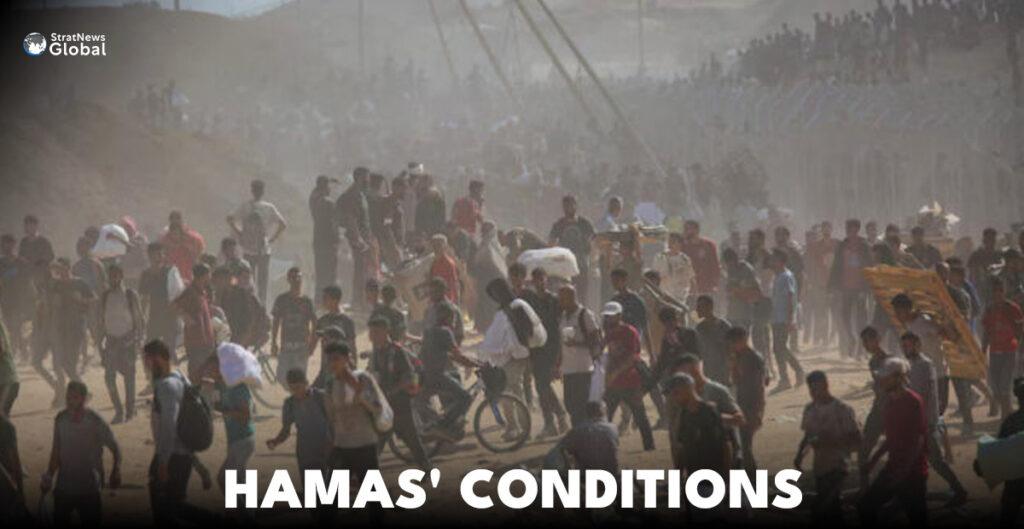
Hamas on Sunday expressed willingness to coordinate with the Red Cross for delivering aid to the hostages it holds in Gaza, provided certain conditions are met by Israel. This statement came after the group released a video showing an emaciated captive, which sparked strong condemnation from Western nations.
Hamas said any coordination with the Red Cross is contingent upon Israel permanently opening humanitarian corridors and halting airstrikes during the distribution of aid.
According to Israeli officials, 50 hostages now remain in Gaza, only 20 of whom are believed to be alive. Hamas, thus far, has barred humanitarian organizations from having any kind of access to the hostages and families have little or no details of their conditions.
David’s Video
On Saturday, Hamas released its second video in two days of Israeli hostage Evyatar David. In it, David, skeletally thin, is shown digging a hole that, he says in the video, is for his own grave. The arm of the individual holding the camera, which can be seen in the frame, is a regular width.
The video of David drew criticism from Western powers and horrified Israelis. France, Germany, the UK and the US were among countries to express outrage and Israel’s foreign ministry announced that the UN Security Council will hold a special session on Tuesday morning on the issue of the situation of the hostages in Gaza.
Israeli Prime Minister Benjamin Netanyahu said on Sunday he had asked the Red Cross to give humanitarian assistance to the hostages during a conversation with the head of the Swiss-based ICRC’s local delegation.
A statement from The Hostages Families Forum, which represents relatives of those being held in Gaza, said Hamas’ comments about the hostages cannot hide that it “has been holding innocent people in impossible conditions for over 660 days,” and demanded their immediate release.
“Until their release,” said the statement, “Hamas has the obligation to provide them with everything they need. Hamas kidnapped them and they must care for them. Every hostage who dies will be on Hamas’s hands.”
Deaths
Six more people died of starvation or malnutrition in Gaza over the past 24 hours, its health ministry said on Sunday as Israel said it allowed a delivery of fuel to the enclave, in the throes of a humanitarian disaster after almost two years of war.
The new deaths raised the toll of those dying from what international humanitarian agencies say may be an unfolding famine to 175, including 93 children, since the war began, the ministry said.
Egypt’s state-affiliated Al Qahera News TV said two trucks carrying 107 tons of diesel were set to enter Gaza, months after Israel severely restricted aid access to the enclave before easing it somewhat as starvation began to spread.
COGAT, the Israeli military agency that coordinates aid, said later in the day that four tankers of UN fuel had entered to help in operations of hospitals, bakeries, public kitchens and other essential services.
There was no immediate confirmation whether the two diesel fuel trucks had entered Gaza from Egypt.
Gaza’s health ministry has said fuel shortages have severely impaired hospital services, forcing doctors to focus on treating only critically ill or injured patients.
Fuel shipments have been rare since March, when Israel restricted the flow of aid into the enclave in what it said was pressure on Hamas militants to free the remaining hostages they took in their October 2023 attack on Israel.
Israel blames Hamas for the suffering in Gaza but, in response to a rising international uproar, it announced steps last week to let more aid reach the population, including pausing fighting for part of the day in some areas, approving air drops and announcing protected routes for aid convoys.
Airdrops
UN agencies say airdrops are insufficient and that Israel must let in far more aid by land and open up access to the territory to prevent starvation among its 2.2 million people, most of whom are displaced amidst vast swathes of rubble.
COGAT said that during the past week over 23,000 tons of humanitarian aid in 1,200 trucks had entered Gaza but that hundreds of the trucks had yet to be driven to aid distribution hubs by UN and other international organisations.
Meanwhile, Belgium’s air force dropped the first in a series of its aid packages into Gaza on Sunday in a joint operation with Jordan, the Belgian defence ministry said.
France on Friday started to air-drop 40 tons of humanitarian aid.
Looted Aid Trucks
The Hamas-run Gaza government media office said on Sunday that nearly 1,600 aid trucks had arrived since Israel eased restrictions late in July. However, witnesses and Hamas sources said many of those trucks have been looted by desperate displaced people and armed gangs.
More than 700 trucks of fuel entered the Gaza Strip in January and February during a ceasefire before Israel broke it in March in a dispute over terms for extending it and resumed its major offensive.
Palestinian local health authorities said at least 80 people had been killed by Israeli gunfire and airstrikes across the coastal enclave on Sunday. Deaths included persons trying to make their way to aid distribution points in southern and central areas of Gaza, Palestinian medics said.
Among those killed was a staff member of the Palestinian Red Crescent Society, which said an Israeli strike at its headquarters in Khan Younis in southern Gaza ignited a fire on the first floor of the building.
The Gaza war began when Hamas killed more than 1,200 people and took 251 hostage in a cross-border attack on southern Israel on October 7, 2023, according to Israeli figures. Israel’s air and ground war in densely populated Gaza has since killed more than 60,000 Palestinians, according to enclave health officials.
(With inputs from Reuters)
Trump’s Tirade Against India Reflects His Domestic Insecurities
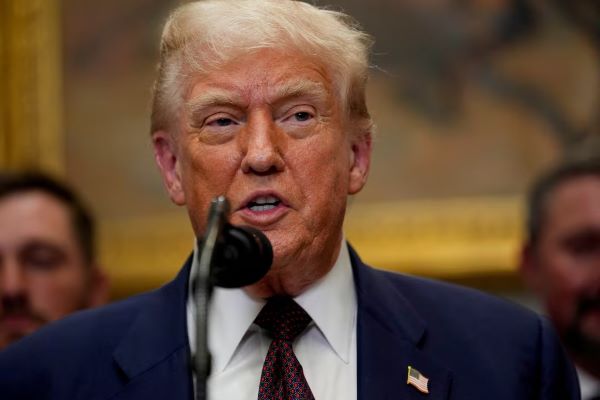
Has Donald Trump set his cross-hairs firmly on India? A cross-section of Indian diplomats suspect it may well be so given his announcement of 25% tariff and references to this country as a “dead economy”.
“The prevailing view is to stay silent, not provoke and find alternatives,” said a senior diplomat and pointed to the government’s directive to economic ministries, to bring to the table sectors where concessions can be offered to the US during negotiations scheduled for later this month.
It suggests an element of urgency, perhaps even hinting at a miscalculation or misreading of the new Trump administration even though India was first off the mark to begin trade talks. But since then from Vietnam to Indonesia and Japan, also Europe and the UK, all major economies, have struck deals with Trump.
US Treasury Secretary Scott Bessent alluded to this when he said “India came to the table early, they have been slow-rolling things, so I think the president, the whole trade team is frustrated with them.”
Pramit Pal Chaudhuri, head of the South Asia practice at the Eurasia Group which is into political risk analysis and consulting, believes that Trump “does want India to look bad but that flows from his own desperation for a deal.”
More than any other issue, Trump wants a deal on corn, soya, wheat and dairy because the states cultivating those crops is where he draws his political backing from.
Chaudhuri says “Trump is pushing hard on soya because his farmers are asking him what are we getting now that China has stopped the import of American soya. His 50% tariff on Brazil flows from the fact that it has now emerged as a major soya supplier to China.”
Globally India is ranked fifth in soya producing around 13 million tons in 2022, but it also imports significant amounts to make edible oil and for animal feed. Unfortunately, it is not very popular with the Indian palate although rich in protein.
Could this be an area where India can offer concessions given that opening up the dairy and wheat markets are a political hot potato?
National treatment in services is another area where Trump is seeking change: currently Indian laws favour Indian players over foreign investors. Example, America’s Citibank for instance, operates under different rules from Indian banks.
“Offering concessions on high end cars that the US does not make barring Tesla, is something Trump will not buy,” Chaudhuri says, noting also that US cars have not proved popular in India: GM exited in 2017, Ford in 2021 and motorcycle maker Harley Davidson in 2020.
Important to note that Trump has not targeted India on services, electronics or pharma that comprise major exports to the US.
Chaudhuri believes Trump is not even interested in the discounted Russian oil India buys, nor in Russia, which is contrary to the view among many in Delhi. Trump’s target is China, his priority is China but domestic political concerns are growing and in that sense, a deal with India would help him reassure that constituency.
But his public targeting of India has reportedly raised eyebrows in Washington DC, and questions are being asked as to what he hopes to achieve. It’s a question being asked in Delhi too.
Anti-Corruption Agencies In Ukraine Expose Drone Fraud
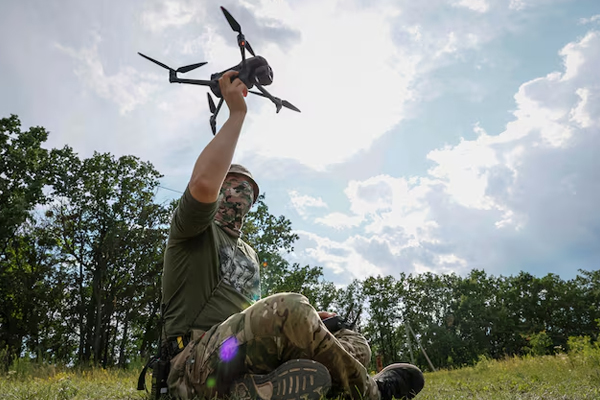
Ukraine’s anti-corruption agencies on Saturday said they had uncovered a major graft scheme involving the purchase of military drones and signal jamming systems at inflated prices.
The independence of Ukraine’s anti-graft investigators and prosecutors, NABU and SAPO, was reinstated by parliament on Thursday after a move to take it away resulted in the country’s biggest demonstrations since Russia’s invasion in 2022.
In a statement published by both agencies on social media, NABU and SAPO said they had caught a sitting lawmaker, two local officials and an unspecified number of national guard personnel taking bribes. None of them were identified in the statement.
Zelenskyy’s Statements
“The essence of the scheme was to conclude state contracts with supplier companies at deliberately inflated prices,” it said, adding that the offenders had received kickbacks of up to 30% of a contract’s cost. Four people had been arrested.
“There can only be zero tolerance for corruption, clear teamwork to expose corruption and, as a result, a just sentence,” President Volodymyr Zelenskyy wrote on Telegram.
Zelenskyy, who has far-reaching wartime presidential powers and still enjoys broad approval among Ukrainians, was forced into a rare political about-face when his attempt to bring NABU and SAPO under the control of his prosecutor general sparked the first nationwide protests of the war.
Zelenskyy subsequently said that he had heard the people’s anger and submitted a bill restoring the agencies’ former independence, which was voted through by parliament on Thursday.
Ukraine’s European allies praised the move, having voiced concerns about the original stripping of the agencies’ status.
Top European officials had told Zelenskyy that Ukraine was jeopardising its bid for European Union membership by curbing the powers of its anti-graft authorities.
“It is important that anti-corruption institutions operate independently, and the law adopted on Thursday guarantees them every opportunity for a real fight against corruption,” Zelenskyy wrote on Saturday after meeting the heads of the agencies, who briefed him on the latest investigation.
(With inputs from Reuters)
Lawsuit Targets Trump’s Policies On Transgender Youth Healthcare
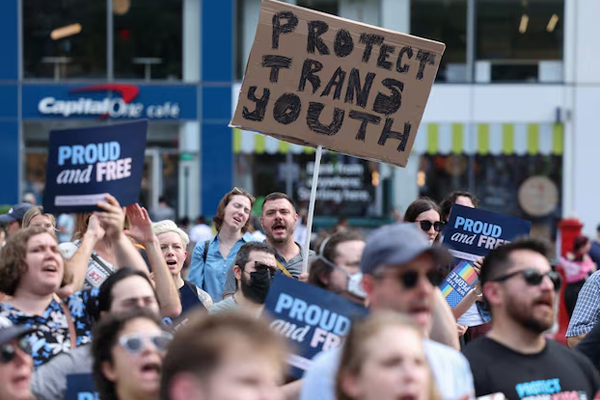
A coalition of Democratic-led states filed a lawsuit Friday to block Trump-era Justice Department policies that target providers of gender-affirming medical care for transgender youth.
States Challenge Justice Department
Sixteen states, along with the District of Columbia, in a lawsuit filed in federal court in Boston, argued Trump unconstitutionally trampled on their rights to regulate medicine with an executive order in January that directed prosecutors to prioritise investigations of transgender youth care.
The executive order, which also directed an end to all federal funding or support for healthcare that aids the transition of transgender youth, formed the basis of two recent Justice Department directives that the lawsuit also challenges.
Those policies include an April memo from U.S. Attorney General Pam Bondi directing prosecutors to investigate cases involving procedures that she said would violate a federal law barring “female genital mutilation”.
Bondi also directed the department to launch civil investigations into medical providers and pharmaceutical companies that manufacture and distribute puberty blockers and hormones prescribed by doctors.
The Justice Department last month said it sent more than 20 subpoenas to doctors and clinics involved in performing transgender medical procedures on children.
Democratic state attorneys general argue the Justice Department’s efforts are part of a campaign by the Republican president’s administration to intimidate healthcare providers into ceasing to provide such treatments to people under the age of 19, even in states where such treatments are legal.
“This administration is ruthlessly targeting young people who already face immense barriers just to be seen and heard and are putting countless lives at risk in the process,” New York Attorney General Letitia James said in a statement.
The states argue that by invoking the female genital mutilation statute, the Food, Drug, and Cosmetic Act, and the False Claims Act, the Justice Department is relying on laws that were never intended to be used to address the conduct at issue.
They say Trump’s executive order violates the states’ rights under the U.S. Constitution’s 10th Amendment.
Regulation of the practice of medicine has long been left to the states.
Conservative lawmakers in 25 states have in recent years adopted bans on various forms of gender-affirming care for adolescents. The U.S. Supreme Court in June upheld one such ban in Tennessee, delivering a major setback for transgender rights advocates.
(With inputs from Reuters)
Homestead Afghanistan: Sowing Stability In An Unstable Land
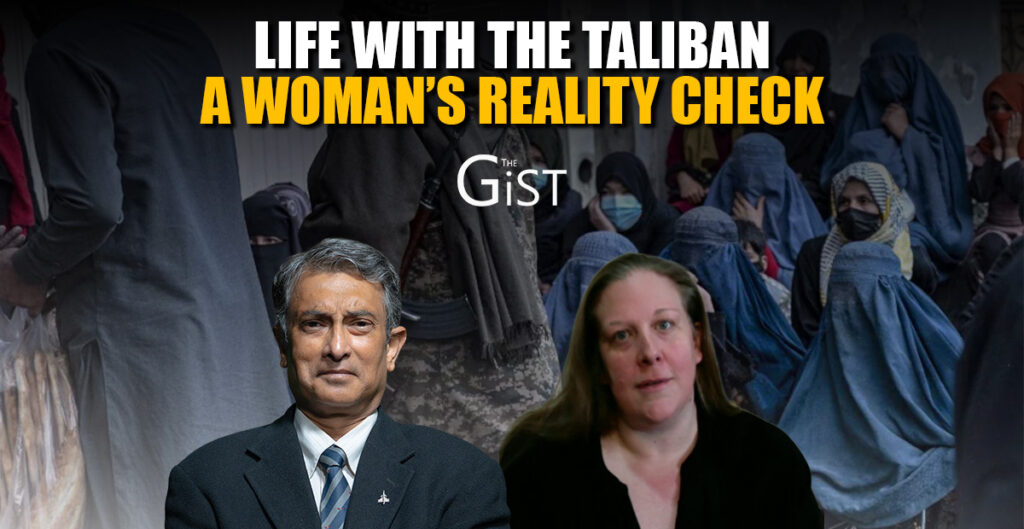
Jill Suzanne Kornetsky has lived and worked in Afghanistan since 2015, running a consulting firm and spearheading agricultural development projects across the country. As an American woman navigating post-2021 Afghanistan under Taliban rule, she offers a perspective that sharply contrasts with dominant media narratives.
“Compared to ten years ago, very little has changed,” she says. Women still go about their business in Kabul, some wearing burqas, others in hijabs or niqabs. “What I hear on social media and what I see out my window don’t match up.”
Operating her nonprofit, Homestead Afghanistan, Jill finds it easier now to access rural areas. “It’s safer. The guys who used to block the roads are now the government. I no longer have to pay bribes or endure inappropriate requests to get work done—unlike under the previous regime,” she says.
Homestead Afghanistan aims to make 200,000 rural families self-sufficient over 25 years by offering a holistic agricultural model. “You can’t just hand out tomato seeds and walk away. We’re addressing poor soil, water scarcity, climate shocks, and the absence of infrastructure—problems the old aid model ignored.”
Despite funding challenges following the end of USAID’s operations, Jill, who’s also a certified anti-terrorism expert, remains undeterred. She is now pitching a pilot model in a single district to demonstrate the viability of self-reliant rural ecosystems.
She rejects simplistic portrayals of Afghanistan as a terrorist haven or Taliban rule as uniquely brutal. “People here prefer order over the corruption and lawlessness of the previous government. And most rural Afghans live today as they always have,” she explains.
On India’s role, she is unequivocal: “India is seen as a friend. The aid it provided—power plants, heritage restoration—was viewed as genuine, not political.”
As Afghanistan adjusts to its new normal, Kornetsky’s work represents a grounded, long-haul approach—one that trusts Afghans to define their own future.
Thousands Join Pro-Palestinian March Across Sydney Harbour Bridge
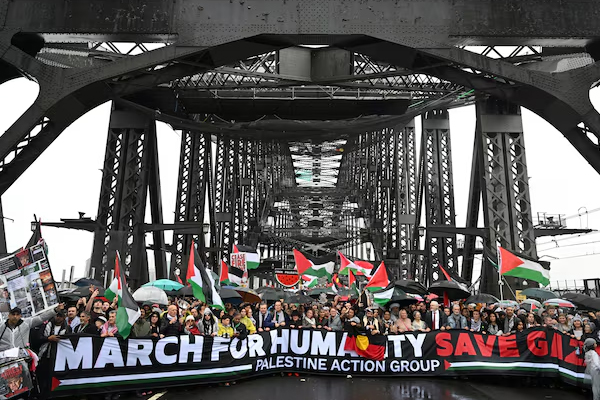
Calling for peace and urgent aid deliveries to war-torn Gaza, thousands of demonstrators marched across Sydney’s iconic Harbour Bridge on Sunday, braving pouring rain as the humanitarian crisis deepens.
Nearly two years into a war that Palestinian authorities say has killed more than 60,000 people in Gaza, governments and humanitarian organisations say a shortage of food is leading to widespread starvation.
Some of those attending the march, called by its organisers the ‘March for Humanity’, carried pots and pans as symbols of the hunger.
“Enough is enough,” said Doug, a man in his 60s with a shock of white hair. “When people from all over the world gather together and speak up, then evil can be overcome.”
Pro-palestinian March
Marchers ranged from the elderly to families with young children. Among them was WikiLeaks founder Julian Assange. Many carried umbrellas. Some waved Palestinian flags and chanted, “We are all Palestinians.”
New South Wales police and the state’s premier last week tried to block the march from taking place on the bridge, a city landmark and transport thoroughfare, saying the route could cause safety hazards and transport disruption.
The state’s Supreme Court ruled on Saturday that it could go ahead.
Police said they were deploying hundreds of personnel and urged marchers to remain peaceful.
Police were also present in Melbourne, where a similar protest march was taking place.
Diplomatic pressure ramped up on Israel in recent weeks. France and Canada have said they will recognise a Palestinian state, and Britain says it will follow suit unless Israel addresses the humanitarian crisis and reaches a ceasefire.
Israel has condemned these decisions as rewarding Hamas, the group that governs Gaza and whose attack on Israel in October 2023 began an Israeli offensive that has flattened much of the enclave.
Israel has also denied pursuing a policy of starvation and accused Hamas of stealing aid.
Australia’s PM Remarked
Australia’s centre-left Prime Minister Anthony Albanese has said he supports a two-state solution and Israel’s denial of aid and killing of civilians “cannot be defended or ignored”, but he has not recognised Palestine.
Therese Curtis, a marcher in her 80s, said she had the human right and privilege of good medical care in Australia.
“But the people in Palestine are having their hospitals bombed; they’re being denied a basic right of medical care and I’m marching specifically for that,” she said.
(With inputs from Reuters)
With One Daughter Dead, Gaza Mother Seeks Evacuation For Another
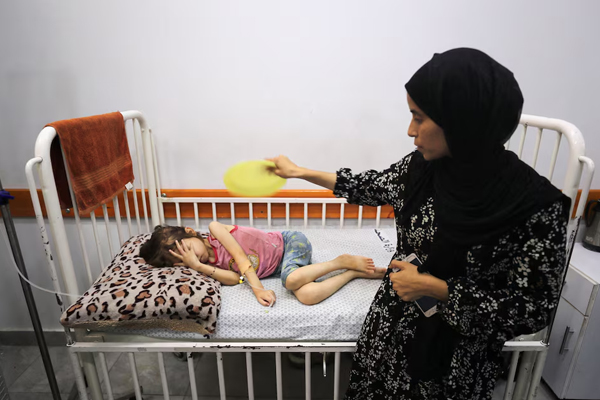
Nasma Ayad fears time is running out to evacuate her malnourished 8-year-old daughter from Gaza City for medical treatment before she meets the same fate as her sister, who died last month.
“I feel I’m slowly losing my daughter, day after day – everything she’s suffering from is multiplying,” Ayad said.
With few medical supplies and limited food, treating malnourished Palestinian children with complicated conditions in war-shattered Gaza has become increasingly difficult, according to medical staff and humanitarian agencies.
Jana received treatment for malnutrition last year at an International Medical Corps clinic in the central town of Deir al-Balah after showing signs of weakness and delayed growth.
Though she improved, the frequent interruption of healthcare services and increasing scarcity of food – as Israeli forces, who control all access to Gaza, have kept up their offensive against Hamas militants – led to a relapse, Ayad said.
She weighs just 11 kilograms (24 pounds) and has trouble seeing, speaking or standing up.
“She started having an oedema, which is fluid retention that makes the limbs and the body swell and store water because of the lack of protein and food,” said Suzan Marouf, a therapeutic nutritionist at Patient Friend’s Benevolent Society Hospital.
Jana’s sister, Joury, died on July 20. The child had kidney problems exacerbated by malnutrition, her mother said.
Gaza’s spiralling humanitarian crisis prompted the main world hunger monitoring body on Tuesday to assess that a worst-case scenario of famine is unfolding and that immediate action is needed to avoid widespread death. Images of emaciated Palestinian children have shocked many around the world.
Gazan health authorities have reported more and more people dying from hunger-related causes. The total now stands at 156, among them 90 children, most of whom died in the past few weeks.
Ayad had hoped both her girls could be evacuated to safety to receive treatment outside the Gaza Strip. Health officials had added them to a list of patients who were in need of evacuation last September.
But the evacuations never transpired. Though it was too late for Joury, her mother still holds out some hope for Jana.
“I am calling for the urgent referral of Jana as soon as possible to be treated outside the country,” she said.
With the international furore over Gaza’s ordeal growing, Israel announced steps over the weekend to ease aid access.
But the U.N. World Food Programme said on Tuesday it was still not getting the permissions needed to deliver sufficient aid.
Israel and the U.S. accuse Hamas of stealing aid – which the Islamist group denies – and the U.N. of failing to prevent this.
The United Nations says it has seen no evidence of Hamas diverting much aid. Hamas accuses Israel of causing starvation and using aid as a weapon, which the Israeli government denies.
(With inputs from Reuters)
Pope Leo Tells Thousands Of Young Catholics To Build A Better World
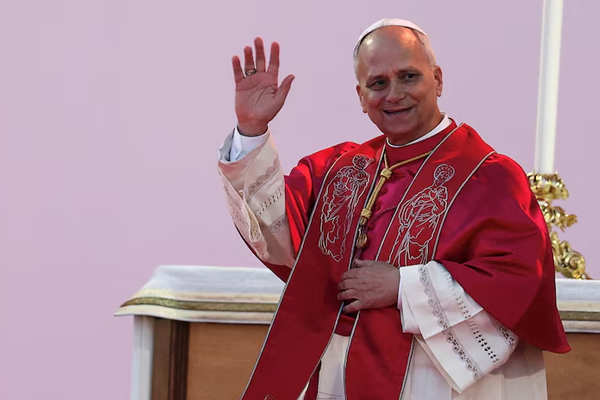
As part of a special weekend aimed at energising Catholic youth, hundreds of thousands of young people filled a vast field on the outskirts of Rome on Saturday to see Pope Leo.
This was the largest event yet of the new pontiff’s tenure.
Young people from more than 146 countries, some wearing colourful bandanas to ward off the hot summer sun, were pressed against fences in the Tor Vergata field as Leo toured the crowd in his white popemobile in the late afternoon.
The pope, smiling broadly, waved, offered blessings and occasionally caught small stuffed animals and national flags thrown by the youth as he passed by.
“Dear young people … my prayer for you is that you may persevere in faith, with joy and courage,” Leo said in remarks later to the crowd.
“Seek justice in order to build a more humane world,” he said. “Serve the poor, and so bear witness to the good that we would always like to receive from our neighbours.”
Many of the youth attending the event with Leo spent all day waiting in the field in heat approaching 30 degrees Celsius (86°F) to see the pope.
Organisers were using water cannons to help cool down people in the crowd.
“For me, it is an incredible emotion because I had never been to an event like this before,” said Maya Remorini, from Italy’s Tuscany region. She said her group had arrived around 5 a.m. that morning.
Many of the youth are expected to sleep in the field overnight, waiting for a second chance to see Leo on Sunday morning, when the pope is due to celebrate a Catholic mass.
The weekend events are tied to the ongoing Catholic Holy Year, which the Vatican says has attracted some 17 million pilgrims to Rome since it started at the end of 2024.
Leo, the first U.S.-born pope, was elected on May 8 by the world’s cardinals to replace the late Pope Francis.
(With inputs from Reuters)
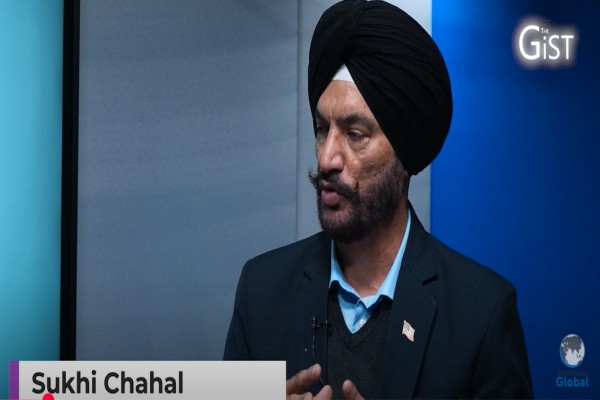
Anti-Khalistan Activist Sukhi Chahal Dies Mysteriously In California
Sukhi Chahal, a well-known Indian-American Sikh activist and fierce critic of Khalistani separatist propaganda, died under mysterious circumstances in California on Thursday night.
The 50-year-old reportedly collapsed after dinner at a friend’s home in San Jose and was declared dead on the spot. While early reports suggest a heart attack, the suddenness of his death—just weeks before a controversial “Khalistan referendum” event he was opposing—has prompted demands for a full, transparent investigation. An autopsy report is awaited.
Chahal was the founder of The Khalsa Today and chairman of the Punjab Foundation, known for building platforms to counter extremism and disinformation targeting the Sikh diaspora. He had long warned that separatist propaganda was endangering Sikh youth abroad and distorting realities in India.
In one of his two interviews to StratNewsGlobal, Chahal posed a direct and pointed question that has since taken on added weight.
Referring to the repeated threats made by New York based lawyer and Khalistani separatist Gurpatwant Singh Pannun—including one where Pannun warned Sikhs not to fly Air India as he “might bring it down”—Chahal asked: “Why hasn’t Air India sued him yet? Pannun publicly threatened to bring down an aircraft—this is terrorism. If he said something like that about American Airlines or British Airways, he would be in jail within 24 hours. Why are we quiet?”
He was clear in calling out double standards in both enforcement and outrage. “If such a statement had been made against any Western airline, their entire national security apparatus would’ve moved,” he said, adding, “But when it’s India, there’s complete silence.”
Throughout the interview, Chahal emphasised that India remains a safe and democratic country for Sikhs. “India is the only country where Sikhs have had a Prime Minister, a President, and an Army Chief,” he said. “So how can anyone say Sikhs are unsafe in India? This is a lie being sold to confuse our youth.
“India is a democratic country. No Sikh in India is being denied the right to go to a gurdwara, or to wear a turban. So how are Sikhs not safe in India?” he asked.
Warning that the Khalistan movement does not speak for the Sikh masses, he said: “They don’t talk about jobs, healthcare, education, or development. Just slogans and protests. That’s not leadership. That’s manipulation.”
Originally from Punjab’s Tarn Taran district, Chahal moved to the United States in the 1990s, built a successful tech business, and later turned to advocacy. Through The Khalsa Today, he led coordinated campaigns to counter separatist narratives in the US, Canada, and the UK, working closely with diaspora leaders and lawmakers.
His sudden death has shaken the global Sikh and Indian communities, particularly those who viewed him as a rare voice of clarity in an increasingly polarised debate.
With the controversial “referendum” on Khalistan scheduled for August 17 in Washington, D.C.—a campaign Chahal was actively opposing—his death has triggered serious concern, with supporters are calling for an independent investigation into the circumstances surrounding his passing.
While law enforcement has yet to announce findings, his friends and community members point out that Chahal had been physically attacked and received death threats from Khalistani activists including Pannun and his followers several times.
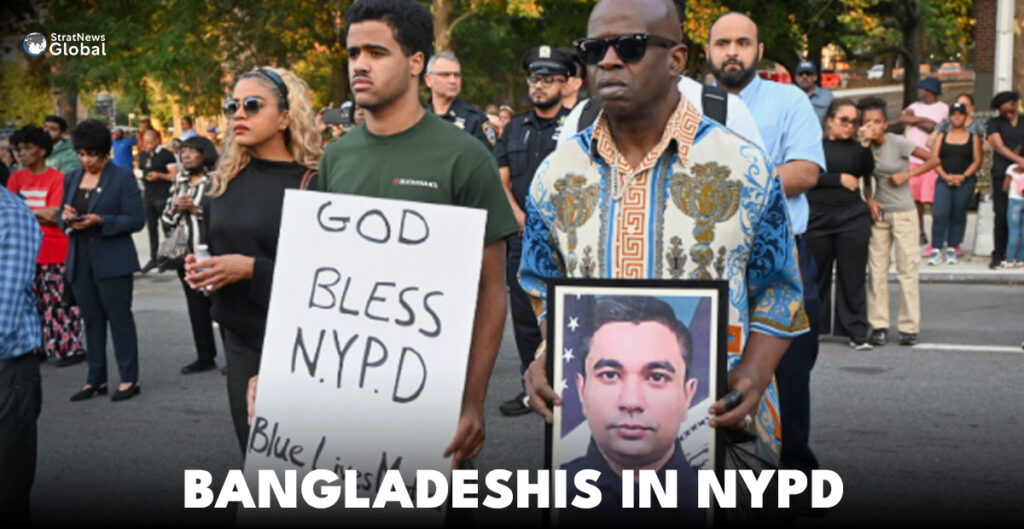
Slain NYPD Officer’s Funeral Highlights Growing Presence Of Bangladeshis In Department
Inside a three-story mosque in the Bronx, dozens of New York City police officers sat cross-legged in solemn silence as they had gathered to honour one of their own—Detective Didarul Islam—the Bangladeshi American NYPD officer who was fatally shot while in uniform just days earlier.
Detective Islam was among the victims of a brutal shooting spree on Monday night, when a gunman stormed a Park Avenue office building, opening fire in the lobby and on an upper floor, killing four people.
In recognition of his service, Islam was awarded a posthumous promotion, but his death sent a particularly strong shock through the NYPD’s growing community of Bangladeshi American officers.
Bangladeshis’ Presence In NYPD
Islam, who immigrated to the United States from Bangladesh 16 years ago, was part of a rapidly expanding cohort of Bangladeshi Americans in the department.
Over the past decade, their numbers have surged, representing a new chapter in the NYPD’s long tradition of integrating immigrant communities seeking security, opportunity, and belonging in America’s largest police force.
“For us, being police officers means serving New Yorkers and helping the community,” said Sergeant Ershadur Siddique, president of the Bangladeshi American Police Association. “It shows we’re part of New York, part of America.”
Fastest-Growing Fraternal Group
The association, founded in 2015, has grown swiftly, now representing nearly 1,000 of the NYPD’s 34,000 uniformed officers, alongside 1,500 civilian employees.
Members include four captains, an inspector, and many others across ranks and roles, making it the department’s second fastest-growing fraternal group.
Islam himself had often encouraged Bronx residents to consider becoming traffic enforcement agents—a job many in the community have embraced.
Like the Irish Americans of earlier generations who once dominated the NYPD, Bangladeshi Americans are now finding their place in the force, drawn by the promise of stable pay, benefits, and public service.
Evolving Demographic Landscape
The face of the department has changed steadily over the years, with 12% of uniformed officers now identifying as Asian—closely matching the city’s demographics—along with 33% Hispanic and 17% Black officers. Among civilian employees, 17% are Asian and 45% are Black.
A rise in minority and immigrant-based fraternal organisations reflects this transformation. Alongside the Bangladeshi American Police Association, others include the New York Dominican Officers Organisation and the Pakistani American Law Enforcement Society.
The Bangladeshi association’s founding mission was not only to encourage recruitment and career growth but also to counter post-9/11 Islamophobia.