

Support us by contributing to StratNewsGlobal on the following UPI ID
ultramodern@hdfcbank

Strategic affairs is our game, South Asia and beyond our playground. Put together by an experienced team led by Nitin A. Gokhale. Our focus is on strategic affairs, foreign policy and international relations, with higher quality reportage, analysis and commentary with new tie-ups across the South Asian region.
You can support our endeavours. Visit us at www.stratnewsglobal.com and follow us on YouTube, Twitter, Facebook and Instagram.
र 500 per month
र 1000 per month
र 5000 per year
र 10000 per year
Donate an amount of your choice
र 500 per month
Donate र 500 per month

र 1000 per month
Donate र 1000 per month
र 5000 per year
Donate र 5,000 per year
र 10000 per year
Donate र 10,000 per year
Donate an amount of your choice
Donate an amount of your choice
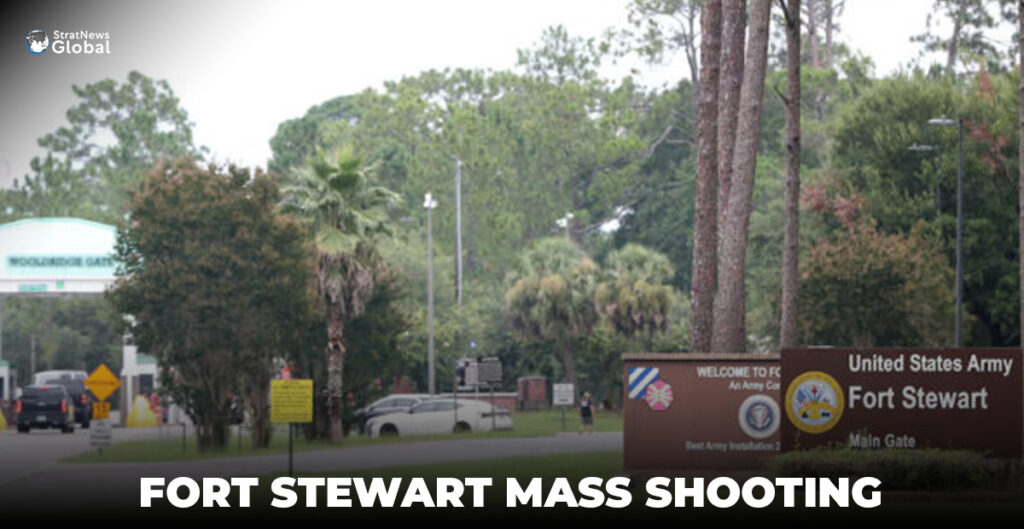
5 Soldiers Injured in Shooting At Fort Stewart; Sergeant In Custody
A US Army sergeant opened fire with his personal handgun at Fort Stewart-Hunter Army Airfield near Savannah, Georgia, on Wednesday, injuring five fellow soldiers before being overpowered by others and taken into custody, according to military officials.
All five soldiers were listed in stable condition following the incident and are expected to recover, though three required surgery, according to Brigadier General John Lubas, the base commander.
Lockdown security measures on the base were lifted after the suspect was taken into custody, and there was no threat to the surrounding community, Lubas said. A motive was not readily apparent, he added.
Suspect Identified
The suspect was identified as Quornelius Radford, 28, an active-duty sergeant specializing in automated logistics and assigned to a supply unit of the 2nd Armored Brigade Combat Team at Fort Stewart. Lubas said Radford, stationed at Fort Stewart since 2022, had not previously been deployed to combat.
Lubas said at an afternoon press conference that the shooting unfolded shortly before 11 a.m. local time at the suspect’s work post on base and involved co-workers in his unit.
“I don’t have reason to believe that it had anything to do with a training event. Other than that, I can’t state the motivations for this soldier.”
How the pistol slipped through base security onto the installation remained unknown, the general said.
Prior DUI Charges
Other soldiers in the area who witnessed the shooting tackled and subdued the suspect before law enforcement arrived and took him into custody, according to the general. Radford was later questioned by Army investigators and was being held pending charging decisions.
Lubas gave little information about Radford’s background except to say he had a prior drunken-driving arrest, which was unknown to the chain of command until “the event occurred and we started looking into the law enforcement databases.”
Speaking to reporters at the White House, President Donald Trump said, “The entire nation is praying for the victims and their families.” He called the suspect “horrible”.
Common Crime
Mass shootings are relatively common in the US, where guns are widely available, and military bases, which are among the highest-security places in the country, have not been spared.
The deadliest was at the Fort Hood Army base in 2009, when a major fatally shot unarmed soldiers in a medical building with a laser-sighted handgun, killing 13 people and injuring more than 30. Less than five years later, a soldier at the same Texas base fatally shot three service members and injured 16 others before killing himself.
In 2013, an employee of a government defence contractor killed 12 people at Washington’s Navy Yard. In 2019, a Saudi Air Force lieutenant shot and killed three people and wounded eight others at a US Navy base in Pensacola, Florida.
Fort Stewart is located in Hinesville, about 225 miles (362 km) southeast of Atlanta and 40 miles (64 km) southwest of Savannah. Nearly 9,000 people live at the base, according to the 2020 Census.
The base supports approximately 15,000 active-duty Army military personnel, as well as thousands of military retirees, family members, and others, according to its website.
(With inputs from Reuters)
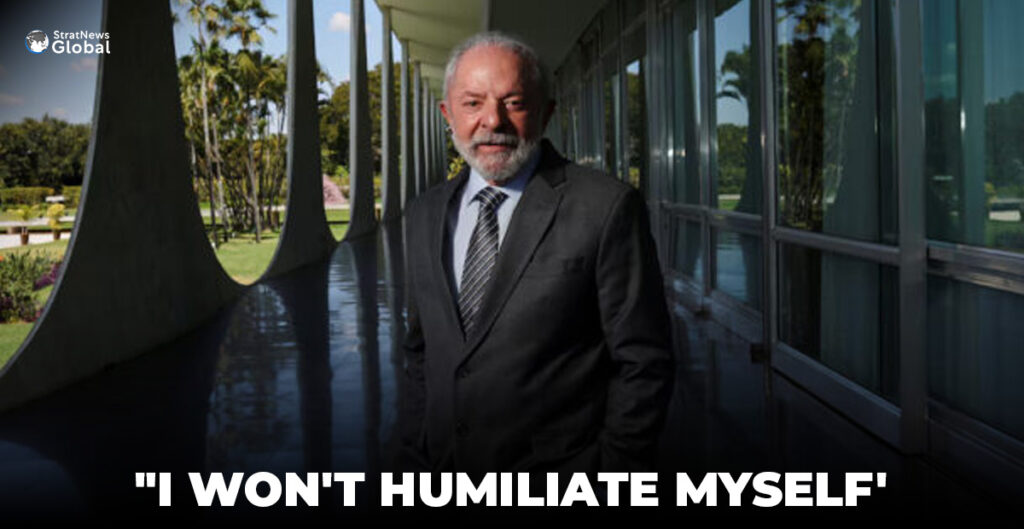
Lula Calls Direct Talks With Trump A ‘Humiliation’
With US tariffs on Brazilian goods surging to 50% on Wednesday, Brazilian President Luiz Inacio Lula da Silva told Reuters he currently saw no scope for direct talks with US President Donald Trump, calling such a meeting likely to be a “humiliation”.
Brazil is not about to announce reciprocal tariffs, he said. Nor will his government give up on cabinet-level talks. But Lula himself is in no rush to ring the White House.
‘I Won’t Humiliate Myself’
“The day my intuition says Trump is ready to talk, I won’t hesitate to call him,” Lula said in an interview from his presidential residence in Brasilia. “But today my intuition says he doesn’t want to talk. And I won’t humiliate myself.”
Despite Brazil’s exports facing one of the highest tariffs imposed by Trump, the new US trade barriers look unlikely to derail Latin America’s largest economy, giving Lula more room to stand his ground against Trump than most Western leaders.
‘Traitor To The Homeland’
Lula described US-Brazil relations at a 200-year nadir after Trump tied the new tariff to his demands for an end to the prosecution of right-wing former President Jair Bolsonaro, who is standing trial for plotting to overturn the 2022 election.
The president said Brazil’s Supreme Court, which is hearing the case against Bolsonaro, “does not care what Trump says and it should not,” adding that Bolsonaro should face another trial for provoking Trump’s intervention, calling the right-wing former president a “traitor to the homeland”.
“We had already pardoned the US intervention in the 1964 coup,” said Lula, who got his political start as a union leader protesting against the military government that followed a US-backed ouster of a democratically elected president.
“But this now is not a small intervention. It’s the president of the United States thinking he can dictate rules for a sovereign country like Brazil. It’s unacceptable.”
‘I Demand Respect’
The Brazilian president said he had no personal issues with Trump, adding that they could meet at the United Nations next month or U.N. climate talks in November. But he noted Trump’s track record of dressing down White House guests such as South African President Cyril Ramaphosa and Ukrainian President Volodymyr Zelenskyy.
“What Trump did with Zelenskyy was humiliation. That’s not normal. What Trump did with Ramaphosa was humiliation,” Lula said. “One president can’t be humiliating another. I respect everyone and I demand respect.”
Lula said his ministers were struggling to open talks with US peers, so his government was focused on domestic policies to cushion the economic blow of US tariffs, while maintaining “fiscal responsibility”.
Mobilising BRICS
The president declined to elaborate on pending measures to support Brazilian companies, which are expected to include credit lines and other export assistance.
He also said he was planning to call leaders from the BRICS group of developing nations, starting with India and China, to discuss the possibility of a joint response to US tariffs.
“There is no coordination among the BRICS yet, but there will be,” Lula said, comparing multilateral action to the strength of collective bargaining in his union days. “What is the negotiating power of one little country with the United States? None.”
Separately, he said Brazil was looking at lodging a collective complaint with other countries at the World Trade Organization.
“I was born negotiating,” said Lula, who was raised in poverty and rose through union ranks to serve two terms as president from 2003 to 2010, then re-entered politics in the 2022 election to defeat the incumbent Bolsonaro.
But he said he was in no rush to strike a deal or retaliate against US tariffs: “We need to be very cautious,” he said.
Asked about countermeasures targeting US companies, such as greater taxation of big technology companies, Lula said his government was studying ways to tax US firms on equal standing with Brazilian companies.
Lula also described plans to create a new national policy for Brazil’s strategic mineral resources, treating them as a matter of “national sovereignty” to break with a history of mining exports that added little value in Brazil.
(With inputs from Reuters)
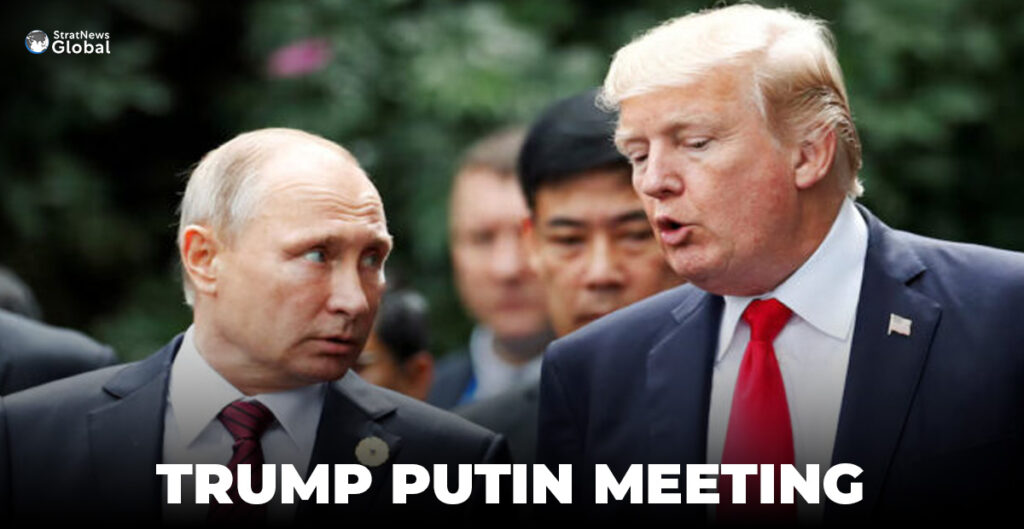
Trump May Meet Putin Next Week Amid Sanctions Threat: Reports
US President Donald Trump may meet Russian President Vladimir Putin as early as next week, a White House official said on Wednesday, even as Washington moves forward with preparations to impose secondary sanctions — possibly targeting China — in a bid to pressure Moscow to halt its war in Ukraine.
Such a face-to-face meeting would be the first between a sitting US and Russian president since Joe Biden met Putin in Geneva in June 2021, some eight months before Russia launched the biggest attack on a European nation since World War Two.
Putin and Ukrainian President Volodymyr Zelenskyy have not met since December 2019 and make no secret of their contempt for each other.
‘Good Chance’
The New York Times reported that Trump told European leaders during a call on Wednesday that he intended to meet with Putin and then follow up with a trilateral involving the Russian leader and Zelenskyy.
“There’s a good chance that there will be a meeting very soon,” Trump told reporters.
White House press secretary Karoline Leavitt said: “The Russians expressed their desire to meet with President Trump, and the president is open to meeting with both President Putin and President Zelenskyy.”
‘Useful, Constructive’
The details emerged following a meeting on Wednesday between Putin and US special envoy Steve Witkoff that Trump described as having achieved “great progress” in a Truth Social post, although later said he would not call it a breakthrough.
A Kremlin aide said the talks were “useful and constructive.”
The diplomatic maneuvers come two days before a deadline set by Trump for Russia to agree to peace in Ukraine or face new sanctions.
Trump has been increasingly frustrated with Putin over the lack of progress towards peace and has threatened to impose heavy tariffs on countries that buy Russian exports, including oil.
Trump on Wednesday also said he could announce further tariffs on China similar to the 25% duties announced earlier on India over its purchases of Russian oil.
“We did it with India. We’re doing it probably with a couple of others. One of them could be China,” he said.
US To Go Through With Secondary Sanctions
The White House official earlier said that while the meeting between Witkoff and Putin had gone well and Moscow was eager to continue engaging with the United States, secondary sanctions that Trump had threatened against countries doing business with Russia were still expected to be implemented on Friday.
Kremlin foreign policy aide Yuri Ushakov said the two sides had exchanged “signals” on the Ukraine issue and discussed the possibility of developing strategic cooperation between Moscow and Washington, but declined to give more details until Witkoff had reported back to Trump.
Zelenskyy said he believed pressure had worked on Russia and Moscow was now more “inclined” to a ceasefire.
“The pressure on them works. But the main thing is that they do not deceive us in the details – neither us nor the US,” Zelenskyy said in his nightly address.
Trump on Truth Social said he had updated some of Washington’s European allies following Witkoff’s meeting.
A German government spokesperson said Trump provided information about the status of the talks with Russia during a call with the German chancellor and other European leaders.
Pressure On India – And Maybe China?
Trump took a key step toward punitive measures on Wednesday when he imposed an additional 25% tariff on imports from India, citing New Delhi’s continued imports of Russian oil.
The new measure raises tariffs on some Indian goods to as high as 50% — among the steepest faced by any US trading partner. India’s external affairs ministry called the decision “extremely unfortunate.”
The Kremlin says threats to penalise countries that trade with Russia are illegal.
Trump’s comment on Wednesday that he could impose more tariffs on China would be a further escalation between the world’s two biggest economies.
US Treasury Secretary Scott Bessent last week warned Chinese officials that continued purchases of sanctioned Russian oil would lead to big tariffs due to legislation in Congress.
The US and China have been engaged in discussions about trade and tariffs, with an eye to extending a 90-day tariff truce that is due to expire on August 12, when their bilateral tariffs shoot back up to triple-digit figures.
Air Strikes
Bloomberg and independent Russian news outlet The Bell reported that the Kremlin might propose a moratorium on airstrikes by Russia and Ukraine – an idea mentioned last week by Belarusian President Alexander Lukashenko during a meeting with Putin.
Such a move, if agreed, would fall well short of the full and immediate ceasefire that Ukraine and the US have been seeking for months. But it would offer some relief to both sides.
Since the two sides resumed direct peace talks in May, Russia has carried out its heaviest air attacks of the war, killing at least 72 people in the capital Kyiv alone. Trump last week called the Russian attacks “disgusting.”
Ukraine continues to strike Russian refineries and oil depots, which it has hit many times.
Putin is unlikely to bow to Trump’s sanctions ultimatum because he believes he is winning the war and his military goals take precedence over his desire to improve relations with the US, three sources close to the Kremlin have told Reuters.
The Russian sources told Reuters that Putin was sceptical that yet more US sanctions would have much of an impact after successive waves of economic penalties during the war.
(With inputs from Reuters)
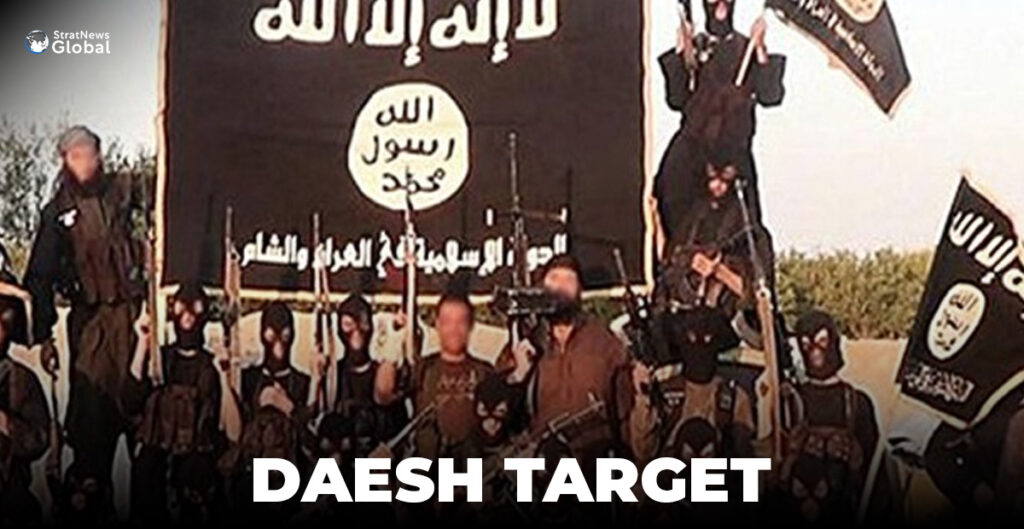
Daesh-Khorasan Eyes India: A New Frontline In Global Jihad
Daesh-Khorasan (Daesh-K), once seen as a regional offshoot of the Islamic State operating within the Afghanistan-Pakistan corridor, has morphed into a transnational threat with strategic designs on South Asia, Central Asia, and Europe.
Its capacity to recruit across borders, exploit local grievances, and deploy propaganda in multiple languages places India and the surrounding region in a critical position in this evolving security landscape.
The SAWAB Center’s June 2025 study underscores how Daesh-K has grown into one of the most dynamic wilayas (provinces) of the Islamic State.
Formally established in 2015 with the blessing of Daesh Central, its current leader, Shahab Al Muhajir—also known as Sanaullah Ghafari—has expanded the group’s operational independence and enhanced its international outreach. He is listed by the UN Security Council for financing and planning acts of terrorism, and his leadership marks a turning point in Daesh-K’s ability to operate beyond traditional boundaries.
Daesh-K’s rise is tied closely to political vacuums in Afghanistan, fractured governance, and the ideological disillusionment of defectors from both the Taliban and Al Qaeda. India, already a repeated target in the group’s rhetoric and propaganda, is named in the report as one of the countries where Daesh-K-linked plots were reportedly thwarted in 2023 and 2024. While the exact details of those foiled attacks are not provided, India’s inclusion in this list places it squarely within the group’s expanding field of interest.
The group’s strategy revolves around exploiting regional grievances, targeting disenfranchised youth, and radicalising individuals through tailored messaging. In South Asia, Daesh-K’s propaganda makes strategic use of emotional and ideological narratives. Voice of Khorasan—its multilingual flagship magazine—routinely attacks the Indian government and security forces, framing the Kashmir conflict as a religious occupation. Issue 39 of the magazine, for example, featured an article titled “Kashmir, the Paradise under the control of Infidels,” blending regional grievances with transnational jihadist narratives.
What makes the Daesh-K threat more acute for India is the group’s demonstrated ability to radicalize beyond physical borders. Many Central Asians linked to Daesh-K were reportedly recruited while working abroad in vulnerable, low-income environments—especially in Russia. The same recruitment logic could extend to South Asian migrant communities, particularly from India, Pakistan, and Bangladesh, who face socio-economic alienation in the Gulf and parts of Southeast Asia.
India’s linguistic diversity and its sizeable Muslim population have not gone unnoticed by Daesh-K propagandists. The group has produced materials in Urdu, Hindi, Malayalam, and other South Asian languages, thereby targeting a wide range of demographics. While India has significantly tightened its counter-radicalisation mechanisms, especially online, the SAWAB report warns that Daesh-K has adapted rapidly to platform bans by migrating to encrypted apps like Telegram and Rocket.Chat. These tools enable the dissemination of propaganda and the coordination of recruitment without detection.
Another area of concern is Daesh-K’s persistent targeting of regional adversaries in its propaganda—India among them. Alongside the Taliban, Iran, and Pakistan, India is depicted as a regional oppressor in Daesh-K’s narratives. These portrayals serve to rally support across various geographies and to justify future attacks. In this sense, India is not merely collateral damage in Daesh-K’s global jihad—it is one of its ideological enemies.
The group’s recent attacks and foiled plots across Eurasia demonstrate both its ambition and its capabilities. While Europe is seen as a high-value target due to symbolic significance and ease of infiltration through migrant routes, South Asia represents an ideological battleground with deep historical and political roots. The group’s criticism of nationalist struggles, including Hamas and the Taliban, indicates its disdain for what it sees as politically compromised Islamist movements. This raises concerns about Daesh-K’s potential to attract more radicalised individuals in South Asia who are disillusioned with existing religious or political groups.
India must also pay attention to Daesh-K’s recruitment of youth and women. The group’s propaganda includes memes, videos, and gamified content designed to resonate with younger audiences. Recent issues of Voice of Khorasan have also shifted in tone toward women, blending traditional gender roles with newer narratives of female leadership and operational readiness. This evolving communication strategy increases the risk of homegrown radicalisation among young men and women alike in South Asia.
The group’s operational doctrine, as outlined by its leader in the 2023 book Islamic Political System, advocates attacks in cities with high security to intimidate adversaries. Such guidance, the report warns, could influence lone-actor or hybrid attacks in dense urban areas of South Asia, including India. While the Crocus City Hall attack in Moscow is cited as a model for such action, similar scenarios targeting high-profile Indian events, religious gatherings, or urban infrastructure cannot be discounted.
India’s multi-layered social fabric, combined with existing communal tensions, could provide fertile ground for radicalisation if not proactively addressed. The SAWAB report repeatedly stresses that effective counterterrorism responses must go beyond security surveillance and include community engagement, socio-economic support, and tailored counter-narratives. This is particularly important in India’s context, where aggressive policing or stigmatisation of certain communities could inadvertently aid extremist recruitment.
The report also outlines efforts by Central Asian governments to combat radicalisation through education and soft-power initiatives. Uzbekistan’s Imam Bukhari Center is highlighted as a model of promoting religious pluralism to counter extremist narratives. Similar models may hold relevance for India, especially in states where Salafist or Wahhabi influences are more pronounced.
Daesh-Khorasan poses a clear and present threat to South Asia, and India in particular, which is highlighted by the group’s rhetoric, attempted attacks, and tailored recruitment strategies. It is a borderless insurgency feeding on alienation, identity politics, and ideological disillusionment. The battle against it will require not just a counterterrorism force but a long-term, culturally literate, and socially inclusive strategy.
India, given its geopolitical and demographic profile, cannot afford to underestimate this growing menace.
India’s SCO Strategy: Delay, Deny, and Diminish China’s Agenda
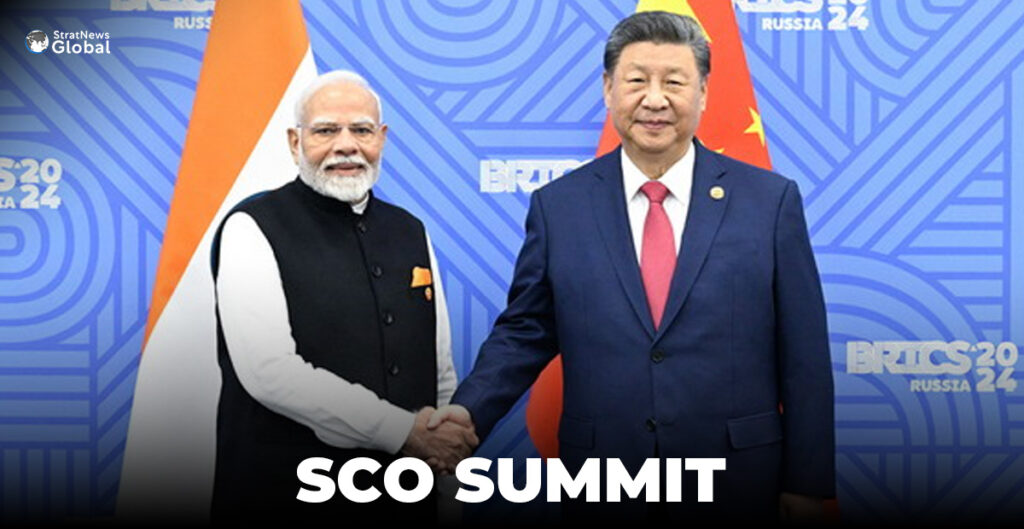
As Prime Minister Narendra Modi prepares to travel to China for the Shanghai Cooperation Organisation (SCO) summit from August 31 to September 1—his first visit to the country since the deadly Galwan Valley clash in June 2020—questions are mounting about how India plans to navigate its complex relationship with Beijing inside multilateral settings.
A new scholarly analysis sheds light on how New Delhi has, in fact, already been doing so: not through overt confrontation, but through calculated, forum-specific forms of soft balancing.
The argument is laid out by Ian Hall in his article “India’s China strategy after Galwan: minilateral and multilateral soft balancing in the Indo-Pacific”, published in International Affairs by Oxford University Press on behalf of The Royal Institute of International Affairs. Hall contends that the Galwan clash marked not just a military escalation, but a turning point in India’s overall China strategy—prompting a shift away from “evasive balancing” toward a more deliberate effort to check China’s influence through non-military tools within shared institutions.
According to Hall, India’s behaviour since Galwan reflects a sophisticated soft balancing approach, using multilateral and minilateral platforms to frustrate, delay or constrain China’s ability to pursue its strategic objectives. These tactics—deployed in forums like the RIC (Russia–India–China), BRICS, the SCO and IBSA—are tailored to each setting but share a common logic: limiting China’s room to manoeuvre while avoiding outright rupture or escalation.
Among these, the SCO stands out—particularly in light of Modi’s impending visit. Hall points out that India has long used the SCO to push back against Chinese initiatives, most notably the Belt and Road Initiative (BRI), which New Delhi has consistently refused to endorse in joint communiqués. But after Galwan, India’s approach hardened.
Hall describes India’s recent SCO conduct as trivialization—remaining formally engaged but deliberately reshaping the agenda to sideline Beijing’s interests. Prime Minister Modi’s own “SECURE” framework, rolled out at a previous SCO summit, emphasized issues like terrorism, connectivity, and sovereignty, effectively contrasting with China’s BRI-centric development narrative.
India’s chairmanship of the SCO in 2023 further deepened this approach. Hall notes that New Delhi used its turn to highlight concerns that resonated with Central Asian partners—such as food security and regional stability—while downplaying or omitting China-led projects. At the same time, India continued to publicly confront China over its LAC posture through statements made on the sidelines of SCO meetings, underlining that engagement in multilateral formats did not imply normalization of bilateral relations.
This pattern, however, is not unique to the SCO. Hall documents similar post-Galwan strategies in other forums, beginning with the RIC trilateral. There, India applied a blunt form of soft balancing: denial. It delayed meetings, withheld consent for joint statements, and froze meaningful engagement. While Russia, sometimes with China’s support, sought to reactivate the format, India demurred—sending a clear signal that business-as-usual would not resume while the border situation remained unresolved. In one instance, even when Russia offered to host a leaders’ summit to “break the ice,” New Delhi declined.
Official Indian statements made the rationale explicit. In 2023, the Ministry of External Affairs linked India’s absence from RIC activity directly to the unresolved border situation. As Hall notes, this tactic denied China both legitimacy and visibility, using silence and non-engagement as tools of restraint.
In the BRICS grouping, India adopted a different soft balancing tool: delay. Particularly during China’s 2022 chairmanship, New Delhi pushed back against Beijing’s push to expand the bloc, which China hoped to shape into a more overtly anti-Western platform. While India did not block expansion outright, it insisted on further consultation and slowed down the process. A final agreement on new members only emerged a year later—after China had relinquished the chair.
This resistance, Hall argues, was not incidental. Indian officials, including the prime minister, used public remarks at BRICS meetings to highlight principles like respect for sovereignty and opposition to the politicisation of counterterrorism—clear, if oblique, references to Chinese conduct. Yet India still participated in summits, issued joint declarations, and advanced its own agenda, notably on development and financial reform. The tactic here was to remain present, but to steer the pace and character of the forum in a direction less favourable to Beijing.
In the G20 context, India revived the IBSA dialogue with Brazil and South Africa—a move Hall identifies as a fourth soft balancing method: exclusion. By working within a like-minded, democratic trio, India created a mini-platform free of Chinese influence. This allowed for coordination on global governance issues without Beijing’s presence, while reinforcing India’s multilateral credentials. Notably, this move did not challenge the G20 directly, but it subtly rebalanced its internal dynamics.
What emerges from Hall’s analysis is a coherent and calibrated strategy. India’s post-Galwan approach does not rely on alliances or military buildups, but on institutional positioning and tactical diplomacy. It is not disengagement, but differentiated engagement—denying space in one forum, delaying decisions in another, trivialising agendas elsewhere, and building coalitions where China is absent.
This reflects, Hall argues, a pragmatic understanding of India’s constraints. Direct confrontation with China carries military and economic risks, especially given the asymmetry in capabilities and continued trade dependencies. But soft balancing offers a way to compete—quietly, consistently, and across multiple arenas—without crossing the threshold into conflict.
In October 2024, following a bilateral meeting between Modi and Xi on the sidelines of the BRICS summit in Kazan, both sides announced a deal to disengage troops in Depsang and Demchok—the last major flashpoints in Ladakh where Indian patrolling rights had been denied since 2020. Whether this was the result of India’s soft balancing in multilateral forums, its hard balancing on the LAC, economic sanctions, or external strategic pressures remains unclear, argues Hall.
But having struck that deal, New Delhi may now adjust the tempo of its diplomatic balancing—though it is unlikely to abandon it entirely, given persistent mistrust and continued military deployments along the frontier.
As Modi prepares to share a table with Xi Jinping at the SCO summit in China later this month, the stage will offer more than handshakes and photo-ops. It will also provide a fresh opportunity to observe the very tactics Hall describes in action. Will India reiterate its objections to Chinese projects? Will it spotlight its own strategic agenda? Or will it engage in visible diplomacy while quietly blocking or blunting Chinese initiatives behind the scenes?
What is clear from Hall’s analysis is that India no longer treats multilateral forums as neutral ground. Since Galwan, they have become contested spaces—arenas where power is not just exercised through troops or tariffs, but through attendance, agendas, communiqués and significant silences.
Severe Water Crisis Grips Gaza Amid Polluted Aquifers And Crippled Pipelines
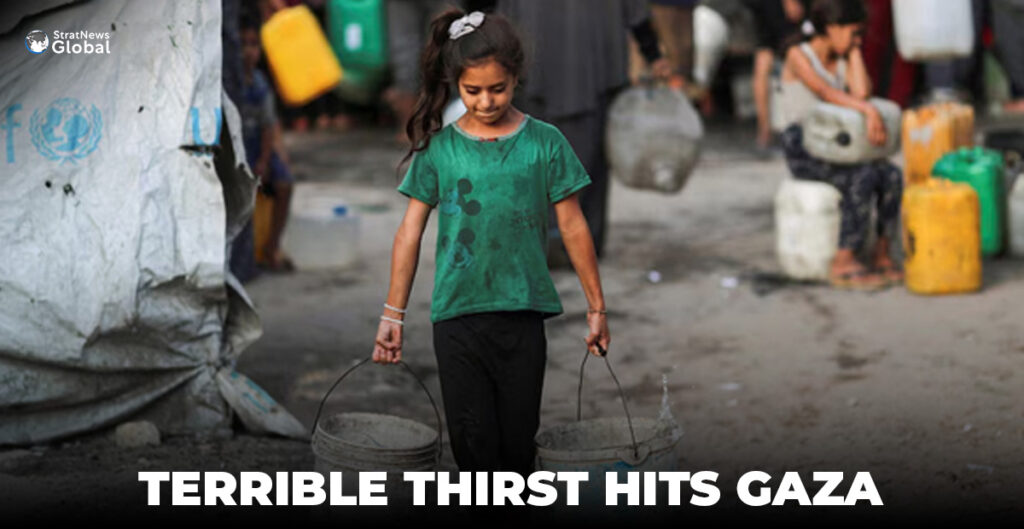
Weakened by hunger, many Gazans traverse the devastated terrain daily to carry scarce water for drinking and washing—still far below essential health standards.
Even as global attention has turned to starvation in Gaza, where, after 22 months of a devastating Israeli military campaign, a global hunger monitor says a famine scenario is unfolding, the water crisis is just as severe, according to aid groups.
Though some water comes from small desalination units run by aid agencies, most is drawn from wells in a brackish aquifer that has been further polluted by sewage and chemicals seeping through the rubble, spreading diarrhoea and hepatitis.
Israeli pipelines that once supplied Gaza with much of its clean water are now dry. Israel stopped all water and electricity supply to Gaza early in the war. Although it resumed some supply later, pipelines were damaged, and Gaza water officials say none have entered recently.
COGAT, the Israeli military aid coordination agency, did not respond to a request for comment on whether Israel is supplying water.
Most water and sanitation infrastructure has been destroyed, and pumps from the aquifer often rely on electricity from small generators – for which fuel is rarely available.
Moaz Mukhaimar, aged 23 and a university student before the war, said he has to walk about a kilometre, queuing for two hours, to fetch water. He often goes three times a day, dragging it back to the family tent over bumpy ground on a small metal handcart.
“How long will we have to stay like this?” he asked, pulling two larger canisters of very brackish water to use for cleaning and two smaller ones of cleaner water to drink.
His mother, Umm Moaz, 53, said the water he collects is needed for the extended family of 20 people living in their small group of tents in Deir al-Balah in the central Gaza Strip.
“The children keep coming and going, and it is hot. They keep wanting to drink. Who knows if tomorrow we will be able to fill up again,” she said.
Their struggle for water is replicated across the tiny, crowded territory where nearly everybody is living in temporary shelters or tents without sewage or hygiene facilities and not enough water to drink, cook and wash as disease spreads.
The United Nations says the minimum emergency level of water consumption per person is 15 litres a day for drinking, cooking, cleaning and washing. Average daily consumption in Israel is around 247 litres a day, according to Israeli rights group B’Tselem.
Bushra Khalidi, humanitarian policy lead for aid agency Oxfam in the Israeli-occupied Palestinian territories, said the average consumption in Gaza now was 3-5 litres a day.
Oxfam said last week that preventable and treatable water-borne diseases were “ripping through Gaza”, with reported rates increasing by almost 150% over the past three months.
Israel blames Hamas for the suffering in Gaza and says it provides adequate aid for the territory’s 2.3 million inhabitants.
Queues For Water
“Water scarcity is definitely increasing very much each day, and people are basically rationing between whether they want to use water for drinking or they want to use a lot for hygiene,” said Danish Malik, a global water and sanitation official for the Norwegian Refugee Council.
Merely queuing for water and carrying it now accounts for hours each day for many Gazans, often involving jostling with others for a place in the queue. Scuffles have sometimes broken out, Gazans say.
Collecting water is often the job of children as their parents seek out food or other necessities.
“The children have lost their childhood and become carriers of plastic containers, running behind water vehicles or going far into remote areas to fill them for their families,” said Munther Salem, water resources head at the Gaza Water and Environment Quality Authority.
With water so hard to get, many people living near the beach wash in the sea.
A new water pipeline funded by the United Arab Emirates is planned to serve 600,000 people in southern Gaza from a desalination plant in Egypt. But it could take several more weeks to be connected.
Much more is needed, aid agencies say. UNICEF spokesperson James Elder said the long-term deprivations were becoming deadly. “Starvation and dehydration are no longer side effects of this conflict.
They are very much frontline effects.”
Oxfam’s Khalidi said a ceasefire and unfettered access for aid agencies were needed to resolve the crisis.
“Otherwise, we will see people dying from the most preventable diseases in Gaza – which is already happening before our eyes.”
(With inputs from Reuters)
Trump Administration Pressures Nations To Oppose Plastic Production Limits In UN Treaty Talks
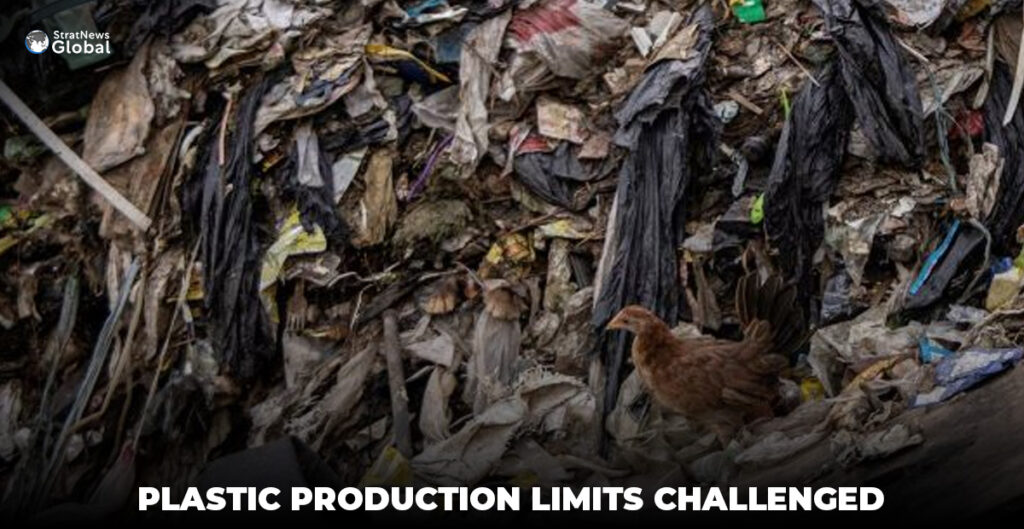
The United States has sent letters to several countries, urging them to oppose the inclusion of plastic production and chemical additive limits in a global agreement, as U.N. plastic treaty negotiations begin in Geneva, according to a memo and communications.
In the communications dated July 25 and circulated to countries at the start of negotiations on Monday, the U.S. laid out its red lines for negotiations that put it in direct opposition to over 100 countries that have supported those measures.
Hopes for a “last-chance” ambitious global treaty that tackles the full life cycle of plastic pollution from the production of polymers to the disposal of waste have dimmed as delegates gather for what was intended to be the final round of negotiations.
Division Between Nations
Significant divisions remain between oil-producing countries— who oppose caps on virgin plastic production fueled by petroleum, coal, and gas — and parties such as the European Union and small island states, which advocate for limits, as well as stronger management of plastic products and hazardous chemicals.
The U.S. delegation, led by career State Department officials who had represented the Biden administration, sent memos to countries laying out its position and saying it will not agree to a treaty that tackles the upstream of plastic pollution.
“We will not support impractical global approaches such as plastic production targets or bans and restrictions on plastic additives or plastic products – that will increase the costs of all plastic products that are used throughout our daily lives,” said the memo that was sent to countries who could not be named due to sensitivities around the negotiations.
Nairobi Meeting
The U.S. acknowledged in the memo that after attending a preliminary heads of delegation meeting in Nairobi from June 30 to July 2, “we plainly do not see convergence on provisions related to the supply of plastic, plastic production, plastic additives or global bans and restrictions on products and chemicals, also known as the global list”.
A State Department spokesperson said each Party should take measures according to its national context.
“Some countries may choose to undertake bans, while others may want to focus on improved collection and recycling,” the spokesperson said.
John Hocevar, Oceans Campaign Director for Greenpeace USA, said the U.S. delegation’s tactics under Trump marked a “return to old school bullying from the U.S. Government trying to use its financial prowess to convince governments to change their position in a way that benefits what the U.S. wants”.
‘Full life Cycle Of Plastics’
One of the world’s leading producers of plastics, the U.S. has also proposed revising the draft objective of the treaty to reduce plastic pollution by eliminating a reference to an agreed “approach that addresses the full life cycle of plastics”, in a proposed resolution.
According to a source, it indicated that the U.S. is seeking to roll back language that had been agreed in 2022 to renegotiate the mandate for the Treaty.
The U.S. stance broadly aligns with the positions laid out by the global petrochemicals industry, which stated similar positions ahead of the talks, and a number of powerful oil and petrochemical producer countries that have held this position throughout the negotiations.
Over 100 countries have backed a cap on global plastic production.
In the U.S., the Trump administration has numerous measures to roll back climate and environmental policies that it says place too many burdens on industry.
Plastic production is set to triple by 2060 without intervention, choking oceans, harming human health and accelerating climate change, according to the OECD.
(With inputs from Reuters)
Pollster Finds Decline In Ukrainians’ Trust In Zelenskyy Following Wartime Protests
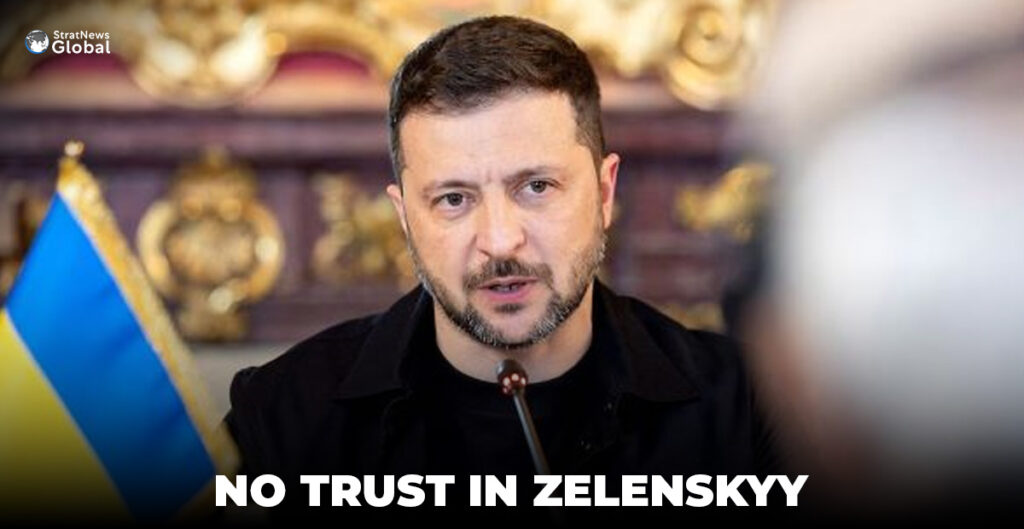
A top polling agency in Kyiv reported on Wednesday that public confidence in Ukrainian President Volodymyr Zelenskyy has dropped to its lowest point in about six months, following rare wartime protests opposing efforts to limit the authority of anti-corruption watchdogs.
The survey, by the Kyiv International Institute of Sociology, is the first by a major Ukrainian pollster to measure public sentiment since Zelenskyy sparked anger with a move to subordinate the agencies to a hand-picked prosecutor-general.
Thousands of Ukrainians had rallied in Kyiv and other cities late last month against the fast-tracked measures, prompting Zelenskyy and his ruling party to quickly reverse course.
The KIIS poll, which began a day after the controversial vote on July 22, found that 58% of Ukrainians currently trust Zelenskyy, down from an 18-month high of 74% in May and 67% in February-March.
Public Discontent
The move against anti-corruption authorities last month had fuelled discontent in particular because of what critics described as the speed and lack of transparency with which the measures were passed.
Fighting corruption and improving governance are key requirements for loan-dependent Ukraine to join the European Union, a step many consider critical to fending off future Russian pressure.
While much smaller, the demonstrations had prompted comparisons to Ukraine’s 2014 Maidan revolution, when protesters toppled a leader accused of graft and heavy-handed rule in favour of closer ties with the West.
KIIS found that those who distrust Zelenskyy cited corruption and his handling of the war as the top two reasons, at 21% and 20%, respectively.
Trust had already been decreasing before the protests, it added, but the demonstrations “undoubtedly had an impact” on the continuing slide.
Zelenskyy’s lowest wartime trust rating was 52% in December 2024, according to KIIS. The latest survey involved more than 1,000 respondents across government-controlled Ukraine.
‘Worrying Signal’
In a research note, executive director Anton Grushetskyi said Zelenskyy still enjoyed “a fairly high level of trust” but said the gradual decrease should serve as a warning.
“The persistent downward trend is a worrying signal that requires attention and thoughtful decisions from the authorities,” he wrote.
Zelenskyy, after bowing to pressure and submitting new legislation reversing the controversial measures last month, said he “respects the position of all Ukrainians”.
However, some protesters said the scandal had at least somewhat altered their perception of Zelenskyy, whose office has also faced allegations of using wartime to centralise power. It has denied those charges.
“On the first day of the protests, I thought about…tattooing #12414 simply as a reminder,” said 22-year-old IT worker Artem Astaf’yev, referring to the controversial law’s designation.
A first-time protester, Astaf’yev added that he would probably not vote for Zelenskyy’s ruling Servant of the People party in future polls. Elections are currently suspended under martial law.
Others like Yuriy Fylypenko, a 50-year-old veteran, said the public outcry had proven that Ukraine’s traditionally vibrant civil society could be stoked even in wartime.
“We have been convinced that Ukraine is not sleeping, that Ukraine is full of potential to defend democratic principles.”
(With inputs from Reuters)
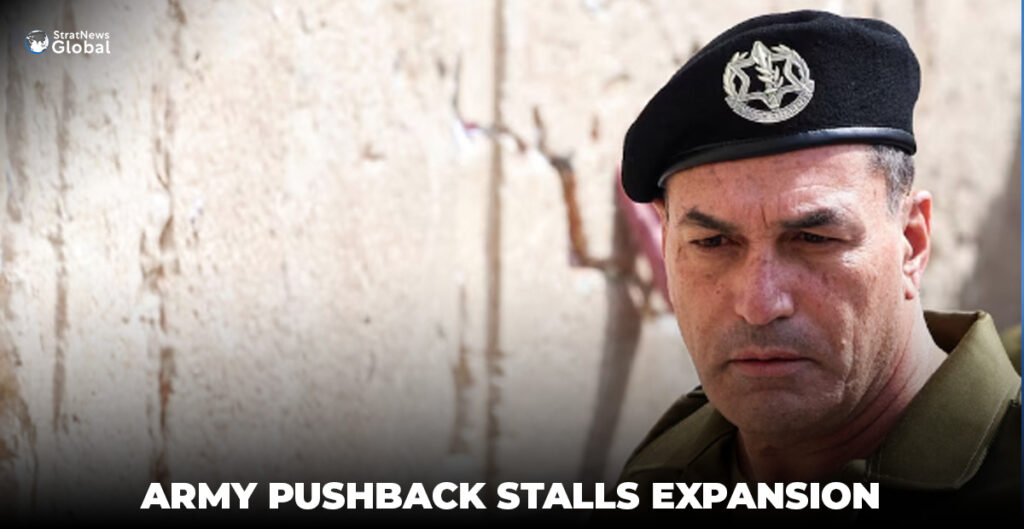
Israeli Military Chief Resists Gaza War Expansion, Sources Say
Israeli Prime Minister Benjamin Netanyahu encountered resistance from the military chief during a tense three-hour meeting over his proposal to capture remaining parts of Gaza still outside Israeli control, according to three Israeli officials.
Eyal Zamir, the military chief of staff, warned the prime minister that taking the rest of Gaza could trap the military in the territory, which it withdrew from two decades ago, and could lead to harm to the hostages being held there, the sources briefed on the Tuesday meeting said.
The Israeli military says it already controls 75% of Gaza after nearly two years of war, which began when the militant group Hamas attacked southern Israeli communities in October 2023.
Much of the crowded, coastal enclave has been devastated in the war, which has destroyed homes, schools, mosques and hospitals. Most of the population has been displaced multiple times, and aid groups say residents are on the verge of famine.
‘Deeply Alarming’
The U.N. has called reports about a possible expansion of Israel’s military operations in Gaza “deeply alarming” if true.
The military, which accuses Hamas of operating amongst civilians, has at times avoided areas where intelligence suggested hostages were held, and former captives have said their captors threatened to kill them if Israeli forces approached.
Netanyahu, who favours an expansion of military operations, told Zamir that so far the military had failed to bring about the release of the hostages, the officials said, speaking on the condition of anonymity.
Diplomatic negotiations have secured the release of most hostages freed so far.
A fourth source said that the prime minister intended to expand military operations in Gaza to put pressure on Hamas.
Defence Minister Israel Katz wrote on X Wednesday that the military chief has both the right and the duty to voice his opinion, but said that the military would carry out the government’s decisions until all war objectives are achieved.
The prime minister’s office confirmed the meeting with Zamir on Tuesday but declined to comment further, and the military did not respond to a request for comment.
The prime minister is scheduled to discuss military plans for Gaza with other ministers on Thursday.
Netanyahu, who in May said that Israel would control all of Gaza, leads the most right-wing coalition government in Israel’s history, and some of his key partners have in the past threatened to quit if the government ended the war.
International Pressure
There are 50 hostages still being held in Gaza, of whom at least 20 are believed to be alive. Videos released by Hamas and Palestinian Islamic Jihad, another militant group in Gaza, last week of two extremely emaciated hostages triggered international condemnation.
Close to 200 Palestinians have died of starvation in Gaza since the war began, about half of them children, according to Gaza’s health ministry. More than 20 died on Wednesday when a truck believed to be carrying food overturned as it was swarmed by a desperate crowd, according to local health authorities.
There is intense international pressure for a ceasefire to ease hunger and appalling conditions in Gaza and for Hamas to release the hostages. The latest ceasefire talks in Qatar broke down last month.
Hamas insists any deal must lead to a permanent end to the war, while Israel accuses the group of lacking sincerity about giving up power afterwards and must be defeated.
An expansion of the military offensive in heavily populated areas would likely be devastating. Many of Gaza’s 2 million Palestinians are living in tent encampments in the territory’s south, displaced by 22 months of bombardment.
“Where will we go?” said Tamer Al-Burai, a displaced Palestinian living at the edge of Deir Al Balah in central Gaza.
“Should people jump into the sea if the tanks rolled in, or wait to die under the rubble of their houses? We want an end to this war, it is enough, enough,” he told Reuters by phone.
Overextended
The war in Gaza has also overextended Israel’s military, which has a small standing army and has had to repeatedly mobilise reservists. It is not clear if more reservists would be needed to expand operations and take more territory.
The military continued to carry out air strikes across Gaza on Wednesday, killing at least 135 people in the past 24 hours, the Gaza health ministry said, with the death toll since the beginning of the conflict now at more than 61,000, mostly civilians, it says.
Hamas-led militants killed about 1,200 people, including more than 700 civilians, and 251 hostages were taken to Gaza on October 7, 2023, when the militant group attacked Israel.
In Israel, public polls show support for a diplomatic deal that would end the war and secure the release of the hostages.
(With inputs from Reuters)
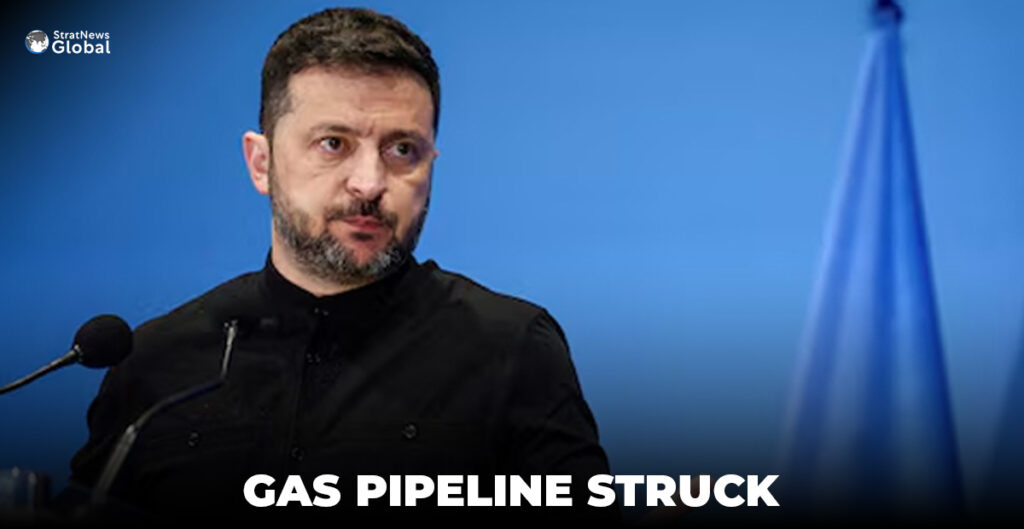
Russia Strikes Gas Station In Odesa, Disrupting Ukraine’s LNG Imports Ahead Of Winter
Russia targeted a gas pumping station in Ukraine’s southern Odesa region used for importing LNG from the U.S. and Azerbaijan, undermining winter preparations, Ukrainian officials said on Wednesday.
President Volodymyr Zelenskyy said the gas infrastructure had been attacked in the village of Novosilske on the border with Romania, where the Orlovka interconnector, through which Ukraine receives gas via the Transbalkan route, is located.
“This was a deliberate blow to our preparations for the heating season, absolutely cynical, like every Russian blow to the energy sector,” Zelenskyy said on Telegram.
Reuters could not independently confirm details of the attack.
Russia’s TASS news agency quoted the Russian defence ministry as confirming the attack on Ukraine’s gas transport system.
Gas Shortage
Ukraine has faced a serious gas shortage since a series of devastating Russian missile strikes this year, which significantly reduced domestic production.
Ukraine’s energy ministry said in a statement that the attacked station was used as part of a route connecting Greek LNG terminals with Ukrainian gas storage facilities via the Transbalkan gas pipeline.
It noted that it had already been used to deliver LNG from the United States and test volumes of Azerbaijani gas.
“This is a Russian strike purely against civilian infrastructure, deliberately targeting the energy sector and, at the same time, relations with Azerbaijan, the United States and partners in Europe, as well as the normal lives of Ukrainians and all Europeans,” the ministry said.
Azerbaijani President Ilham Aliyev will meet U.S. President Donald Trump in Washington this week.
Russia has repeatedly denied targeting civilians since launching its full-scale invasion of Ukraine more than three years ago, but says infrastructure, such as energy systems, is a legitimate target because it helps Ukraine’s war effort.
Main Gas Pipeline Hit
Earlier on Wednesday, the governor of the southern Odesa region reported an attack on the main gas pipeline.
Ukrainian energy officials did not say whether gas would continue to be pumped via the interconnector.
Kyiv says 0.4 million cubic metres of gas were scheduled to be pumped through Orlovka on Wednesday.
Last month, Ukraine pumped a small test volume of Azerbaijani gas through the Transbalkan route for the first time and announced plans to significantly increase gas imports from Azerbaijan’s SOCAR energy firm.
Kyiv has called the route “extremely important”, as it provides access to liquefied gas from Greek and Turkish LNG terminals, Azerbaijani and Romanian pipeline gas and, potentially, to Bulgarian offshore gas.
(With inputs from Reuters)