

Support us by contributing to StratNewsGlobal on the following UPI ID
ultramodern@hdfcbank

Strategic affairs is our game, South Asia and beyond our playground. Put together by an experienced team led by Nitin A. Gokhale. Our focus is on strategic affairs, foreign policy and international relations, with higher quality reportage, analysis and commentary with new tie-ups across the South Asian region.
You can support our endeavours. Visit us at www.stratnewsglobal.com and follow us on YouTube, Twitter, Facebook and Instagram.
र 500 per month
र 1000 per month
र 5000 per year
र 10000 per year
Donate an amount of your choice
र 500 per month
Donate र 500 per month

र 1000 per month
Donate र 1000 per month
र 5000 per year
Donate र 5,000 per year
र 10000 per year
Donate र 10,000 per year
Donate an amount of your choice
Donate an amount of your choice
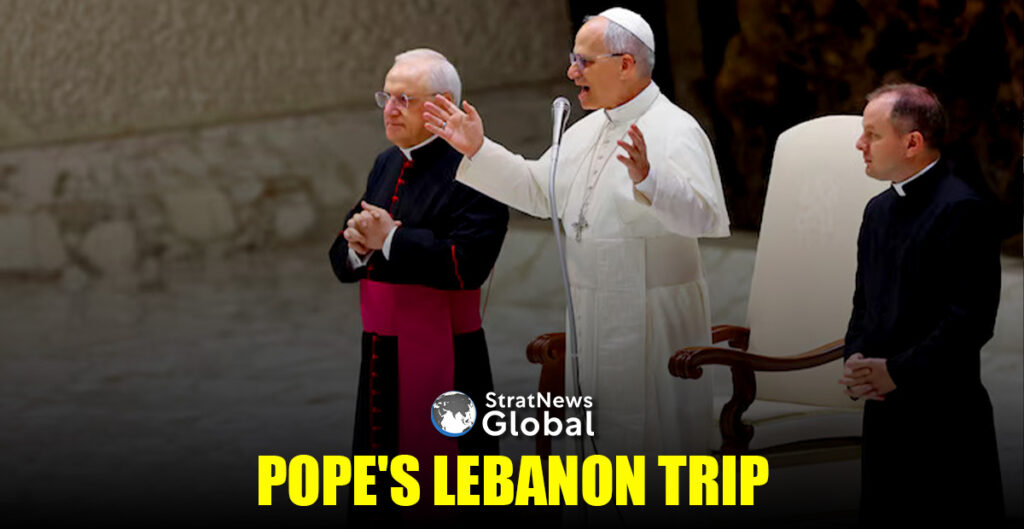
Pope Leo Expected To Visit Lebanon In December
Pope Leo is set to make his first overseas visit as head of the global Catholic Church, with Lebanon likely to be his destination, the country’s senior Catholic official announced on Wednesday.
The pope will travel to Lebanon “by December”, Cardinal Bechara Rai told the al-Arabiya television channel.
Preparations Underway
Rai, leader of the 3.5-million-member Maronite Catholic Church, did not give a specific date for the visit but said “preparations are already underway”.
A Lebanese official familiar with the matter confirmed that discussions were being held about a visit towards the end of the year, though a date had not yet been finalized.
New Era Under First U.S. Pope
Leo, the first U.S. pope, was elected by the world’s Catholic cardinals on May 8 to replace the late Pope Francis, who had planned to visit Lebanon but was unable to go because of health issues.
Lebanon is home to more than two million Catholics, according to Vatican statistics.
A Vatican spokesperson did not immediately respond to a request for comment about Rai’s remarks.
A Vatican official, who asked not to be named, confirmed that a trip was being planned and said it could be part of a tour that would also include Turkey.
Global Outreach Through Travel
Travelling abroad has become a major part of the modern papacy, with popes seeking to meet local Catholics, spread the faith, and conduct international diplomacy. They often draw crowds in the millions.
Francis made 47 visits abroad during his 12-year papacy, travelling to 68 countries. He made a policy of visiting countries that often did not draw international attention as a way of highlighting problems in what he called the “peripheries” of the world.
Leo has been expected to visit Turkey in late November as part of celebrations for the 1,700th anniversary of a major early Church council, which took place in Nicaea, now called Iznik.
Pope’s Message To Lebanon
In a message to Lebanon earlier this month, Leo commemorated the fifth anniversary of a huge chemical explosion at the Beirut port that killed 200 people and caused billions of dollars’ worth of damage. “Beloved and suffering Lebanon remains at the Centre of our prayers,” said the pope.
(With inputs from Reuters)
‘Friends Don’t Impose Sanctions’: Russia Slams U.S. Tariffs On India
Russia has sharply criticised the U.S. for imposing punitive measures on India for buying discounted Russia oil that the Americans say is feeding the war in Ukraine. An additional 25% tariffs imposed by the Trump administration is scheduled to come into effect later this month.
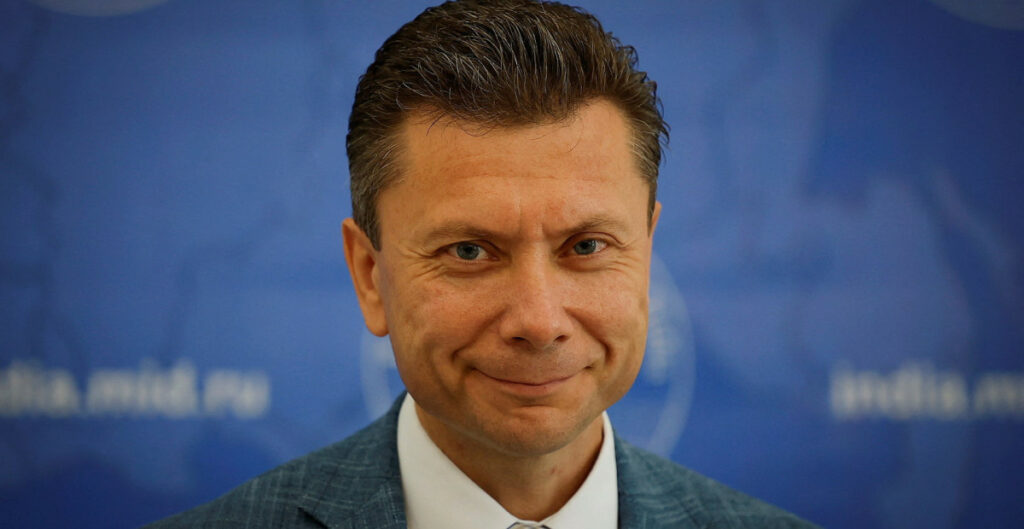
“Friends don’t impose sanctions. Such pressure is unjustified and these secondary sanctions are illegal under international law,” says Roman Babushkin, Chargé d’Affaires at the Russian Embassy in India. “If the West criticises you, it means you’re doing everything right.”
Russia Rejects U.S. Claims
He rejected the White House’s claim that U.S. pressure, including tariffs on India, had influenced Russia’s position on Ukraine peace talks. He called the claims “speculative” and “rumours.”
“If Indian goods are facing difficulties in the U.S. market, Russian markets are open for them. Don’t worry,” he said at a press briefing. “The narrative that India is being used as leverage on Russia is misleading. We do not accept that.”
‘No Alternative To Russian Crude’
Despite Western pressure, Indian state-run refiners, including Indian Oil Corporation (IOC) and Bharat Petroleum, have resumed purchase of Russian crude for September and October deliveries after more favourable discounts returned.
Evgeniy Griva, Deputy Trade Representative of Russia to India, made clear that Russian oil remains India’s best option. “There is no alternative to Russian crude oil… The price we offer is very competitive and very, very profitable for India,” he said.
Babushkin added: “Russia is the largest producer of oil, and India is one of the largest consumers. Unilateral actions [from the West] destabilise markets and threaten the energy security of developing countries.”
Moscow has put in place a “very, very special mechanism” to ensure continued supplies and streamline payment systems, he noted.
India-Russia Trade Growing Rapidly
Trade between the two countries has increased seven-fold in recent years, with Russia now India’s fourth-largest trading partner, according to Griva. He predicted an annual growth of around 10%, with Indian exports of pharmaceuticals, electronics and machinery also rising.
Russia is also working on “eliminating trade barriers and improving payment systems” to make bilateral trade more efficient. This includes more use of local currencies to bypass dollar-based sanctions. Asked about pressure on countries to avoid national currency trade, Griva responded bluntly: “Blackmail.”
Babushkin added: “Trade protectionism and instability are violations of the WTO’s MFN rules. Our markets are open for Indian goods. We don’t believe in coercion.”
BRICS As Counterbalance To The West
Babushkin described BRICS as a “stabilising force” and a “trusted platform” that fosters “robust cooperation” in a multipolar world.
“BRICS has developed a culture of open partnership. In GDP terms, it is bypassing the G7. A majority of developing countries are now interested in joining,” he said, reiterating that Russia would never impose sanctions within BRICS.
He criticised Western countries for adopting a “neo-colonial approach focused only on their own interests”, while Russia emphasises “mutual benefit and trust” in its relations with India.
Strategic Signals And Symbolic Gestures
This year marks the 78th anniversary of India-Russia diplomatic ties and 25 years of the strategic partnership. President Putin recently congratulated PM Modi on India’s Independence Day and offered condolences over the Kashmir floods.
India’s External Affairs Minister S. Jaishankar is currently in Moscow and will meet his Russian counterpart Sergey Lavrov on Thursday. The visit is expected to further set the stage for the Modi-Putin summit and bolster alignment on global issues including energy, trade and multipolarity. Asked when the summit is expected, Babushkin replied “sooner than later”.
Russia-India-China ‘Important’
Discussions are ongoing to revive the trilateral Russia-India-China (RIC) dialogue, with Babushkin noting: “RIC is important. When the right time comes, it will be resumed.”
Trump Rules Out Troops In Ukraine, Considers Air Support For Peace Deal
U.S. President Donald Trump on Tuesday stated that he had ruled out deploying American troops on the ground in Ukraine but indicated that the United States could offer air support as part of a potential agreement to bring Russia’s war in the country to an end.
A day after Trump pledged security guarantees to help end the war at an extraordinary White House summit, the path to peace remained uncertain as the U.S. and allies prepared to work out what military support for Ukraine might include.
“When it comes to security, (Europeans) are willing to put people on the ground. We’re willing to help them with things, especially, probably … by air,” Trump said in an interview with the Fox News “Fox & Friends” programme.
Trump did not elaborate. Later, in an interview with radio host Mark Levin, Trump characterised his negotiating style in trying to end the war as “probably instinct more than process.”
Russia Intensifies Attacks
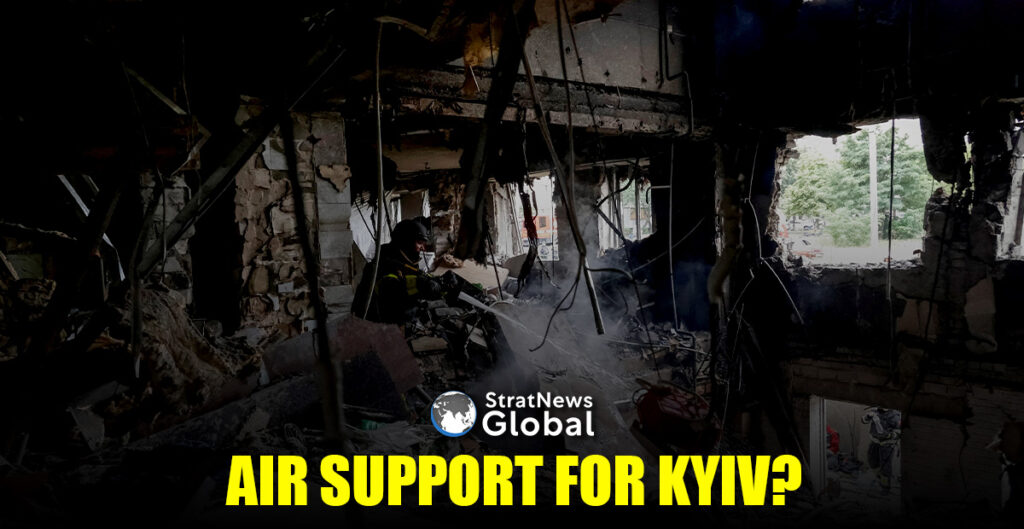
Hours after Zelenskyy’s meetings in Washington, Russia launched its biggest air assault in more than a month on Ukraine, with 270 drones and 10 missiles launched, the Ukrainian air force said. The energy ministry said the strikes caused big fires at energy facilities in the central Poltava region, home to Ukraine’s only oil refinery.
Trump conceded that Russian President Vladimir Putin might not want to make a deal after all, saying, “We’re going to find out about President Putin in the next couple of weeks.”
The nature of U.S. military aid for Ukraine under a peace deal was unclear. Air support could take many forms, such as missile defence systems or fighter jets enforcing a no-fly zone.
‘An Option And A Possibility’
White House press secretary Karoline Leavitt confirmed that U.S. air support was “an option and a possibility,” but, like Trump, she did not provide any details.
“The president has definitively stated U.S. boots will not be on the ground in Ukraine, but we can certainly help in the coordination and perhaps provide other means of security guarantees to our European allies,” she said at a news briefing.
Before Monday’s summit in Washington, Russia, which has often said that it agreed with the idea of security guarantees for Kyiv, reiterated its long-standing position that it “categorically” rejected “any scenarios involving the deployment of NATO troops in Ukraine.”
Analysts say more than 1 million people have been killed or wounded in the conflict, which began with Russia’s full-scale invasion of Ukraine in February 2022.
Trilateral Meeting?
Ukrainian President Volodymyr Zelenskyy hailed the White House talks as a “major step forward” toward ending Europe’s deadliest conflict in 80 years and setting up a trilateral meeting with Putin and Trump. Zelenskyy’s warm rapport with Trump contrasted sharply with their disastrous Oval Office meeting in February.
Trump discussed Budapest as a venue for a summit involving Zelenskyy and Putin with Hungarian Prime Minister Viktor Orban on Tuesday, a White House official said.
Istanbul, where delegations for the two countries have met previously, has also been mentioned, a senior administration official said.
Hungary is one of the few European places that Putin could visit without fear of arrest on International Criminal Court charges, as Orban maintains close ties with the Russian leader. It was unclear whether Ukraine would accept Hungary as a venue.
Neutral Switzerland also said it would be ready to host Putin for any peace talks.
“They are in the process of setting it up,” Trump told radio host Levin about a Putin/Zelenskyy meeting.
Trump Signals Reluctance
But Trump cast doubt on whether he would attend. “Now I think it would be better if they met without me. … If necessary, I’ll go,” he said.
Trump, asked by Levin how he balanced the interests of all the parties involved, said, “Well, it’s probably instinct more than process. I have instincts.”
There has been so far no confirmation from Russia that a potential bilateral meeting between Putin and Zelenskyy is being planned.
After Trump’s call to Putin on Monday, Kremlin aide Yuri Ushakov said only that the discussion included the idea of “raising the level of representatives” in peace talks from both countries – but he did not elaborate to what level.
Russian Foreign Minister Sergei Lavrov said in remarks published on Tuesday that contacts involving national leaders must be prepared “with the utmost thoroughness” and cannot be pursed for the sake of “media coverage or evening broadcasts.”
Ukraine’s allies held talks in the so-called Coalition of the Willing format on Tuesday, discussing additional sanctions to crank up the pressure on Russia. The grouping has also agreed that planning teams will meet U.S. counterparts in the coming days to develop security guarantees for Ukraine.
NATO Leaders Likely To Meet
NATO military leaders were expected to meet on Wednesday to discuss Ukraine, with U.S. General Dan Caine, the chairman of the Joint Chiefs of Staff, expected to attend virtually, officials told Reuters.
Putin has shown no sign of backing down from demands for territory, including land not under Russia’s military control, following his summit with Trump on Friday in Alaska.
Neil Melvin, a director at the International Security at the Royal United Services Institute think-tank, said Russia could drag out the war while trying to deflect U.S. pressure with a protracted peace negotiation.
Melvin said both Ukraine and its European allies, on one side, and Russia on the other were striving “not to present themselves to Trump as the obstacle to his peace process.”
“They’re all tiptoeing around Trump” to avoid any blame, he said, adding that Trump’s statements on security guarantees were “so vague it’s very hard to take them seriously.”
(With inputs from Reuters)
Moscow Turns Water Into Weapon In Donetsk
The centralised water supply in Russian-occupied south-eastern Ukraine has collapsed, leaving nearly two million residents of the Donetsk region facing severe shortages.
While water access has been a problem since the conflict began in 2014, reports say the crisis has sharply worsened in recent weeks.
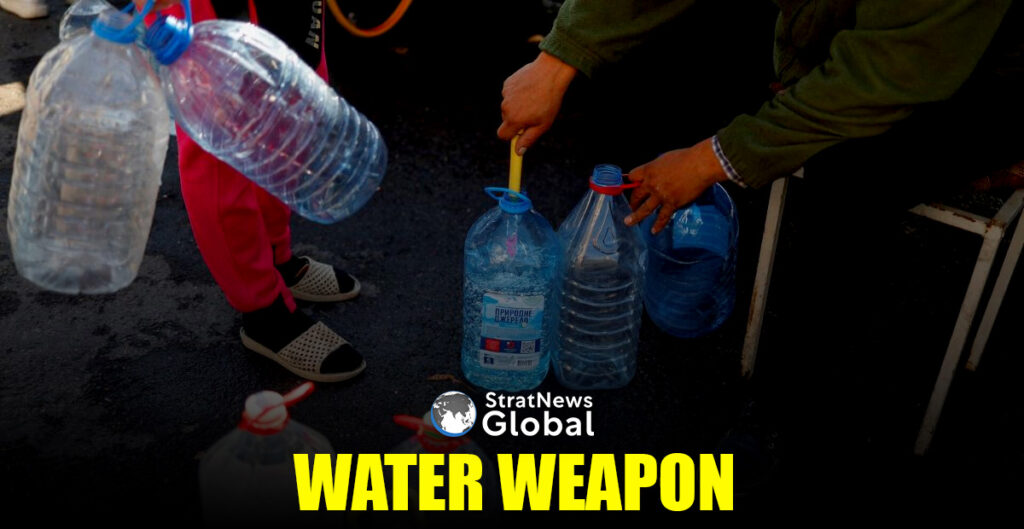
Residents now receive running water for only two to four hours every three days, and even then, the supply is described as unhygienic and “disgusting.” Many are forced to rely on water delivery trucks or buy bottled water sold under Russian authority at high prices. Videos have surfaced of children appealing directly to Russian President Vladimir Putin for help.
The shortages affect all sections of society, with people—including the elderly and disabled—compelled to carry water up to higher floors of residential buildings where the supply does not reach.
Kyiv maintains that Russia bears responsibility, pointing out that the shortages stem from damage caused during the war, first in 2014 and again in 2022, when river systems became battlegrounds. Ukraine also stresses that since Russia’s occupation of Donetsk is illegal under international law, Moscow is obliged to provide for the population.
Moscow, however, has rejected blame and accused Ukraine of blocking water and neglecting infrastructure maintenance. Russian authorities inside Donetsk have echoed this narrative, with Kremlin-backed leader Denis Pushilin previously suggesting the problem could only be solved by “liberating” the city of Slavyansk in the north of the region.
Reports also indicate that pro-Russian online networks are exploiting the crisis to spread propaganda, portraying Moscow as a provider of aid while undermining Ukraine. Observers note that such narratives may complicate any future peace talks, as Russia leverages a basic human necessity to consolidate its hold on the territory.
(This article was written by Tisya Sharma, she is an intern at StratNews Global)
Russian Overnight Strike Injures 14 In Ukraine’s Sumy Region
At least 14 individuals, among them a family with three children, sustained injuries during an overnight Russian strike on Ukraine’s northern Sumy region, the country’s prime minister announced on Wednesday.
The strike took place at a time of intense efforts by U.S. President Donald Trump to bring an end to the Russian war in Ukraine.
Russia launched 15 drones in an assault on the Okhtyrka area in the early hours of Wednesday, local prosecutors said on the Telegram messaging app.
The children injured in the attack, which struck a residential neighbourhood in the town, were aged 5 months, 4 years and 6 years, Prime Minister Yulia Svyrydenko wrote on X.
“Russia continues to manifest its fears through acts of pure terrorism across Ukraine, once again targeting the homes of families and their sleeping children,” she said.
Russia has repeatedly said it does not attack civilians or civilian infrastructure.
Russian Strikes Continue
Overall, Russia launched a total of 93 drones and two missiles to attack the country overnight, the Ukrainian air force said, adding it downed 62 drones and one missile, and recorded hits at 20 locations.
Ukraine’s State Emergency Services reported a “massive drone strike” on the southern region of Odesa, saying one person was wounded and a large fire erupted at a fuel and energy facility.
Officials of the Izmail district in the Odesa region said port infrastructure in the city was damaged.
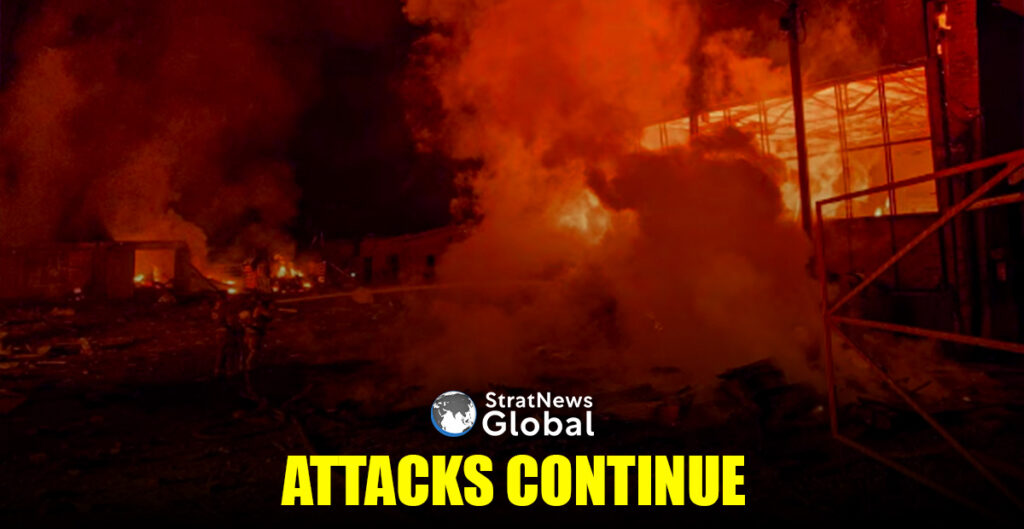
Russia has stepped up its attacks on Ukraine’s energy sector this week. One attack sparked fires at an oil depot belonging to the Azerbaijani state oil company SOCAR, while another damaged a gas transport facility in the central region of Poltava.
Russia has regularly attacked oil depots and fuel storage facilities since the first days of the full-scale invasion it launched in February 2022. The Energy Ministry said Ukrainian energy facilities had been attacked 2,900 times since March 2025 alone.
(With inputs from Reuters)
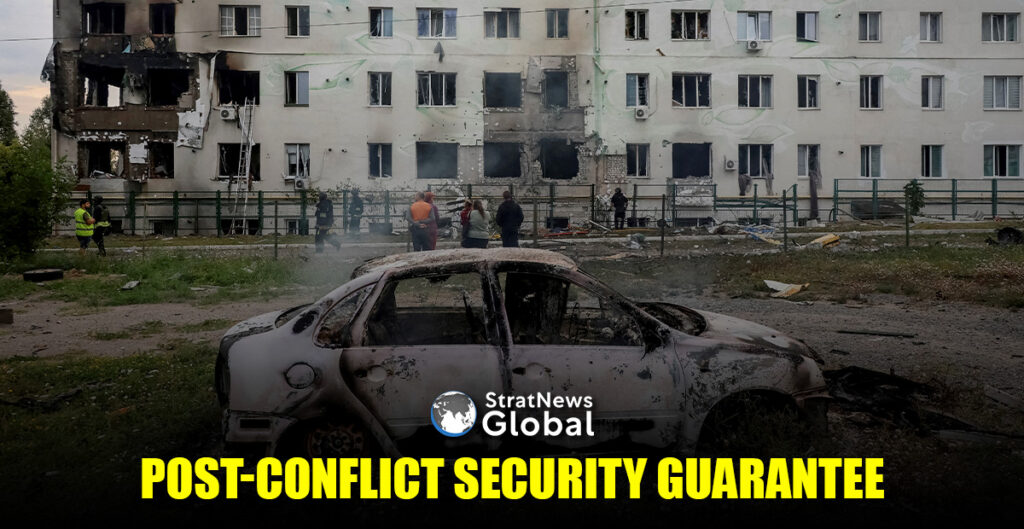
US, NATO Begin Shaping Security Guarantee Options For Ukraine
U.S. and European military planners have begun examining potential post-conflict security guarantees for Ukraine, U.S. officials and sources said on Tuesday, following President Donald Trump’s commitment to ensuring the country’s protection as part of any agreement aimed at ending Russia’s war.
Ukraine and its European allies have been buoyed by Trump’s promise during a summit on Monday of security guarantees for Kyiv, but many questions remain unanswered.
Officials told Reuters that the Pentagon is carrying out planning exercises on the support Washington could offer beyond providing weapons.
But they cautioned that it would take time for U.S. and European planners to determine what would be both militarily feasible and acceptable to the Kremlin.
One option was sending European forces to Ukraine but putting the U.S. in charge of their command and control, two sources familiar with the matter told Reuters. The sources added that the troops would not be under a NATO banner but operate under their own nations’ flags.
The Pentagon and NATO did not immediately respond to a request for comment on the idea.
In a press briefing, the White House said that the United States could help coordinate a security guarantee for Ukraine.
Russia’s Foreign Ministry has ruled out the deployment of troops from NATO countries to help secure a peace deal.
Possible US Air Support
Trump has publicly ruled out deploying U.S. troops in Ukraine, but on Tuesday appeared to leave the door open to other U.S. military involvement.
In an interview with the Fox News “Fox & Friends” program, he suggested Washington could provide air support to Ukraine.
“When it comes to security, (Europeans) are willing to put people on the ground, we’re willing to help them with things, especially, probably, … by air because nobody has stuff we have, really they don’t have,” Trump said.
He did not provide further details.
U.S. air support could come in a variety of ways, including providing more air defence systems to Ukraine and enforcing a no-fly zone with U.S. fighter jets.
Since Russia’s full-scale invasion of its neighbour in 2022, the United States has shipped billions of dollars’ worth of weapons and munitions to Kyiv.
The Trump administration briefly halted those weapons shipments, including after a contentious White House meeting between Trump and Ukrainian President Volodymyr Zelenskyy in February and again in July.
Shipments have resumed, and Trump has pledged to send weapons, primarily defensive ones, to help the war-torn country.
NATO Military Leaders To Meet
NATO military chiefs will focus on Ukraine and the way forward when they meet virtually on Wednesday, a conference first reported by Reuters.
U.S. Air Force General Alexus Grynkewich, who also oversees NATO operations in Europe, will brief the chiefs of defence on the Alaska meeting between Trump and Russian President Vladimir Putin last week.
A U.S. official speaking on condition of anonymity said U.S. General Dan Caine, chairman of the Joint Chiefs of Staff, was expected to attend the meeting.
The official added that Caine would meet with some of his European counterparts in Washington on Tuesday evening.
Trump has pressed for a quick end to Europe’s deadliest war in 80 years, and Kyiv and its allies have worried he could seek to force an agreement on Russia’s terms after the president last week rolled out the red carpet for Putin.
Russia says it is engaged in a “special military operation” in Ukraine to protect its national security, claiming NATO’s eastward expansion and Western military support for Ukraine pose existential threats. Kyiv and its Western allies say the invasion is an imperial-style land grab.
(With inputs from Reuters)
India Shreds Pakistan At UN For Shameful Record Of Sexual Violence Since 1971
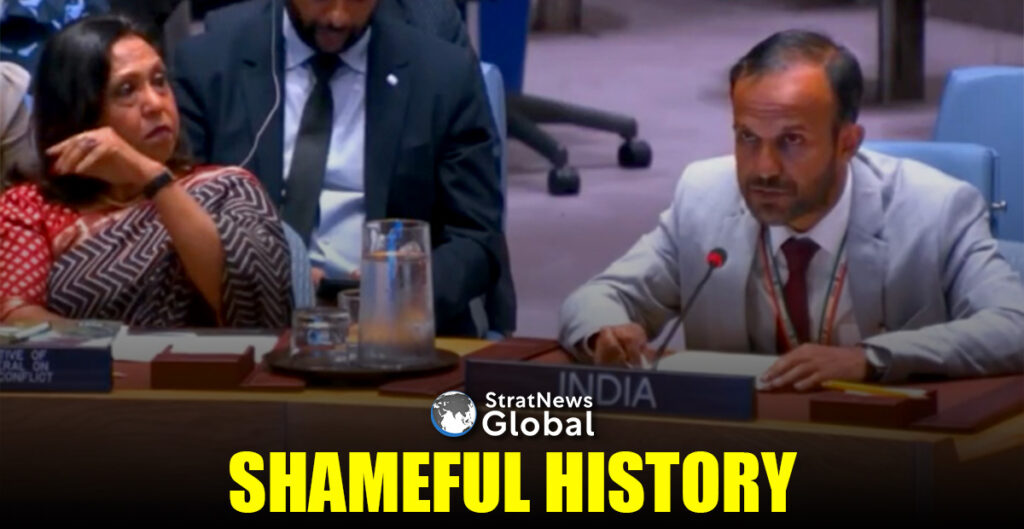
India’s Charge d’Affaires at the United Nations, Eldos Mathew Punnoos, on Tuesday (local time) strongly denounced Pakistan’s long-standing record of sexual violence, tracing it back to the atrocities of 1971.
Speaking at the UN Security Council’s Open Debate on “Conflict-Related Sexual Violence,” Punnoos underlined that such crimes, particularly against women from minority groups in Pakistan, remain a grim reality even today.
‘Mass Sexual Violence’
“The Pakistan Army’s appalling record of committing mass sexual violence against hundreds of thousands of women in erstwhile East Pakistan during 1971 is well-documented and remains a permanent blot in history. Tragically, this deplorable trend continues without accountability to this very day,” he said.
With Pakistan currently holding a non-permanent seat on the UNSC, India reminded the council of the Army’s brutalities against Bangladeshi women during the Liberation War.
“Cases of abduction, trafficking, forced and child marriages, domestic servitude, sexual abuse, and coerced religious conversions continue to be deployed as tools of persecution against vulnerable women and girls belonging to ethnic and religious minorities. These crimes are not only reported widely but are also documented in recent OHCHR reports,” Punnoos noted.
He went on to say that Pakistan’s judiciary itself has often lent legitimacy to such practices, perpetuating impunity.
Call For Justice
“These reports reveal how the judiciary validates such vile acts. It is strikingly ironic that those guilty of committing and enabling these crimes now try to present themselves as defenders of justice. Their duplicity and hypocrisy speak for themselves,” he said.
Calling for accountability, Punnoos stressed that perpetrators of such heinous acts must face justice.
“Conflict-related sexual violence must be condemned unequivocally, and those responsible must be punished. Such crimes not only shatter the lives of individuals but also tear apart the social fabric, leaving communities scarred for generations,” he said.
Punnoos further emphasised the importance of victim support alongside punitive measures.
“Addressing this grave issue requires a multi-pronged strategy—prosecuting offenders, ensuring they do not escape justice, and centring the needs of survivors in both prevention and response efforts,” he said.
India Stresses Victim Support
He also referred to UNSC Resolution 2467 (2019), which underscores the necessity of providing victims with access to relief and reparations programmes, healthcare, psychosocial assistance, safe shelter, legal aid, and measures for rehabilitation and reintegration.
Highlighting India’s proactive role, Punnoos recalled that India was among the earliest contributors to the Secretary General’s Trust Fund in support of victims of sexual exploitation and abuse.
“This fund remains a vital instrument that must be strengthened further. India was one of the first to contribute to it and continues to extend its support,” he said.
He added that in November 2017, India entered into a voluntary compact with the UN Secretary-General, pledging to eliminate sexual exploitation and abuse in peacekeeping, humanitarian, and development work.
Punnoos also noted that under Prime Minister Narendra Modi, India joined the circle of leadership for the prevention of sexual exploitation and abuse within UN operations, underscoring the seriousness with which the country treats the issue.
Women Peacekeepers Driving Impact
“Our women engagement teams deployed in conflict zones as part of peacekeeping missions have proven highly effective in connecting with local communities, supporting victims, addressing gender-sensitive concerns, and enhancing the overall success of such operations,” he said.
Citing India’s pioneering contributions, he pointed out that in 2007, India became the first country to deploy an all-women police contingent to the UN Mission in Liberia.
Today, female contingents serve in MONUSCO, UNICEF, and UNMAS, specifically with the goal of countering sexual and gender-based violence in conflict situations.
Building on this, the Centre for United Nations Peacekeeping in Delhi runs specialised training to prepare more women peacekeepers and provide targeted instruction on preventing gender-based violence.
“India stands ready to share its experience and expertise with member states interested in adopting similar measures. This was also discussed at the Global South Women Peacekeepers Conference held in New Delhi in February 2025,” he said.
Punnoos highlighted that India’s domestic initiatives could also serve as a model for others.
He pointed to the Nirbhaya Fund—created with around USD 1.2 billion—as a non-lapsable resource dedicated to women’s safety, swift justice delivery, and crisis support infrastructure.
Emergency Response Mechanism
In addition, India operates a nationwide emergency response mechanism through helpline number 112 for women’s safety and has established Sakhi One Stop Centres in every district, providing integrated support such as police help, medical treatment, legal aid, shelter, and economic assistance.
“India has also instituted specialised training programs to expedite investigation and prosecution processes, including forensic training for medical officers to ensure evidence collection stands up in court,” Punnoos said, encouraging other countries to consider replicating such initiatives.
Concluding his remarks, Punnoos reaffirmed India’s firm commitment to eradicating sexual violence in armed conflicts and extending support to survivors.
“Let me once again reiterate India’s unwavering resolve to eliminate sexual violence in conflict and stand by survivors of such atrocious crimes,” he said.
(With inputs from IBNS)
India Strengthens Latin America Ties With High-Level Visits To Colombia, Peru
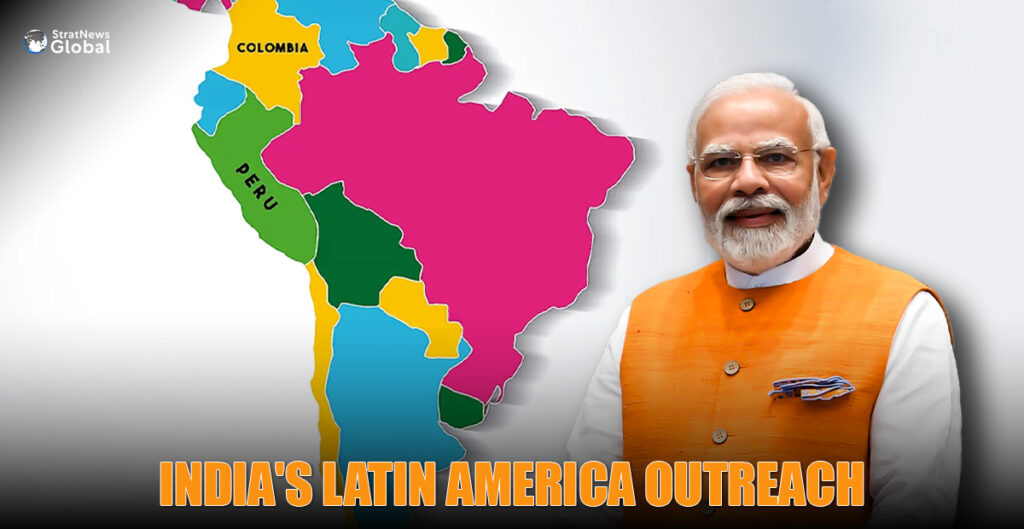
India is sending a high-level delegation to Colombia and Peru this week, underscoring its commitment to deepening ties with the Global South. Led by Secretary (East) P. Kumaran, the visit from August 21 to 26, marks a renewed push to enhance cooperation with two of South America’s most dynamic economies.
This visit reflects India’s growing strategic focus on the Latin America and Caribbean (LAC) region, a region rich in natural resources, economic potential and shared values such as democracy and multilateralism.
Colombia: Expanding Trade And Democratic Solidarity
India’s relations with Colombia have grown steadily, with bilateral trade reaching US $4.72 billion in the last fiscal. Colombia is a major oil supplier to India and hosts Indian investments in pharmaceuticals, automobiles and IT.
“We are very pleased and honoured with the visit of P. Kumaran, Secretary (East), and Joint Secretary Dr. Praphullachandra Sharma. This high-level visit reflects India’s intention to deepen engagement with the LAC region,” Victor Hugo Echeverri Jaramillo, Colombia’s Ambassador to India, told StratNews Global.
He highlighted the alignment of values and global vision. “India and Colombia share democratic principles, freedom of speech and a genuine concern for human rights and global challenges. That foundation gives strength to our partnership.”
On the expectations from the visit, Ambassador Victor said, “We hope it paves the way for the XI Bilateral Mechanism meeting. Our focus includes trade, investment, alternative energy, IT and health. While oil dominates our trade, we seek a more diversified commercial exchange.”
He noted that Indian businesses are already well-integrated in Colombia’s economy and hoped for further diversification in his country’s exports to India.
He also pointed to Colombia’s current leadership roles in Community of Latin American and Caribbean States (CELAC) and the Pacific Alliance. “We aim to advance toward an India-CELAC ministerial meeting. It would help shape a collective LAC-India response to global issues under the principle of mutual respect.”
He mentioned Colombia having eased travel for Indian citizens holding valid U.S. or Schengen visas, making it “one of the most flexible migration processes in the region”.
Peru: Natural Resources And Strategic Sectors
In Peru, the Indian delegation will explore cooperation in mining, agriculture, rare earths and pharmaceuticals. “This is an important visit and a step towards building a strategic relationship between India and Peru,” Javier Manuel Paulinich Velarde, Peru’s Ambassador to India, told StratNews Global.
He added that a key focus would be to identify opportunities in Peru’s mining sector, “He [Secretary Kumaran] is going to talk specifically to learn more about the mining opportunities in Peru as well as rare earth minerals.” Peru could be a strategic partner for India, particularly in food security and agricultural cooperation, according to him.
Resource Synergy & Connectivity Potential
Dr Aparaajita Pandey, Assistant Professor at Amity University and a specialist in Latin American affairs, highlighted the broader potential for India-Peru cooperation. “Peru also has large reserves of metals like silver, zinc and iron. Potential reserves of rare earth metals have been found as well. A collaboration here would be mutually beneficial.”
She noted that Peru’s geographic and logistical assets could be valuable for India’s Indo-Pacific strategy. “The Port of Chancay is emerging as a major maritime logistics hub in South America. It could connect directly with Asian shipping routes and significantly cut down shipping time and costs.”
On agricultural cooperation, Dr Pandey added: “India and Peru have historic ties in agricultural research since India’s Green Revolution. Peru has invested in large-scale irrigation projects covering nearly a million hectares. India could explore joint ventures to stabilise its supply of lentils, grains and pulses.”
Latin America’s Growing Role In India’s Global Strategy
Rochelle Miranda, a Bogotá-based expert on India-Latin America relations, noted the strategic timing of the visit. “India already has more trade in value terms with some Latin American countries than with several of its neighbours. This visit reflects a long-term commitment to deepening ties with Colombia and Peru—two of the most forward-looking economies in the region.”
She highlighted India’s strengths as a partner. “There’s strong economic complementarity. Latin America can offer natural resources and agricultural goods, while India brings strengths in IT, pharmaceuticals and capacity-building.”
Miranda also stressed the value of soft power and digital diplomacy, “These visits help foster people-to-people ties, mutual understanding and open doors for cultural and academic exchange — essential pillars for sustained cooperation within the Global South.”
India’s visit to Colombia and Peru is not just a diplomatic gesture. It’s a strategic assertion of Global South solidarity, resource diplomacy and the pursuit of a multipolar world order. By focusing on areas like rare earths, energy security, digital collaboration, and sustainable agriculture, India is carving out a distinct and future-oriented role in Latin America.
Albanese Responds To Netanyahu’s Criticism With Diplomacy
Australian Prime Minister Anthony Albanese on Wednesday responded firmly yet diplomatically, stating that he treats leaders of all nations with respect, following sharp criticism from Israeli Prime Minister Benjamin Netanyahu over Australia’s decision to recognise a Palestinian state.
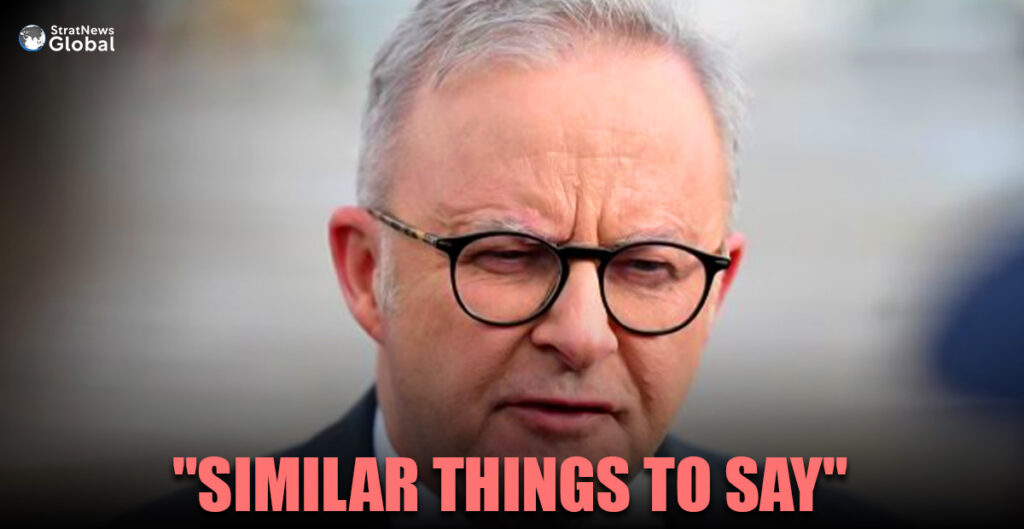
“I don’t take these things personally, I engage with people diplomatically. He has had similar things to say about other leaders,” Albanese said during a media briefing.
‘A Weak Politician’
Netanyahu’s personal attack on Albanese has further strained diplomatic relations between the two nations, which have already been under pressure since Australia announced last week that it would conditionally recognise a Palestinian state during the upcoming UN General Assembly session in September.
“History will remember Albanese for what he is: A weak politician who betrayed Israel and abandoned Australia’s Jews,” Netanyahu said in a post on X on Tuesday.
Prime Minister Benjamin Netanyahu:
History will remember Albanese for what he is: A weak politician
who betrayed Israel and abandoned Australia’s Jews.— Prime Minister of Israel (@IsraeliPM) August 19, 2025
Decision Was Informed
Albanese told reporters that he had informed Netanyahu about Australia’s decision to support a Palestinian state before his centre-left government formally announced the plan.
“At that time, I gave Prime Minister Netanyahu a clear indication of my view and Australia’s view going forward but also a clear indication of the direction in which we were headed,” Albanese said. “I gave him the opportunity to outline what political solution there was and gave him that opportunity.”
Tit-For-Tat Diplomacy
Israel this week revoked the visas of Australian diplomats to the Palestinian Authority after Albanese’s Labor government cancelled the visa of an Israeli lawmaker over remarks the Australian government considered controversial and inflammatory.
Israel has been facing increasing international pressure over its military offensive in the Gaza Strip that has killed thousands of civilians and plunged Gaza into a humanitarian crisis, displacing most of its population.
The offensive began nearly two years ago after Hamas-led militants stormed into southern Israel, killing 1,200 people and taking 251 more hostage.
(With inputs from Reuters)
Maldives Balancing Act Tests India’s Influence
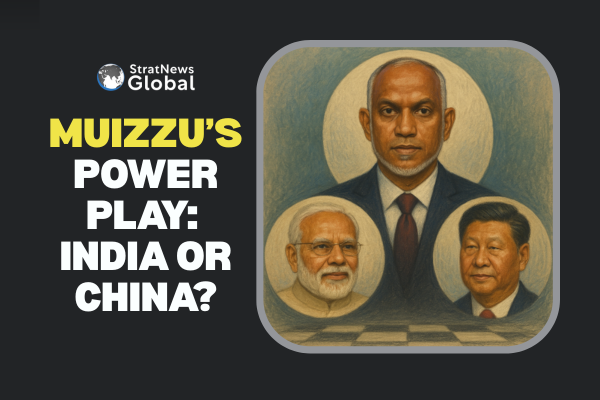
Prime Minister Narendra Modi’s state visit to the Maldives in July marked a shift in relations that began on a rocky note after President Mohamed Muizzu took office in September 2023, according to Aditya Gowdara Shivamurthy, Associate Fellow with the Strategic Studies Programme’s Neighbourhood Studies Initiative at the Observer Research Foundation.
Speaking to StratNewsGlobal, Shivamurthy said that Muizzu’s initial policies focused on reducing India’s presence, strengthening ties with China, and broadening partnerships, influenced by domestic politics and the “India Out” campaign. Over the past year, however, ties have been recalibrated, with both countries adopting a pragmatic, issue-based approach.
“No nation puts all its eggs in one basket. Despite closer ties with China, Muizzu is diversifying relations. Economic constraints also leave him little choice. Indian and Chinese debts are maturing, and he will have to balance both,” Shivamurthy said.
According to him, Modi’s visit allowed India to reaffirm its influence in the region, while for the Maldives, it provided an economic lifeline and space to manage financial challenges. The visit also opened avenues for deeper cooperation across sectors.
Maldivian politics remain divided, with the Maldivian Democratic Party (MDP) traditionally aligned with India, while Muizzu’s People’s National Congress (PNC) is seen as more conservative and open to external players, particularly China. Shivamurthy noted that New Delhi’s outreach to multiple parties during the visit signalled its intent to build a resilient, cross-party partnership.
China’s expanding naval and military presence in the Indian Ocean, through port projects, patrols and Belt and Road-linked infrastructure, continues to concern New Delhi. The Maldives, Shivamurthy said, is navigating this environment by balancing ties to secure sovereignty and economic stability.
“As competition in the Indo-Pacific intensifies, regional players still look to India for leadership,” he said. “For the Maldives, it is natural to diversify ties and safeguard sovereignty, but going forward, Male will need to remain sensitive to India’s red lines while using its balanced policy to secure its own interests.”