

Support us by contributing to StratNewsGlobal on the following UPI ID
ultramodern@hdfcbank

Strategic affairs is our game, South Asia and beyond our playground. Put together by an experienced team led by Nitin A. Gokhale. Our focus is on strategic affairs, foreign policy and international relations, with higher quality reportage, analysis and commentary with new tie-ups across the South Asian region.
You can support our endeavours. Visit us at www.stratnewsglobal.com and follow us on YouTube, Twitter, Facebook and Instagram.
र 500 per month
र 1000 per month
र 5000 per year
र 10000 per year
Donate an amount of your choice
र 500 per month
Donate र 500 per month

र 1000 per month
Donate र 1000 per month
र 5000 per year
Donate र 5,000 per year
र 10000 per year
Donate र 10,000 per year
Donate an amount of your choice
Donate an amount of your choice
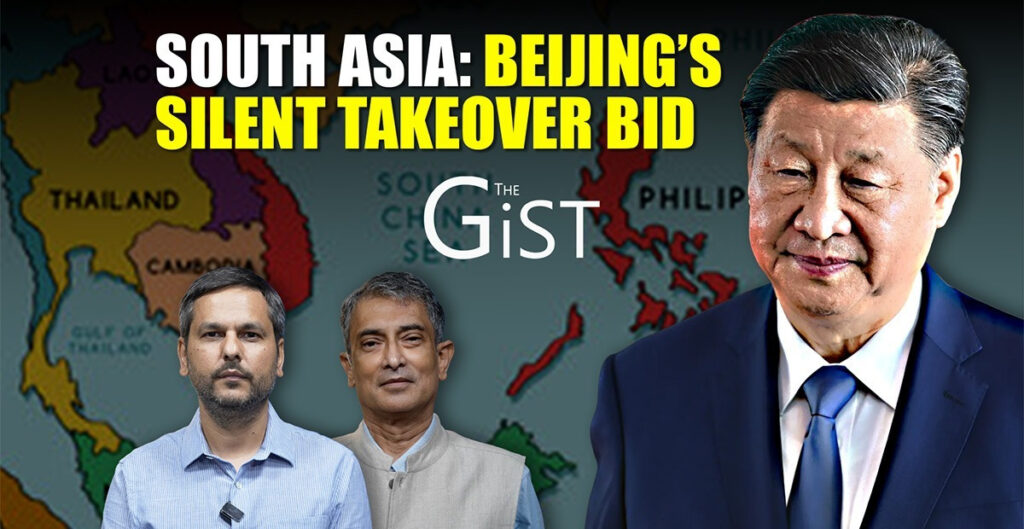
Submarines To Social Media: China’s Long Game in South Asia
China’s engagement with South Asia goes well beyond flashy infrastructure projects or arms sales, argues a new report by the Centre for Social and Economic Progress (CSEP). Edited by Constantino Xavier and Jabin Jacob, How China Engages South Asia in the Open and Behind the Scenes brings together 20 scholars from across the region to track Beijing’s visible and invisible footprint.
Speaking on the project, Xavier, Senior Fellow at CSEP, said the motivation was to move beyond polarized narratives that either demonize or celebrate China. “We know a lot about China in Africa or Europe, but far less about its presence in India’s neighborhood. So we asked local scholars—those best placed to observe—to map the actual modus operandi of Chinese engagement,” he explained.
The findings highlight how China is investing in the “long game” of influence. In Bangladesh, for instance, Chinese military training and exchanges are subtly shaping doctrines and mindsets, far more consequential than the sale of outdated Ming-class submarines. In Sri Lanka, research shows how Chinese companies have influenced regulatory frameworks to secure favorable long-term conditions for their investments. Beijing’s digital operations are also evident, with coordinated social media campaigns in Sinhala and Tamil pushing narratives that enhance China’s image while countering those of India or the West.
Crucially, Xavier underlined that China’s outreach now transcends ideology. “The Communist Party engages not just leftists, but also royalists in Nepal, Islamists in Bangladesh, and even the Taliban. It is a far more agile, adaptive strategy than the ideological support Beijing offered in the 20th century,” he noted.
For India, the report offers both a warning and an opportunity. Xavier stressed the need to strengthen China studies in Indian universities and think tanks, and to respond with faster delivery of aid, digital public infrastructure, and developmental partnerships. “These countries realize that growth is impossible without India. The question is: what alternatives can India provide to meet their needs?” he said.
The report’s bottom line is clear: China is systematically embedding itself into South Asia’s political, legal, and social ecosystems. Whether India can match this “long game” with its own strategic depth will shape the region’s future balance of power.
US Trade Talks Ongoing, But Redlines Remain: Jaishankar
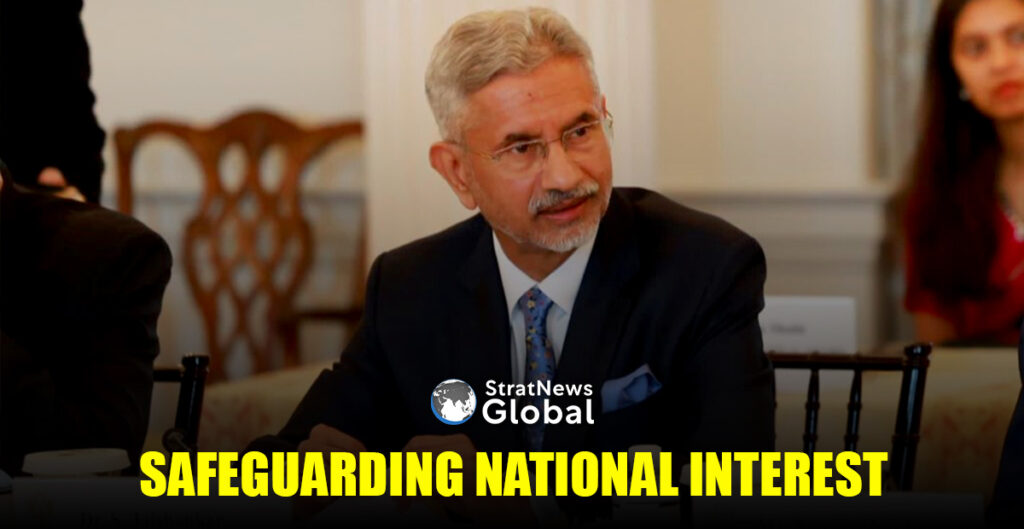
Foreign Affairs Minister Subrahmanyam Jaishankar on Saturday said trade talks with Washington are ongoing, but asserted that certain national interests must be safeguarded, just days ahead of steep additional US tariffs coming into effect.
Indian goods face additional US tariffs of up to 50%, among the highest imposed by Washington, due to its increased purchases of Russian oil. A 25% tariff has already come into effect, while the remaining 25% is set to be enforced from August 27.
A planned visit by US trade negotiators to New Delhi from August 25-29 has been called off, dashing hopes that the levies may be lowered or postponed.
Redlines
“We have some redlines in the negotiations, to be maintained and defended,” Jaishankar said at an Economic Times forum event in New Delhi, singling out the interests of the country’s farmers and small producers.
India-US trade talks collapsed earlier this year due to India not agreeing to open its vast agricultural and dairy sectors. Bilateral trade between the world’s largest and fifth largest economy is worth over $190 billion.
“It is our right to make decisions in our ‘national interest’,” Jaishankar said.
Analysts at Capital Economics said on Friday that if the full US tariffs come into force and stick, the hit to India’s economic growth would be 0.8 percentage points both this year and next. “The longer-term harm could be even greater as a high tariff could puncture India’s appeal as a global manufacturing hub.”
‘Unusual’
Jaishankar described US President Donald Trump’s policy announcements as “unusual”.
“We have not had a US president who conducts his foreign policy so publicly as the current one and (it) is a departure from the traditional way of conducting business with the world,” Jaishankar said.
He also said Washington’s concern over India’s Russian oil purchases was not being applied to other major buyers such as China and European Union.
“If the argument is oil, then there are (other) big buyers. If argument is who is trading more (with Russia), than there are bigger traders,” he said.
Russia-European trade is bigger than India-Russia trade, he added.
Jaishankar also said India’s purchases of Russian oil had not been raised in earlier trade talks with the US before the public announcement of tariffs.
(With inputs from Reuters)
Farage Proposes Large-Scale Deportations Of Migrants In His Party’s Policy Plan
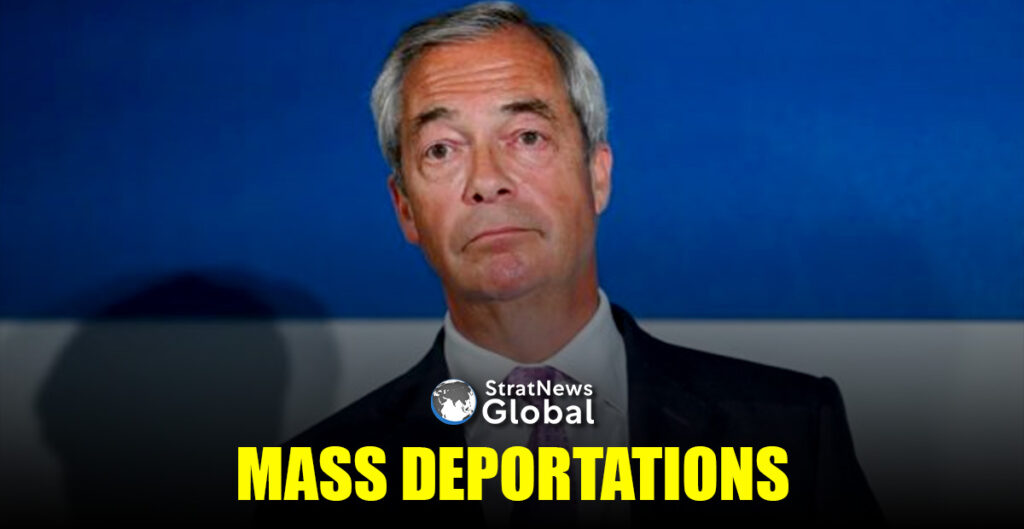
Former Brexit campaign leader Nigel Farage on Saturday unveiled proposals for the “mass deportation” of asylum seekers arriving in Britain on small boats across the English Channel, a policy he vowed to pursue if his Reform UK party wins power.
In an interview with The Times newspaper, Farage said he would withdraw Britain from the European Convention on Human Rights and sign deals with Afghanistan, Eritrea and other top countries of origin to repatriate illegal migrants.
“We can be nice to people, we can be nice to other countries, or we can be very tough to other countries … I mean (U.S. President Donald) Trump has proved this point quite comprehensively,” Farage said.
Asked if he was concerned that asylum seekers would be killed or tortured if they were sent to countries with poor human rights records, Farage said he was more worried about the threat he believed asylum seekers posed to Britons.
“I can’t be responsible for despotic regimes all over the world. But I can be responsible for the safety of women and girls on our streets,” he said.
‘Greatest Concern’
Britain has seen regular small-scale protests in recent weeks outside hotels housing asylum seekers, spurred in part by concerns about public safety after some migrants were charged with sexual assault.
Broader opinion polls show that immigration and asylum are the public’s greatest concern, just ahead of the economy, and Reform UK – which won five seats at last year’s general election – has topped recent voting intention polls.
Last year 37,000 people – mostly from Afghanistan, Syria, Iran, Vietnam and Eritrea – arrived in Britain from France by crossing the English Channel in small boats. The total was up by a quarter from 2023 and accounted for 9% of net migration.
About two-thirds of people who arrive via small boats and claim asylum are successful and only 3% have been deported, according to figures analysed by the University of Oxford.
Farage told The Times he would end the right to claim asylum or to challenge deportation for those who arrived by small boats by replacing existing human rights legislation and opting Britain out of refugee treaties, citing a national emergency.
“The aim of this legislation is mass deportations,” Farage said, adding that a “massive crisis” caused by asylum seekers was fuelling public anger.
The Times said Farage wanted to create holding facilities for 24,000 migrants on air bases at a cost of 2.5 billion pounds ($3.4 billion) and operate five deportation flights a day with total deportations reaching the hundreds of thousands.
If that failed, asylum seekers could be held on Ascension Island, a British territory in the South Atlantic, to send a symbolic message, Farage said.
($1 = 0.7395 pounds)
(With inputs from Reuters)
Ishiba, Lee Strengthen Japan-South Korea Cooperation Ahead Of Lee’s Meeting With Trump
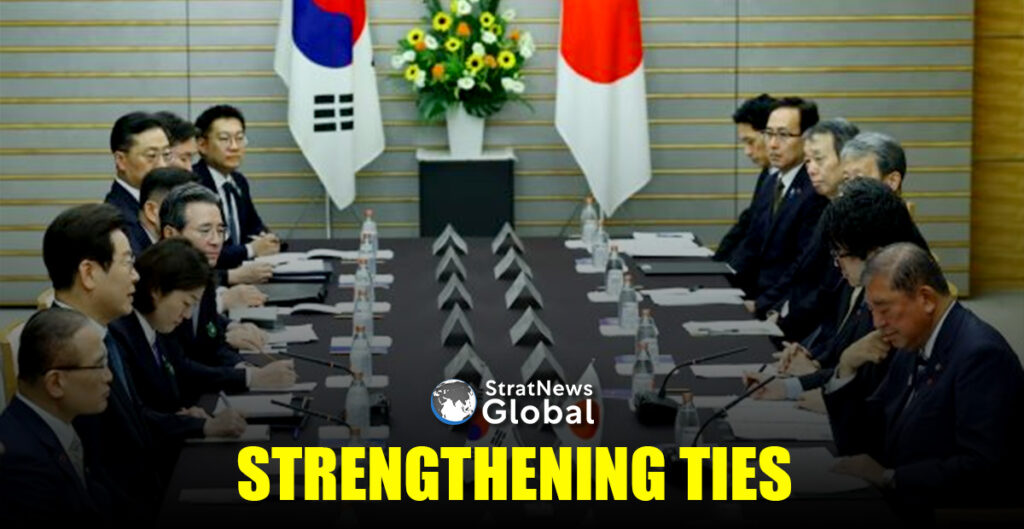
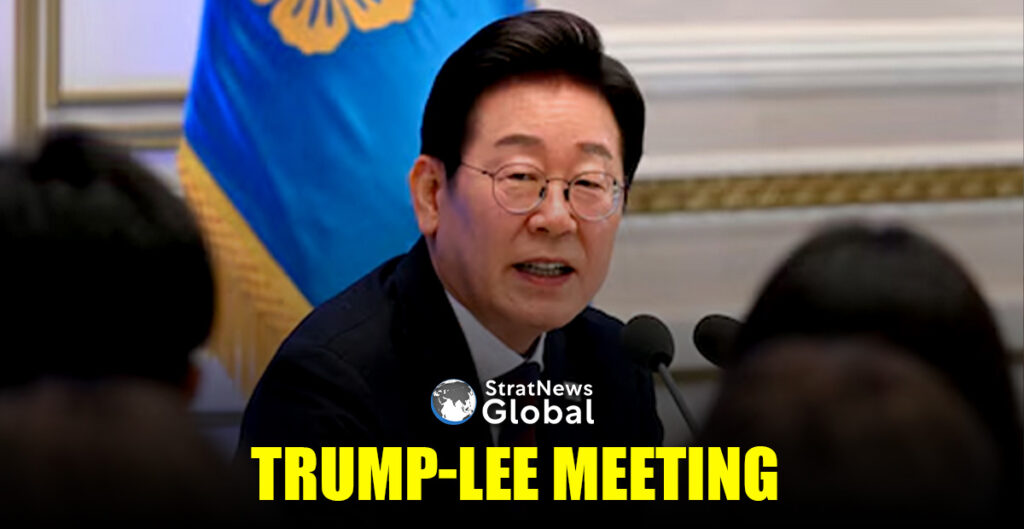
Japanese Prime Minister Shigeru Ishiba and South Korean President Lee Jae Myung agreed to deepen security and economic cooperation, just before Lee’s scheduled meeting with U.S. President Donald Trump on Monday.
On his first official visit to Japan since taking office in June, Lee met Ishiba at the premier’s residence in Tokyo to discuss bilateral ties between the East Asia neighbours, including closer security coordination with the United States under a trilateral pact signed by their predecessors.
“As the strategic environment surrounding both our countries grows increasingly severe, the importance of our relations, as well as trilateral cooperation with the United States, continues to grow,” Ishiba said in a joint announcement with Lee after their meeting.
The leaders agreed to resume shuttle diplomacy, expand exchanges such as working holiday programs, and step up cooperation in defence, economic security, artificial intelligence and other areas. They also pledged closer coordination against North Korea’s nuclear and missile threats.
The snap election victory of the liberal Lee – following the impeachment of conservative President Yoon Suk Yeol for declaring martial law – raised concerns in Tokyo that relations with Seoul could sour.
Lee has criticised past efforts to improve ties strained by lingering resentment over Japan’s 1910–45 colonial rule of the Korean Peninsula.
The South Korean government last week expressed “deep disappointment and regret” after Japanese officials visited a shrine in Tokyo to Japan’s war dead that many Koreans see as a symbol of Japan’s wartime aggression.
Closer Relations
In Tokyo, however, Lee reaffirmed support for closer relations with Japan as he did when he met Ishiba for the first time in June on the sidelines of a Group of Seven summit in Canada.
Despite their differences, the two U.S. allies rely heavily on Washington to counter China’s growing regional influence. Together, they host around 80,000 U.S. troops, dozens of American warships and hundreds of military aircraft.
We “agreed that unwavering cooperation between South Korea, the U.S. and Japan is paramount in the rapidly changing international situation, and decided to create a virtuous cycle in which the development of South Korea-Japan relations leads to stronger cooperation,” Lee said alongside Ishiba.
In Washington, Lee and Trump are expected to discuss security concerns including China, North Korea, and Seoul’s financial contribution for U.S. forces stationed in South Korea – something the U.S. leader has repeatedly pressed it to increase.
Japan and South Korea also share common ground on trade, with both agreeing to 15% tariffs on U.S. imports of their goods after Trump had threatened steeper duties.
(With inputs from Reuters)
Troops Sent To Washington’s National Mall Under Trump Crime Crackdown
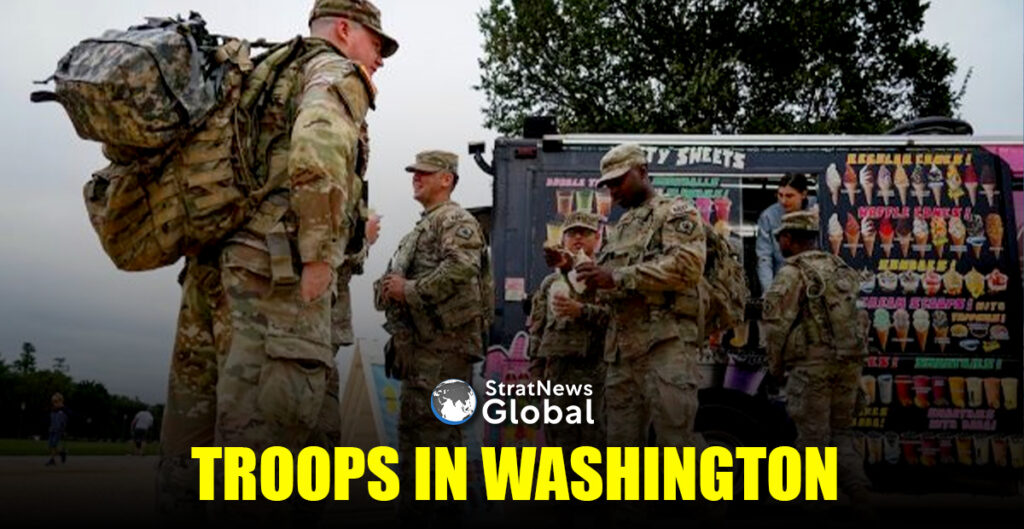
On Thursday, hundreds of National Guard soldiers in fatigues and combat boots were deployed across Washington’s National Mall, one of the capital’s safest locations, where they mingled with tourists, posed for selfies, and even stopped for ice cream at food trucks.
On occasion an angry local would hurl verbal abuse at them, but the soldiers simply shrugged and carried on what appeared to be an undemanding assignment.
Outside the National Museum of African American History and Culture, five members of the West Virginia National Guard were standing on the street corner far away from the city’s crime hot spots.
“It’s boring. We’re not really doing much,” said Sergeant Fox, who declined to give his first name.
Fox is among almost 2,000 troops, including 1,200 from six Republican-led states, who are being deployed in Washington as part of an extraordinary militarization inside the Democratic-led city.
The soldiers said they did not get involved in arrests, are officially in Washington to support a federal crackdown on what President Donald Trump calls a crime epidemic. But that depiction appears to run counter to the fact that crime rates overall have shrunk in recent years.
That disconnect, combined with the troop concentration near the Washington Monument, the Lincoln Memorial and in view of the U.S. Capitol, highlights criticism by the city’s Democratic leaders that this massive deployment is more a show of power by Trump, rather than a serious effort to fight crime.
Soldiers Were Not Armed
Washington Mayor Muriel Bowser said this week she did not think the arrival of troops was about tackling crime. She also expressed concern about the presence of “an armed militia in the nation’s capital.”
The soldiers were not armed, but the Pentagon said on Friday the troops will soon be on mission with their service-issued weapons.
By contrast with central Washington, residents of Ward 8 in the city’s southeast – the area with the highest crime rate – said there was not a guardsman in sight. With the ward’s murder rate dwarfing that of most other neighborhoods, many locals said they would welcome troops on their streets.
“I haven’t seen any. This is where they need to be,” said Shawana Turner, 50, a housing case manager on a Ward 8 street.
The Joint Task Force for the District of Columbia, which is leading the crime crackdown, said where National Guard troops are deployed is based on requests from law enforcement agencies.
Abigail Jackson, a White House spokeswoman, said teams of federal law enforcement officials are making arrests in Washington’s highest crime areas every night.
“The National Guard is not making arrests at this time, their role is to protect federal assets – including law enforcement officers – and provide a visible law enforcement presence,” she said.
The troops are one element of a surge of local and federal law enforcement agents in Washington, including the FBI, who have conducted active arrest operations since Trump announced earlier this month that he was federalizing law enforcement responsibility in Washington.
Rare Deployments
Deploying troops on American streets is rare and controversial. National Guard have been sent to Washington in recent years, to help bolster security at presidential inaugurations and during protests, including the January 6, 2021 riot at the U.S. Capitol by Trump supporters.
But the city’s declining crime rate, coupled with the limited involvement of the troops in crime fighting, has raised questions about the political motivations behind the current deployment.
Randy Manner, a retired National Guard major general, said he believed the deployment is a step towards Trump sending National Guard troops into other Democratic-led cities.
“Not in our lifetimes has a president said that I’m going to use uniformed soldiers to reduce crime,” Manner said.
“There will be soldiers in other cities in the not-too-distant future. We’re turning this into a militarized environment, and it’s extremely sad.”
During a visit to a police base in Washington on Thursday, Trump said his law enforcement crackdown will “go onto other places.” Earlier this month Trump suggested he could shift his focus to cities including Chicago and New York.
To be sure, the presence of the guard in the heart of Washington was welcomed by some visitors.
As troops on the National Mall mingled with tourists from the U.S. and abroad, a group of guardsmen from Mississippi were walking alongside Anu Pokharel, his wife, and two daughters aged 8 and 5.
The software engineer, 43, who lived in Washington in the 1990s, was visiting the city with his family from Boston.
He said he supported the deployment. “It feels cleaner and safer,” he said.
Printed Statements
As they strolled around central Washington, some soldiers said that they did not expect to get involved in arrests.
Specialist Nevaeh Lekanudos, part of West Virginia’s National Guard, was outside a Metro station in the National Mall with several fellow guard members. She said she had not assisted in crime incidents or arrests.
Asked if she thought that is likely, she said, “Honestly at this rate I don’t believe so.” She added by being deployed in the National Mall, “it frees up the local law enforcement to do what they need to do.”
Governors from two other Republican-led states, Ohio and Louisiana, have also sent National Guard troops at Trump’s request.
Most of the soldiers said they had been instructed not to talk to the press. Instead they had all been issued with a printed statement they produced from their pockets. It states that they are in the city to support “district and federal law enforcement by keeping DC beautiful and safe.”
(With inputs from Reuters)
Taiwan: Maanshan Nuclear Plant To Stay Shut As Referendum Fails
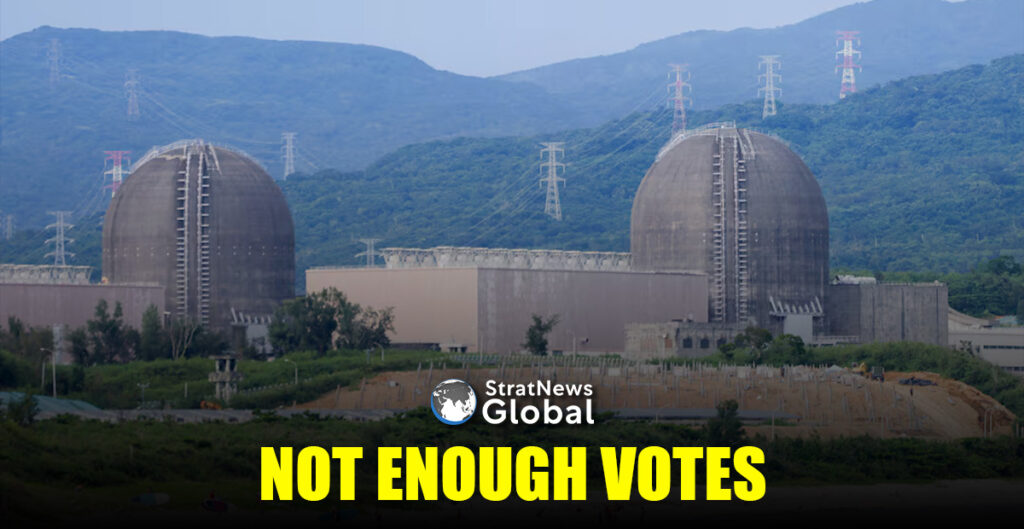
A bid to reopen Taiwan’s last nuclear power plant fell short in Saturday’s referendum, failing to meet the legal threshold, though the president indicated the island may reconsider nuclear energy in future if safety norms are strengthened.
The plebiscite, backed by the opposition, asked whether the Maanshan power plant should be re-opened if it was “confirmed” there were no safety issues. The plant was closed in May as the government shifts to renewables and liquefied natural gas.
The small Taiwan People’s Party (TPP) proposed the referendum earlier this year, and with the backing of the much larger Kuomintang (KMT) passed the legislation for the vote, saying Taiwan needs reliable power supplies and not to be so reliant on imports.
Not Enough Votes
Around 4.3 million people voted in favour of the plant’s re-opening in the referendum, a clear majority over the 1.5 million who voted against, figures from the Central Election Commission showed.
But the motion needed the backing of one quarter of all registered electors – around 5 million people – to get through under electoral law, meaning the plant on Taiwan’s southern tip will not re-open.
Taiwan’s government says there are major safety concerns around generating nuclear power in earthquake-prone Taiwan and handling nuclear waste.
One For The Future
Taiwan President Lai Ching-te told reporters on Saturday evening that while the referendum had failed, he understood “society’s expectations for diverse energy options”.
“If in the future, the technology becomes safer, nuclear waste is reduced, and societal acceptance increases, we will not rule out advanced nuclear energy,” he added.
Recall Vote
In a separate vote on Saturday, electors rejected the recall of seven KMT lawmakers.
A larger recall vote, to try and oust 24 lawmakers from the same party, also failed last month.
Civic groups who had run the recall campaigns, with the backing of Taiwan’s ruling Democratic Progressive Party (DPP), accused the lawmakers of being too close to China and intentionally trying to snarl government spending and legislation, charges the legislators strongly denied.
Lai said Premier Cho Jung-tai had asked many times to resign after the failure of the recall votes in July, but he had asked Cho to stay on.
There will be a cabinet reshuffle to make the team more efficient and governance more effective, Lai added.
The two opposition parties together form a majority in parliament, though the DPP controls the presidency and hence the government in Taiwan’s system.
(With inputs from Reuters)
Putin Sees ‘Light At The End Of The Tunnel’ In Russia-US Relations
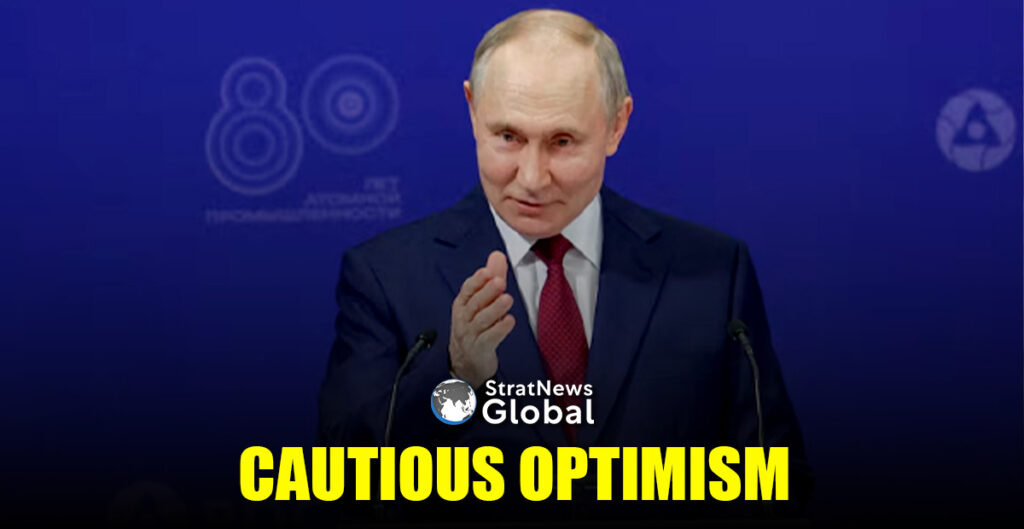
President Vladimir Putin said on Friday that Russia-U.S. relations show “light at the end of the tunnel” and that both nations are discussing joint projects in the Arctic and Alaska.
The Russian president, answering questions during a visit to a nuclear research centre, said he was sure that U.S. President Donald Trump‘s leadership qualities would help in restoring relations from recent lows.
“With the arrival of President Trump, I think that a light at the end of the tunnel has finally loomed. And now we had a very good, meaningful and frank meeting in Alaska,” Putin said, referring to last week’s summit.
“The next steps now depend on the leadership of the United States, but I am confident that the leadership qualities of the current president, President Trump, are a good guarantee that relations will be restored.”
Cautious Optimism
His comments signalled Russia’s optimism that it can mend relations with the U.S. and strike business deals, despite the lack of clear progress towards ending the Ukraine conflict at his August 15 summit with Trump.
Putin did not give details of possible U.S.-Russia cooperation in the Arctic but said there were “huge, huge” mineral reserves in the region and noted that Russian liquefied natural gas company Novatek was already operating there.
“We are discussing, by the way, with American partners the possibility of working together in this area. And not only in our Arctic zone, but also in Alaska. And at the same time, the technologies that we possess today no one but us possesses. And this is of interest to our partners, including those from the States,” he said.
Both Russia and the United States have said they see enormous economic opportunities if they can normalise relations after ties plunged to a post-Cold War low because of the war in Ukraine.
(With inputs from Reuters)
Troop Costs, China To Take Centre Stage In Lee-Trump Talks Next Week
During their first summit next week, South Korean President Lee Jae Myung will face United States President Donald Trump’s request to increase funding for American troops on the peninsula, in talks largely focused on security and China.
Left largely out of the frantic trade talks that culminated in an unwritten deal last month, questions over the future of the South Korea-U.S. alliance and the approach to nuclear-armed North Korea will be a key part of the White House discussions, officials and analysts said.
A thorny issue for Lee may be Trump’s push for Seoul to pay significantly more for the 28,500 U.S. troops stationed in South Korea as a legacy of the 1950-1953 Korean War.
‘Burden-Sharing’ In Focus
A U.S. official, speaking on condition of anonymity, said a key area of focus would be so-called burden-sharing, and Trump is expected to push the South Koreans for more.
Seoul provides more than $1 billion a year to support the U.S. troop presence and also pays to build the largest U.S. base overseas, Camp Humphreys, said Victor Cha, of Washington’s Centre for Strategic and International Studies.
“But President Trump clearly wants more,” Cha said, noting his past calls for Seoul to pay $5 billion or even $10 billion. “He wants defence spending closer to 5% of GDP for all allies; South Korea is currently at 3.5%.”
South Korea wants to modernise the U.S. alliance to adapt to the changing security environment, such as U.S.-China rivalry and is looking at higher defence spending, Seoul’s top security advisor Wi Sung-lac said.
“The issue (spending) is being discussed between South Korea and the United States, and the figures and such are still in progress and under discussion,” Wi told a press briefing.
‘Strategic Flexibility’
There are discussions within the Pentagon about removing some U.S. troops from South Korea, the U.S. official said.
To head that off, some at the Pentagon are trying to refocus the alliance towards the threat posed by China.
While a lot will depend on Seoul’s willingness, the U.S. official said the desire was to discuss in broad terms how the alliance, and U.S. forces in South Korea, could be used to counter China.
That could bring more headaches for Lee, who has expressed full support for the U.S. alliance but vowed to take a balanced approach between Washington and Beijing.
General Xavier Brunson, commander of U.S. Forces Korea (USFK), said this month it was not a foregone conclusion that South Korea would be involved with any conflict over Taiwan, which China claims as its own.
However, he said there should be a recognition that nothing happens in the region in isolation, and U.S. troops in South Korea could be needed to “solve bigger problems”.
Asked about more such “strategic flexibility”, South Korea’s Foreign Ministry said it was difficult to predict USFK operations in a hypothetical situation.
“However, the operation of the USFK is carried out under close consultation and communication between South Korea and the United States,” a spokesperson said.
Rubio Meets South Korean FM
U.S. Secretary of State Marco Rubio met with South Korean Foreign Minister Cho Hyun in Washington on Friday, and a State Department statement said the two “highlighted the enduring strength” of the seven-decade-old alliance.
It said they discussed “a forward-looking agenda that enhances deterrence in the Indo-Pacific, increases our collective burden sharing, helps to revitalise American manufacturing, and restores fairness and reciprocity in our trade relationship.”
They also reinforced the importance of U.S.-Japan-South Korea cooperation, the statement added.
South Korea’s Foreign Ministry statement said besides discussing summit agendas, Rubio and Cho also evaluated the July tariff agreement between the two countries and decided to encourage ongoing negotiations despite some issues remaining undecided. It did not elaborate.
North Korea And Nukes
Lee and Trump are likely to see eye to eye on North Korea, with both open to engaging its leader, Kim Jong Un, and the U.S. president frequently casting himself as a global peacemaker.
However, Pyongyang has rebuffed attempts to revive the unprecedented diplomatic engagement seen in Trump’s first term and doubled down on its deepening ties to Russia.
“I doubt much substance will be said on North Korea beyond committing to diplomacy and reiterating a goal of denuclearisation,” said Jenny Town, of the Washington-based 38 North programme, which monitors North Korea.
Lee told a Japanese newspaper on Thursday his administration would lay the groundwork to ultimately dismantle North Korea’s nuclear weapons programme, through talks with Pyongyang and close cooperation with Washington.
North Korea has repeatedly said its nuclear weapons are not open for negotiation.
South Korean Foreign Minister Cho told parliament this week that South Korea could also try to use the summit to win approval to reprocess or enrich its own nuclear materials.
‘Nuclear Latency’
Despite talk from some South Korean officials about the need to attain “nuclear latency”, or the means to quickly build an atomic arsenal, Cho said reprocessing would be only for industrial or environmental purposes.
Daryl Kimball, executive director of the U.S.-based Arms Control Association, said there was no practical “industrial or environmental” need for South Korea to start reprocessing, or for a domestic uranium enrichment capability for its energy programme.
Both activities are prohibited under the current U.S.-South Korea Agreement for Nuclear Cooperation because they could be used to produce nuclear bombs, he said.
“Too many South Korean politicians are flirting with the idea of their country acquiring the nuclear weapons option,” he added.
(With inputs from Reuters)
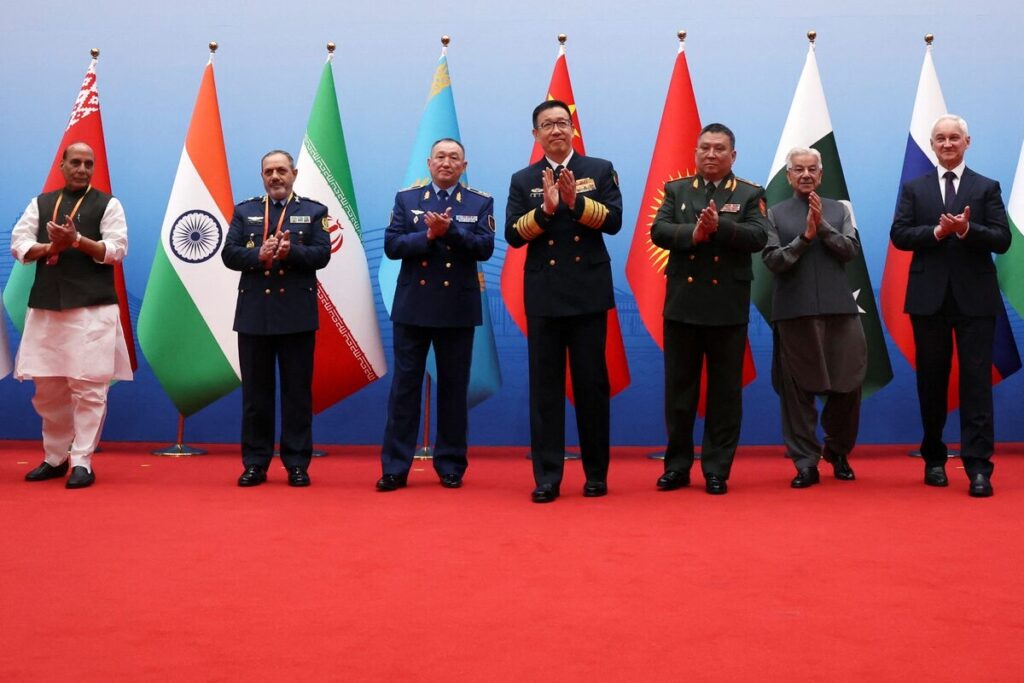
Elusive Definition Marks SCO Anti-Terror Fight
“Terrorism is the enemy of the world, Pakistan too is a victim of terrorism,” Chinese Ambassador to India Xu Feihong asserted on Friday.
His remark, at a panel discussion in New Delhi on the upcoming Shanghai Cooperation Organisation (SCO) summit, underlines the absence of a common definition of terrorism, a gap that has prevented the implementation of the Comprehensive Convention on International Terrorism (CCIT) at the United Nations since the 1970s.
India has consistently pushed for a zero-tolerance policy, arguing there should be “no ifs or buts” in identifying terrorism, and that it must be treated as a universal crime without exceptions for political or separatist causes. New Delhi was the initiator of the CCIT proposal at the UN.
China, on the other hand, emphasizes its “Three Evils” framework—terrorism, separatism, and extremism—largely focused on internal threats such as separatism in Xinjiang. While Beijing has flagged groups like the Baloch Liberation Army, it has not publicly named Pakistan-based outfits such as Lashkar-e-Taiba or Jaish-e-Mohammad, despite their UN designation as terrorist groups.
The divergence between the Indian and Chinese approaches has shaped SCO’s counter-terrorism agenda. The bloc’s Regional Anti-Terrorism Structure reflects Beijing’s “Three Evils” framework, without reference to state-sponsored or cross-border terrorism. At the 2023 Goa summit, India’s attempt to introduce the phrase “cross-border terrorism” was opposed by China and Pakistan.
“We should join hands together to fight against terrorism,” Ambassador Xu declared.
But that is not as easy it sounds, given that differences over its definition continue to hinder consensus within the SCO.
(This article was written by Tisya Sharma, she is an intern at StratNewsGlobal)
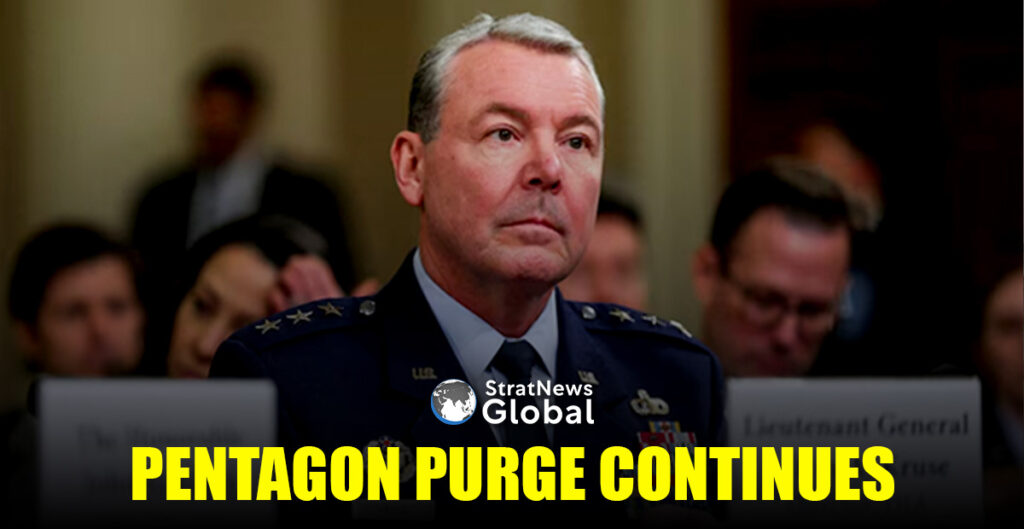
Hegseth Ousts Pentagon Intelligence Chief, Two Top Commanders In Latest Purge
U.S. Defence Secretary Pete Hegseth removed the chief of the Pentagon’s intelligence agency along with two other senior military commanders, three U.S. officials said on Friday, marking the latest Trump administration effort to purge Pentagon officials.
It was not immediately clear why Lieutenant General Jeffrey Kruse, who led the Defence Intelligence Agency, was fired.
Hegseth’s purge broadened later on Friday. One U.S. official, speaking on the condition of anonymity, told Reuters that in addition to Kruse, Hegseth had also ordered the removal of the chief of U.S. Naval Reserves and the commander of Naval Special Warfare Command.
All three officials said it was unknown why they were fired.
“The firing of yet another senior national security official underscores the Trump administration’s dangerous habit of treating intelligence as a loyalty test rather than a safeguard for our country,” said U.S. Senator Mark Warner, who is the vice chair of the Senate Select Committee on Intelligence.
The firing was first reported by the Washington Post.
Latest Firing
The move appeared to be the latest attempt by the Trump administration to penalise current and former military, intelligence and law enforcement officials whose views have been seen as at odds with Trump.
In April, Trump fired General Timothy Haugh as director of the National Security Agency, in a purge that included more than a dozen staff at the White House National Security Council.
Hegseth has also gone after uniformed military officials at the Pentagon. In February, he fired Air Force General C.Q. Brown, chairman of the Joint Chiefs of Staff, who was dismissed along with five other admirals and generals in an unprecedented shake-up of U.S. military leadership.
The chief of the U.S. Air Force made a surprise announcement on Monday that he planned to retire only halfway through his tenure.
While it was not clear exactly why Kruse was fired, it came after a preliminary DIA assessment leaked to the news media that said the June 22 U.S. airstrikes on three Iranian nuclear facilities had set Tehran’s program back only a few months, a finding contradicting Trump’s claim that the targets were “obliterated.”
The leaking of the assessment, which Reuters also reported, enraged Trump. The White House denounced the top-secret assessment as “flat out wrong,” and Trump attacked CNN, the New York Times and other outlets that obtained the report, calling them “scum” and “FAKE NEWS.”
Trump’s Sweeping Purge
The Trump administration has conducted a sweeping purge of U.S. military and intelligence officers and diplomats that it says is part of an effort to slash the size of the U.S. government, shrinking the federal budget and punishing what it describes as the “politicisation or weaponisation” of intelligence.
News of Kruse’s firing came two days after Director of National Intelligence Tulsi Gabbard announced that she was revoking, on Trump’s orders, the security clearances of 37 current and former U.S. intelligence professionals.
This week’s security clearance revocations were only the latest of scores of such revocations of Trump’s second term. They have included Biden, who defeated Trump in the 2020 election, and former Vice President Kamala Harris, who lost last year’s vote.
Earlier this week, Gabbard also announced the first major overhaul of her office since its creation, slashing personnel by more than 40% by October 1 and saving more than $700 million per year.
(With inputs from Reuters)